The Best Custom Head Cover Manufacturer: The Complete Selection Guide
The best custom head cover manufacturer is defined by six capabilities: multi-material production (leather, PU, knit, fleece-lined synthetics), embroidery and branding at 10,000+ stitch counts with thread-matched precision, sizing systems covering driver through alignment sticks, closure engineering (magnetic, zipper, elastic), MOQ flexibility with genuine sampling, and QC that inspects embroidery and fit on every unit. This guide defines each capability with the audit questions that verify it, then maps the programme terms that make custom head covers practical for brands, clubs and corporate buyers. Our head cover work runs through the head cover programme.
QUANZHOU JUNYUAN BAGS, established 2014 in Quanzhou, Fujian, manufactures through an affiliated factory of 4,950 m², 7 production lines, 149 machines (126 sewing stations) and 137 staff — rated at 200,000 pieces per month, actual output around 150,000. Every order runs AQL 2.5 inspection, MOQ 200 (100-piece trial), sampling 6–10 days, bulk 35–50 days, with BSCI, ISO 9001:2015, CE, CPC and RoHS certifications (SGS audit, March 2026). We serve 200+ brands in 100+ countries.
Why Head Covers Are Their Own Discipline
Head covers look like the simplest product in golf — a padded sock for a club — and manufacture like one of the most demanding: small panels with tight curves, branding at sizes where every stitch shows, closures that must work one-handed thousands of times, and fit tolerances measured in millimetres against club heads the factory may never hold. The gap between a factory that makes covers and a factory that makes them well is wider than in any other golf soft good.
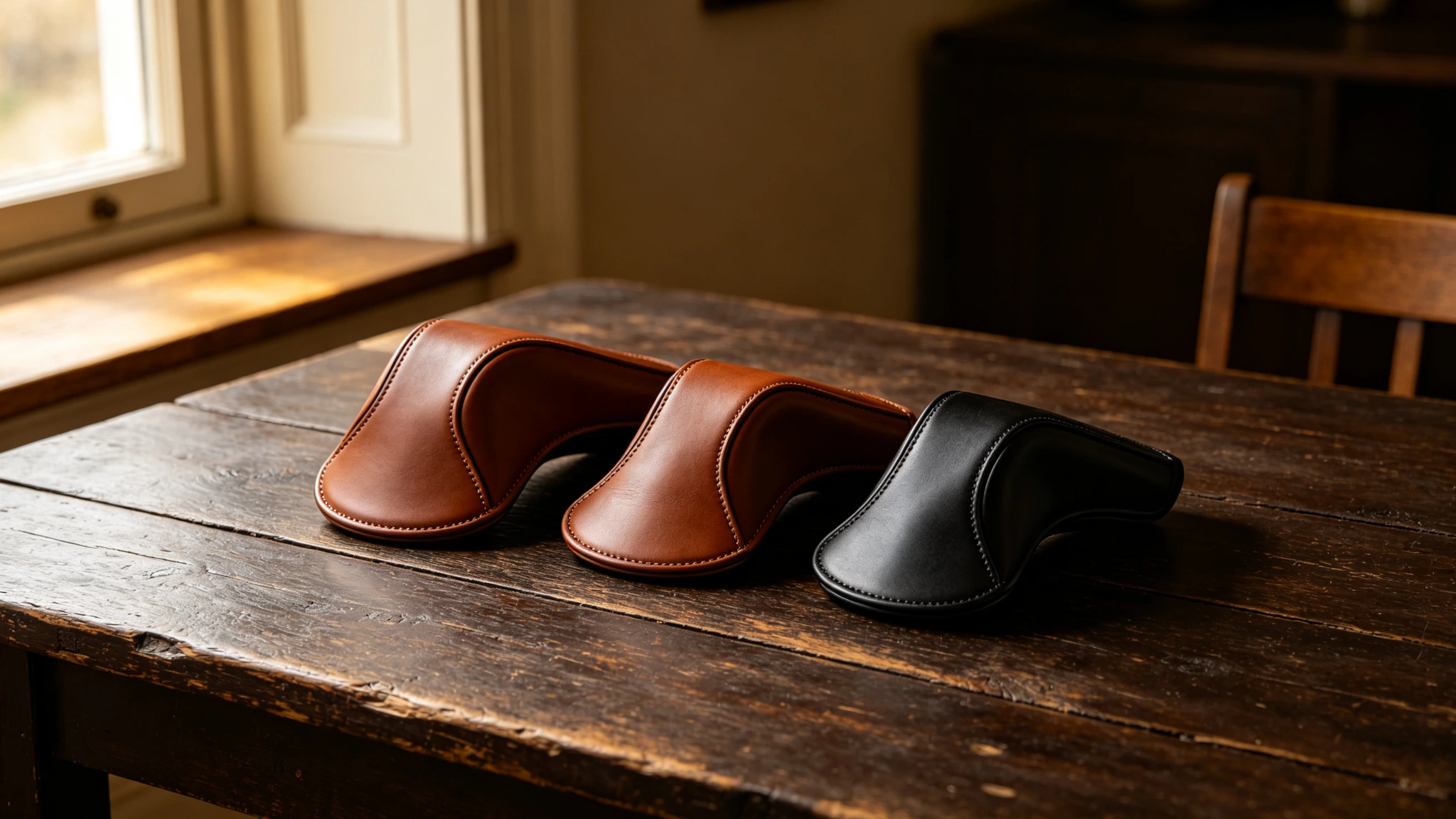
The commercial stakes explain why the discipline matters: head covers are golf’s highest-visibility accessory (the bag’s crown, in every bag-room and first-tee photograph), its highest-margin small good (production cost versus retail multiples rival anything in the category), and its most-gifted item (tournament tees, corporate events, member welcomes). A bad cover embarrasses daily; a great cover advertises daily.
The 2026 market context: head covers have become the collectable category — limited drops, major-championship editions, artist collaborations — and the manufacturing bar has risen with the collectability. Buyers now expect embroidery density, material depth and packaging that read as objects of design. Our 2026 best-of analysis maps where the bar now sits.
Capability 1: Multi-Material Production
A serious custom cover manufacturer runs the full material matrix: full-grain and top-grain leather (the premium register, covered in our leather cover guide), premium PU (colour-exact branding, weather indifference), knit and crochet constructions (the heritage register, per our knit manufacturing guide), fleece-lined technical synthetics (the volume performance class), and specialty executions (croc-embossed, suede-touch, canvas hybrids).
Why the matrix matters: brands almost never want one material — a typical programme pairs leather drivers with knit fairways, or runs a leather premium line beside a synthetic volume line — and a factory strong in only one material forces compromise or multiple suppliers. The single-source matrix keeps colour, quality and lead time coordinated across the set.
The audit question: show production samples in every material class, from current runs, not archived golden samples. Material breadth is provable in five minutes on the sample table — and the factory that hesitates has a matrix with holes in it.
Capability 2: Embroidery and Branding Depth
Head cover branding is embroidery-first, and embroidery quality is the category’s visible differentiator: stitch density (10,000-15,000+ stitches on a chest-logo-scale design), thread quality (colourfast rayon or polyester, matched to Pantone within tolerance), registration (multi-colour designs holding alignment across curved panels), and the digitising craft that converts artwork into stitches without losing detail.
Beyond embroidery, the branding menu includes debossing and foil on leather, woven and printed labels, appliqué patches, metal badges, and sublimation on synthetics — each with its own minimum-detail and durability profile. The full option map is in our logo options guide; the manufacturing point is that the factory should advise which method suits the artwork, not force the artwork into its only method.
The audit is visual: examine multi-colour embroidery on a curved panel from a production run — look for puckering (tension failure), thread breaks, registration drift between colours, and backing show-through. Then flex the panel: quality embroidery moves with the material; poor embroidery sits stiff and cracks its base fabric. Five samples tell the whole story.
Capability 3: Sizing Systems and Fit Engineering
Fit is the silent quality axis: a cover too tight fights the golfer every round; too loose falls off in the cart and is lost by the third hole. A serious manufacturer maintains a sizing system — driver (460cc and vintage persimmon sizes), fairway woods (modern and classic), hybrids, blade and mallet putters (including oversize and counterbalance grips) — with fit verified against actual club heads, not nominal dimensions.
The engineering details that separate systems: elastic and gusset placement (hold without fight), internal depth (crown clearance for modern driver shapes), shaft-sock length on knit sets, and the interchangeability question (will the fairway cover fit the customer’s specific 3-wood and 5-wood). Our driver fit guide and sizing chart publish the reference dimensions.
The audit question: what club heads do you fit-test against, and how often is the library updated? Club shapes evolve (driver heads have grown and reshaped within five years), and a sizing system frozen in 2019 fits 2019’s clubs. The answer reveals whether fit is engineering or folklore at that factory.
Capability 4: Closure Engineering
Closures are the cover’s mechanism, and each system is a separate engineering discipline. Magnetic closures (the 2026 premium default, analysed in our magnetic vs zipper comparison): magnet grade, seating depth, retention strength through vibration, and polarity alignment across thousands of units. Zipper closures: moulded-tooth quality, pull ergonomics with gloved hands, garage design at the ends. Elastic and sock constructions: tension retention after thousands of cycles.
The failure modes are specific and testable: magnets that release under cart vibration, zippers that jam on lint and fail at the pull, elastic that relaxes into uselessness within a season. Each failure is a warranty claim and a lost brand impression — the cover is handled multiple times per round, and its mechanism is the product’s handshake.
The audit: cycle the closure fifty times on a production sample. Magnetic should seat with consistent snap and release with consistent force; zippers should run smooth under one finger; elastic should rebound. Then ask for the cycle-test standard in the QC plan — closures should be life-tested, not assumed.
Capability 5: Programme Flexibility and Sampling
Custom cover buyers arrive at every scale: the club ordering 100 covers for a member-guest, the brand launching a 10,000-unit line, the corporate buyer needing 500 by a fixed event date. The manufacturer’s flexibility — MOQ structure, sampling speed, rush capacity — decides which buyers it can actually serve. Our terms: MOQ 200 per design with 100-piece trials, 6–10 day sampling, 35–50 day bulk, with rush programmes for event dates that cannot move.
Sampling is where flexibility proves itself: a proper custom sample carries the actual material, the digitised embroidery, the specified closure — not a "similar" stock cover with a printed mock-up. The sample is the contract made physical, and factories that sample properly rarely dispute at production; factories that sample loosely dispute constantly.
The programme shapes that work in practice: sets (driver + fairway + hybrid + putter as one design family), editions (seasonal and event drops on standing patterns), and evergreen-plus-drops (a standing core line with rotating limited colourways). Each shape has its own MOQ and lead-time logic, and a manufacturer with real programme experience proposes the shape before being asked. Our wholesale buying guide maps the structures from the buyer’s side.
Capability 6: QC on the Details That Decide Covers
Head cover QC concentrates on four checkpoints: embroidery (density, registration, thread breaks — inspected under magnification on production samples per batch), fit (each size verified against the club-head library per production lot), closure (cycle-tested per batch: magnets seated and force-checked, zippers run 50 cycles), and cosmetics (panel symmetry, seam straightness, lining placement — the cover is small enough that every flaw is visible).
The inspection philosophy matches the product’s visibility: covers sit at the top of the bag in every photograph and every first-tee meeting — they are the most-seen square foot in golf. Our cover lines run 100% embroidery inspection and per-lot fit verification under AQL 2.5, because the product forgives nothing and the camera forgives less.
The audit question that reveals everything: what is your embroidery rejection rate, and may I see the rejection bin? A factory with real embroidery QC has a rejection bin with examples and can explain each reject; a factory without one either has no defects (impossible) or ships them (probable). The bin is the proof.
The Manufacturer Scorecard
| Capability | What best looks like | Audit method |
|---|---|---|
| Materials | Leather, PU, knit, synthetic — one source | Current-run samples in every class |
| Embroidery | 10-15k stitches, Pantone-matched, clean registration | Flex test + magnification on production units |
| Sizing | Club-head library, updated fit standards | Ask what heads they fit-test against |
| Closures | Cycle-tested magnets/zippers/elastic | Fifty cycles by hand + QC cycle standard |
| Programme | MOQ 200, 100-pc trials, 6–10 day samples | Written terms + rush policy |
| QC | 100% embroidery inspection, per-lot fit checks | The rejection bin |
Use the scorecard on any shortlist: the manufacturer strong across all six rows is rare, and the rarer ones are busy — lead times on the best cover programmes stretch in season, which is itself a quality signal. The factory with immediate unlimited capacity in April is telling you something about its order book.
Our own scorecard, stated plainly: full material matrix on dedicated lines, embroidery at 15,000-stitch capability with in-house digitising, a club-head fit library updated annually, closure cycle-testing in the QC plan, MOQ 200 with genuine custom samples in 6–10 days, and a rejection bin we will happily walk you through. The complete manufacturing guide documents the process end to end.
The selection mistake to avoid: choosing on unit price alone. Head cover quotes differ by embroidery stitch count, closure grade, lining quality and QC depth — a $2-cheaper cover usually means sparse embroidery, commodity magnets and fit by assumption, and the savings surface later as returns and embarrassed gift recipients. Compare quotes itemised against the six capabilities, and the price differences explain themselves honestly.
The Bottom Line
The best custom head cover manufacturer proves six capabilities: multi-material production under one roof, embroidery depth verified on production units, sizing engineered against real club heads, closures cycle-tested to failure data, programme terms with genuine sampling, and QC with a rejection bin it can explain. The audit takes one factory visit or one video call.
The product stakes justify the audit: covers are golf’s most-visible accessory, highest-margin small good, and most-gifted item — the category where quality advertises daily and failure embarrasses daily. Choose the manufacturer like the crown of the bag depends on it, because it does.
Send the artwork and the set plan, and custom samples — actual material, digitised embroidery, specified closures — come back in 6–10 days. The quote page starts it; the rejection bin tour, if you want it, closes the case.
The last word goes to the product’s strange power: no other item in golf is photographed as often, gifted as reliably, or kept as long per dollar spent. A cover costing single digits to manufacture rides the first tee for a decade. Choosing its manufacturer on the six capabilities is not procurement fussiness — it is respect for the most efficient brand surface in the sport. Spec it well, and the crown of the bag works for the brand on every tee, every round, every year.
Start Your Custom Cover Project
Send the artwork and set plan. We return true-spec custom samples in 6–10 days, quoted at MOQ 200.
Request a Quote →People Also Ask
What makes the best custom head cover manufacturer?
Six proven capabilities: multi-material production (leather, PU, knit, synthetic under one roof), embroidery at 10,000-15,000 stitches with Pantone-matched thread and clean registration on curves, sizing systems fit-tested against real club heads, closure engineering with cycle-test data (magnetic, zipper, elastic), programme flexibility (MOQ 200, 100-piece trials, 6–10 day true-spec sampling), and QC that inspects embroidery and fit per lot — with a rejection bin it can explain.
What is the MOQ for custom golf head covers?
Our terms: MOQ 200 pieces per design with 100-piece trial runs — sized for club events, brand launches and corporate programmes. Sampling 6–10 days with actual materials and digitised embroidery, bulk 35–50 days under AQL 2.5 with 100% embroidery inspection. Rush programmes exist for fixed event dates. Start at our quote page.
How much do custom head covers cost to manufacture?
Ex-works by class: technical synthetic covers from $3-6, premium PU from $5-9, knit sets from $6-11 per cover, leather covers from $9-18 — varying with embroidery complexity (stitch count drives cost), closure type, and order volume. Retail multiples run 3-5x ex-works, making covers the category’s margin engine. Quotes itemise embroidery, closure and material separately so cost decisions are visible.
What materials are best for custom head covers?
By register: full-grain leather for premium and heritage (patinas, decades of service, per our leather cover guide), premium PU for colour-exact branding and wet climates, knit for the heritage and gift register, fleece-lined synthetics for volume performance. Most programmes mix: leather drivers with knit fairways, or leather premium lines beside synthetic volume. The best manufacturers run all four classes in-house.
How is embroidery quality judged on head covers?
Four checks: stitch density (10-15k+ stitches for logo-scale designs), registration (multi-colour alignment held on curved panels), tension (no puckering — flex the panel and the embroidery should move with it), and backing (no show-through, clean reverse). Inspect production units under magnification, not golden samples, and ask for the rejection rate — real embroidery QC produces rejects it can show you.
What sizes do custom head covers come in?
The standard system: driver (460cc modern and vintage persimmon fits), fairway woods (modern and classic), hybrids, blade putters, mallet putters (including oversize), and specialty (alignment sticks, hybrids long-neck, barrel putters). Fit should be verified against actual club heads — our sizing chart publishes the reference dimensions for every class.
Magnetic or zipper closures — which is better for custom covers?
Magnetic is the 2026 premium default: one-handed operation, no jamming, clean aesthetics — provided magnet grade and seating are engineered and cycle-tested (cheap magnets release under cart vibration). Zippers remain best for maximum retention security and wet conditions. Elastic sock constructions suit knit heritage sets. The full comparison is in our magnetic vs zipper guide.
How long does custom head cover production take?
Sampling 6–10 days (artwork digitising, material cutting, closure assembly to true spec), bulk 35–50 days depending on volume and embroidery complexity. Rush programmes compress for fixed event dates — tournament and corporate deadlines are a standard programme shape. The critical path is usually artwork approval; digitised sew-outs within the sampling window keep programmes on schedule.
Can head covers be made as matching sets?
Sets are the strongest programme shape: driver + fairway + hybrid + putter in one design family, with size-specific pattern engineering so the design reads consistently across different cover geometries. Sets drive the highest gift and retail values in the category. Our set guide covers design-family discipline across the four silhouettes.
What branding methods work on leather head covers?
Debossing and foil (the elegant standards), embroidery (works on leather with adjusted density and backing), metal badges, and appliqué leather patches. Deep textures like croc-embossing swallow fine embroidery detail — marks belong on smooth zones or patches. The option map with minimum-detail specs is in our logo options guide.
Do custom head covers work for corporate golf events?
They are the corporate golf gift: every golfer uses them, the branding sits at the bag’s crown in every photograph, unit costs sit comfortably in gift budgets, and quality covers are kept for years (unlike most event merchandise). Programme notes: fix the event date backward from 35–50 day bulk plus approval time, keep embroidery stitch counts moderate for clean logos at cover scale, and spec presentation sleeves for the gift moment.
How do I evaluate a head cover factory before ordering?
Six audits: current-run samples in every material class, embroidery flex-tested on production units, the club-head fit library (ask what heads they test against and how current the library is), fifty hand-cycles on closures, written programme terms including rush policy, and the rejection bin with explained rejects. One visit or video call covers all six; the manufacturing guide provides the reference standards.
What is the difference between retail and OEM head cover quality?
Retail covers are engineered to a price point for shelf appeal; OEM custom covers are engineered to a spec — material, embroidery density, closure, fit — with QC per lot. The visible differences: retail embroidery minimises stitch counts (sparse fills, single-colour shortcuts), retail closures use commodity magnets and zippers, and retail fit targets the average of club shapes. OEM spec work fixes all three to the buyer’s standard.
Can vintage-style knit covers be produced at scale?
Yes — knit and crochet constructions run on dedicated lines at programme volumes, with pom-pom sizing, shaft-sock lengths and colour-work all specifiable. Knit suits heritage ranges, club-traditional programmes and gift sets; production lead times run slightly longer than sewn covers due to knit cycle times. Our knit manufacturing guide covers yarn, sizing and programme detail.
What artwork formats do head cover manufacturers need?
Vector artwork (AI, EPS, PDF) for embroidery digitising and debossing dies, with Pantone references for thread matching; high-resolution rasters acceptable for sublimation on synthetics. Small-detail artwork may need simplification for embroidery at cover scale — a competent factory advises on stitch-count-friendly adaptation rather than discovering the limits at sampling. Digitised sew-outs for approval are standard before production.
Sources & Authority
Capability standards and programme terms reflect head cover manufacturing operations at QUANZHOU JUNYUAN BAGS under AQL 2.5 (SGS-verified March 2026), across club, brand and corporate programmes since 2014. Pricing benchmarks from current 2026 programme ranges; embroidery and closure standards from our QC bench protocols.