Driver Head Covers Built for the 460 cc Era

The driver is the biggest, most expensive and most visible club in the bag, so its cover is the SKU that defines a brand’s whole accessory range. We manufacture OEM driver head covers sized for modern 440–460 cc heads in full-grain leather, PU, knit and neoprene, lined with plush fleece and finished with elastic, snap or magnetic closure. Standard MOQ is 200 pieces, sampling takes 10–20 days, and every cover is built to your actual driver model on 149 machines (126 sewing stations) in an affiliated factory rated at 200,000 pieces a month.

QUANZHOU JUNYUAN BAGS, established 2014 in Quanzhou, Fujian, manufactures these covers through an affiliated factory of 4,950 m², 7 production lines, 149 machines (126 sewing stations) and 137 staff — rated at 200,000 pieces per month, actual output around 150,000. Every order runs AQL 2.5 inspection, MOQ 200 (100-piece trial), sampling 10–20 days, bulk 45–60 days, with BSCI, ISO 9001:2015, CE, CPC and RoHS certifications (SGS audit, March 2026). We serve 200+ brands in 100+ countries.

Why the Driver Cover Deserves Its Own Die

A driver head cover is not simply a bigger fairway cover. Since the industry standardised on the 460 cc maximum volume allowed under the equipment rules, the modern driver head has grown into a wide, tall, aerodynamic shape with a flat crown, a sloped skirt and a hosel that drops well below the top line. A fairway cover stretched onto a 460 cc driver will split at the seam within weeks, or sit so loosely it falls off in the cart. That is why we cut a dedicated driver die — tall enough to swallow the crown, slim at the opening to hug the hosel, and padded through the body to absorb the knocks a driver takes rattling against irons in the bag.

The driver also carries the most branding real estate of any cover. Its long upper panel is a flat, unbroken surface the eye lands on first at the tee, which is why premium brands treat the driver cover as the hero of the set. A clean deboss or embroidered wordmark there does more brand work than the same mark on a hybrid pod that never sees daylight. At the same time, the driver is the most expensive club the owner protects — a replacement titanium head can cost US$300–600 — so the lining and the padding underneath the branding are engineered to a higher standard than the outer surface.

Oversized driver head cover in full-grain leather standing beside a 460cc driver

Anatomy of a Driver Cover

Reading a driver cover as five layers explains both the price and the failure modes. From the outside in: the outer shell (leather, PU, knit or neoprene) sets the look and the abrasion resistance; the foam or EVA padding gives it body and absorbs impact; the lining (plush fleece or tricot) touches the crown and must be softer than the satin or carbon finish; the closure (elastic cuff, snap or magnetic flap) holds it on; and the branding panel carries the logo and the number “1” or an unnumbered emblem. Get any one layer wrong — a lining that scratches the crown, elastic that fatigues, a seam that pulls open — and the cover fails its single job.

Driver Cover Specification Sheet

ParameterSpecification
Head fit440–460 cc oversized driver (1-wood)
Outer materialsFull-grain leather / PU leather / knit / neoprene
LiningPlush fleece or tricot (softer than club finish)
ClosureElastic cuff / press-snap / magnetic flap
BrandingEmbroidery, blind deboss, hot-stamp, sublimation, woven label
Numbering“1” or unnumbered emblem; custom tagline
MOQ200 pcs (100-piece test order available)
Sampling10–20 days against your actual club model
Bulk lead time45–60 days

Outer Material & Closure Options

Full-Grain Leather

The premium driver cover. Ages to a patina, takes a crisp deboss, and pairs with our leather golf bags. For the top tier of the range see leather head covers.

PU Leather

Same smooth look and stitch lines at a lower material cost. The default mid-tier driver cover, easy to colour-match to Pantone.

Knit

Retro, stretchy, lightweight — the tour-café look that rides the current nostalgia wave. Sits comfortably on the 460 cc head.

Neoprene

Waterproof and cushioning; the rugged, value line that shrugs off wet carts and hot trunks. Full-colour print friendly.

Elastic Cuff

The classic draw-on. Branded latex-core elastic, recovery tested over 1,000 cycles. Lowest cost, universal fit.

Magnetic Flap

Hidden neodymium magnets, one-handed on/off, zero stretch fatigue. The premium default — compare it in magnetic vs elastic covers.

Sizing the Driver Die: Why We Ask for Your Club Model

Every driver manufacturer shapes the 460 cc head a little differently. One brand’s crown is rounded; another’s is squared off at the heel; a third sweeps the skirt sharply toward the hosel. A cover that is a millimetre too narrow at the opening will not go on; one too wide will slide down the shaft. Rather than gamble on a generic template, we ask for the exact driver model — or a set of measurements — and build the first sample against that club. This is the single step that separates a cover that feels made for the product from one that feels like a universal bag. It is also why sampling is 10–20 days: we are not printing a stock shell, we are prototyping a fit.

For a brand that does not yet know its customer’s driver model, we offer a universal “fits most 460 cc” pattern tuned to the industry median, but we always flag the small risk of a tight or loose fit at the extremes. The premium route — the one that earns five-star reviews — is a die built to a named head.

The Driver as the Brand Hero

Because the driver cover is photographed, held and commented on more than any other accessory, it is where branding investment pays back fastest. We see three recurring premium treatments. The first is a tonal leather cover with a single blind deboss — quiet, expensive, vintage. The second is a colour-block cover with an embroidered crest — club or corporate identity made tactile. The third is a magnetic, structured cover with a metal badge — modern, technical, tour-adjacent. All three share the same underlying construction; only the finish and the closure move. Choose the treatment to match the price point of the driver it sits beside, and the cover will sell the bag rather than look bolted onto it.

Driver head cover with embroidered crest resting on a premium cart bag

Quality Control on the Driver Line

A driver cover faces three stresses a fairway cover does not: a wider opening to stretch over, a taller body that flexes when the club swings in the bag, and a heavier head that pulls the cover down. Our QC bench therefore runs three checks specific to the driver die. First, a fit pull — the cover goes on and off the reference driver cleanly and holds without sliding. Second, a seam strength check across the wide crown seam, which takes the most load. Third, a lining check — the fleece is stitched flat with no loose threads that could catch on the crown paint. Samples are pulled to AQL 2.5 inspection before pack, and the whole programme is backed by the affiliated plant’s BSCI, ISO 9001:2015, CE, CPC and RoHS certifications (SGS audit, March 2026).

Pairing the Driver Cover With the Set

The driver rarely sells alone. A complete wood cover programme pairs the driver with fairway wood covers (numbered 3, 5, 7) and a hybrid pod in the same material and palette, and finishes with a putter cover. Selling them as a coordinated set raises the average order value and — critically for repeat business — gives the customer a consistent brand experience across every club they pull from the bag. For novelty, sculpted and character driver covers, our sister line at customgolfbagsfactory.com takes over; for premium leather, stay right here.

How a Driver Cover Actually Wears Out

To design a driver cover that lasts, it helps to watch how one fails in the field. The opening cuff is the first casualty: stretched over a 460 cc head hundreds of times a season, weak elastic goes soft and the cover slides down the shaft on every swing. The second failure point is the crown seam, which flexes as the driver clatters against irons in a cart bag. Thread fatigue there turns a small split into a torn-open panel by the end of a season. The third is the lining, which pills and sheds fleece if it is low grade, leaving lint on the crown. The fourth is branding — a heat-applied logo cracks with the flex, while embroidery and deboss sit through it all.

Our build choices map directly onto these four failures: branded elastic core or a magnetic closure that has no elastic to fatigue; a turned-and-lockstitch crown seam tested for strength; a dense plush fleece lining stitched flat; and embroidery or deboss as the default mark. A cover built this way does not just look premium at unboxing — it still looks premium two years later, which is the difference between a one-off sale and a repeat customer.

Driver Cover Customisation Ideas That Sell

The driver cover’s large, flat panel is the most canvas-like surface in the accessory range, so the customisation options are unusually rich. For a brand, the four highest-converting treatments are:

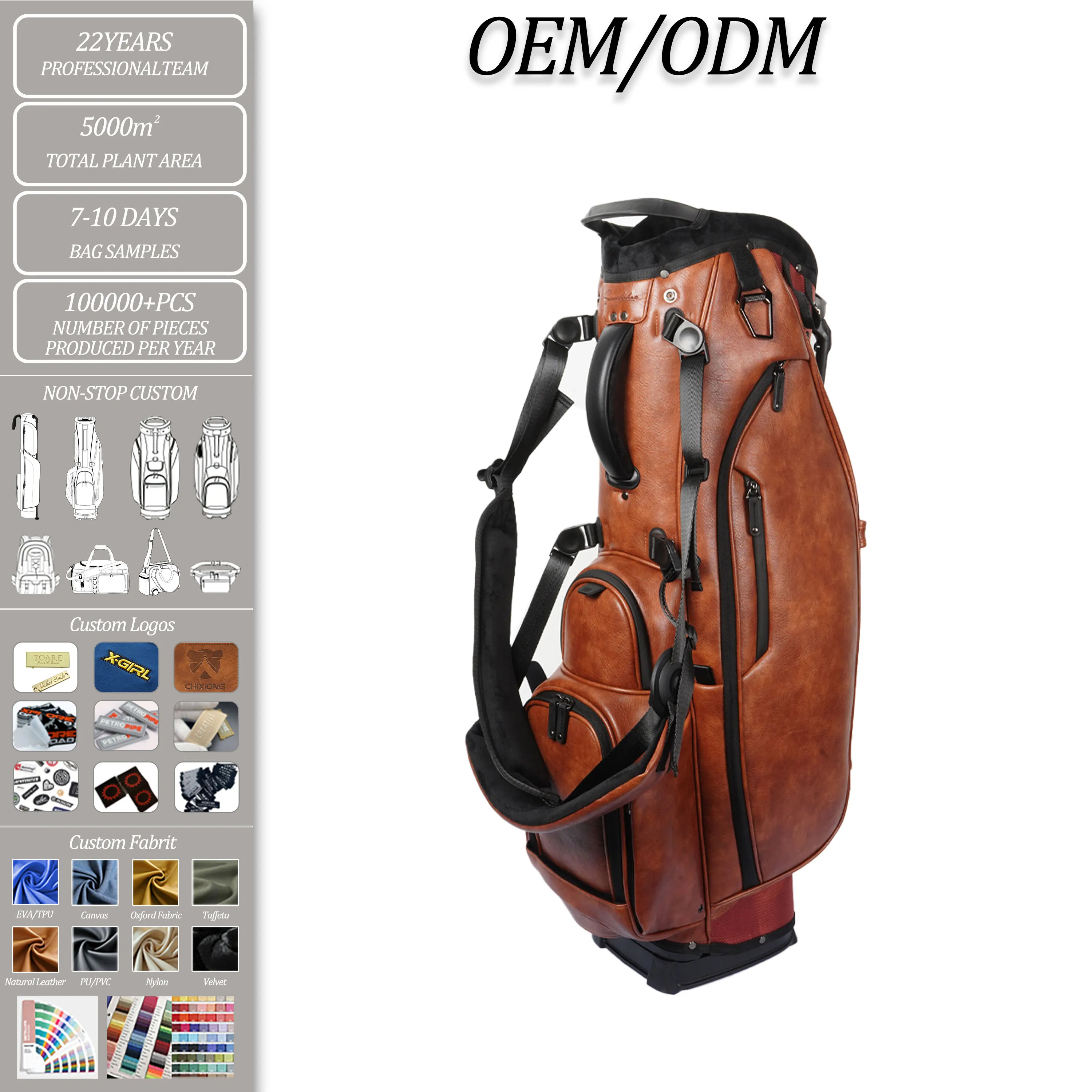
Because the same sewing benches produce our leather golf bags, we can match the driver cover to a matching bag hide so the whole set reads as one deliberate collection. That coordination is where the premium margin lives.

Packaging the Hero Product

The driver cover is the SKU most often sold as a gift, so its box does quiet selling for you. In polybag it ships as an e-commerce replenishment; in a printed paper sleeve it hangs on a retail peg; in a rigid gift box with a fitted EVA insert it reads as a present — the Father’s Day and corporate-outing tier. We recommend the gift box for the hero driver cover at any price point above mid, because the unboxing is where a buyer decides whether to leave a five-star review. A belly band with your logo turns the box into a fully branded touchpoint at near-zero tooling.
Gift-boxed leather driver head cover next to matching leather golf bag

Driver Cover vs Full Set: What to Launch With

New brands often ask whether to start with a single driver cover or a full wood set. Our advice: lead with the driver as the hero SKU, then bundle. A lone driver cover tests your brand and your fit quality with the lowest tooling risk. Once it sells, add the numbered fairway covers and a putter cover to form a complete set — and that set is where the average order value doubles. The driver carries the marketing; the set carries the margin. Either way, MOQ stays 200 per design, so the ladder of investment is gentle.

The Four Driver Materials, Tested

Choosing the outer material is the decision that most shapes the customer’s first touch. We have run all four families through the same two-year field use, and they behave very differently. Full-grain leather starts firm and softens to a supple patina; it scuffs gracefully rather than tearing, and a wiped-clean hide looks better with age than it did new. It is the right choice for a brand that wants the cover to outlast two drivers. PU leather holds a flawless factory finish for its life but will eventually craze and crack in hard sun, so it is the honest mid-tier pick rather than a forever material. Knit is the lightest and most breathable, stretches to hug the head, and leans retro; its weakness is that cheap knit pills, so we use a tighter gauge. Neoprene is the workhorse — waterproof, shock-absorbent and almost impossible to tear — but it reads casual, not luxury, and print on it fades before the fabric does.

The lining choice is just as important and often overlooked. A driver crown is a satin or carbon surface that scratches easily, so the interior must be softer than the finish it touches. Plush fleece is our default for wood covers because it cushions without abrading; a cheap polyester knit lining will leave micro-scratches on a satin top line within a season. This is a detail a buyer cannot see on a spec sheet but will feel in a returned review.

Economics and Lead Time for a Driver Programme

A driver cover programme is the lowest-risk way to enter soft-goods manufacturing. Tooling is a single die rather than a mould, so there is no hard sunk cost; MOQ is 200, with a 100-piece test order for first-time buyers; and sampling lands in 10–20 days. Bulk runs at 45–60 days on an affiliated plant rated at 200,000 pieces a month across 149 machines (126 sewing stations). Because covers share the sewing benches with our premium-material bags, lead times stay consistent even when bag production peaks. For a brand, that means a hero driver cover can be sampled, approved and reordered through a full selling season without the long commitment a full bag line demands — the ideal first step before scaling into fairway, hybrid and putter covers.

Driver vs Fairway vs Hybrid: Why They Are Different Dies

Buyers new to the category often ask why a single “wood cover” cannot serve the whole set. It cannot, because each club shrinks by a predictable step. The driver is the tallest and widest, built for roughly 460 cc and a long hosel. A fairway wood steps down to about 160–250 cc — narrower in the crown, shorter in the body — and is numbered 3, 5 or 7. A hybrid shrinks further still into a compact rescue pod around 100–160 cc. Stretch a driver cover over a hybrid and it flops loose; force a hybrid cover onto a driver and the seam splits. Getting the three dies right is what makes a set look engineered rather than thrown together. We size each line against its own club shape, number them consistently, and match the material and palette so the driver, fairway and hybrid read as one family. For the middle and smallest of that family, see the fairway wood cover page.

The through-line across all three wood covers is simple: protect the crown, hold the fit, and let the branding do quiet work. We treat each die as a precision part rather than a generic sock because a driver cover that slides off on the first tee undoes every other decision in the programme. Build it to the club, line it softer than the finish, close it without fatigue, and the cover stays on, stays looking new, and stays marketing your brand for years. That is the standard we hold every driver cover to before it leaves the QC bench — and the reason brands come back to reorder season after season.
Quote Your Driver Cover

Tell us your driver model, material and closure, and send the logo. We will return a sized spec sheet and a 10–20 day sample timeline at MOQ 200.

Request a Quote →

People Also Ask

What size is a standard driver head cover?

A modern driver cover is built for 440 to 460 cc heads, the legal maximum volume under the equipment rules. It is the tallest cover in the set, with a long body that drops over the hosel and a cuff sized to stretch over the largest wood in the bag. We build each die to your actual driver model for a precise fit — see our full head cover range for the complete set.

Will your driver cover fit a 460cc driver?

Yes. Our driver line is purpose-built for 440 to 460 cc oversized heads, the shape used by nearly every current driver. Because manufacturers shape that volume slightly differently, we confirm your exact driver model before cutting the die and sample against it — share your model on the contact page.

What is the best material for a driver head cover?

Full-grain leather is the best premium material, ageing well and taking a crisp deboss; PU leather gives the same look at lower cost; neoprene is the most rugged and waterproof value option; knit is the lightest, retro choice. The lining, in every case, is plush fleece chosen to be softer than the crown finish — see our leather driver covers for the premium build.

Do you make magnetic driver covers?

Yes. A hidden neodymium magnetic closure is our fastest-growing driver option — one-handed on/off, no elastic fatigue, and a premium feel. See our magnetic head cover guide to weigh it against a traditional elastic cuff.

What is the MOQ and lead time for custom driver covers?

MOQ is 200 pieces per design, with a 100-piece test order for first-time buyers — start a trial on the contact page. Sampling takes 10 to 20 days and bulk production 45 to 60 days, run on a plant rated at 200,000 pieces per month.

Can the driver cover match my leather golf bag?

Yes. Because the same affiliated plant produces both, we can match full-grain hides, Pantone thread and hardware finishes across a coordinated driver-cover and leather-bag collection — one of the strongest cross-sells in the premium segment.

Sources & Authority

The claims on this page draw on long-running industry tracking of the golf accessory market — the National Golf Foundation’s golfer-spend research and Golf Datatech’s retail reporting, which consistently rank head covers among the most consistently purchased, lowest-price-sensitivity equipment aftermarket products — together with tour-level equipment observation of the PGA Tour. Production figures, materials and lead times are our own working numbers from the affiliated plant, independently verified by SGS (March 2026) under BSCI and ISO 9001:2015, with CE, CPC and RoHS product-safety certification. Where a recommendation is made, it is based on what our QC bench actually measures, not on marketing.