Leather golf bags are the premium choice for brands that want a bag that ages well, photographs as a luxury product, and accepts hand-stitched, embossed or debossed branding that woven fabrics cannot match. For OEM/ODM programs, QUANZHOU JUNYUAN BAGS — established 2014 in Quanzhou, Fujian — coordinates an affiliated factory of 4,950 m² running 7 production lines with 149 machines (126 sewing stations) and 137 staff, rated at 200,000 bags per month (actual run-rate around 150,000). Standard terms are MOQ from 200 pieces (100-piece trial), sampling 10–20 days, mass production 45–60 days, and AQL 2.5 final inspection, serving 200+ brand clients across 100+ countries. According to the National Golf Foundation, the United States alone has roughly 26 million active golfers, which sustains steady year-round demand for premium leather equipment from new and established brands alike.
Why Choose Leather Golf Bags
Leather golf bags are the premium choice for brands that want a bag that ages well, looks more expensive than nylon, and accepts hand-stitched, embossed or debossed branding that woven fabrics cannot match. Full-grain cowhide and saddle leather develop a personal patina over years of use, resist scuffing better than printed polyester, and pair naturally with brass, bridle leather and antique hardware. They cost more per unit than nylon builds, but they command a higher retail margin and anchor a brand’s premium range. QUANZHOU JUNYUAN BAGS has produced leather bags for 200+ brands across 100+ countries out of an affiliated factory rated at 200,000 bags per month (actual run-rate around 150,000).
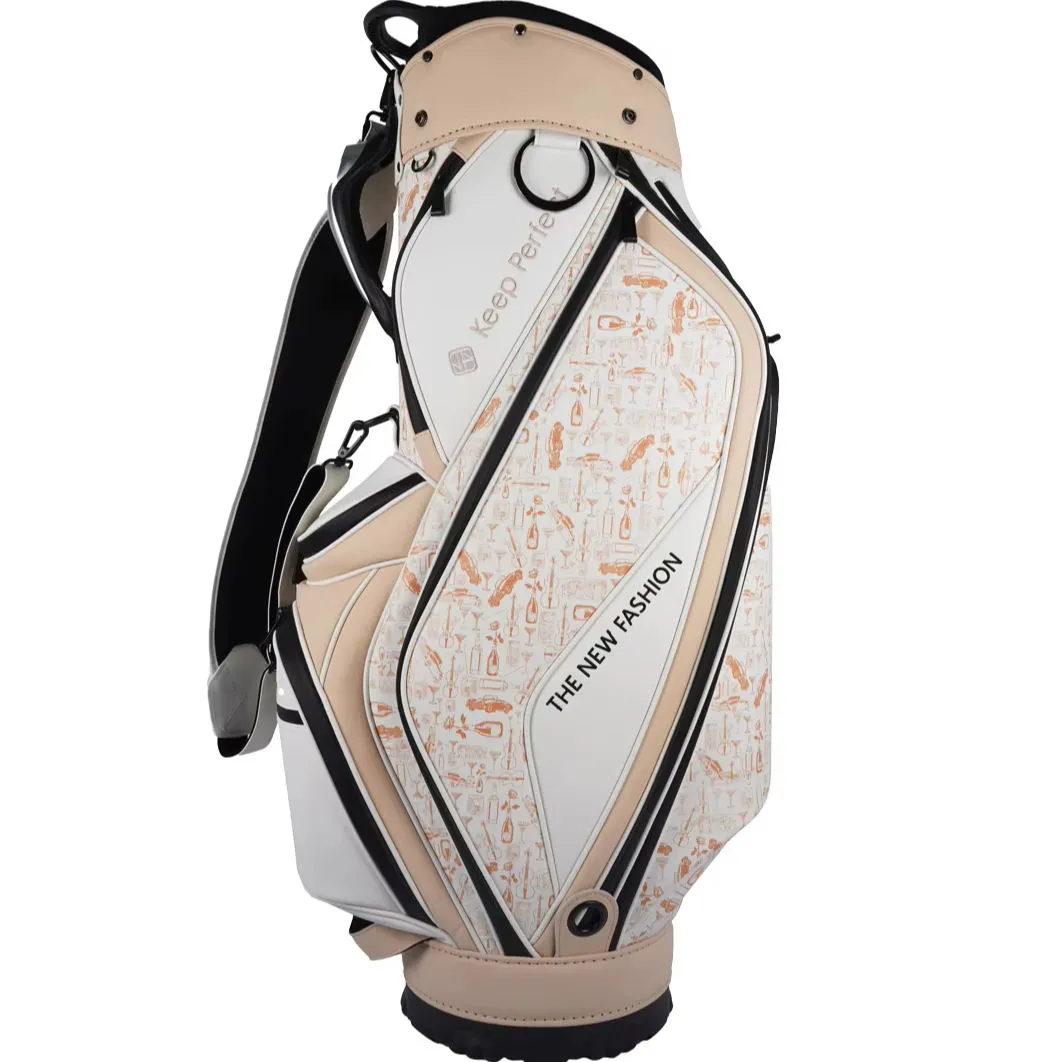
What Is a Leather Golf Bag?
A leather golf bag is a staff, cart, stand or pencil bag whose main body panels — and often the hood, pocket flaps, strap and grips — are cut from natural hide or a high-grade synthetic leather substitute. The category sits above polyester and nylon builds in material cost, labour time and retail price. A leather bag is not simply a nylon bag wrapped in a leather look; the construction changes. Panels must be book-matched for hide consistency, edges are painted or folded rather than taped, stitch density is higher, and hardware is anchored through reinforced patches because leather does not flex and self-heal the way woven fabric does.
For B2B buyers, the term “leather” covers a spread of grades. Full-grain is the outermost layer of the hide and retains the natural grain and fibre structure. Top-grain is sanded and corrected, losing some natural character but gaining consistency. Genuine leather, as the term is used in retail, often means split or corrected grain and should not be assumed to mean full-grain. Saddle leather is a specific vegetable- or fat-liquor-tanned full-grain traditionally used for horse saddles — dense, stiff and broken-in. Vegan leather, microfiber and coated PU complete the range for buyers who want the leather look without animal hide.
Why Buyers Move from Nylon to Leather
Golf bag buyers trade up for three concrete reasons. First, perceived value: a leather bag reads as a luxury product on the retail floor and justifies a price point 2 to 4 times a comparable nylon bag. Second, durability on contact surfaces: the cart-strap channel, the base rub points and the pocket edges take abuse every round. Leather abrades slowly and can be conditioned; printed nylon panels scuff and expose the weave. Third, brand expression: hand-stitching, edge paint, debossed monograms and custom embossed crests all look intentional on leather, while they tend to look like decoration on woven fabric.
These reasons line up with what we see on our production floor. The brands that commission leather bags from us are typically launching a flagship or limited-edition line, restocking a vintage-inspired range, or building a corporate-gift programme for hospitality and club pro shops. They are not trying to compete on entry-level price; they are competing on finish, story and long-term product life. Our premium materials guide covers how leather grades pair with zippers, lining and base materials.
Material Specs at a Glance
The table below is the reference spec sheet our sourcing team sends to new B2B buyers. Every figure is aligned with what our affiliated factory runs in production — not a marketing estimate.
| Parameter | Full-Grain Cowhide | Saddle Leather | Top-Grain / Corrected | Vegan / Microfiber PU |
|---|---|---|---|---|
| Typical thickness | 1.6–2.0 mm | 1.8–2.2 mm | 1.2–1.6 mm | 1.0–1.4 mm |
| Tanning / coating | Chrome or veg-tan | Vegetable / fat-liquor | Chrome + pigment finish | PU over microfiber / woven |
| Patina over time | Strong | Very strong | Minimal | None (coating degrades) |
| Weight (staff bag empty) | 5.0–6.5 kg | 5.5–7.0 kg | 4.5–5.8 kg | 3.8–5.0 kg |
| Expected service life | 8–15 years | 10–20 years | 6–10 years | 4–7 years |
| Best bag type | Staff / cart / vintage | Staff / limited edition | Cart / premium retail | Stand / weight-sensitive lines |
| MOQ (private label) | 200 pcs | 200 pcs | 200 pcs | 200 pcs (trial 100) |
| Sampling lead time | 10–20 days | 10–20 days | 10–15 days | 10–15 days |
| Bulk lead time | 45–60 days | 50–60 days | 45–55 days | 45–60 days |
Leather Grades We Build On
Full-Grain Cowhide
Full-grain leather is the most desirable surface for a premium golf bag. It is taken from the top of the hide, left un-sanded, and carries the natural fibre structure that makes it strong and repairable. On a golf bag, full-grain shows the small natural markings — vein scratches, insect bites, texture variation — that buyers associate with genuine luxury goods. Those marks are not defects; they are proof that the hide was not corrected and printed. We book-match hides across panels so the grain flows consistently around the body, and we grade incoming hides against a burn-in sample approved by the brand.
Full-grain ages differently from every other material. It darkens where it touches hands and straps, lightens where it stays covered, and develops a satin sheen in high-wear zones. This patina is the single strongest argument for leather in a product category that many buyers treat as disposable. A bag that looked perfect on day one can look better at year five, which is exactly the story vintage and heritage brands want to tell. Our vintage and classic bags line is built almost entirely on full-grain.
Saddle Leather
Saddle leather is a dense, heavily finished full-grain traditionally tanned for horse tack. It starts stiff, holds its shape, and breaks in over months of use. On a golf bag, saddle leather gives a structured, almost architectural body that does not slouch in the cart or lean on the bag stand. It is the material behind many of the most recognizable “heritage tour staff” bags on the market. We run a dedicated saddle-leather build path with thicker edge paint, solid brass hardware and linen-waxed thread because the material demands a slower, more deliberate assembly. Read the dedicated saddle leather golf bags page for the full material and tooling breakdown.
Top-Grain and Corrected Grain
Top-grain leather has been sanded lightly on the surface to remove scars and marked with an artificial grain. It is more consistent hide-to-hide, which makes colour matching easier for large production runs, and it is cheaper than full-grain. It does not develop the same deep patina and it cannot be sanded and restored as many times. We recommend top-grain for brands that need predictable colour across a 1,000+ piece run or that retail at a price point where full-grain is a stretch. Corrected grain with a printed emboss sits one tier below and is usually the line between “leather” and “leather-look” in the consumer mind.
Vegan Leather and Microfiber
Vegan leather for golf bags comes in two families. Coated PU uses a polyurethane layer over a woven or knitted backing; it is the most affordable way to get a leather aesthetic. Microfiber leather uses a non-woven microfiber substrate impregnated with PU, which gives it a fibrous structure that behaves much more like natural hide — better flex, better tear strength, better breathability. Plant-based leathers (cactus, mushroom, apple, grape) are emerging at small volume and premium price. We build all three; the dedicated vegan leather golf bags page compares them on hydrolysis, flex cycles and retail positioning.
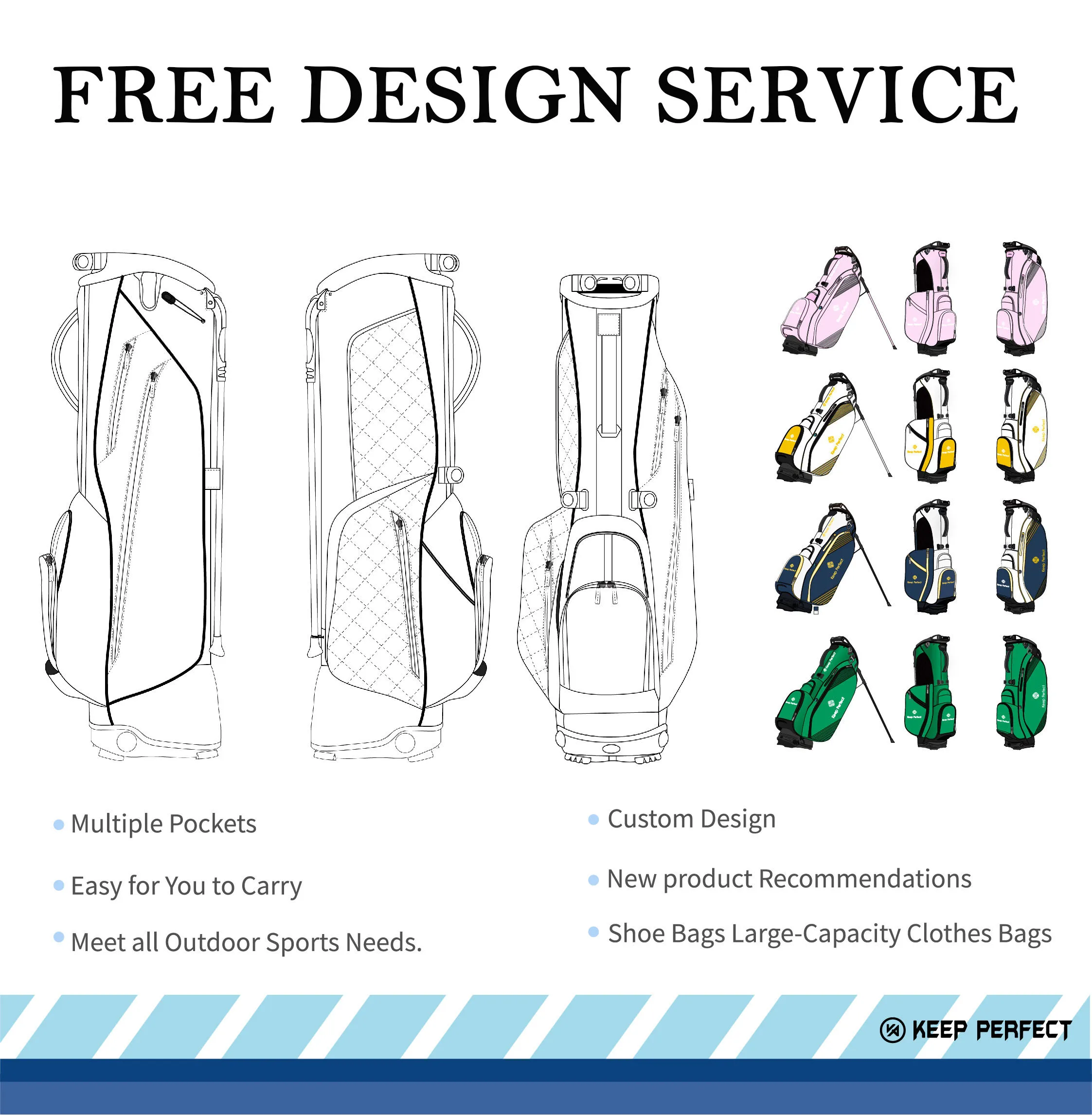
How a Leather Golf Bag Is Built
Leather construction follows the same broad outline as any golf bag — panels, body, base, divider, pockets, straps — but almost every step changes because the material does not behave like nylon. The flow below reflects what our affiliated factory runs on its seven production lines.
1. Hide Selection and Book-Matching
Hides are graded on thickness, grain consistency and surface marks. A single staff bag uses the equivalent of one to one-and-a-half hides; colour and grain must flow around the body, so panels are cut in matched pairs from the same hide batch. Cutting is done single-layer with an oscillating knife or band knife, not multi-layer, to avoid surface adhesion and to preserve the natural grain direction. We reject any hide with loose grain, open scars near panel centres or thickness variation above 0.2 mm.
2. Edge Painting and Buffing
Raw cut leather edges expose the fibre cross-section and would fray, soak up moisture and look unfinished. Premium leather bags use a multi-step edge finish: dyestuff to match the leather colour, two or three coats of flexible edge paint, and a final buff. This is a hand operation and one of the biggest cost drivers in a leather build. A bag with 4 metres of painted edge takes roughly 45 minutes of skilled work per unit just on edges. Buyers comparing quotes should ask how edge finishing is specified — it is the easiest place for a supplier to cut cost.
3. Stitching and Thread
Leather cannot self-heal around needle holes the way woven fabric does, so every stitch is permanent. We use waxed polyester or linen thread on premium builds, 6–7 stitches per inch, with back-tacking at every stress point. Decorative contrast stitching is a signature of the category; it must be perfectly even because the smooth leather surface shows every uneven stitch. Our operators trained on leather workstations are assigned exclusively to leather builds rather than rotated across nylon lines, which keeps quality consistent across runs.
4. Hardware Attachment
Zippers, D-rings, strap anchors and bottom feet are all load-bearing on a leather bag. Leather stretches less than fabric but concentrates stress at hole edges, so every hardware point is reinforced with a leather patch under the panel. We spec YKK or equivalent coil zippers on leather builds because metal-tooth zippers can cut the leather at the tape edge over time. Brass and antique-brass finishes are standard on heritage lines; matte black and gunmetal on contemporary lines.
5. Lining and Divider
The inside of a leather bag sees clubs sliding in and out, so the divider and lining matter. We use 600D to 1680D polyester lining with EVA or PE board dividers, 14-way full-length on staff bags. The liner is cut slightly oversized to leave air movement between hide and board, which prevents the leather from stretching tightly over a rigid insert and cracking at the corners.
Styles We Build on Leather
Staff / Tour Bags
6-way to 10-way top, full-length dividers, multiple apparel pockets, towel loop, glove pocket. The flagship expression of leather — most commonly full-grain or saddle.
Cart Bags
Forward-facing pockets, cart-strap channel, 14-way top. Leather panels on the wear zones, often paired with a water-resistant nylon lower panel for balance and cost.
Stand Bags
Thinner leather panels over an aluminium or fibreglass leg frame. The fastest-growing leather subcategory; see leather stand golf bags.
Pencil / Sunday Bags
Minimalist 3–4 way top, single strap, no stand. A natural fit for full-grain because the small format makes the material cost affordable and the hand-finish visible.
Headcovers
Leather is the natural partner to a leather bag. We match grain, colour and thread across bags and leather head covers so a brand’s range reads as one product family.
Accessory Pouches
Valuables pouches, ball pouches, scorecard holders — small leather goods that extend the bag range and lift average order value at retail.
Colourways and Aesthetic Direction
Leather takes dye differently from coated fabric, so colour stories are planned around the hide rather than a Pantone chip. Tan, saddle brown, whiskey, dark chocolate, olive and black are the perennial premium palette; cream and off-white are smaller-volume but high-margin; navy and burgundy run on smaller runs for limited editions. The dedicated leather golf bags in tan, black and brown page walks through how each colour ages, pairs with hardware, and reads on the retail floor. The tan leather golf bags page goes deeper on the most searched colourway.
B2B Sourcing: MOQ, Sampling and Lead Times
We quote a 200-piece minimum order for private-label leather golf bags, with a 100-piece trial order for first collaborations who want to validate a design before committing to full production. Sampling takes 10 to 20 days depending on hide availability and hardware complexity; bulk production runs 45 to 60 days from approved pre-production sample. These numbers reflect our seven production lines and 126 sewing stations, not a theoretical capacity figure. The factory is SGS-audited (March 2026) and holds BSCI, ISO 9001:2015, CE, CPC and RoHS documentation, which means leather builds can be routed into European and North American retail programmes without additional social audit work.
For new buyers, the typical project path is: reference images or tech pack → material swatch selection → 3D or pattern mock-up → physical sample (10–20 days) → revisions → bulk (45–60 days). We send photo and short-video QC updates at raw-material cut, panel stage, finished sample and final inspection. Final inspection follows AQL 2.5 for visual and functional checks. Buyers can use a third-party inspector (BV, SGS, Intertek) on our floor; the schedule is built around their attendance window.
| Project stage | Typical duration | Buyer deliverable |
|---|---|---|
| RFQ and spec review | 1–3 working days | Quotation with material, hardware and packaging options |
| Material swatch ship | 3–5 working days | Hide, thread, zipper and finish swatches |
| Sample development | 10–20 days | 1–2 physical samples |
| Sample revisions | 5–10 days per round | Revised samples |
| Bulk production | 45–60 days | Photo/video QC at cut, panel and finish |
| Final inspection + packing | 5–7 days | AQL 2.5 inspection report |
Care and After-Sales
Leather outlasts nylon when it is cared for; it fails fastest when it is ignored. The care instructions we print in every private-label hangtag are simple: wipe with a soft dry or lightly damp cloth after wet rounds, never machine wash, store on the included bag boot in a ventilated cool space, and feed with a neutral leather conditioner once or twice a season. Avoid silicone-based sprays — they coat the grain and prevent the hide from breathing. For brands, we co-brand care kits (a 30 ml conditioner tin and a lint cloth) as a value-add SKU that improves unboxing and repeat purchase.
Repairs are part of the leather value story. A cracked edge paint line, a replaced zipper slider or a re-stitched handle is a 20-minute job for a leather worker; on a nylon bag the same damage usually means panel replacement. Warranties on our leather builds are commonly 2 years against manufacturing defects, with an expected usable life well beyond that. This is a meaningful contrast to nylon bags, where warranty claims cluster at 12–18 months when the coating or lining begins to fail.
How Leather Compares to Nylon and PU at a Glance
Buyers often ask us how leather really stacks up against nylon and coated PU on the retail floor. The honest answer depends on the price point, the climate the bag will be sold in, and how long the brand expects the product to live. Nylon is lighter, cheaper and more water-resistant out of the box, but it scuffs, fades and cannot be restored. PU looks like leather for a season or two, then the coating hydrolyses and cracks. Leather sits at the top of the durability curve but costs more up front and demands basic care. The dedicated pillar guide leather vs PU vs nylon golf bags walks through the full engineering comparison, including flex-cycle testing, hydrolysis ratings and typical retail margin structure.
| Dimension | Full-Grain Leather | Coated PU | Woven Nylon / Polyester |
|---|---|---|---|
| Unit material cost (relative) | 100 | 25–40 | 15–30 |
| Empty weight (staff bag) | 5.0–6.5 kg | 3.8–5.0 kg | 3.0–4.2 kg |
| Surface water resistance | Good (with wax) | Good | Variable (coated) |
| Abrasion on cart-strap channel | Slow, repairable | Medium, peels | Fast, exposes weave |
| Branding finish options | Deboss, hot stamp, hand stitch | Hot stamp, print | Print, embroidery |
| Expected service life | 8–15 years | 4–7 years | 3–6 years |
| Typical retail band | $350–$900+ | $120–$300 | $60–$200 |
Branding and Personalisation on Leather
Leather is the most brandable material in the golf bag category because it accepts finishes that nylon simply cannot. The four finishes we spec most often for B2B clients are blind debossing, hot foil stamping, laser engraving and contrast hand-stitching. Blind debossing presses a logo into the hide without ink or foil; it looks quiet and expensive, and it ages with the bag. Hot foil stamping adds a metallic or matte colour layer on top; it is the standard for corporate hospitality gifts. Laser engraving gives a fine, graphic mark that suits modern minimalist brands. Hand-stitched monograms on a strap, valet or glove patch are the highest-touch option and are usually reserved for limited editions and club-pro-shop commissions.
Hardware finish is part of the brand story too. Solid brass, brushed nickel, antique brass, matte black and gunmetal are the five finishes we hold in stock for leather builds. Brass ages and darkens with hand contact, which reinforces the heritage narrative; matte black and gunmetal read contemporary. We recommend locking the hardware finish at the sample stage because changing it later in bulk is expensive. Embossed crests, monogram initials and co-branded club marks all work well on leather; we can produce them in-house on our stamping presses, which keeps lead time short and cost predictable.
Export, Tariffs and Documentation
Leather golf bags ship under HS code 4202.21 or 4202.92 depending on construction, and duties differ between US, EU and UK markets. We work with buyers on FOB, CIF and DDP terms and can supply commercial invoice, packing list, certificate of origin, fumigation-free carton declaration and, on request, a leather composition declaration for customs. For US buyers subject to Section 301 tariffs, we can split the leather panel and the lining declaration on the invoice to support correct classification. Our shipping team prepares carton labels, UPC/EAN barcodes and Amazon FNSKU labels for brands that fulfil through Amazon or 3PLs.
Quality, Certifications and External References
Our affiliated factory passed its SGS social and technical audit in March 2026 and holds BSCI, ISO 9001:2015, CE, CPC and RoHS. Incoming leather is inspected against our own spec sheets for thickness tolerance (±0.15 mm), colour Delta E (< 1.0 across a batch), flex-crack resistance and salt spray on hardware. We cross-reference material claims against industry bodies including the Leather Naturally trade initiative, the Leather Working Group environmental rating, and the SATRA furniture and leather testing standards when our buyers request independent lab reports. Buyers are welcome to send their own audit team or use a nominated third party.
People Also Ask
Are leather golf bags worth the money?
For a brand positioning above $250 retail — the tier our premium luxury bag line targets — yes. Leather delivers a higher perceived margin, a longer service life, and a storytelling angle (heritage, patina, hand-finish) that nylon cannot match. For a sub-$150 retail bag, no — the material cost cannot be amortised without cutting corners on hide quality or edge finishing.
Do leather golf bags hold up in rain?
Full-grain and saddle leather resist surface water well, but they are not waterproof. Seams, stitch holes and zipper tracks will admit moisture over a long round. Use a rain hood and dry the bag naturally away from direct heat. Conditioned leather handles repeated wetting far better than neglected leather.
Can I get a custom colour leather golf bag?
Yes, but lead time and MOQ change. Off-the-chromatic colours (navy, burgundy, olive, cream) run on standard hides with dye matching — see our leather colour guide for the full palette. Custom Pantone colours require a dedicated dyelot at the tannery, which extends sampling to 20–30 days and usually requires a higher MOQ. Talk to our team before locking a retail date.
What is the difference between genuine leather and full-grain?
“Genuine leather” is a legal marketing term in many markets that allows lower splits and corrected grain, while full-grain is the un-sanded top layer of the hide. Full-grain is stronger, more repairable and ages better — learn more in our premium materials guide. Always write “full-grain cowhide” on your tech pack rather than “genuine leather” to avoid ambiguity with suppliers.
How do I clean a leather golf bag?
Wipe with a soft dry cloth after each round. For heavier soiling, use a damp cloth with a tiny amount of pH-neutral soap, then dry immediately. Condition once or twice a season with a neutral wax — the same routine recommended for our saddle leather builds. Do not use saddle soap on modern chrome-tanned golf bag leather, and never put the bag in a washing machine or near direct heat.
Can leather golf bags be personalised with a monogram?
Yes. Blind debossing, hot foil stamping, laser engraving and hand-stitched initials are all standard. Debossing is the most premium look; foil stamping works well for corporate gifting; hand-stitching on a wrist strap or valet pouch is a high-touch limited-edition option. We recommend personalisation be done in-house before packing to avoid aftermarket labour — see our FAQ page for current lead times.
What packaging do you use for leather golf bags?
Each bag ships in a non-woven dust bag inside a five-layer corrugated carton. For premium retail, we offer custom rigid gift boxes, cotton dust bags with drawcord, and branded hangtags. Packaging is quoted separately and usually adds 3–8% to unit cost depending on box grade — request a spec sheet via our about page.
Source Your Leather Golf Bag Line
MOQ 200 pieces, samples in 10–20 days, bulk in 45–60 days. BSCI / ISO 9001:2015 certified. 200+ brands, 100+ countries.
Get a Quoteservice@junyuanbags.com · WhatsApp +86 17750020688