Golf Head Cover Size Chart: Dimensions for Every Club in the Bag
The correct golf head cover sizes: driver 34-36 cm with a 13-14 cm stretch mouth, fairway wood 28-30 cm with an 11-12 cm mouth, hybrid pod 24-26 cm with a 10-11 cm mouth, blade putter 16 × 13 cm envelope, mallet putter 14 × 12 × 6 cm shell. This chart page collects every dimension, tolerance and padding spec in one reference — for buyers speccing a range and players checking a fit. Each geometry links to its deep-dive guide and its product line at our head cover hub.
QUANZHOU JUNYUAN BAGS, established 2014 in Quanzhou, Fujian, manufactures through an affiliated factory of 4,950 m², 7 production lines, 149 machines (126 sewing stations) and 137 staff — rated at 200,000 pieces per month, actual output around 150,000. Every order runs AQL 2.5 inspection, MOQ 200 (100-piece trial), sampling 6–10 days, bulk 35–50 days, with BSCI, ISO 9001:2015, CE, CPC and RoHS certifications (SGS audit, March 2026). We serve 200+ brands in 100+ countries.
How to Use This Chart
Head cover sizing fails in two directions: covers cut on outdated geometries (pre-460 cc driver patterns are still common in the supply chain) and covers cut on scaled patterns (one driver die shrunk for everything else). This chart gives the current, purpose-cut dimensions for every club category, with the tolerances our fit lab holds and the failure each wrong dimension produces. Use it to spec a range, audit a supplier, or check whether a cover in your hand is built right.
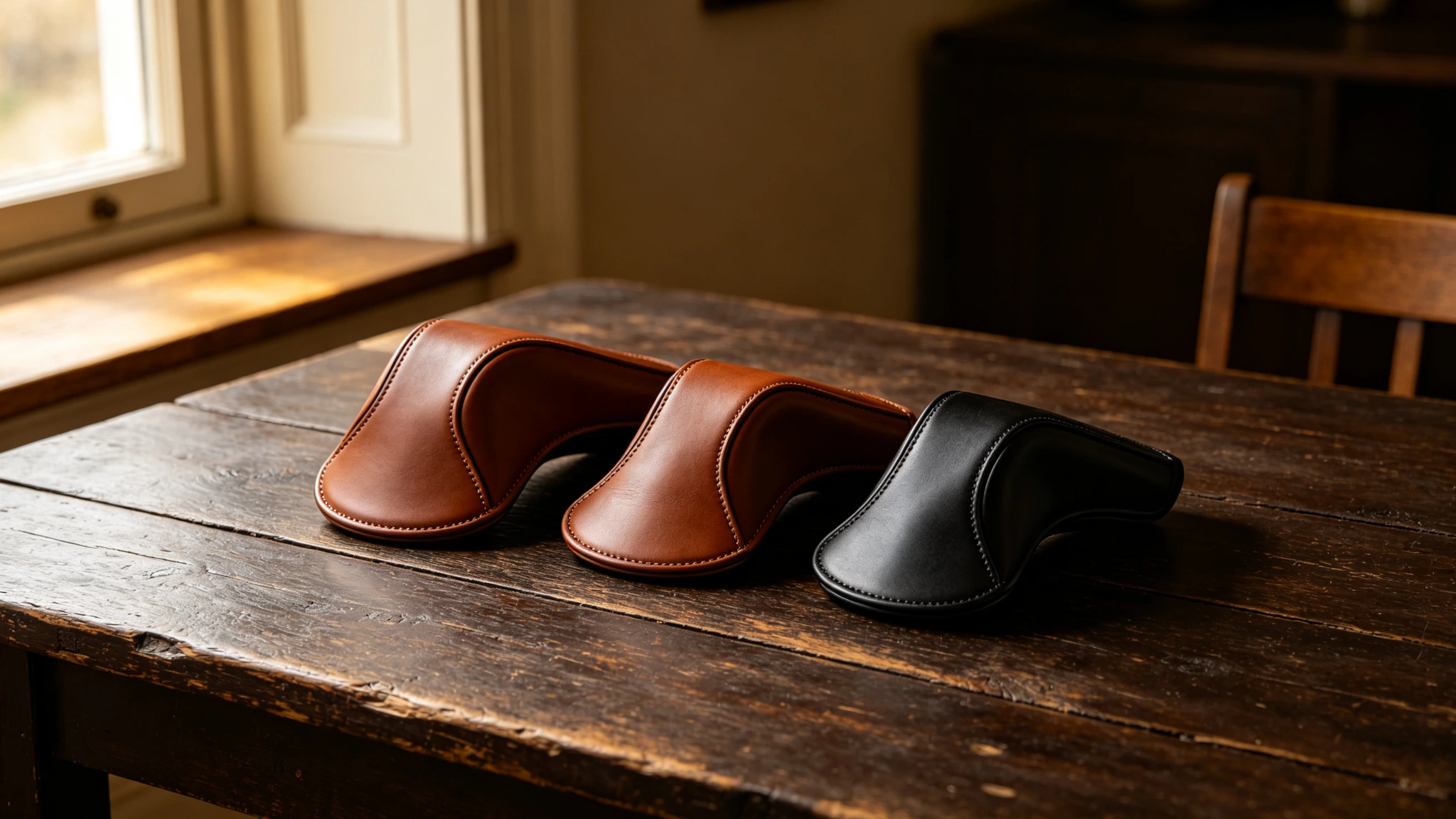
Three principles govern every number below. First, fit is tested on physical club heads, not drawings — every dimension here is verified against current reference geometries from the major manufacturers. Second, each geometry needs its own die; no row in this table is a scaled version of another. Third, the mouth stretch tolerance assumes a quality collar — elastic-blend binding or gusseted leather — adding roughly 2 cm of working range.
Where a club falls between rows — mini-drivers, 7-woods, armlock putters — the rule is to spec to the head volume and hosel length, not the club name. The deep-dive guides linked from each section cover the edge cases; the chart covers the standards.
A note on measuring convention, because factories and buyers sometimes talk past each other here: lengths in this chart are laid-flat measurements from crown top to cuff end, not circumference-following measurements, and mouths are measured relaxed across the opening, not stretched. Padding figures are nominal EVA sheet thickness before compression into the panel. When you brief a supplier from this chart, state the convention alongside the numbers — one sentence of convention prevents a sample that measures "correctly" against the wrong ruler.
The Master Size Chart
Every dimension below is production-verified on current geometries. Lengths are crown-to-cuff; mouths are relaxed opening before stretch; padding is EVA thickness over impact zones:
| Cover | Length | Mouth | Padding | Shaft sock | Tolerance |
|---|---|---|---|---|---|
| Driver (460cc) | 34-36 cm | 13-14 cm | 8-10 mm EVA | 10-12 cm | ±5 mm |
| Mini-driver (420cc) | 32-34 cm | 12-13 cm | 8 mm EVA | 10 cm | ±5 mm |
| Fairway wood | 28-30 cm | 11-12 cm | 6-8 mm EVA | 8-10 cm | ±4 mm |
| Hybrid pod | 24-26 cm | 10-11 cm | 6-8 mm EVA | 6-8 cm | ±4 mm |
| Blade putter | 16 × 13 cm | flap | 6 mm EVA | — | ±3 mm |
| Mid-mallet putter | 13 × 11 × 5 cm | flap | 8-10 mm EVA | — | ±3 mm |
| Mallet putter | 14 × 12 × 6 cm | flap + tab | 10 mm EVA | — | ±3 mm |
| Centre-shaft putter | mallet + top slot | slot bridge | 10 mm EVA | — | ±3 mm |
| Iron cover | 12 × 8 cm | slip / window | 3-4 mm | — | ±3 mm |
Read the chart with the tolerances in mind: a driver cover at 33 cm is out of spec even though it seats, because the missing 2 cm exposes the lower crown and hosel junction where bag chatter concentrates. Tolerance is not pedantry — it is the difference between a cover that protects and a cover that photographs.
The full testing protocol behind these numbers — 50 seat-and-remove cycles per geometry, timed under two seconds, shake-tested for play — is documented in our driver fit guide and applies to every row above.
Driver: The 460cc Standard
The driver row is the one that matters most and the one most often wrong. Modern drivers run to the USGA 460 cc limit with crown shapes from deep pear to stretched shallow, plus long-neck and short-neck hosel variants. The 34-36 cm / 13-14 cm spec seats correctly across the spread; anything shorter exposes the crown, anything tighter strains the seams.
Mini-drivers — the 420 cc category that re-emerged as a tour and fitting option — need their own die at 32-34 cm. A standard 460 cc cover on a mini-driver bags and rotates; a mini cover on a 460 will not seat. Japanese and compact-tour segments make the second die commercially real rather than theoretical.
Padding holds at 8-10 mm EVA over crown and toe, tapering at the cheeks — drop testing shows paint transfer through 4 mm padding in roughly 40% of one-metre drops versus under 5% at 8 mm. The shaft sock (10-12 cm) protects the graphite finish where divider rails touch; crown-only covers leave exactly that zone bare. Full detail: driver size and fit guide. Product line: driver head covers.
Fairway Woods and Hybrids
Fairway covers run 28-30 cm with slimmer 11-12 cm mouths, purpose-cut for the shallower, rounder fairway geometry. One well-cut die covers the 150-190 cc band (3-wood through 7-wood) when tested at both extremes; beyond that spread, strain begins. Padding runs lighter than drivers — 6-8 mm — because fairway heads sit lower and less exposed, but lining standards do not relax: 280gsm fleece minimum, velvet for dark PVD finishes.
Hybrid pods are the architecture most ranges still miss: 24-26 cm, wider squarer mouth, shaped crown insert for the hybrid’s abrupt shoulders. With players carrying two or three hybrids where long irons used to live, the pod is not an accessory to the range — it is the fastest-growing geometry in it.
Numbering is the fairway-and-hybrid-specific spec: embroidered numbers for premium tiers, woven clip tags for mid, double-riveted dials with nylon washers for value knit, and H/X dials or matched numbers for hybrids. The full numbering failure analysis and die logic is in our fairway and hybrid guide. Product line: fairway wood covers.
Putters: Four Geometries, Four Covers
Putter sizing is architecture, not scale. The blade envelope (16 × 13 cm, 6 mm EVA, magnetic flap) fits Anser-style geometries. Mid-mallet shells (13 × 11 × 5 cm, 8-10 mm) fit half-moon and compact fang heads. Full mallet shells (14 × 12 × 6 cm, 10 mm, magnetic-plus-tab) fit high-MOI mallets. Centre-shaft designs add a reinforced top slot with its own closure for centre-shafted and armlock putters.
The fit test for putter covers is the shake test: head in, closure closed, shake firmly — silence is the spec. A mallet that rattles inside its shell is being worn by its own cover across seasons. Lining runs to velvet rather than fleece on putters, because modern putter finishes — black PVD, raw carbon, torched — scratch more easily than driver crowns.
Closure pull force sits at 1.5-2.5 kg for magnetic flaps: strong enough to survive cart vibration, gentle enough for one-handed operation 60-80 times per round. Full architecture mapping: putter cover types guide. Product line: putter covers.
Iron and Wedge Covers
Iron covers are flat envelopes at roughly 12 × 8 cm with 3-4 mm padding — a different product class from wood covers, aimed at forged-set protection, travel, and the East Asian markets where they are retail standard. Construction is neoprene or PU with clear numbering windows, breathable linings, and drainage — sealed covers trap moisture against chrome and accelerate the pitting they exist to prevent.
The honest market note: Western touring players skip iron covers, and raw-finish wedges should go uncovered regardless — they need to breathe, and rust-patina is expected. Spec iron covers for Japanese and Korean distribution, forged premium sets, and travel programmes; skip them for North American volume retail. The full assessment is in our club protection guide.
Sizing across an iron set is simpler than woods: one envelope geometry fits 4-iron through pitching wedge on current head sizes, with a slightly larger variant for oversized game-improvement irons. The numbering window does the identification work that separate dies do on woods — which keeps iron cover economics viable at set volumes.
Wedge treatment within iron sets deserves one clarifying line. Where a set includes gap, sand and lob wedges, the envelopes are sized identically to the irons — but the care instruction differs: raw and unplated wedge finishes should be uncovered to dry after wet rounds rather than stored sealed. Retail programmes shipping iron sets to humid markets should print that exception on the care card, because "my wedges rusted under the covers" is a preventable complaint that reads as a product defect.
Fit Testing: Verifying the Chart
Every dimension in this chart is verified the same way: physical reference heads, 50 seat-and-remove cycles per die, timed under two seconds per seat, head-down shake test for play (under 3 mm fairway, 5 mm driver), silence test for putters. Buyers can run the field version on any sample without equipment: seat and remove 20 times, measure the four key dimensions with a tape, shake, and listen.
The audit catches the two industry shortcuts. Scaled patterns — one die shrunk across geometries — show up as crown play above tolerance and bags at the shoulders. Outdated patterns — pre-460 cc driver dies — show up as seam strain on modern heads. Both pass photography; both fail the field test in two minutes.
Production QC then holds the chart at three inline gates — post-cutting dimensions, post-closing seam and fit, post-packing completeness — under AQL 2.5 final inspection. The discipline framework is documented in our five-stage inspection guide and applies to a $4 knit cover exactly as to a $20 leather one.
Spec Sheet: Briefing a Factory from This Chart
Turn this chart into a purchase-ready brief by adding five fields per geometry: shell material and thickness, lining type and weight, closure type with pull spec, branding execution and placement, and Pantone references. With those plus the dimensions above, a competent sampling room returns fitted samples in 6–10 days — our own timeline at MOQ 200 with a 100-piece trial, bulk in 35–50 days.
The two fields buyers under-spec are lining weight and closure pull force. "Fleece lining" spans 180-320gsm; specify the gram weight. "Magnetic closure" spans glued fridge magnets to sewn N38 pairs at 2 kg pull; specify grade, encapsulation and force. Both are tech-pack lines, and both are audited at golden sample before bulk.
Colour and branding complete the brief. Pantone references travel with the material spec, thread matches verify under D65 lighting, and logo placement is stated in millimetres from named seams — not "logo on front." A brief at this level of precision returns a right-first-time sample; a vague brief returns a revision cycle, and every revision costs a week of season. Precision at brief stage is the cheapest project management in manufacturing.
For full ranges, brief geometries in sequence: driver die first (largest, highest-visibility), then fairway and hybrid harmonised to it, then putter architectures. The sequencing logic and stage-by-stage timeline mirror our sample development guide. Start the brief at our quote page.
The Bottom Line
Cover sizing is a chart, not a guess: driver 34-36 cm, fairway 28-30 cm, hybrid 24-26 cm, four putter architectures, iron envelopes for the markets that want them — each purpose-cut, each tolerance-tested on physical heads. Print it, spec from it, audit against it.
The brands that win the cover category are the ones whose covers fit — it is the first thing a customer tests and the first thing a reviewer mentions. The factories that win are the ones whose dies are cut on current geometries and verified on every lot. Ours are.
Send the club list and the material, and fitted samples to these exact dimensions come back in 6–10 days. The chart is the contract; the sample is the proof.
Spec Covers to the Chart
Send the club list and material. We return fitted samples in 6–10 days, quoted at MOQ 200 with a 100-piece trial.
Request a Quote →People Also Ask
What size is a standard driver head cover?
For modern 460cc drivers: 34-36 cm overall length, 13-14 cm mouth opening plus stretch, 8-10mm EVA crown padding, and a 10-12 cm shaft sock, with ±5mm tolerance. Mini-drivers (420cc) take a 32-34 cm variant. Anything shorter than 34 cm exposes the lower crown and hosel junction where bag chatter concentrates. See our driver cover line.
What size head cover fits a 3-wood?
A purpose-cut fairway wood cover: 28-30 cm length, 11-12 cm mouth, 6-8mm EVA padding, 8-10 cm shaft sock, ±4mm tolerance. One well-cut die covers 150-190cc heads (3-wood through 7-wood) when fit-tested at both extremes. Covers scaled down from driver patterns bag at the crown and rotate loose — check for purpose-cut dies.
What size is a hybrid head cover?
Hybrid pods run 24-26 cm with a wider, squarer 10-11 cm mouth and a shaped crown insert matching the hybrid’s abrupt shoulders. The pod architecture differs from fairway socks because hybrid heads are shorter, deeper and wider-soled. A fairway cover on a hybrid bags and slides; a hybrid pod on a fairway wood will not seat.
What are the dimensions of a blade putter cover?
A flat envelope of roughly 16 x 13 cm with 6mm EVA padding, velvet lining and a magnetic flap closure, ±3mm tolerance. Centre-shafted blade variants need a top-slot version. The fit test: head in, flap closed, shake — silence is the spec. Product line at our putter cover hub.
What size cover fits a mallet putter?
A structured shell of roughly 14 x 12 x 6 cm with 10mm EVA padding on faces and base, magnetic mouth plus security tab, velvet lining. Mid-mallets take a shallower 13 x 11 x 5 cm variant. Oversize and centre-shafted mallets need dedicated dies with reinforced top slots — no single mallet pattern covers all three geometries.
Do head covers come in different sizes or one-size-fits-all?
Both exist, but only sized covers fit properly. "Universal" covers are cut on one mid-size geometry and stretch-tolerated across clubs — strain on some heads, bagginess on others. Purpose-cut dies per geometry (driver, fairway, hybrid, each putter type) hold crown play under 3-5mm in shake tests; universal patterns average 6-9mm.
How do I measure my club for a head cover?
Measure head width at the widest crown point and the depth from crown top to sole, then check the cover’s mouth opening against the width and its internal depth against the head depth. For drivers also confirm overall cover length (34-36 cm for 460cc) and shaft sock length. The field test matters more than tape: seat and remove 20 times — under two seconds, no seam strain, no rotation.
Will a 460cc driver cover fit a 3-wood?
No — it will bag at the crown, rotate during play, and work loose. The geometries differ: fairway heads are shallower, rounder and shorter-hoseled, needing a 28-30 cm purpose-cut die with an 11-12 cm mouth. Using a driver cover on a fairway wood leaves the head moving inside its own cover, abrading the paint it should protect.
What size are iron head covers?
Flat envelopes of roughly 12 x 8 cm with 3-4mm padding, neoprene or PU construction, clear numbering windows, breathable linings and drainage. One geometry fits 4-iron through pitching wedge on current head sizes, with a larger variant for oversized game-improvement irons. Iron covers are standard in East Asian retail, optional elsewhere.
How much stretch should a head cover mouth have?
Roughly 2 cm of working range beyond the relaxed opening, from elastic-blend binding or a gusseted cuff. The cover should seat one-handed in under two seconds without straining seams, and stay seated through cart vibration. Mouth stretch is specified and tested as part of die approval — it is not a detail to leave to factory discretion.
Do head cover sizes differ between brands?
The underlying club geometries are shared across equipment brands (USGA limits standardise head volumes), so a properly cut 460cc die fits all major manufacturers’ drivers. What differs between cover brands is whether the die was cut on current geometries or an outdated/scaled pattern — the two-minute field test tells you which you are holding.
What tolerance is acceptable in head cover sizing?
Driver ±5mm on length, fairway and hybrid ±4mm, putters ±3mm. Beyond tolerance, covers expose crowns (too short), strain seams (too tight) or rotate loose (too wide). Production QC should verify dimensions at the post-cutting gate on every lot, with AQL 2.5 final inspection before freight — the discipline in our five-stage QC framework.
Should head covers fit tight or loose?
Snug, not tight. The cover should seat with light one-handed pressure and hold under a head-down shake, but without seam strain — white stress lines at stitching mean the die is too small and the seams will fail early. Loose covers are worse than tight ones: a cover that rotates migrates off the club and abrades the crown it should protect.
Are there junior-size head covers?
Yes — junior clubs have smaller heads and shorter shafts, so junior covers scale to roughly 70-80% of adult dimensions with the same padding and lining rules. Junior programmes carry CPC compliance requirements for the US market, which ship with the order from certified factories. Junior sets are a growing gift segment, particularly matched parent-child colourways.
How do I measure a head cover’s length correctly?
Lay the cover flat and measure from the crown top to the cuff end in a straight line — not following the curve of the fabric. Mouth openings are measured relaxed across the opening, and padding is nominal EVA sheet thickness. State the convention when briefing a supplier so both sides measure against the same ruler.
Sources & Authority
All dimensions are production-verified against physical reference heads from the major equipment manufacturers (460/440/420cc drivers, current fairway, hybrid and putter geometries) in the QUANZHOU JUNYUAN BAGS fit lab. Tolerances and test protocols follow our AQL 2.5 framework, SGS-verified (March 2026) under BSCI and ISO 9001:2015.