Golf Head Covers Set Guide: Building the Right Combination for Retail and OEM
A golf head covers set is commercially defined by three decisions: architecture (three-piece vs full-bag), numbering (embroidered vs rotating tags), and material consistency (one hide, one thread, one hardware finish across every piece). Get those right and a set anchors a premium bag range; get them wrong and even good covers look assembled rather than designed. This guide covers set architecture, OEM economics at MOQ 200, and the packaging decisions that move sets at retail — from the lines that build them. See the components in our head cover hub.
QUANZHOU JUNYUAN BAGS, established 2014 in Quanzhou, Fujian, manufactures through an affiliated factory of 4,950 m², 7 production lines, 149 machines (126 sewing stations) and 137 staff — rated at 200,000 pieces per month, actual output around 150,000. Every order runs AQL 2.5 inspection, MOQ 200 (100-piece trial), sampling 6–10 days, bulk 35–50 days, with BSCI, ISO 9001:2015, CE, CPC and RoHS certifications (SGS audit, March 2026). We serve 200+ brands in 100+ countries.
What a Head Cover Set Actually Includes
Strip away the marketing and a golf head covers set is a coordinated family of covers built from one material lot, one colour story and one branding execution, sized for the clubs a player actually carries. The core set protects the clubs that need it — driver, fairway woods, hybrids and putter — while extended sets add iron covers and speciality pieces. What defines "set" versus "singles" is not the count but the coordination: matched hides, matched thread, matched hardware, matched logo.
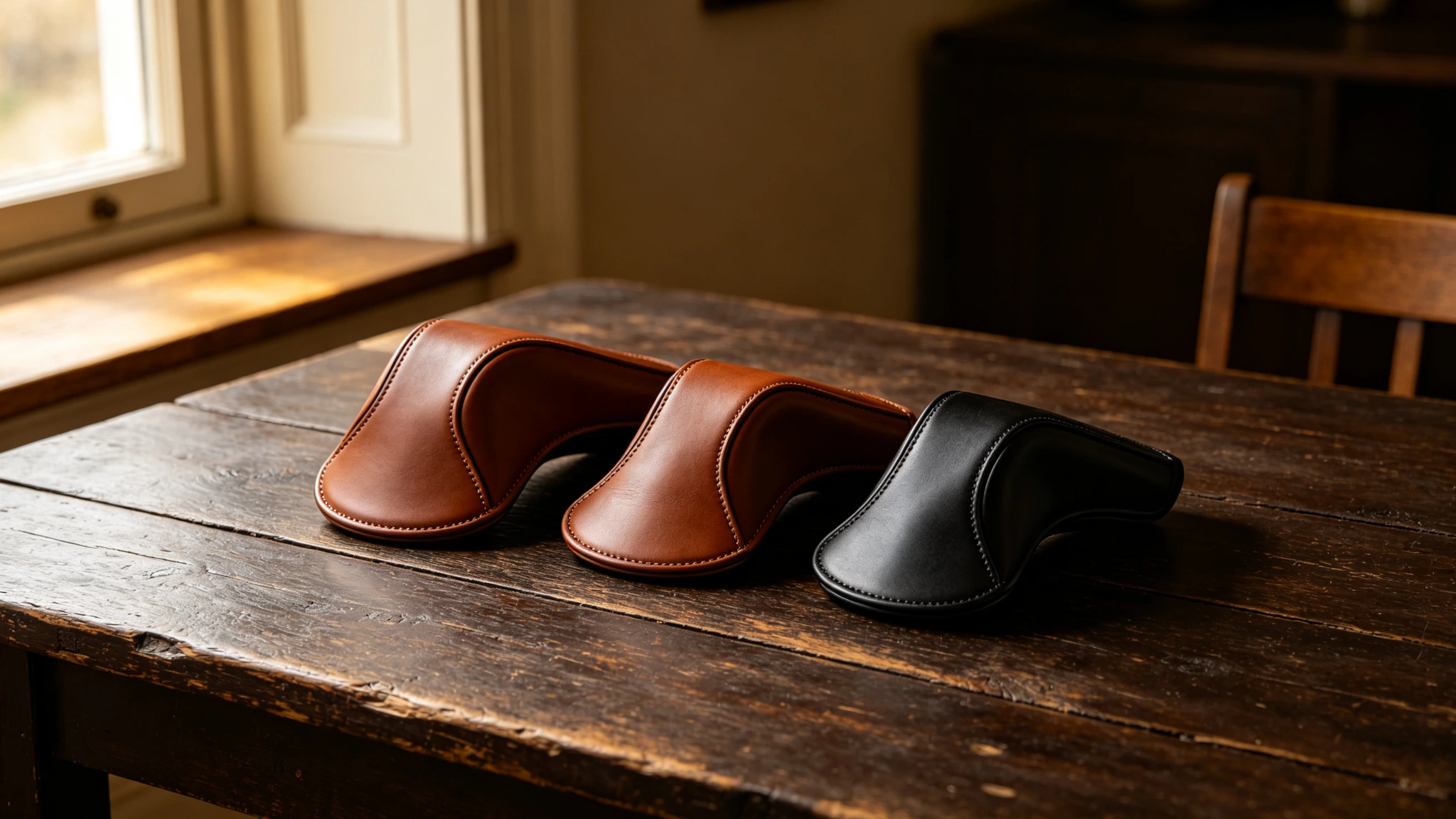
That coordination is harder than it looks, and it is where cheap sets fail. Leather hides vary batch to batch; PU colour lots drift; thread that matches under office fluorescent light mismatches under daylight. A serious set programme locks all of it at sourcing: one material purchase order for the whole set run, Pantone verification under D65 lighting, and a golden-sample set sealed and signed before bulk begins. This is the process discipline we apply to every set at MOQ 200 — the same discipline described in our sampling process guide.
The commercial case for sets over singles is simple arithmetic: a three-piece set at $12 ex-works retails at $59-79, while the same three covers as singles retail at $25-30 each. The set saves the customer $16-31, moves three units in one transaction, and photographs as one hero image that out-converts three separate listings. Sets are how accessory programmes build basket size without building inventory complexity.
The Standard Three-Piece Set
The three-piece set — driver, fairway, hybrid — is the industry’s volume architecture for a reason: it covers the clubs 80% of players most want protected, at a price point that sits comfortably in the $59-79 gift band. Each piece needs its own die: 34-36 cm for the driver on a true 460 cc geometry, 28-30 cm for the fairway, 24-26 cm for the hybrid pod. Scaling one pattern across all three is the most common factory shortcut and the easiest defect for a buyer to catch — check that the fairway and hybrid sit snug, not swimming.
Material execution in a three-piece set should be identical across pieces: same hide or PU lot, same lining weight, same closure family, same logo size relative to each piece’s canvas. The one intentional variation is closure tuning — many premium sets use magnetic on the driver and putter but elastic cuffs on fairway pieces, because fairway covers are pulled on and off more often per round and benefit from the faster action. That is a design choice, not an inconsistency; document it in the tech pack so the line does not "correct" it.
For OEM buyers, the three-piece set is also the smartest first SKU. Tooling is three dies rather than a mould; MOQ 200 sets with a 100-set trial keeps entry cash light; and the set format generates the review volume and retail photography that a later full-bag extension builds on. Our programme data across 200+ brands: labels that launch with a tight three-piece set extend to full ranges at roughly twice the rate of labels that launch with a scattered single-SKU catalogue.
Full-Bag Sets: When Nine Pieces Make Sense
Full-bag sets — driver, two fairways, two hybrids, four iron covers, putter — occupy a specific and profitable niche: gift channels, tour-style merchandising, and markets where iron covers are culturally standard (Japan and Korea above all). The engineering is identical to a three-piece set multiplied; the complexity is logistical. Nine dies, nine size checks, nine chances for a colour-lot mismatch, and a packing line that must barcode and verify nine pieces per box under AQL 2.5.
Iron covers deserve a candid note. Western touring professionals rarely use them — they slow play and can trap moisture against forged chrome — but in East Asian retail they are expected, and a "full set" without them reads as incomplete. If your channel includes Japanese or Korean distribution, spec iron covers in neoprene or PU with clear window numbering; if your channel is North American pro shops, leave irons out and price the set accordingly. This is a market-fit decision, not a quality decision.
The putter is the ninth piece that punches above its weight. In full-bag sets the putter cover is the most handled item — off and on 30+ times per round — and the piece reviewers photograph first. Spec it a half-grade above the rest of the set: velvet lining where woods get fleece, 10 mm EVA where woods get 8 mm, and the cleanest logo execution of the family. Our putter cover architectures show the four geometries (blade, mid-mallet, mallet, centre-shaft) a complete set programme must choose among.
Numbering and Tag Systems
Numbering seems trivial until a set reaches retail and the returns begin. Three systems exist, and they are not equal. Rotating dial tags (3/5/7/X) offer one-size flexibility but are the highest-failure component in the category: the rivet loosens, the dial spins free, the tag rattles. Fixed embroidered numbers never fail mechanically but lock each cover to one club. Woven clip-on tags split the difference — replaceable, quiet, and survive roughly three times the rotation cycles of a riveted dial.
Our default recommendation by tier: premium leather and PU sets get embroidered numbers (or deliberate no-number minimalism with club shapes debossed); mid-tier PU sets get woven clip tags; value knit sets get double-riveted dials with nylon washers, which is the only dial execution that passes our 1,000-rotation bench test. Whatever the choice, specify it in the tech pack with the washer and rivet grade — "number tag" alone is how 3% defect rates happen.
Hybrid numbering is the detail 2026 ranges get wrong most often. With players carrying anything from a 2-hybrid to a 7-wood, a rigid 3/5/7 dial misses half the market. The clean solution is an H/X dial or a blank embroidered patch the retailer can marker — or, for OEM sets, numbered pieces matched to the actual bag composition of your target player. If your data says your customer carries driver, 5-wood and 4-hybrid, build exactly that set and say so on the box. Specificity sells.
Material Consistency Across a Set
The single biggest quality risk in a set programme is not any one cover — it is drift between pieces. Leather hides from different dye lots vary a half-shade; PU from different production runs varies in gloss; thread from different cones varies in sheen. On a shelf, under retail lighting, customers see it instantly as "the cheap set." Preventing it is a sourcing discipline: one material PO covering the full set quantity, one cutting session, one sewing window, one packing run.
The verification protocol is physical, not photographic. Before bulk, we seal a golden-sample set — every piece, in the final packaging — signed by the line leader, the QC manager and the buyer. During production, inline checks compare pieces against that golden set at three gates: post-cutting, post-closing, post-packing. Pieces that drift beyond Delta-E 1.5 on the spectrophotometer are pulled. This is the same five-stage discipline documented in our QC framework, applied to sets as a system rather than to covers as singles.
Lining consistency matters as much as shell consistency and is checked less often. A set where the driver lining is plush 280gsm fleece and the fairway lining is 220gsm feels wrong in the hand even if the customer cannot name why. Spec lining weights explicitly per piece in the tech pack, and lot-test fleece for pilling (ISO 12945, grade 3-4 minimum) — linings are the first place recycled-material substitutions go wrong, which matters if your set carries sustainability claims.
Set Architecture for Retail: Good / Better / Best
Retail buyers rarely want one set — they want a ladder. The proven architecture is three rungs with clear, honest separation:
| Rung | Contents | Materials | Closure | Ex-works | Retail band |
|---|---|---|---|---|---|
| Good | Driver + fairway + hybrid | Double knit / basic PU | Elastic | $9-13 | $39-49 |
| Better | 3pc + putter cover | Premium PU, EVA padded | Magnetic driver/putter | $14-19 | $59-79 |
| Best | 4pc + gift box + personalisation | Full-grain leather | Magnetic throughout | $26-38 | $99-149 |
Two rules make ladders work. First, each rung must be visibly better in a way a customer can verify in ten seconds: closure type, padding thickness, and packaging are the three cues that read instantly. Second, never let rungs share a material lot — if the Good set uses the same PU as the Better set, buyers will notice and the ladder collapses into a pricing argument. Distinct materials per rung keep the architecture honest and the margin structure clean.
The Better rung is where volume concentrates — typically 55-65% of unit sales in the programmes we ship — so it deserves the design attention: the best colourway, the hero photography, the review seeding. Good exists to make Better look reasonable; Best exists to make Better look like value. That is not cynicism, it is how accessory ladders have always worked, and cover sets are a textbook case.
OEM Set Design: From Brief to Golden Sample
A set programme begins with a one-page brief: target player, retail price band, channel, material tier, closure preferences, logo file, and the bag it must coordinate with if one exists. From that brief we return a set architecture document — pieces, dies, materials, Pantone references, branding placements — within two working days. Sampling follows in 6–10 days: every piece sewn on the real line, not a sample room, so what you approve is what production repeats.
The fit-testing stage is where set programmes earn their quality. Each die is seated and removed 50 times on physical club heads — 460/440/420 cc drivers, current fairway and hybrid geometries, blade and mallet putters — and any piece taking more than two seconds to seat is re-died. Numbering is checked for rattle and rotation life; closures are cycled; the full set is photographed together under D65 light for colour-lot verification. Only then is the golden sample sealed.
Bulk runs 35–50 days at MOQ 200 sets (100-set trial for first programmes), with inline QC at cutting, closing and packing, and AQL 2.5 final inspection before freight. Reorders compress to 5–7 weeks because dies, material lots and the golden sample are already locked. The full stage-by-stage timeline mirrors our sample development timeline — sets simply run the stages in parallel across pieces rather than in sequence.
Packaging and Gift Boxing
Packaging is where sets out-earn singles most visibly. A three-piece set in a printed kraft sleeve looks like product; the same set in a rigid gift box with tissue, a care card and a brand story insert looks like a present — and golf covers are bought as presents at extraordinary rates, peaking in Q4 and around Father’s Day in May-June markets. The box adds $1.2-2.5 ex-works and routinely supports $15-25 more retail.
The packaging spec sheet for a premium set is short but unforgiving: rigid 2mm greyboard box with matte lamination, fitted insert (die-cut card or EVA) so pieces do not shift in transit, tissue wrap, care instruction card, and a scannable barcode on the base for retail receiving. For leather sets, add a conditioning wipe sachet — it costs cents, signals expertise, and measurably reduces "dried out after one season" complaints. Our packaging design guide covers structural options in depth.
E-commerce changes the packaging maths. Amazon-friendly sets ship in a mailer-rated box that passes ISTA 1A drop testing without an outer carton — saving $0.8-1.4 per unit in fulfilment fees and reducing damage returns. If your channel mix includes marketplace, spec the gift box to mailer strength from day one rather than designing a pretty box that then needs a shipping carton. Dual-purpose packaging is the unglamorous detail that protects margin.
Pricing a Set vs Singles
Set economics reward both sides of the transaction, which is why the format dominates. For the customer, a $16-31 saving versus singles. For the brand, one pick-pack-ship instead of three, one listing to photograph and review-seed instead of three, and a gift-ready presentation that lifts conversion. The trade-offs are real but manageable: higher per-unit inventory value, and colour-lot risk concentrated in one SKU.
| Model | Ex-works | Retail | Customer saves | Brand fulfilment cost |
|---|---|---|---|---|
| 3 singles | $12.00 | $84 (3 × $28) | — | 3 × pick-pack |
| 3-piece set | $11.00 | $65 | $19 | 1 × pick-pack |
| 4-piece gift set | $16.50 | $89 | $23+ | 1 × pick-pack |
Notice the set ex-works is lower than singles — coordinated cutting from one material lot reduces waste 8-12%, and one packing run replaces three. That efficiency is the brand’s to keep or share; most successful programmes split it, pricing the set to show a visible customer saving while banking 3-5 margin points. Pricing sets at full singles-equivalent margin is the common beginner mistake: it removes the customer’s reason to buy the format and leaves the ladder without a volume engine.
Singles still matter — as replacements (players lose covers constantly) and as architecture extenders (the hybrid pod, the second fairway, the mallet variant). The healthy catalogue structure is sets as the volume core, matched singles at 35-40% of set piece-price as the long tail. Replacement demand is the quiet annuity of the cover business: a player who bought your set in 2024 buys your single driver cover in 2026, if the colourway still matches. Never orphan a colourway while its set is still selling.
Common Set Design Mistakes
Across 200+ set programmes, the same five mistakes recur. First: scaled patterns — one driver die shrunk for fairway and hybrid, producing baggy small covers that slide off. Every piece needs its own die, fitted on real heads. Second: mixed material lots — the half-shade drift between pieces that reads as "cheap set" under retail lighting. One PO, one lot, one cutting window.
Third: numbering afterthoughts — single-rivet dials that rattle and fail, or 3/5/7 sets sold into a market carrying 5-woods and hybrids. Fix numbering in the tech pack, not in the returns queue. Fourth: packaging as an afterthought — a beautiful set in a polybag photographs like a bulk buy. The box is 4% of cost and 40% of perceived value; budget it from day one. Fifth: orphaned colourways — discontinuing a set colour while its installed base still needs replacement singles.
A sixth mistake is strategic rather than technical: launching too many sets at once. Three colourways × one architecture beats one colourway × three architectures for a new brand, because colour is the variable customers shop by and architecture is the variable they do not see. Concentrate the range, win the reviews, then extend. The brands that try to launch a full ladder in season one usually discount it by season two.
Merchandising and Cross-Sell with Bags
Sets earn their highest margin as bag companions. A customer buying a ¥2,000 premium leather bag is the single most receptive audience for a matched ¥300 cover set — same hide, same thread, same hardware — and the attach rate data from our partner brands runs 25-40% when the set is merchandised beside the bag versus 6-9% when merchandised separately. Coordination is the cross-sell engine.
The physical merchandising rules are simple: set displayed on actual clubs, beside the matched bag, with the box visible. Online, the equivalent is the hero image showing set-plus-bag as one composition, and a "complete the look" module on the bag’s product page. Our leather bag range and cover hub are built for exactly this pairing — shared material lots make the photography honest.
For brands without their own bag line, covers are the wedge product: launch the set, build the review base and the customer list, then extend into bags with proof of demand. Tooling risk stays trivial (dies, not moulds), MOQ 200 keeps cash light, and the cover customer becomes the bag launch list. It is the lowest-risk entry sequence in golf soft goods, and it is the one we recommend to eight out of ten new brands that walk through our door.
The Bottom Line
A golf head covers set succeeds on architecture, numbering and consistency — three-piece for volume, full-bag for gift and East Asian channels; embroidered numbers for premium, woven tags for mid-tier; one material lot, one golden sample, one AQL 2.5 gate for everything. The format beats singles on economics for both customer and brand, and the gift box is the highest-ROI dollars in the programme.
The numbers that govern a serious set programme are all in this guide, and they are all working production figures from our own lines: MOQ 200 sets with a 100-set trial, sampling in 6–10 days, bulk in 35–50 days, on a plant rated at 200,000 pieces a month. Bring the brief — player, price band, channel, logo — and the architecture document comes back in two working days.
Covers are the most-touched, most-gifted, most-replaced items in golf. A well-built set turns that behaviour into margin and brand visibility that compounds season after season. Start tight — three pieces, three colourways, one honest ladder — and let the reorders fund the extension. That is the whole playbook.
Design Your Cover Set
Send the target price band, channel and logo. We return a set architecture in 2 working days and golden samples in 6–10 days.
Request a Quote →People Also Ask
What comes in a golf head covers set?
A standard set is three pieces — driver, fairway wood and hybrid — built from one material lot with matched thread, hardware and logo execution. Four-piece sets add a putter cover; full-bag sets run to nine pieces including iron covers for East Asian markets. What makes it a "set" rather than singles is the coordination: same hide or PU lot, same colourway, same branding across every piece.
Is it cheaper to buy head covers as a set?
Yes, typically 20-35% cheaper than equivalent singles. A three-cover set at $65 retail versus $84 for three singles saves the customer $19, because coordinated cutting from one material lot reduces factory waste 8-12% and one packing run replaces three. Brands still gain margin: set ex-works costs are lower and fulfilment is one pick-pack instead of three.
Should I get a 3-piece or full-bag cover set?
Three-piece (driver, fairway, hybrid) covers the clubs 80% of players most want protected and dominates North American volume. Full-bag nine-piece sets make sense for gift channels and East Asian retail where iron covers are culturally standard. Match the architecture to your channel: pro shops sell three-piece; Japanese and Korean distribution expects full sets.
Are iron covers worth including in a set?
It depends on market. Western touring professionals rarely use iron covers — they slow play and can trap moisture against forged chrome. But in Japanese and Korean retail they are expected, and a "full set" without them reads as incomplete. Spec neoprene or PU iron covers with clear numbering for East Asian channels; leave them out of North American sets and price accordingly.
What numbering system is best for head cover sets?
Premium leather and PU sets: embroidered numbers, which never fail mechanically. Mid-tier: woven clip-on tags, replaceable and quiet, surviving roughly 3x the rotation cycles of dials. Value knit: double-riveted dials with nylon washers — the only dial execution passing a 1,000-rotation bench test. For hybrids, use H/X dials or matched numbers reflecting the clubs your target player actually carries.
What is the MOQ for a custom head cover set?
Our standard MOQ is 200 sets per design, with a 100-set trial for first-time buyers. Sampling takes 6–10 days with every piece sewn on the real production line; bulk runs 35–50 days under AQL 2.5 final inspection. Individual name personalisation is available from the same MOQ. Start through our quote request.
How do I keep colours consistent across a cover set?
Lock it at sourcing: one material purchase order covering the full set quantity, one cutting session, one sewing window. Verify with a sealed golden-sample set signed by line leader, QC and buyer, then compare production pieces against it at three inline gates. Pieces drifting beyond Delta-E 1.5 on the spectrophotometer get pulled. Thread and lining weights must be specified per piece in the tech pack.
Can a cover set be matched to my leather golf bag?
Yes — the strongest merchandising play in the category. Because the same affiliated plant builds bags and covers, we match hides from the same tannery lots, Pantone thread under D65 lighting, and hardware finish across the collection. Matched set-plus-bag merchandising lifts cover attach rates to 25-40% versus 6-9% sold separately. See our leather bag range.
What packaging should a gift cover set have?
A rigid 2mm greyboard box with matte lamination, fitted insert so pieces do not shift, tissue wrap, care card and base barcode — adding $1.2-2.5 ex-works and supporting $15-25 more retail. For leather sets add a conditioning wipe sachet. For e-commerce channels, spec the gift box to ISTA 1A mailer strength from day one to avoid double-boxing costs. Details in our packaging guide.
How long does a custom cover set take to produce?
Architecture document in 2 working days from brief; golden samples in 6–10 days with 50-seat fit testing per die on real club heads; bulk in 35–50 days at MOQ 200. Reorders compress to 5-7 weeks because dies, material lots and the golden sample are locked. The stage-by-stage framework is in our sample timeline guide.
What are the most common cover set design mistakes?
Five recur across programmes: scaled patterns (one die shrunk for all pieces), mixed material lots causing half-shade drift, single-rivet number dials that rattle and fail, polybag packaging that photographs like bulk buy, and orphaned colourways that strand customers needing replacement singles. A sixth is strategic: launching too many architectures at once instead of concentrating on colourways.
Do covers in a set need different closures per piece?
Often, yes — and deliberately. Many premium sets use magnetic closures on driver and putter (one-handed operation, premium feel) but elastic cuffs on fairway pieces, which are pulled on and off more per round and benefit from faster action. Document intentional variation in the tech pack so the production line does not "correct" it into inconsistency.
Sources & Authority
Set architecture and attach-rate figures draw on Golf Datatech retail panel data for the golf accessory aftermarket and programme data across 200+ OEM brand clients of QUANZHOU JUNYUAN BAGS. Colour-tolerance (Delta-E 1.5), rotation-cycle and fit-testing protocols are from our own QC bench under AQL 2.5, independently verified by SGS (March 2026) under BSCI and ISO 9001:2015 with CE, CPC and RoHS certification.