Head Cover Embroidery and Logo Options: The Branding Guide for OEM Buyers
Head cover branding comes in five executions — embroidery, debossing, foil stamping, intarsia knitting and woven labels — and the right choice is dictated by material: embroidery for knit and PU, debossing for leather, foil for gift editions, intarsia for premium knit, woven labels for value tiers. Get it wrong and the logo puckers the shell, peels at the flex point, or blurs at knit gauge. This guide gives the stitch specs, placement rules and unit costs for each method, from a plant that brands thousands of covers weekly. The covers themselves are at our head cover hub.
QUANZHOU JUNYUAN BAGS, established 2014 in Quanzhou, Fujian, manufactures through an affiliated factory of 4,950 m², 7 production lines, 149 machines (126 sewing stations) and 137 staff — rated at 200,000 pieces per month, actual output around 150,000. Every order runs AQL 2.5 inspection, MOQ 200 (100-piece trial), sampling 6–10 days, bulk 35–50 days, with BSCI, ISO 9001:2015, CE, CPC and RoHS certifications (SGS audit, March 2026). We serve 200+ brands in 100+ countries.
Why Branding Decides the Cover’s Value
A head cover is a branding surface that happens to protect a club. It sits at the top of the bag — the most photographed position in golf — and it is touched before nearly every shot from the tee and the green. The logo on that surface is seen more often per round than any other brand mark in the sport. Which is why the execution of that logo is not decoration; it is the product’s voice, and it carries the entire premium argument.
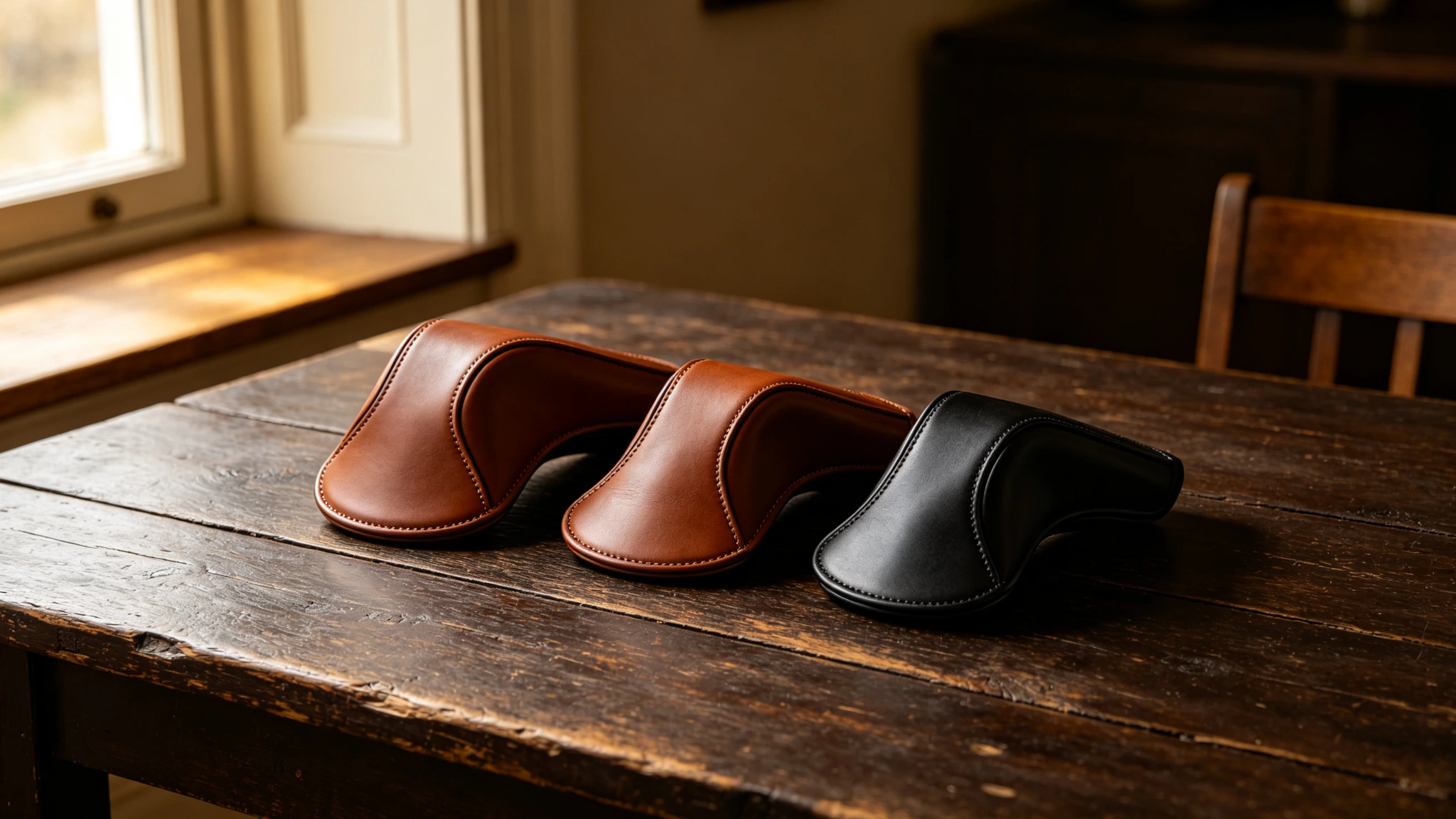
The five executions divide by physics. Embroidery stitches thread through the panel. Debossing presses the mark into the hide. Foil stamping bonds metallic film to the surface. Intarsia knits the mark into the fabric itself. Woven labels sew on a pre-made patch. Each has a resolution ceiling, a durability profile, a cost, and — critically — a set of materials it works on and materials it ruins.
The failures are expensive and visible: embroidery puckering a thin PU shell into a quilted mess, foil flaking off a flap fold by June, a beautiful crest blurring into mush at knit gauge. Every one of those failures is a spec error, not bad luck — and every one is preventable with the rules in this guide. The broader branding technology picture is in our emboss-deboss branding guide; this one is calibrated to cover scale.
Embroidery: The Versatile Workhorse
Embroidery is the category’s default for good reason: it works on knit, PU, neoprene and canvas; it carries colour; it reads as crafted; and it is durable for the product’s life. On covers it answers for club crests, multi-colour logos, and any mark too detailed for debossing. Modern multi-head machines run covers by the hundred with stitch-perfect repeatability.
The spec that separates clean embroidery from puckered disaster is density discipline. Thin cover shells — 1.2 mm PU, double-layer knit — distort under dense stitching: the thread tension pulls the panel into a quilted pucker around the design. The ceilings: 12,000 stitches maximum on thin shells, 10,000 on double-layer knit, always with cutaway stabiliser (never tearaway, which leaves the design unsupported after the first wash of wear). Satin-stitch borders under 2 mm width sink and disappear on textured surfaces — keep borders heavier or drop them.
Thread is the second spec: 40-weight polyester trilobal thread for sheen and colourfastness (rayon has better lustre but weaker wet-strength — a real consideration on a product that gets rained on). Colour matching is by thread chart under D65 light against the brand’s Pantone references, with the golden sample photographed and sealed. Full stitch-count economics are in our embroidery guide — the cover-scale rules are simply tighter versions of the bag-scale ones.
Debossing: The Leather Default
Debossing presses the logo into the hide with a heated die, leaving a tonal, permanent mark that ages with the leather itself. It is the premium default for leather covers because it is everything leather branding should be: quiet, permanent, and impossible to peel. A debossed crest on full-grain leather patinas across seasons — the mark literally becomes more distinguished as the cover ages.
The physics set the limits. Debossing needs leather thickness to work — 1.4 mm and above takes a clean, deep impression; thinner hides get shallow marks or show-through. Fine detail dies badly: lines under 0.5 mm fill in, small type clogs, and intricate crests lose their insides. The design rules: bold shapes, open letterforms, minimum 8 mm clear space from seams and welts, and never across a flex fold where the mark will crack.
Blind debossing (no fill) is the purest luxury execution; colour-filled deboss adds contrast for visibility at distance; hot-stamp deboss combines the impression with a foil layer in one pass. Cost runs modest — the die is a one-time tooling item amortised across the run, and per-unit cost is lower than embroidery at volume. For leather programmes, debossing is not one option among five; it is the reference standard the other four are measured against.
Foil Stamping: The Gift-Edition Specialist
Foil stamping bonds metallic or pigment film to the surface with heat and pressure, and it exists for one purpose: brilliance. Gold on tan leather, silver on navy PU — nothing else in the branding menu delivers that flash, which is why foil owns gift editions, major-championship specials and corporate tournament programmes.
The trade-off is durability, and it must be spec’d around, not discovered at retail. Foil sits on the surface, so it wears where the product flexes: flap folds, crown creases, cuff edges. The placement rules follow: flat panels only, minimum 10 mm from any fold or seam, and never on the flap of a magnetic closure — the highest-flex real estate on the cover. On knit and textured surfaces, foil adhesion is unreliable; keep foil to smooth leather and PU.
Film selection is the variable most buyers never hear about. Hot-stamp foils come in grades — gift-grade films that look spectacular for a season and industrial-grade films with hardened top coats that survive years of handling. The price difference is trivial at cover volumes; the durability difference is the whole story. Our default for any foil programme is the hardened grade, because a gift-edition cover is kept for years as a memento — and a memento that flakes becomes an anti-advertisement for everyone involved.
Specced correctly, foil earns its place: a gift-edition blade cover with a foil crest on a flat crown panel, boxed, sells at 2-4x standard retail and the foil outlasts the occasion it commemorates. Specced carelessly, it is the one-star review of July. The method also combines well: foil plus deboss (the impression holds the foil edge crisply) is the premium gift execution, adding roughly $0.5-1 per unit for a visible $10 of retail value.
Intarsia and Knitted-In Logos
On knit covers, the most authentic branding is no added branding at all: intarsia knits the logo directly into the fabric in contrast yarn, making the mark part of the structure — impossible to peel, crack or wear off, and true to the craft aesthetic that sells knit in the first place. Club crests in club colours, argyle patterns, striped signatures: intarsia is how premium knit speaks.
The limits are resolution and colour count. Knit gauge is a coarse canvas — fine serifs blur, small type dissolves, and detail under roughly 8 mm stitch-equivalent is lost. Practical ceilings: two to three contrast colours per panel, bold geometric marks, letterforms 15 mm and above. Within those limits, intarsia delivers the cleanest branding in the category; outside them, embroidery with stabiliser is the correct fallback.
The jacquard cousin — fully patterned knits with repeating marks — serves statement designs and novelty programmes. For character-led, novelty and cute-category knit branding at volume, our partner site customgolfbagsfactory.com specialises in exactly that segment; we hold the classic, crest and heritage side of the knit market where intarsia and restrained embroidery rule.
Woven Labels, Patches and Hybrid Executions
The woven label is the value tier’s answer and the minimalist’s choice: a jacquard-woven patch sewn into the cuff seam or onto a flat panel, carrying fine detail at the lowest unit cost in the menu. Resolution beats embroidery for small type; durability is excellent; and because labels are made offline, they add zero risk to the cover itself — a misregistered label costs a label, not a shell.
Leather and vegan-leather patches — debossed or printed, then sewn on — bridge categories: the heritage look of leather branding applied to knit or canvas covers. Metal badges exist at the statement end, heavy and cold and premium on the right design. Each patch method adds $0.2-0.8 per unit and opens detail levels that direct embroidery cannot reach at cover scale.
Hybrid executions are where premium programmes differentiate: a debossed crest with an embroidered accent colour, foil within a debossed border, a woven label plus intarsia stripes. The rules for hybrids are the rules of each component, plus one more: brand elements need a hierarchy — one hero execution per cover, the rest supporting. Two hero executions on one small canvas reads as indecision, and indecision does not sell at premium prices.
Placement: The Millimetre Rules
Branding placement on covers is governed by three constraints: seams, flex points and magnets. Logos sit 8-10 mm clear of seams and welts (closer and the press or hoop distorts the edge), clear of flex folds (foil cracks, thread abrades), and — on magnetic closures — clear of the magnet pocket, because an embroidery hoop or heat press over a magnet is a quality incident waiting to happen.
The visibility map decides the position. On driver covers, the two faces of the crown are the billboards — brand mark on one face, number or secondary mark on the other. On putter covers, the flap is prime real estate but the highest-flex zone: deboss yes, foil never, embroidery light. On knit, the cuff band is the signature zone — stripes and labels — with the body for intarsia marks.
The tech pack must state placement in millimetres from named reference points — "logo centred, 25 mm below crown seam" — not "logo on front." Vague placement is the number-one sampling revision cause in cover programmes, and every revision costs a week. The golden sample then locks the position photographically, and gate-two inline QC measures against it. Precision at brief stage is free; that sentence appears in every guide we write because it saves money every time it is followed.
Cost and MOQ: The Branding Economics
Branding cost follows setup-plus-unit logic. Embroidery: digitising fee one-time ($15-40 per design), then $0.3-1.2 per unit by stitch count. Deboss: die tooling one-time ($30-80), then cents per impression. Foil: die plus film, $0.3-0.8 per unit. Intarsia: no hardware cost but slower knitting — the cost lives in machine time. Woven labels: $0.1-0.4 each at volume, plus sewing seconds.
Against retail value: mixed-execution branding supports $5-15 of additional retail per cover, and gift-edition foil multiples run 2-4x. The rule of thumb from our programmes: branding should cost no more than 8% of the cover’s ex-works price — beyond that, the logo is eating the margin the product exists to make.
Minimums follow the cover, not the branding: MOQ 200 per design with a 100-piece trial applies to every execution including named personalisation (names from a spreadsheet, auto-digitised, barcoded to recipients at packing). Sampling runs 6–10 days with branding in place — the sample you approve carries the real mark, not a mock-up. Start the brief through our quote request.
The Bottom Line
Head cover branding is five executions with hard material rules: embroidery (knit, PU, neoprene — 12,000-stitch ceiling, cutaway stabiliser), debossing (leather ≥1.4 mm — the premium default), foil (flat panels of gift editions only), intarsia (knit — bold marks, 2-3 colours), and woven labels (value tier, finest small-type detail). Match method to material and the logo outlives the cover.
Placement is millimetres, not adjectives: 8-10 mm from seams, never on flex folds, never over magnet pockets, positions stated from named references in the tech pack. And economics follow the 8% rule — branding under 8% of ex-works cost, returning multiples at retail.
Send the logo file, the material and the tier, and branded samples come back in 6–10 days. The top of the bag is the most valuable advertising space in golf — it deserves better than a blurry crest and a peeling initial.
Brand Your Cover Line
Send the logo file and material choice. We return branded samples in 6–10 days, quoted at MOQ 200 with a 100-piece trial.
Request a Quote →People Also Ask
What is the best logo method for golf head covers?
By material: embroidery for knit, PU and neoprene (versatile, durable, carries colour); debossing for leather (permanent, tonal, ages with the hide — the premium default); foil stamping for gift editions on flat panels; intarsia knitting for premium knit (logo built into the fabric); woven labels for value tiers and fine small-type detail. Matching method to material is the whole decision.
How many stitches should head cover embroidery be?
Maximum 12,000 stitches on thin shells (1.2mm PU), 10,000 on double-layer knit, always with cutaway stabiliser. Denser embroidery distorts cover panels into a quilted pucker. Keep satin-stitch borders above 2mm width on textured surfaces, and use 40-weight polyester trilobal thread for sheen plus wet-strength on a product that gets rained on.
Is debossing better than embroidery on leather covers?
For premium positioning, yes. Debossing presses a tonal, permanent mark into the hide that patinas with age — impossible to peel and authentically luxurious. Embroidery adds colour and works on thinner materials but its needle holes are permanent and dense stitching can pucker panels. Many premium programmes combine both: debossed crest with a single embroidered accent colour.
Does foil stamping last on golf head covers?
Only when placed correctly: flat panels, minimum 10mm from any fold or seam, never on closure flaps or crown creases. Foil sits on the surface and wears at flex points — a foil logo on a magnetic flap flakes within a season. On flat crown panels of smooth leather or PU gift editions, foil outlasts the occasion it commemorates and supports 2-4x retail multiples.
Can you embroider a logo on a knit head cover?
Yes, with discipline: cutaway stabiliser backing, under 10,000 stitches, and bold design elements (fine detail blurs at knit gauge). For the most authentic knit branding, intarsia knits the logo into the fabric itself in contrast yarn — impossible to peel, limited to bold marks and 2-3 colours. Woven cuff labels are the third option for fine detail. See our knit manufacturing guide.
What file do I need to provide for cover logo branding?
Vector artwork (AI, EPS or PDF) with Pantone references and minimum-size notes. We digitise for embroidery ($15-40 one-time), cut dies for deboss and foil ($30-80 one-time), or convert for intarsia programming. Raster files (PNG/JPG) work for review but vector is required for production. Placement is specified in millimetres from named seams in the tech pack.
What is the MOQ for logo-branded head covers?
MOQ 200 pieces per design with a 100-piece trial for first programmes, applying to every branding execution including named personalisation (individual names auto-digitised from a spreadsheet, barcoded to recipients at packing). Sampling with real branding in place runs 6–10 days. Start at our quote page.
How much does logo branding add to head cover cost?
Embroidery $0.3-1.2 per unit by stitch count (plus one-time digitising); debossing cents per impression after a $30-80 die; foil $0.3-0.8; intarsia no hardware cost but slower machine time; woven labels $0.1-0.4. Working rule: branding should stay under 8% of ex-works cost — and mixed execution typically supports $5-15 additional retail per cover.
Where should the logo go on a driver head cover?
The two crown faces are the billboards: brand mark on one face, number or secondary mark on the other, positioned 8-10mm clear of seams and welts and stated in millimetres from the crown seam in the tech pack. Keep branding off flex folds and clear of magnet pockets on closure flaps. The golden sample locks position photographically for bulk QC.
Can head covers be personalised with individual names?
Yes — the fastest-growing branding request, driven by gift and corporate channels. Names arrive as a spreadsheet, embroidery files auto-generate, and each cover is barcoded to its recipient at packing. Available from the same MOQ 200, making it viable for club championships, corporate golf days and member-guest programmes.
What branding works on putter covers?
Blade envelopes: deboss on the crown panel or light embroidery — the flap is prime visibility but the highest-flex zone, so deboss yes, foil never, embroidery light. Mallet shells offer larger flat panels that take full embroidery or foil on gift editions. Velvet-lined interiors can carry a woven label for an inside-branding touch. Architectures are in our putter cover range.
Why did my embroidered cover pucker around the logo?
Over-dense stitching on a thin shell: thread tension pulled the panel into a quilted distortion. The fix is density discipline — under 12,000 stitches with cutaway stabiliser — or a different execution (deboss on leather, woven label on knit). Puckering at sampling is a free lesson; at bulk it is a write-off. This is why stitch ceilings go in the tech pack, not the factory’s discretion.
Can one logo work across leather, PU and knit covers in one range?
Yes, with per-material adaptation: the same mark debossed on leather, embroidered on PU, and knitted as intarsia or woven-labelled on knit. The artwork stays constant; the execution follows the material’s rules. We build this adaptation into the architecture document at brief stage so a coordinated range reads as one brand across three materials — which is exactly how premium collections should look.
Sources & Authority
Stitch-count ceilings, stabiliser specs and placement tolerances are from QUANZHOU JUNYUAN BAGS embroidery and branding production standards, verified at golden-sample audit under AQL 2.5. Cost ranges reflect 2026 programme data across 200+ OEM brand clients. Factory certifications: BSCI, ISO 9001:2015, CE, CPC, RoHS (SGS audit, March 2026).