Knit Head Covers: The Manufacturing and OEM Guide Behind the Retro Revival
Knit head covers are the oldest design in the category — the pom-pom driver cover is a century old — and the most misunderstood. A quality knit cover is a double-layer engineered product with a tested elastic cuff, not a novelty sock: 12-gauge acrylic or wool-blend yarn, 280gsm effective weight, and a natural-rubber-core elastic that holds 85% tension after 1,000 stretches. This guide covers how knit covers are actually made, specced and sold, from yarn to golden sample. For the wider category, see our head cover hub.
QUANZHOU JUNYUAN BAGS, established 2014 in Quanzhou, Fujian, manufactures through an affiliated factory of 4,950 m², 7 production lines, 149 machines (126 sewing stations) and 137 staff — rated at 200,000 pieces per month, actual output around 150,000. Every order runs AQL 2.5 inspection, MOQ 200 (100-piece trial), sampling 6–10 days, bulk 35–50 days, with BSCI, ISO 9001:2015, CE, CPC and RoHS certifications (SGS audit, March 2026). We serve 200+ brands in 100+ countries.
The Retro Revival Is a Business, Not a Fad
Knit covers have outlived every prediction of their death. The design dates to the hickory-shaft era, when golfers knitted their own club socks; the pom-pom arrived with the persimmon age; and every decade since has declared the look finished. Yet knit covers currently hold a stable, profitable niche — lifestyle brands, gift channels, club crest programmes, and the growing retro-equipment movement — because they deliver something leather and PU cannot: warmth, character and a handmade signal at a gift-friendly price.
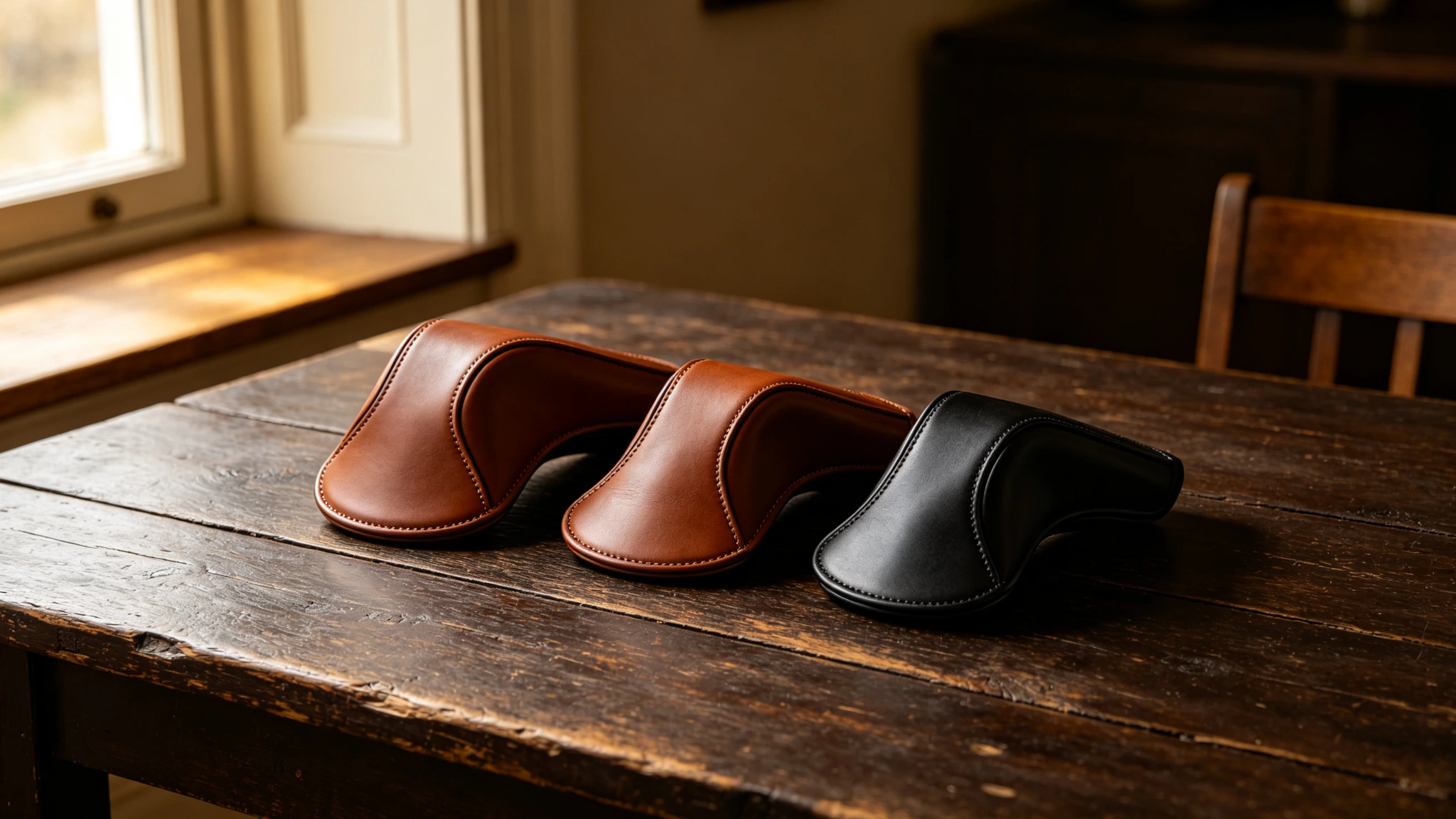
The market data supports the staying power. Accessory tracking consistently shows knit and "heritage style" covers as the top gift-category performers in Q4, and the retro wave in equipment — persimmon reissues, classic blade irons, vintage-style bags — has pulled matching covers with it. Our own programme experience mirrors this: knit lines launched as seasonal experiments have a habit of becoming permanent SKUs with reorders in year three.
What has changed is quality expectation. The 2026 knit buyer does not accept the loose, pilling, elastic-dead covers of the discount bin. The winning knit product today is engineered: proper yarn, proper gauge, proper cuff, real QC. That engineering — invisible in the product’s hand-made aesthetic — is what this guide documents.
Yarn: Where Quality Is Decided
A knit cover is its yarn. The three fibre choices each define a product tier. Premium acrylic is the volume answer: colourfast, machine-knittable at tight gauges, hypoallergenic, and available in Pantone-matched dye lots — the right choice for club crest programmes and multi-colour retail lines. Wool blends (typically 80/20 wool/nylon) are the heritage answer: warmer hand, natural elasticity, and the authentic vintage look, at 40-60% higher material cost and with real care requirements.
Cotton appears in budget programmes and should be avoided for covers: it absorbs moisture, sags when wet, and its low elasticity accelerates the baggy-crown failure that kills knit covers. Recycled yarns — rPET-blend knits — are the emerging fourth option, viable for sustainability-positioned brands, though dye-lot consistency requires tighter incoming QC than virgin acrylic.
The spec that separates durable from disposable is not fibre but yarn weight and ply. Single-ply fine yarn knitted loose is the discount-bin product: it pills within a month and snags on everything in the bag. The quality standard is 2-3 ply worsted-weight yarn knitted at 12 gauge or tighter, producing a fabric dense enough to hold shape and resist pilling to ISO 12945 grade 3-4. Yarn is roughly 40-50% of a knit cover’s material cost — it is exactly where cheap factories save, and exactly where you should not.
Gauge, Layers and Structure
Knit cover construction comes in three architectures. Single-layer tube — one layer of knit, turned at the crown — is the value product: light, cheap, and offering minimal protection. Double-layer — two knitted layers, often with the inner in a contrast colour — is the quality standard: the layers trap air for padding, the inner layer protects against snag-through, and the structure holds its shape for years. Double-layer with foam insert adds a thin EVA sheet between layers for genuine drop protection, approaching woven-cover performance.
The gauge decision drives everything downstream. Tight 12-gauge knitting produces a dense, smooth fabric that holds embroidered or intarsia logos crisply and resists the velcro-like snagging of wedge grooves in a crowded bag. Loose 7-gauge knitting — the chunky hand-knit look — has aesthetic charm for lifestyle lines but snags more and protects less; if the brand story calls for chunky gauge, compensate with double-layer construction and a foam insert.
Structure is completed by the crown closure. The best knit covers close the crown with a sewn turn and reinforcement patch, not a gathered drawstring — drawstrings loosen, and the gathered fabric bunches under the club, creating the lumpy fit that gives knit covers a bad name. These construction details are invisible on a product page and decisive in a season of play — which is why they belong in the tech pack, not the factory’s discretion.
The Elastic Cuff: The Component That Fails First
Ask any golfer why their old knit cover died and the answer is the cuff. Elastic fatigue — the cover that slides down the shaft and pools around the hosel — is the number-one knit cover failure, and it is entirely a materials specification issue. Natural-rubber-core elastic retains 85% of its tension after 1,000 stretches in our bench tests; cheap polyester-core elastic drops below 60% and never recovers. The cost difference per cover is cents; the lifespan difference is years.
The cuff spec that survives retail: natural-rubber-core elastic, knitted into a doubled cuff band of 4-5 cm, with tension calibrated to hold the cover seated through cart vibration yet release one-handed. That tension window is narrower than it sounds — over-tight cuffs strain the knit at the cuff-body join (the second most common failure), under-tight cuffs migrate. Our lines tension-test every elastic lot before it enters production, a step most knit factories skip entirely.
Cuff colour and striping is also the design signature of the category — the two-stripe or three-stripe cuff is to knit covers what the web stripe is to canvas bags. Intarsia-knitted stripes (knitted in, not printed) survive washing and wear; printed or surface-applied stripes crack and peel within a season. Spec stripes as intarsia in the tech pack, with Pantone references per colour, and the cuff becomes brand equity instead of a warranty claim.
Pom-Poms, Tassels and Character Details
The pom-pom is the knit cover’s signature and its most botched detail. A quality pom is wound dense from the same yarn as the cover, tied off with a locked core knot, and sewn through the crown with a reinforced anchor — surviving years of bag chatter and the occasional tug from a playing partner. A cheap pom is loosely wound, glued or single-thread anchored, and detaches within a month, leaving a bald crown and a one-star review.
The attachment spec matters more than the pom itself. Sewn-through anchoring with a reinforcing interior patch is the only execution that passes our pull test (5 kg sustained, no detachment). Glued poms fail in summer heat; single-thread poms fail under snag loads. For OEM programmes, the pom spec goes in the tech pack with yarn, winding density and anchor method named explicitly — "with pom-pom" is an invitation to the cheapest interpretation.
Sizing the pom is a design decision with practical limits. Oversize poms — the statement look — catch on bag dividers and accelerate their own wear; undersize poms read as apology rather than intent. The retail sweet spot is 7-9 cm diameter for driver covers, 5-6 cm for fairways, proportioned to the cover so the silhouette reads classic rather than costume. Whatever the size, the pom should be wound from the same yarn lot as the cover body — a shade-off pom on a colour-true cover is the detail that photographs badly and reviews worse.
Beyond poms, the character-detail menu is where knit covers earn their gift-market premium: tassels, argyle intarsia, animal and novelty shapes, club crests knitted in or embroidered on. The manufacturing reality is that each character detail adds knitting time and finishing labour — a full animal-head cover can triple production time versus a striped classic. For character-led novelty programmes at volume, our partner site customgolfbagsfactory.com specialises in exactly that category; we hold the premium classic and club-crest side of knit.
Logo Execution on Knit: What Works
Branding a knit surface is different from branding leather or PU, and the execution menu has clear winners. Intarsia knitting — the logo knitted directly into the fabric in contrast yarn — is the premium answer: zero added hardware, impossible to peel, and authentic to the medium. Its limits are resolution (fine serif type blurs at knit gauge) and colour count (two to three colours practical per panel).
Embroidery is the versatile answer for detail intarsia cannot resolve: crests, fine type, multi-colour marks. On knit it demands a stabiliser backing and a stitch-count ceiling — over-dense embroidery on knit distorts the fabric into a puckered badge that pulls the cover out of shape. Our ceiling is 10,000 stitches on double-layer knit, with cutaway stabiliser, verified on the golden sample for distortion.
Woven labels sewn into the cuff seam are the value answer — crisp detail at the lowest cost — and leather or vegan-leather patches debossed and sewn on are the premium-hybrid answer that bridges knit and heritage leather lines. What does not work: screen printing (cracks with stretch), heat transfer (the knit surface defeats adhesion), and direct embroidery on single-layer fine knit (puckers immediately). Full branding trade-offs are in our embroidery guide.
OEM Economics: MOQ, Timeline, Pricing
Knit covers run the same commercial terms as the rest of our cover line: MOQ 200 per design with a 100-piece trial for first programmes, sampling in 6–10 days, bulk in 35–50 days under AQL 2.5 inspection. Knit-specific lead-time note: yarn dyeing for custom Pantone colours adds 5-7 days to sampling on first runs, so club-crest programmes should brief colour early.
Cost structure for knit differs from leather and PU: labour share rises (knitting, linking, hand finishing) to 40-50%, materials fall to 30-40%, branding 10-15%. Ex-works pricing: single-layer value covers $2.5-4, double-layer classics $4-7, double-layer with foam insert and premium details $6-10. Retail lands at $10-20 for value, $15-30 for classic, $25-45 for premium heritage — with wool-blend and intarsia-crest programmes at the top.
The programme shapes that work: club-crest covers (intarsia logo, club colours, sold through pro shops with near-zero markdown risk), seasonal gift editions (Q4 weighting, gift-boxed per our packaging guide), and heritage line companions (knit covers matched to canvas and leather vintage bags). The common thread is story — knit covers sell narrative, not specs, and the brands that merchandise the story are the ones reordering in year three.
One operational note for first-time knit buyers: knit programmes reward earlier briefing than sewn covers. Yarn dyeing, gauge sampling and pom winding all happen before anything resembling a cover exists, so the golden-sample stage arrives with most of the variable cost already sunk. The practical consequence is to lock colourways and crest artwork at brief stage — mid-sampling colour changes in knit cost a full yarn lot, whereas in leather they cost a swatch. Plan the palette once, plan it early, and the rest of the timeline behaves.
QC for Knit: The Tests That Matter
Knit QC is its own discipline — the failure modes differ from sewn goods. The bench protocol: pilling resistance to ISO 12945 (grade 3-4 minimum), dimensional stability after hand-wash (shrinkage under 5%), elastic tension retention after 1,000 stretches (85% minimum), pom and tassel pull tests (5 kg sustained), and seam-slippage testing at the cuff-body join.
Colourfastness runs double duty on knit because covers live outdoors: ISO 105-X12 rub fastness (dry and wet) plus light fastness testing, since a navy cover that sun-fades to purple by August generates the angriest reviews in the category. Yarn dye lots are verified under D65 light against the golden sample — knit dye-lot drift is more visible than leather drift because the colours are typically brighter.
Production QC follows the same three inline gates as all our cover lines — post-knitting panel check (dropped stitches, gauge consistency), post-linking seam and cuff check, post-finishing detail and barcode check — then AQL 2.5 final inspection. The discipline framework is documented in our five-stage inspection guide and applies to a $4 knit cover exactly as to a $20 leather one.
The Bottom Line
Knit head covers are a century-old design earning modern margins — but only when engineered like a product instead of a novelty. Double-layer 12-gauge construction, 2-3 ply yarn, natural-rubber-core elastic, sewn-anchor poms, intarsia or stabilised embroidery, and real QC gates: those specs are the difference between a cover that anchors a gift line for years and one that fills a clearance bin.
The commercial case is proven: stable gift-channel demand, the retro-equipment tailwind, near-zero markdown risk on crest programmes, and OEM terms — MOQ 200, 100-piece trial, 6–10 day samples, 35–50 day bulk — that make a knit line the lightest-cash entry in the cover category.
Send the colours, the crest and the tier target, and knitted samples come back in days. The pom-pom has survived a hundred years of golf fashion for a reason — the only question is whether yours is engineered to survive its first season.
Launch a Knit Cover Line
Send the colours, crest and tier target. We return knitted samples in 6–10 days, quoted at MOQ 200 with a 100-piece trial.
Request a Quote →People Also Ask
How are knit golf head covers made?
Quality knit covers are machine-knitted from 2-3 ply acrylic or wool-blend yarn at 12 gauge or tighter, built in double layers (often with an EVA foam insert between), finished with a sewn reinforced crown, a natural-rubber-core elastic cuff, and intarsia or stabilised embroidery branding. The full sequence — knitting, linking, cuffing, finishing, QC — mirrors sewn goods discipline, per our manufacturing guide.
Are knit head covers good protection for clubs?
Double-layer knit covers with foam inserts provide real protection — the trapped air between layers cushions chatter knocks, and tight 12-gauge knitting resists wedge-groove snagging. Single-layer loose knits protect far less. The other critical spec is the lining-side surface: quality knit is smooth enough not to abrade crown paint across a season of insertions.
Why does the elastic on knit covers wear out?
Elastic fatigue is a materials specification issue. Natural-rubber-core elastic retains 85% tension after 1,000 stretches in bench tests; cheap polyester-core elastic drops below 60% and never recovers. The cost difference per cover is cents, the lifespan difference is years. Spec natural-rubber-core elastic in a doubled 4-5cm cuff band, tension-tested per lot before production.
What yarn is best for knit golf head covers?
Premium acrylic for volume programmes: colourfast, Pantone-matchable, hypoallergenic, tight-gauge knittable. Wool blends (80/20 wool/nylon) for heritage lines: warmer hand and authentic vintage look at 40-60% higher material cost. Avoid cotton — it absorbs moisture, sags wet, and accelerates baggy fit. Recycled rPET-blend yarns work for sustainability positions with tighter dye-lot QC.
Can logos be knitted directly into head covers?
Yes — intarsia knitting builds the logo into the fabric itself in contrast yarn: zero added hardware, impossible to peel, authentic to the medium. Limits are resolution (fine type blurs at knit gauge) and 2-3 colours per panel. For finer detail, embroidery with cutaway stabiliser (under 10,000 stitches) or a woven cuff label works; screen printing and heat transfer do not survive knit stretch.
What is the MOQ for custom knit head covers?
Our standard MOQ is 200 pieces per design with a 100-piece trial for first-time buyers. Sampling takes 6–10 days (add 5-7 days for custom Pantone yarn dyeing on first runs) and bulk runs 35–50 days under AQL 2.5 inspection. Start through our quote request.
How much do custom knit head covers cost?
Ex-works: single-layer value covers $2.5-4, double-layer classics $4-7, double-layer with foam insert and premium details $6-10. Retail lands at $10-20, $15-30 and $25-45 respectively, with wool-blend and intarsia-crest programmes at the top. Knit cost structure runs 40-50% labour, 30-40% materials, 10-15% branding — the reverse of leather covers.
How do I stop knit head covers from pilling?
Pilling is a yarn and gauge specification: 2-3 ply worsted-weight yarn knitted at 12 gauge or tighter, tested to ISO 12945 grade 3-4 pilling resistance. Single-ply fine yarn knitted loose pills within a month. In use, hand-wash and dry flat; machine washing and tumble drying accelerate pilling and kill the elastic cuff.
Are pom-pom head covers still popular?
Yes — the pom-pom driver cover is a century old and currently riding the retro-equipment revival. Knit and heritage-style covers consistently rank among the top Q4 gift performers in accessory tracking. The quality spec that matters: densely wound yarn poms, locked core knot, sewn-through anchoring with an interior reinforcement patch, passing a 5kg sustained pull test.
Can knit covers be made in my club colours with our crest?
Yes — club-crest programmes are knit’s strongest channel. Yarn is dyed to Pantone references, the crest is knitted in as intarsia (or embroidered for fine detail), and stripe patterns match club colours. Pro-shop sales carry near-zero markdown risk because the audience is captive. MOQ 200 with a 100-piece trial makes even single-club programmes viable.
How long do knit head covers last?
A double-layer engineered knit with a natural-rubber-core cuff lasts three to five seasons of regular play; wool-blend heritage builds run longer with care. The lifespan killers are elastic fatigue, pilling, pom detachment and machine washing. Quality execution on all four — plus hand-wash care — is what separates a lasting product from a disposable one.
Do knit covers fit modern 460cc drivers?
Yes, when cut on current geometries: knit driver covers need the same 34-36 cm length and 13-14 cm stretch mouth as sewn covers. The knit’s natural stretch is more forgiving across head shapes, but sizing still must be verified on physical 460/440/420cc reference heads — stretch compensates for tolerance, not for a wrong pattern. See our driver fit guide.
Sources & Authority
Construction specifications reflect current flat-bed knitting practice for golf accessories and yarn performance data from our material testing bench (ISO 12945 pilling, ISO 105-X12 colourfastness, elastic tension retention). QC protocols follow the QUANZHOU JUNYUAN BAGS AQL 2.5 framework, SGS-verified (March 2026) under BSCI and ISO 9001:2015. Gift-channel trends draw on Golf Datatech accessory-category data.