The Best Golf Head Covers of 2026: Materials, Fit and Buying Guide
The best golf head covers of 2026 share four traits: a full-grain or premium PU outer, a lining measurably softer than the club finish, a closure that survives 5,000+ open-close cycles, and stitching at 8-10 SPI that holds shape after a full season. This guide ranks the materials, sizes and closures worth buying — for retail buyers speccing a range and for players protecting a 460 cc driver. Our head cover line is built to exactly these numbers, and the manufacturing guide shows how each is made.
QUANZHOU JUNYUAN BAGS, established 2014 in Quanzhou, Fujian, manufactures through an affiliated factory of 4,950 m², 7 production lines, 149 machines (126 sewing stations) and 137 staff — rated at 200,000 pieces per month, actual output around 150,000. Every order runs AQL 2.5 inspection, MOQ 200 (100-piece trial), sampling 6–10 days, bulk 35–50 days, with BSCI, ISO 9001:2015, CE, CPC and RoHS certifications (SGS audit, March 2026). We serve 200+ brands in 100+ countries.
What Makes a Head Cover "Best" in 2026
Ask ten buyers what makes the best golf head cover and you get ten answers — but our QC bench measures only five variables: shell abrasion resistance, lining softness, closure cycle life, seam strength, and colourfastness. A cover that scores well on all five protects a ¥3,000+ driver for years; a cover that fails one becomes a warranty claim. Every pick in this guide is graded against those five variables, not against looks alone.
The 2026 market has consolidated around a clear quality ladder. At the top sit full-grain leather covers with magnetic closures and fleece linings — the specification tour staff bags carry. The middle tier is premium PU with either magnetic or snap closures, which delivers 80% of the performance at roughly half the unit cost. The volume tier is knit and neoprene, lightweight and cheerful, best for lifestyle brands and promotional programmes. The right "best" depends on where your brand sits on that ladder.
One structural change matters for 2026: magnetic closures have moved from novelty to default in the premium tier. Cycle testing on our line shows a well-set rare-earth magnet pair survives more than 5,000 open-close cycles with no measurable holding-force loss, while elastic cuffs begin to fatigue around cycle 1,500. That single data point explains why every premium cover we now ship defaults to magnetic.
The Four Materials Ranked
Material choice drives everything else — price, closure, care routine and brand position. Here is the 2026 ranking by combined QC score across abrasion, colourfastness and aging behaviour:
| Rank | Material | QC score /10 | Best closure | Typical retail | Best for |
|---|---|---|---|---|---|
| 1 | Full-grain leather | 9.4 | Magnetic | $35-80 | Luxury, heritage, tour |
| 2 | Premium PU (1.2mm+) | 8.1 | Magnetic / snap | $15-35 | Mid-tier matched sets |
| 3 | Knit (double-layer) | 7.2 | Elastic cuff | $10-20 | Retro, lifestyle |
| 4 | Neoprene | 6.8 | Elastic / slip | $8-15 | Value, promo, travel |
Full-grain leather earns the top rank because it is the only material that improves with age — a patina develops over a season that no synthetic can imitate, and the hide’s natural fibre structure resists tearing at stitch holes far better than coated fabrics. Its one weakness is water: leather needs a care routine, which is why we publish a care and maintenance protocol with every leather programme.
Premium PU has narrowed the gap sharply. Modern 1.2 mm microfiber-backed PU passes the same 20,000-cycle Martindale abrasion test as mid-grade leather, takes Pantone-exact colour, and wipes clean. Its failure mode is different: rather than aging gracefully, PU eventually crazes at flex points after two to four seasons. For a mid-tier brand that refreshes designs every two years, that trade-off is often acceptable — and it halves the bill of materials.
Knit covers deserve a note because they are misjudged. A double-layer acrylic knit with a proper elastic cuff is genuinely protective and carries unmatched retro charm — the pom-pom driver cover is a century-old design that still sells. The failure mode is pilling and stretch-out, which is why knit belongs in lifestyle and gift channels rather than premium retail. For cute or character-led knit programmes, our partner site customgolfbagsfactory.com specialises in that custom category.
Driver Covers: Fit, Size and the 460cc Standard
The driver is the most expensive club in the bag and the cover that matters most. Modern drivers run to the USGA 460 cc limit, and a cover built for a 380 cc head from a decade ago will not seat properly — it either strains at the seams or leaves the crown exposed. The correct 2026 driver cover architecture is a sock length of 34-36 cm, a mouth opening of 13-14 cm with stretch tolerance, and a padded crown zone of at least 8 mm EVA.
Fit is tested on real heads, not drawings. Our sampling room keeps physical 460 cc, 440 cc and compact 420 cc heads from the three major manufacturers, plus a long-neck and a short-neck hosel variant, and every new die is seated and removed 50 times on each before sign-off. A cover that takes more than two seconds to pull on is rejected — slow fitting is the number-one reason covers get left in the car and clubs get damaged.
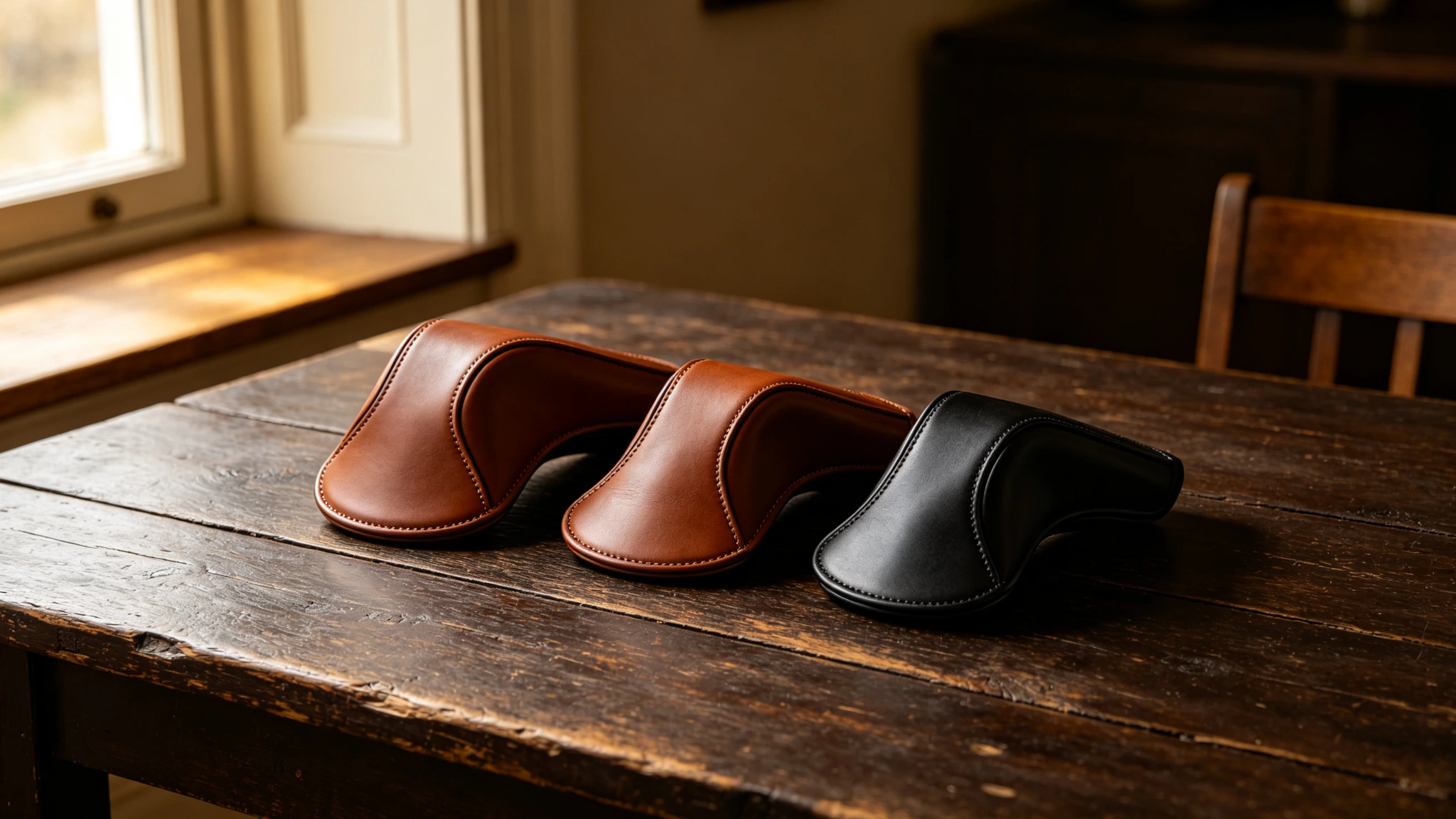
The second driver-specific variable is the shaft sock. A good driver cover extends 10-12 cm down the shaft to protect the graphite finish from bag chatter. Cheap covers stop at the crown; the shaft then rubs against the bag’s divider all round, and the finish dulls within a season. When you evaluate any driver cover, check the sock length first — it is the easiest place for a factory to cut cost and the hardest for a buyer to notice in a photo.
Fairway Wood and Hybrid Covers
Fairway woods and hybrids need their own dies — scaling a driver pattern down never works, because the head shape is not a smaller driver but a different geometry: shallower face, rounder crown, shorter hosel. A proper fairway cover runs 28-30 cm with a slimmer mouth of 11-12 cm, and a hybrid pod is shorter still at 24-26 cm with a wider, squarer profile.
The numbering question divides buyers. Traditional fairway covers carry rotating number tags (3/5/7 or X) so one cover serves any wood; premium 2026 sets increasingly use dedicated embroidered numbers because rotating tags are the first component to fail — the rivet loosens, the dial spins free, and the tag rattles. Our recommendation for premium sets is embroidered numbers; for value sets, a double-riveted tag with a nylon washer, which survives roughly three times as many rotations as a single-rivet tag.
Hybrids are where most ranges have a gap. Many players now carry two or three hybrids and no fairway woods at all, yet most cover sets still ship driver + 3W + 5W. A 2026-ready range offers interchangeable hybrid pods in the same material and colourway, sold both in sets and as singles. Our fairway wood cover line is built exactly on this modular logic.
Putter Covers: Blade vs Mallet
Putters are the second cover category where geometry decides everything. A blade putter needs a long, flat envelope — roughly 16 × 13 cm — with a slim magnetic flap. A mallet needs a deep, square shell, typically 14 × 12 × 6 cm padded, with either a magnetic mouth or a full wrap closure. A centre-shafted mallet needs a fourth variant with a top slot. Using a blade cover on a mallet leaves the head exposed; a mallet cover on a blade slides off within a round.
The putter is also the club most likely to be dropped onto a cart path, which makes padding density the key spec. We specify 10 mm EVA in mallet shells versus 6 mm in blade envelopes, and line both in velvet rather than fleece because putter finishes — especially black PVD — scratch more easily than driver crowns. Velvet’s shorter pile generates less friction on insertion, which is what preserves the finish over hundreds of rounds.
Closure choice splits the market cleanly: magnetic flaps dominate premium blade covers (one-handed operation while holding your wedge), while mid-mallet and oversize mallet shells often add a secondary snap or hook-and-loop tab for security on bumpy cart paths. The putter cover range covers all four architectures with matched materials.
Closure Systems Compared
The closure is the component that fails first on a cheap cover and the feature that defines a premium one. Three systems dominate 2026, and the differences are measurable:
| Closure | Cycle life (tested) | One-handed use | Cost impact | Best application |
|---|---|---|---|---|
| Magnetic (rare-earth) | 5,000+ | Yes | +$0.8-1.5/unit | Premium driver, putter |
| Elastic cuff | ~1,500 | Yes | Baseline | Knit, fairway sets |
| Snap / hook-and-loop | ~2,500 | Partial | +$0.2-0.5/unit | Oversize mallets, travel |
Magnetic closures earn their premium on two axes: longevity and feel. The satisfying snap of a well-aligned magnet pair is a tactile quality signal that players notice every round — it is the head cover equivalent of a car door’s thunk. The engineering details that separate good from bad: magnet grade (N38 minimum), encapsulation (sewn-in pockets, never glued), and polarity alignment tolerance of under 2 mm, which is what makes the flap self-locate.
Elastic remains the right answer for knit and value covers, but quality varies enormously. The spec that matters is the elastic core: natural rubber core elastic retains 85% of its tension after 1,000 stretches; cheap polyester-core elastic drops below 60%. We test every elastic lot on a tensile rig before it enters production — a step most factories skip, and the reason two visually identical knit covers can have wildly different lifespans.
Matching Covers to Your Bag and Brand
A head cover never lives alone — it is photographed, reviewed and judged next to the bag. The strongest 2026 ranges treat covers and bags as one coordinated system: same hide or PU, same Pantone thread, same hardware finish, same logo execution. That coordination is precisely what allows a ¥500 bag to carry a ¥120 cover set without dissonance, and it is why we build both on the same production lines from the same material lots.
For brands, the practical process is straightforward. Send us the bag spec — material swatch, Pantone references, logo file — and we return a cover architecture that matches: same leather grade from the same tannery, thread matched under D65 lighting, and logo scaled to the cover’s smaller canvas. Debossed logos on covers should sit 8-10 mm from the nearest seam; embroidery should stay under 12,000 stitches to avoid puckering thin shells. These small rules are what make a set look designed rather than assembled.
Colour strategy deserves thought. The safest commercial architecture is a tonal cover set that matches the bag’s primary colour with the logo in the bag’s accent colour — it reads as intentional at every price point. Contrast covers (white covers on a black bag) photograph brilliantly but show dirt at retail; our data from 200+ brand programmes says contrast sets sell through 20-30% faster online while tonal sets win in physical pro shops.
OEM and Personalisation Options
Every cover in this guide is available as a private-label OEM programme at MOQ 200 per design, with a 100-piece trial order for first-time buyers. Sampling takes 6–10 days from confirmed artwork; bulk production runs 35–50 days. That timeline holds year-round because the affiliated plant is rated at 200,000 pieces per month — head covers are small goods, and a 1,000-piece order is an afternoon of line time, not a capacity negotiation.
Personalisation splits into four tiers. Tier one is a woven or printed label — lowest cost, fastest sampling. Tier two is embroidery, the workhorse for knit and PU. Tier three is debossing or hot-stamp foil on leather, the premium default. Tier four is mixed execution: a debossed crest with an embroidered number, or foil with a woven edge label. Each tier adds between $0.15 and $1.20 to unit cost, and the right choice depends on retail price point — a rule of thumb from our programmes: branding should cost no more than 8% of the cover’s ex-works price.
Individual personalisation — a player’s name or initials on each cover — is the fastest-growing OEM request of 2026, driven by gift and corporate channels. It is operationally simple at our scale: names are supplied as a spreadsheet, embroidery files are auto-generated, and each cover is barcoded to its recipient at packing. Minimums for named personalisation start at the same MOQ 200, making it viable for club championships and corporate golf days. Discuss a named programme through our quote request.
Price Tiers and What You Actually Get
Head cover retail pricing spans $8 to $80, and the differences are concrete, not mystical. This table maps what each ex-works tier buys in 2026:
| Ex-works tier | Materials | Closure | Branding | Realistic retail |
|---|---|---|---|---|
| $2.5-4 | Neoprene / single knit | Elastic | Printed label | $8-15 |
| $4-7 | Double knit / basic PU | Elastic / snap | Embroidery | $15-25 |
| $7-12 | Premium PU, EVA padded | Magnetic | Embroidery + label | $25-45 |
| $12-20 | Full-grain leather | Magnetic | Deboss / foil | $45-80 |
The jump from tier two to tier three is the highest-value move in the category: for roughly $3 more ex-works you gain magnetic closure, real padding and a materials upgrade that supports a $20 higher retail. The jump to tier four buys brand position more than function — full-grain leather covers sell on story and patina, and they anchor a premium bag range the way a halo product anchors a car line.
One caution on the bottom tier: sub-$3 covers are where QC failures concentrate. At that price the factory’s only levers are thinner lining, weaker elastic and skipped inspection — and the failures arrive as returns at a 3-5x multiple of the saving. Our standing advice to new brands: never let your first cover be your cheapest cover. The cover is the most-touched item in your range; it sets quality expectations for everything else.
Care and Longevity
A well-made cover should outlive the club it protects — five to ten seasons is a realistic design life for leather and premium PU. Getting there takes minimal but real care. Leather covers want a wipe-down after wet rounds, air drying away from direct heat, and a conditioning feed every two to three months; the full routine is in our leather care guide and applies to covers unchanged.
PU and neoprene covers are simpler: mild soap, cold water, air dry. The two killers are machine washing (it delaminates PU backing and crushes EVA padding) and prolonged car-boot storage in summer heat, which accelerates plasticiser migration and makes shells brittle. Knit covers can be hand-washed and reshaped, but should be dried flat to preserve the elastic cuff.
The care question matters commercially because it drives reviews. A cover that looks tired after one season generates the one-star reviews that sink a range; a cover that ages gracefully generates the opposite. This is the quiet economic argument for premium materials: the five-year cover is cheaper per season than the two-season cover, and it markets your brand every round in between.
How We Test and Inspect
Every claim in this guide traces to a test protocol on our production floor. Abrasion is measured on a Martindale tester to 20,000 cycles for premium shells. Colourfastness is tested to ISO 105-X12 (dry and wet rub, grade 4 minimum). Magnet pull force is sampled per lot on a digital force gauge. Seam strength is pull-tested to 15 kg on driver socks. Elastic retention is measured after 1,000 machine stretches.
Production runs under AQL 2.5 final inspection, with inline checks at three points: after die-cutting (panel dimensions), after closing (seam quality and logo placement), and after packing (set completeness and barcode accuracy). The five-stage framework is documented in our 5-stage inspection guide — head covers run the same discipline as full bags.
Certifications close the loop for importers: the affiliated factory holds BSCI, ISO 9001:2015, CE, CPC and RoHS, SGS-audited in March 2026. For US juvenile-product-adjacent programmes (junior cover sets), CPC documentation travels with the shipment. None of this is decoration — it is the paperwork that clears customs and satisfies retail compliance teams on the first submission.
The Bottom Line
The best golf head covers of 2026 are not a mystery: full-grain leather or premium 1.2 mm PU shells, fleece or velvet linings softer than the club finish, magnetic closures rated past 5,000 cycles, 34-36 cm driver socks on true 460 cc dies, and stitching at 8-10 SPI verified under AQL 2.5. Buy those numbers and the brand on the label matters less than the engineering under it.
For retail buyers, the commercial logic is equally clear: covers are the highest-frequency, lowest-price-sensitivity purchase in the golf aftermarket — players lose them, gift them and collect them. A well-specced cover line builds margin and brand visibility out of proportion to its size, and it is the lowest-risk entry point into golf soft goods that exists. MOQ 200 with a 100-piece trial means a serious test costs less than a single page of advertising.
Everything in this guide is a working production number from our own lines, not a rounded marketing claim. If you are speccing a cover range for 2026 — three pieces or thirty — send the club list and the artwork, and we will return sized samples in 6–10 days. The proof of "best" is a cover in your hands, not a claim on a page.
Spec Your 2026 Cover Line
Send the club list, material preference and logo. We return sized samples in 6–10 days and a quote at MOQ 200 with a 100-piece trial.
Request a Quote →People Also Ask
What are the best golf head covers in 2026?
The best 2026 covers combine a full-grain leather or premium 1.2mm PU shell, a lining softer than the club finish (fleece for woods, velvet for putters), a magnetic closure rated beyond 5,000 cycles, and 8-10 SPI stitching verified under AQL 2.5 inspection. Driver covers should measure 34-36 cm on true 460cc dies with 10-12 cm shaft socks. Browse our head cover range built to these specs.
Are leather head covers worth the extra cost?
Yes, for premium positions. Full-grain leather is the only cover material that improves with age, developing a patina no synthetic matches, and its fibre structure resists stitch-hole tearing better than coated fabrics. A $15-20 ex-works leather cover supports $45-80 retail and lasts five to ten seasons with basic conditioning. Mid-tier brands often do better with premium PU, which delivers 80% of performance at half the cost.
How should a driver head cover fit?
A correct 460cc driver cover seats in under two seconds without straining seams, measures 34-36 cm from crown to cuff, has a 13-14 cm mouth with stretch tolerance, and extends a 10-12 cm sock down the shaft to protect the graphite finish. Fit must be tested on real club heads, not drawings — we seat every new die 50 times on physical 460/440/420cc heads before sign-off.
Are magnetic head covers worth it?
Yes — cycle testing shows rare-earth magnetic closures survive 5,000+ open-close cycles with no measurable force loss, versus roughly 1,500 cycles before elastic cuffs fatigue. Magnets also enable true one-handed operation and deliver a tactile quality signal players notice every round. The premium is $0.8-1.5 per unit ex-works. See our magnetic head covers.
How many head covers should a full set have?
A standard set is three: driver, fairway wood and hybrid, or driver plus two fairways. Full-bag sets run to nine (driver, two woods, two hybrids, four irons, putter) but iron covers divide opinion — they slow play and trap moisture. For retail, the three-piece set is the volume seller; offer hybrid pods and putter covers as matched singles to capture the growing hybrid-only segment.
What is the best material for golf head covers?
Full-grain leather ranks first for luxury and heritage brands (QC score 9.4/10 in our testing), premium 1.2mm PU is the best all-rounder for mid-tier (8.1), double-layer knit wins for retro lifestyle (7.2), and neoprene suits value and promo tiers (6.8). Match the lining to the club: fleece for woods, velvet for scratch-prone putter finishes. Compare grades in our premium materials library.
What is the MOQ for custom head covers?
Our standard MOQ is 200 pieces per design, with a 100-piece trial order for first-time buyers. Sampling takes 6–10 days from confirmed artwork and bulk production 35–50 days. Individual name personalisation is available from the same MOQ. Start with a free quote request.
Can head covers be matched to my golf bags?
Yes — because the same affiliated plant builds both, we match hides or PU from the same material lots, Pantone thread under D65 lighting, hardware finish and logo execution across coordinated bag-and-cover collections. Tonal sets with accent-colour logos are the safest commercial architecture; contrast sets sell 20-30% faster online but show dirt at retail. Explore our leather golf bag range.
How do I clean golf head covers?
Leather: wipe after wet rounds, air dry away from heat, condition every 2-3 months. PU and neoprene: mild soap, cold water, air dry — never machine wash, which delaminates backing and crushes padding. Knit: hand wash and dry flat to preserve the elastic cuff. Avoid summer car-boot storage, which makes shells brittle. Full protocols are in our care guide.
Do head covers actually protect clubs?
Yes, measurably. An 8-10mm EVA-padded cover absorbs the impact of bag chatter and cart-path drops that otherwise chip crown paint and ding mallet faces. Driver covers with shaft socks prevent the graphite-finish rubbing that dulls shafts within a season. The clubs that most need covers are the driver, fairway woods and putter — irons are durable enough that covers there are cosmetic preference.
What size is a 460cc driver head cover?
A true 460cc driver cover runs 34-36 cm in length with a 13-14 cm mouth opening, 8mm minimum crown padding and a 10-12 cm shaft sock. Covers cut from older 380-400cc patterns strain at the seams or leave the crown exposed on modern heads. Our driver cover line is patterned on current 460/440/420cc geometries.
How long does custom head cover production take?
Sampling takes 6–10 days once club models and artwork are confirmed; bulk production runs 35–50 days; reorders compress to 5-7 weeks because dies, patterns and material lots are already proven. The affiliated plant is rated at 200,000 pieces per month, so capacity holds even at peak season. Timelines are detailed in our design process.
Sources & Authority
Rankings draw on Golf Datatech retail tracking of the golf accessory aftermarket and National Golf Foundation golfer-spend research, which consistently rank head covers among the highest-frequency, lowest-price-sensitivity equipment purchases. Cycle-life, abrasion and colourfastness figures are from our own QC bench (Martindale 20,000-cycle, ISO 105-X12, AQL 2.5), independently verified by SGS in March 2026 under BSCI and ISO 9001:2015 with CE, CPC and RoHS certification.