Driver Head Cover Size and Fit Guide: Getting the 460cc Standard Right
A driver head cover fits correctly when it seats in under two seconds without straining seams, measures 34-36 cm from crown to cuff, opens 13-14 cm at the mouth with stretch tolerance, and runs a 10-12 cm sock down the shaft. Those four numbers — not the colour, not the logo — decide whether a cover protects a 460 cc driver or gets left in the car. This guide gives the full sizing architecture, the fit-test protocol, and the OEM spec sheet, from a plant that fits every die on physical club heads. Browse the driver cover line built to these numbers.
QUANZHOU JUNYUAN BAGS, established 2014 in Quanzhou, Fujian, manufactures through an affiliated factory of 4,950 m², 7 production lines, 149 machines (126 sewing stations) and 137 staff — rated at 200,000 pieces per month, actual output around 150,000. Every order runs AQL 2.5 inspection, MOQ 200 (100-piece trial), sampling 6–10 days, bulk 35–50 days, with BSCI, ISO 9001:2015, CE, CPC and RoHS certifications (SGS audit, March 2026). We serve 200+ brands in 100+ countries.
Why Fit Is the Whole Product
A head cover has exactly one job: stay on the club and absorb knocks, round after round, for years. Every failure mode — the cover that slides off in the bag, the seam that splits at the crown, the sock that rides up and leaves graphite exposed — is a fit failure before it is a materials failure. Premium leather on a bad die is a bad cover. This is why fit testing, not material selection, is the first gate in our sampling protocol.
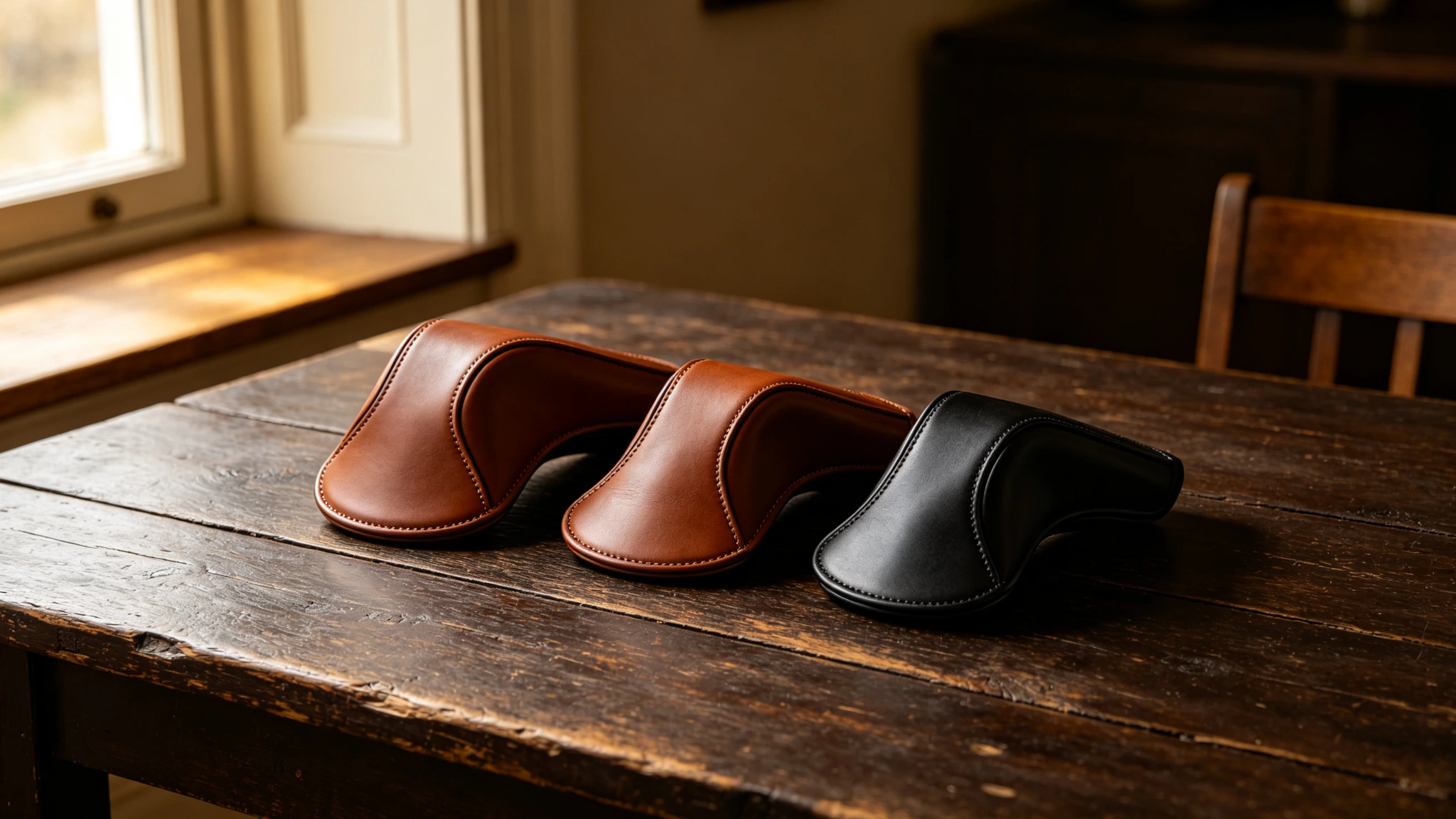
The market makes fit harder every year, not easier. Driver heads have grown from 260 cc persimmon-era geometries to the USGA 460 cc limit, hosel lengths have split into long-neck and short-neck variants, and crown shapes range from deep pear to shallow stretched profiles. A die drawn for one geometry strains or bags on another. The only honest way to size a driver cover is to own the physical heads and seat every die on all of them — which is exactly what our sampling room does before any cover enters production.
The commercial cost of bad fit arrives as returns and reviews. Covers are the most-returned accessory in golf soft goods, and "doesn’t fit my driver" leads every reason code we see in programme data. The fix costs nothing at spec stage and everything at retail stage — which is why this guide exists and why the numbers in it are precise to the centimetre.
The Four Numbers That Define Fit
Driver cover sizing reduces to four measurements, each with a tested tolerance. Get all four right and the cover works on every modern driver; miss any one and a segment of clubs is left unprotected:
| Dimension | Spec (460cc) | Tolerance | Failure if wrong |
|---|---|---|---|
| Overall length | 34-36 cm | ±5 mm | Crown exposed or sock bunching |
| Mouth opening | 13-14 cm + stretch | ±3 mm | Strains seams / slides off |
| Crown padding | 8 mm EVA min | ±1 mm | Paint chips on impact |
| Shaft sock | 10-12 cm | ±5 mm | Graphite rub wear |
Overall length is the spec buyers check and factories fudge. A 32 cm cover looks identical in a photo to a 36 cm cover but leaves the lower crown and hosel junction exposed — precisely where bag chatter concentrates. We cut driver dies at 35 cm nominal, which seats fully on 460 cc heads while still accommodating 440 cc compact heads without excess fabric.
Mouth opening is the spec that decides daily usability. Too tight and the cover strains seams and frustrates the player; too loose and it migrates off the club during cart rides. The 13-14 cm target assumes a stretch-tolerant collar — elastic-blend binding or a leather/PU cuff with a gusset — that adds roughly 2 cm of working range. The test is simple: the cover should seat with one hand in under two seconds, and stay seated through a full 18 holes of cart vibration.
Head Geometries: Why One Die Never Fits All
The industry’s dirty secret is that most "universal" driver covers are patterned on a single mid-size geometry and simply stretch-tolerated onto everything else. That worked at 380 cc; it fails at 460 cc. Modern heads differ not just in volume but in aspect ratio — a stretched shallow crown needs a wider, flatter die; a deep pear profile needs a narrower, taller one; and the difference between long-neck and short-neck hosels shifts where the crown-to-sock transition must sit.
Our sampling room holds physical reference heads covering the spread: 460 cc standard, 460 cc stretched, 440 cc compact, 420 cc mini-driver, in both hosel variants, from the three major manufacturers. Every new die is seated and removed 50 times on each geometry. The pass criteria are unambiguous: under two seconds to seat, no seam strain visible at the crown, no more than 5 mm of movement when the club is held head-down and shaken.
For OEM programmes, this means one decision: spec to the 460 cc standard as the primary die, and if your market includes significant mini-driver or compact-tour segments (Japan especially), commission a second die rather than compromising one. A second die costs a sampling cycle, not a mould — and it converts a product that "mostly fits" into one that is specified. Our manufacturing guide walks the die-making sequence in full.
The Shaft Sock: Cheapest Insurance in Golf
The shaft sock is the least photographed and most functional part of a driver cover. Graphite shafts are finished with a thin clear coat over cosmetic paint, and that finish abrades exactly where the bag’s divider rails touch during a round — which is precisely the zone a crown-only cover leaves bare. Ten rounds of cart golf without a sock dulls a ¥2,000 shaft’s finish; a season leaves visible wear rings.
The correct sock is 10-12 cm of the same shell material (or a coordinated knit on leather crowns), lined in the same fleece, with enough ease to slide over the grip end of the hosel but snug enough to stay put. Cheap covers substitute a thin single-layer knit tube with no lining — it photographs fine and protects nothing. The spec test: pinch the sock — you should feel two layers and a soft core, not fabric alone.
There is one legitimate exception: minimalist tour-style covers with open bottoms, worn by professionals whose caddies manage the bag. For retail products aimed at cart and trolley players, the sock is not optional. It is the difference between a cover that protects a driver and a hat for a driver. Our driver line specs the full sock on every build, including the entry tier — it is that important.
Padding: The 8mm Rule
Padding absorbs the two impact types that actually damage drivers: bag chatter (thousands of low-energy knocks per round) and drops (rare but high-energy). EVA foam at 8 mm handles both; below 6 mm, drop protection falls off measurably in our bench tests — a 1-metre cart-path drop onto the crown leaves visible paint transfer through 4 mm padding roughly 40% of the time, versus under 5% at 8 mm.
Padding placement matters as much as thickness. The crown and toe zones take the impacts; the face side needs less. Well-engineered covers map the EVA accordingly — full 8-10 mm over the crown, tapering at the cheeks — which keeps the cover slim enough to seat easily while protecting where it counts. Uniform thick padding is the mark of an un-engineered cover: bulky to fit, and still thin where the die cutter saved foam.
The lining is the padding’s partner. Whatever the foam absorbs, the lining must not scratch — fleece at 280gsm or heavier for driver crowns, with a pilling resistance of ISO 12945 grade 3-4 minimum. On dark PVD and matte finishes we move to velvet, whose shorter pile generates less insertion friction. The full material logic is in our premium materials library, and it applies to covers exactly as to bags.
Fit Testing: The 50-Seat Protocol
Every driver die we cut passes the same protocol before bulk: 50 seat-and-remove cycles on each reference geometry, timed. Pass means every seat under two seconds, no visible seam strain, no padding migration, and less than 5 mm of play when shaken head-down. Fail means the die goes back — not the tolerance widened. This is the protocol that converts "fits most drivers" marketing into specified fit.
The protocol catches the failures photographs never show. A die can look perfect on a product table and strain at the crown seam under real seating force; a mouth binding can feel fine for five seats and begin to roll at thirty; a sock can stay put on the bench and migrate after cart vibration. Fifty cycles with timing and shake tests surface all three before a single production unit exists.
Buyers can run a field version of this test on any sample: seat and remove the cover 20 times, holding the club naturally. Any two-handed struggle, any seam that whitens under tension, any padding crunch that does not recover — reject. A factory that fits dies properly will pass this test casually; one that stretches universal patterns will not. Ask for the test at golden-sample stage. It costs ten minutes and saves a product line.
OEM Spec Sheet: What to Send the Factory
A driver cover brief that produces a right-first-time sample is one page with eight fields: target geometry (460 cc standard / compact / both), shell material and thickness, lining type and weight, padding spec, closure type, branding execution and placement, Pantone references, and retail price band. With those eight, our sampling room returns a fitted sample in 6–10 days. Without them, sampling becomes guess-and-revise — the most expensive way to develop a simple product.
The two fields buyers most often under-spec are lining weight and branding placement. "Fleece lining" spans 180-320gsm and the difference is tactile in the hand; specify the gram weight. "Logo on the front" lands wherever the pattern maker’s eye puts it; specify the placement in millimetres from the crown seam and the maximum stitch count (12,000 for embroidery on thin shells) so the logo cannot pucker the panel. Precision at brief stage is free; correction at bulk stage is not.
MOQ for a custom driver cover is 200 pieces with a 100-piece trial for first programmes, bulk at 35–50 days after golden-sample sign-off. Reorders compress to 5–7 weeks because the die and material lots are locked. For brands building a full family, the driver die is always cut first — it is the largest geometry, the highest-visibility piece, and the reference against which fairway and hybrid dies are harmonised. The sequence is detailed in our sampling process guide.
Common Fit Failures and How to Spot Them
Five fit failures account for nearly all driver cover returns. The baggy crown — cover slides and rotates on the head — signals a die cut too wide or padding too thin to hold shape. The strained seam — white stress lines at the crown stitching — signals a die cut for a smaller geometry. The runaway sock — sock migrates up the shaft — signals insufficient sock ease tolerance or missing interior grip texture.
The slow seat — cover needs two hands and ten seconds — signals a mouth opening below spec or a binding with no stretch. And the crown gap — visible club between cover edge and sock — signals overall length below 34 cm, the most common cost-cut in the category. Each failure is visible in a 20-second field test; none of them are visible in product photography, which is why samples matter more than catalogues.
For retail buyers auditing an existing range: pull three random units from stock, run the field test, and measure the four numbers with a tape. If any unit fails, the die or the line discipline is wrong — not the batch. The fix is a new golden sample and a re-locked spec, and any factory that resists that conversation is telling you something important about their QC. Our five-stage inspection framework shows what disciplined looks like.
The Bottom Line
Driver cover fit is four numbers — 34-36 cm length, 13-14 cm stretch mouth, 8 mm crown padding, 10-12 cm shaft sock — verified by a 50-seat protocol on physical 460/440/420 cc geometries. Everything else in the category is styling. Spec the numbers, run the test, and the cover does its one job for years.
For brands, the driver cover is the highest-visibility accessory you will ever make — it sits on the most expensive club, at the top of the bag, in every on-course photo. It deserves an engineered die, not a stretched universal pattern, and the engineering costs a sampling cycle, not a fortune: MOQ 200, 6–10 day samples, 35–50 day bulk.
Send the geometry target, the material and the logo, and a fitted sample comes back in days. The proof of fit is a cover that seats in two seconds and stays seated for five seasons — and that is a promise we can put in a tech pack.
Get a Fitted Driver Cover Sample
Send the club geometry, material and logo. We return a die-cut sample fitted on real 460cc heads in 6–10 days.
Request a Quote →People Also Ask
What size head cover fits a 460cc driver?
A true 460cc driver cover measures 34-36 cm overall with a 13-14 cm mouth opening (plus stretch tolerance), 8mm minimum EVA crown padding and a 10-12 cm shaft sock. Covers patterned on older 380-400cc geometries strain at the crown seams or leave the lower crown exposed on modern heads. Our driver cover line is cut on current 460/440/420cc reference heads.
How do I know if a driver cover fits properly?
Run the 20-second field test: the cover should seat one-handed in under two seconds without straining seams, show no white stress lines at the crown stitching, and move less than 5mm when the club is held head-down and shaken. Then seat and remove it 20 times — any binding that worsens, padding crunch that does not recover, or sock migration is a reject.
Should a driver cover have a shaft sock?
Yes. Graphite shaft finishes abrade exactly where bag divider rails touch — the zone a crown-only cover leaves bare. A 10-12cm lined sock prevents the wear rings that dull a premium shaft within a season. The only legitimate exception is minimalist tour-style covers managed by caddies; for cart and trolley players the sock is essential.
How thick should driver cover padding be?
8mm EVA minimum over the crown and toe zones, tapering at the cheeks. Bench drop tests show paint transfer through 4mm padding in roughly 40% of one-metre cart-path drops, versus under 5% at 8mm. Uniform thick padding is actually a design flaw — it makes the cover bulky to seat while still under-protecting the impact zones.
Why does my driver cover keep falling off?
Three usual causes: a die cut too wide for your head geometry (baggy crown), a mouth opening with no stretch recovery, or an elastic cuff that has fatigued past its roughly 1,500-cycle life. If the cover rotated and slid from new, it was never the right die. If it fitted for a season and loosened, the closure has worn — magnetic closures avoid this failure entirely.
Do expensive drivers need head covers?
Yes — more than cheap ones. Premium drivers carry thin cosmetic paint over carbon crowns that chips on cart-path drops and dulls from bag chatter. An 8mm-padded cover with a shaft sock absorbs both impact types. The economics are stark: a $40 cover protects a $600 club whose resale value drops far more than $40 with a chipped crown.
What is the MOQ for a custom driver cover?
Our standard MOQ is 200 pieces per design with a 100-piece trial for first-time buyers. Sampling takes 6–10 days including 50-seat fit testing on physical reference heads; bulk production runs 35–50 days under AQL 2.5 inspection. Start with a sample request.
Can one driver cover fit all brands of driver?
Only if it is genuinely patterned and tested across geometries — 460cc standard and stretched crowns, 440cc compact, long and short hosels. Most "universal" covers are cut on one mid-size die and stretch-tolerated, which means strain on some heads and bagginess on others. A properly engineered universal fit exists, but verify it with the 20-second field test on your specific driver.
What lining is best inside a driver cover?
280gsm or heavier fleece with ISO 12945 pilling resistance grade 3-4 for most finishes; velvet for dark PVD and matte crowns, whose shorter pile generates less insertion friction. The lining must always be softer than the club finish it touches — that single rule prevents the micro-scratching that shows up after a season of use.
How long does a good driver head cover last?
A well-built leather or premium PU cover with a magnetic closure lasts five to ten seasons. The components that end cover life are closure fatigue (elastic around 1,500 cycles), lining pilling, and seam failure from an under-spec die. Magnetic closures and correct fit eliminate the first and third; heavyweight fleece defers the second for years.
What should I send a factory to get a custom driver cover made?
A one-page brief with eight fields: target geometry (460cc standard/compact/both), shell material and thickness, lining type and gram weight, padding spec, closure type, branding execution with placement in millimetres from seams, Pantone references, and retail price band. With those eight fields we return a fitted sample in 6–10 days; without them, sampling becomes expensive guess-and-revise.
Are knit or leather driver covers better?
Different jobs. Full-grain leather is the premium choice — magnetic closure, patina aging, five-to-ten-season life, $45-80 retail. Double-layer knit is the lifestyle choice — retro character, light weight, $10-20 retail, but elastic cuffs fatigue and knit pills. For a heritage or luxury range choose leather; for gift and lifestyle channels knit earns its place. See our leather cover line.
Sources & Authority
Sizing specifications reflect current USGA 460cc equipment limits and physical reference-head measurements from the three major driver manufacturers. Drop-test, cycle-life and abrasion figures are from the QUANZHOU JUNYUAN BAGS QC bench under AQL 2.5, independently verified by SGS (March 2026) under BSCI and ISO 9001:2015 with CE, CPC and RoHS certification. Market context draws on Golf Datatech accessory-category tracking.