Golf Club Covers: The Complete Guide to Protecting Every Club in the Bag
Golf club covers protect against the three documented damage mechanisms in a golf bag: bag chatter (thousands of low-energy knocks per round), drops (rare, high-energy), and finish abrasion from divider rails. The clubs that need covers are the driver, fairway woods, hybrids and putter; irons are durable enough that covers there are preference, not necessity. This guide maps every club to its correct cover architecture, with the fit numbers and OEM economics behind each. The full range is at our head cover hub.
QUANZHOU JUNYUAN BAGS, established 2014 in Quanzhou, Fujian, manufactures through an affiliated factory of 4,950 m², 7 production lines, 149 machines (126 sewing stations) and 137 staff — rated at 200,000 pieces per month, actual output around 150,000. Every order runs AQL 2.5 inspection, MOQ 200 (100-piece trial), sampling 6–10 days, bulk 35–50 days, with BSCI, ISO 9001:2015, CE, CPC and RoHS certifications (SGS audit, March 2026). We serve 200+ brands in 100+ countries.
What Club Covers Actually Protect Against
The case for covers is not sentiment — it is physics. A golf bag in motion is an impact environment: fourteen clubs swinging against each other with every step, every cart bump, every trolley kerb. The damage is cumulative and specific. Crown paint chips at the top edge where the driver meets the bag rim. Shaft finishes dull in rings where divider rails touch. Putter faces and alignment lines wear against the iron heads sharing their compartment.
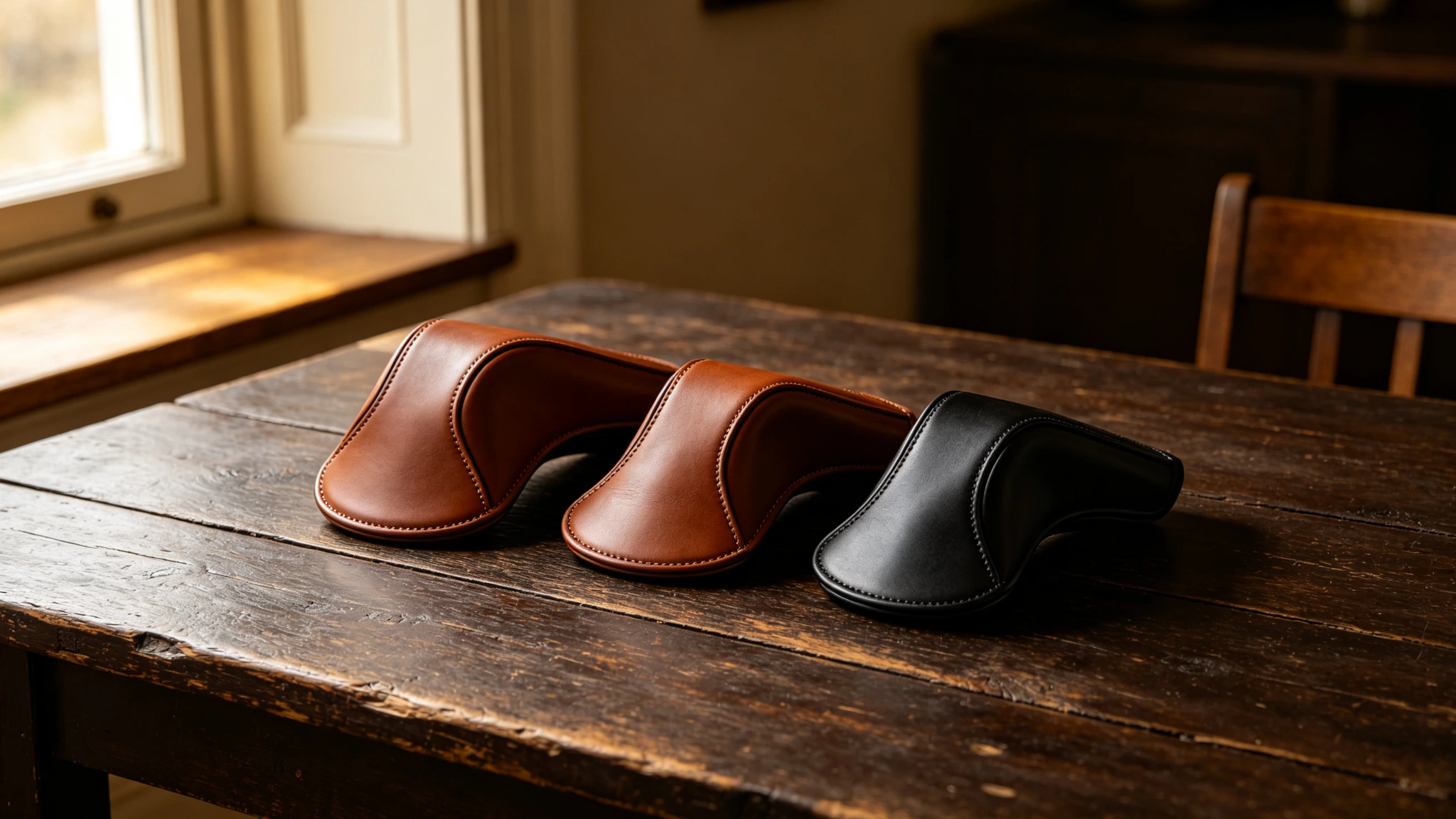
The second mechanism is the drop. Clubs fall — off trolleys, off benches, out of car boots — and the energy of a one-metre drop onto a cart path concentrates on the crown edge or face. Bench testing on our QC floor shows an unpadded crown chips under drop energy that an 8 mm EVA-padded cover absorbs completely. The third mechanism is moisture: raw carbon and torched putter finishes spot when stored wet, and chrome irons pit when bagged damp under a rain hood all round.
What covers cannot do is equally worth stating: they do not protect against shaft shear from crushing loads (that is travel-case territory), and cheap covers with hard linings can themselves micro-scratch soft finishes across thousands of insertions. Protection is a specification — padding weight, lining softness, closure security — not a product category. The rest of this guide is that specification, club by club.
The Protection Hierarchy: Which Clubs Need Covers
Not every club justifies a cover, and pretending otherwise is how ranges end up with products nobody buys. The hierarchy follows replacement cost and finish fragility. Tier one — cover always: the driver (highest cost, most fragile crown finish, most exposed position), fairway woods (same physics, slightly smaller), and the putter (highest handling frequency, most drop-prone, softest premium finishes).
Tier two — cover recommended: hybrids, whose painted crowns chip exactly like woods and which now occupy the long-iron slots in most bags. Tier three — preference, not necessity: irons and wedges. Forged chrome irons are hard and durable; their cosmetic wear is slow and many players accept it as character. Iron covers make sense for East Asian markets where they are culturally standard, for forged premium sets whose owners baby them, and for travel. Wedges, with their raw and rusting finishes, actively dislike sealed covers.
This hierarchy is also the retail architecture. The volume product is the wood family (driver + fairway + hybrid) plus putter; the long-tail products are iron sets for specific markets and travel-grade padded covers. A brand speccing its first cover range should start exactly there — the clubs customers already know need protecting — rather than launching all fourteen slots at once. The set architecture guide details the good/better/best ladder built on this hierarchy.
Driver Covers: The Flagship Protection Product
The driver cover carries the category, for sound reasons: the driver is the most expensive club in most bags, its 460 cc carbon crown wears the thinnest cosmetic paint in golf, and it rides at the top of the bag where every impact lands. The protection spec that works: 34-36 cm overall on a true 460 cc die, 8-10 mm EVA crown padding, a 10-12 cm shaft sock, and a lining softer than the crown finish.
The shaft sock deserves its own mention in a protection guide because it guards the most neglected damage zone. Graphite shafts are finished in thin clear coat over cosmetic layers, and that finish abrades exactly where divider rails touch — precisely the zone a crown-only cover leaves bare. Ten rounds of cart golf without a sock dulls a premium shaft visibly; a season leaves wear rings no cover can reverse.
Full driver cover sizing, fit testing and the 50-seat protocol are documented in our driver fit guide — the short version is that fit is the protection: a cover that rotates or migrates exposes exactly the zones it exists to guard. Protection begins with a die cut on the real head geometry, not a scaled pattern.
Fairway Woods and Hybrids: The Undercovered Majority
Fairway woods suffer the same damage physics as drivers — painted crowns, exposed positions — at slightly lower stakes, and the protection spec mirrors accordingly: 28-30 cm purpose-cut dies, 6-8 mm EVA, fleece linings, shaft socks of 8-10 cm. The key word is purpose-cut: fairway heads are shallower and rounder than drivers, and scaled driver patterns bag at the crown and rotate loose, turning the cover itself into an abrasion source.
Hybrids are the protection gap of the modern bag. As long irons disappear in favour of hybrids — hollow-headed, painted, wood-shaped clubs — millions of bags now carry two or three small expensive crowns banging against each other uncovered. The correct architecture is the pod: 24-26 cm, wider squarer mouth, shaped crown insert, built to absorb the dense lateral contact of the low bag compartment.
The full geometry and sizing treatment is in our fairway and hybrid guide. The protection point here is simpler: any club with a hollow body and a painted crown belongs under a padded cover, and the modern bag contains more such clubs than it did five years ago. Ranges that still merchandise covers as "driver plus one" are structurally behind the bag composition of 2026.
Putter Covers: The Highest-Frequency Protection Case
No club touches a cover as often as the putter — off and on 30-40 times per round — and no club pays the protection dividend so directly. Putters are dropped on cart paths, leaned against benches, and clattered into by wedges sharing their compartment. Premium milled putters retail at ¥3,000-6,000 with finishes — black PVD, raw carbon, copper, torched — that scratch under a careless fingernail. The cover is not optional equipment at that value.
The putter protection spec differs from woods in three ways: padding runs heavier on mallets (10 mm EVA faces versus 6 mm on blade envelopes), linings run to velvet rather than fleece (shorter pile, less insertion friction on soft finishes), and closures must survive 60-80 operations per round, one-handed — which is why magnetic flaps tuned to 1.5-2.5 kg pull force dominate the premium tier.
Four architectures cover the market — blade envelope, mid-mallet shell, full mallet shell, centre-shaft slot — each mapped to a head geometry in our putter cover types guide. The protection principle unifying them: a mallet that rattles inside its shell is being sanded by its own cover. Fit and padding are the product; the logo is decoration.
Iron and Wedge Covers: The Honest Assessment
Iron covers divide the golf world, and a protection guide should give the honest physics rather than a side. The case for: forged carbon-steel irons scratch and bag-chatter wears their faces and ferrules; premium sets are expensive; resale value tracks cosmetics. The case against: cast stainless irons are genuinely durable; covers trap moisture against chrome (accelerating pitting, especially on raw wedges); they slow play; and on-course they are fiddly.
The market resolution is geographic and segment-based. Japanese and Korean retail treat iron covers as standard equipment — a "full set" without them reads incomplete. Western premium-forged buyers are split roughly by equipment enthusiasm. Wedges should generally go uncovered: raw finishes need to breathe and rust-patina is expected. Any iron cover programme should spec breathable linings and drainage, and advise uncovering irons to dry after wet rounds.
For brands, the commercial read: iron covers are a market-fit product, not a universal one. Spec them for East Asian distribution, forged-set accessory programmes, and travel-grade padded lines; skip them for North American volume retail. Neoprene or PU envelopes with clear numbering windows are the proven construction, at $1.5-3 ex-works per piece — the economics work only at set volumes, which is another reason iron covers belong inside full-bag set architecture rather than as singles.
Travel: When Every Club Needs a Cover
Travel changes the protection calculus completely. Airline baggage handling subjects golf bags to drops, crush loads and compression that no round of golf produces — and in that environment, every exposed head is at risk, irons included. The travel protection hierarchy: a padded travel cover or hard case for the bag itself (the real protection), stiff-arm internal supports against crush, and then covers on every club as the scratch-and-chip layer.
Travel-specific covers differ from play covers: heavier padding (12 mm EVA), full-length zippers or wrap closures (magnetic flaps can jolt open in a tumbling bag), and water-resistant shells. They are also a distinct product line with distinct economics — travel covers sell at $15-35 retail in the pre-holiday peak, and brands with a cover range extend into travel naturally. Our bag-versus-case travel guide maps the outer-layer decision that the covers sit inside.
One protection detail the travel market taught the whole category: zippers belong on travel covers, not play covers. The two-second usability rule governs play (magnetic flaps win); the containment rule governs travel (zippers win). Confusing the two — zippered play covers that slow every hole, magnetic travel covers that burst open in transit — is the most common spec error in the category.
Materials: The Protection Specification
Protection performance is a stack of five layers, each with a spec: outer shell (abrasion resistance), padding (impact absorption), lining (finish safety), closure (retention), and stitching (structural integrity). The shell options rank leather and 1.2 mm PU at the top for abrasion (both pass 20,000-cycle Martindale), knit and neoprene below — adequate for chatter, weaker for sharp knocks.
Padding is EVA foam, specced by thickness and placement: 8-10 mm over impact zones for woods, 6 mm blade / 10 mm mallet for putters, 12 mm for travel. Lining follows the single hardest rule in the category — always softer than the finish it touches: 280gsm fleece for crowns, velvet for putter PVD, and never bare foam or shell material against a club. Closure is cycle-tested: 5,000+ operations for magnetic, ~1,500 for elastic, ~2,500 for snap.
Stitching closes the spec: 8-10 stitches per inch on stress seams, bar-tacked closure anchors, bonded nylon thread. A cover that fails structurally at the seam in month two protected nothing — which is why our lines hold covers to the same stitching standards as full bags, detailed in the stitching quality standards.
OEM: Speccing a Protection-First Range
A protection-first cover range is a spec document before it is a product line. The brief that works: target clubs (wood family + putter as the core), protection tier per club (padding weights, lining specs), closure per club, then materials and branding. With that brief, sampling runs 6–10 days per geometry, MOQ 200 per design with a 100-piece trial, bulk 35–50 days under AQL 2.5.
The economics reward the protection-first approach because protection specs are verifiable — and verifiable specs are what convert browsers at retail and on marketplaces. "8 mm EVA padding, velvet lining, magnetic closure tested to 5,000 cycles" sells; "deluxe protection" does not. The brands winning the cover category in 2026 merchandise their spec sheets, and the factories that can document them win the programmes.
Programme shape follows the hierarchy: launch the wood family and putter (the protection essentials), extend to travel and market-specific iron covers as the range matures, and merchandise matched singles for the replacement demand that protection products generate. Customers who trust your protection come back — covers are the most-replaced accessory in golf, and the replacement goes to the brand that protected the club last time.
The Bottom Line
Club covers are a specification, not a category: padding weight, lining softness, closure cycle life and structural stitching, matched club by club to the real damage physics of a golf bag. The driver, fairways, hybrids and putter need covers; irons are a market-fit call; travel changes everything and demands its own construction.
The brands that win this category are the ones that spec protection honestly and merchandise the numbers. The factories that win are the ones whose QC bench can document every figure. Ours does — MOQ 200, 6–10 day samples, 35–50 day bulk, AQL 2.5, on a plant rated at 200,000 pieces a month.
Send the club list and the protection tier, and spec-sheet samples come back in days. Golf clubs have never been more expensive or more fragile — the market for protecting them properly has never been better.
Spec a Protection-First Range
Send the club list and target tier. We return spec-documented samples in 6–10 days, quoted at MOQ 200 with a 100-piece trial.
Request a Quote →People Also Ask
Which golf clubs need head covers?
Always cover: driver, fairway woods and putter — the most expensive, most fragile-finished, most exposed clubs. Recommended: hybrids, whose painted crowns chip like woods. Preference, not necessity: irons and wedges — durable enough for most Western players, though iron covers are standard in Japanese and Korean retail and sensible for forged premium sets and travel.
Do golf club covers really protect clubs?
Yes, against the three documented damage mechanisms: bag chatter (thousands of low-energy knocks per round that chip crown paint and dull shaft finishes), drops (an unpadded crown chips under energy an 8mm EVA-padded cover absorbs), and finish abrasion from divider rails. Protection is a specification — padding weight, lining softness, closure security — not just owning a cover.
Are iron covers worth using?
It depends on market and irons. Forged carbon-steel irons scratch and their cosmetics drive resale value — covers help. Cast stainless irons are genuinely durable — covers are optional. Japanese and Korean retail treat iron covers as standard; Western players split by preference. Wedges with raw finishes should generally go uncovered — they need to breathe, and trapped moisture accelerates pitting.
Can head covers damage clubs?
Poorly specced ones can. A lining harder than the club finish micro-scratches across thousands of insertions; a cover that rotates loose abrades the crown it should guard; trapped moisture under a cover spots raw carbon and torched finishes. The rules: lining always softer than the finish, fit verified on real geometries, and dry the club before covering.
What is the best material for golf club covers?
Full-grain leather and 1.2mm premium PU rank top for shell abrasion resistance (both pass 20,000-cycle Martindale testing). Padding should be 8-10mm EVA on woods, 10mm on mallet putters. Linings: 280gsm fleece for crowns, velvet for soft putter finishes. Closure: magnetic rated beyond 5,000 cycles for premium, natural-rubber-core elastic for value.
How much do custom golf club covers cost?
Ex-works: neoprene/knit value covers $2.5-4, premium PU $4-7, full-grain leather $10-20. Retail lands at $8-15, $15-35 and $35-80 respectively. Iron cover sets run $1.5-3 per piece ex-works, viable only at set volumes. Full pricing tiers are mapped in our 2026 buying guide.
Should I cover my clubs for air travel?
Yes — every club, irons included. Baggage handling produces drops and crush loads no round of golf matches. The travel hierarchy: a padded travel cover or hard case for the bag (the real protection), a stiff-arm support against crush, then covers on every club as the scratch layer. Travel covers spec 12mm padding, full zippers and water-resistant shells — different construction from play covers.
What closure is best for club covers?
For play: magnetic flaps tuned to 1.5-2.5kg pull — one-handed, silent, cycle-tested beyond 5,000 operations. For value knit: natural-rubber-core elastic cuffs (85% tension retention after 1,000 stretches). For oversize mallets: magnetic plus a security tab. For travel: full zippers. Zippers on play covers fail the two-second usability rule; magnets on travel covers can jolt open.
What is the MOQ for a custom club cover range?
Our standard MOQ is 200 pieces per design with a 100-piece trial for first programmes. Sampling runs 6–10 days per geometry; bulk 35–50 days under AQL 2.5 inspection on a plant rated at 200,000 pieces monthly. A wood family plus putter launch covers the protection essentials at four dies. Start at our quote page.
Do professional golfers use club covers?
Yes — tour players cover drivers, fairway woods, hybrids and putters without exception, because their equipment is expensive, tour-trucked weekly, and sponsor-visible. What tour players skip is iron covers, for speed of play and because their irons are replaced frequently. The tour behaviour maps exactly onto the protection hierarchy: cover the fragile crowns, leave the durable irons.
How do I stop my clubs from clanking in the bag?
Three fixes: padded covers on the wood family and putter (absorbs contact energy), a 14-way divider bag (separates shafts so heads cannot meet), and correct club ordering (woods top, irons mid, wedges and putter in their own wells). Covers plus a divider system eliminate virtually all chatter damage. Divider architecture is covered in our divider systems guide.
How long do quality club covers last?
Leather and premium PU covers with magnetic closures last five to ten seasons; knit with natural-rubber-core elastic runs three to five; value elastic-cuff covers fatigue around 1,500 cycles. Lifespan killers: summer car-boot heat (brittles shells, crushes padding), machine washing (delaminates, crushes EVA), and hard linings on soft finishes. Care extends life materially.
Sources & Authority
Damage-mechanism and padding-performance figures are from the QUANZHOU JUNYUAN BAGS QC bench (drop testing, Martindale abrasion, cycle-life rigs) under AQL 2.5, SGS-verified (March 2026) under BSCI and ISO 9001:2015 with CE, CPC and RoHS certification. Club-composition and market-segmentation context draws on Golf Datatech equipment and accessory tracking.