Putter Cover Types: Blade, Mallet and Everything Between
Putter covers come in four architectures — blade envelope, mid-mallet shell, full mallet shell and centre-shaft slot design — because putters come in four geometries, and no single pattern protects them all. A blade cover on a mallet leaves the head exposed; a mallet cover on a blade slides off within a round. This guide maps each type to its geometry, closure and padding spec, with the OEM numbers behind each. The full range lives at our putter cover hub.
QUANZHOU JUNYUAN BAGS, established 2014 in Quanzhou, Fujian, manufactures through an affiliated factory of 4,950 m², 7 production lines, 149 machines (126 sewing stations) and 137 staff — rated at 200,000 pieces per month, actual output around 150,000. Every order runs AQL 2.5 inspection, MOQ 200 (100-piece trial), sampling 6–10 days, bulk 35–50 days, with BSCI, ISO 9001:2015, CE, CPC and RoHS certifications (SGS audit, March 2026). We serve 200+ brands in 100+ countries.
Why Putters Need Their Own Cover Logic
The putter is the most-used club in the bag — 30 to 40 touches per round — and the one most likely to be dropped on a cart path, leaned against a bench, or clattered against a wedge. It is also, per gram, often the most expensive club a player owns: premium milled putters retail at ¥3,000-6,000, and their value lives in a finish that scratches. Cover logic for putters is therefore different from woods: higher handling frequency, higher drop risk, more delicate finishes.
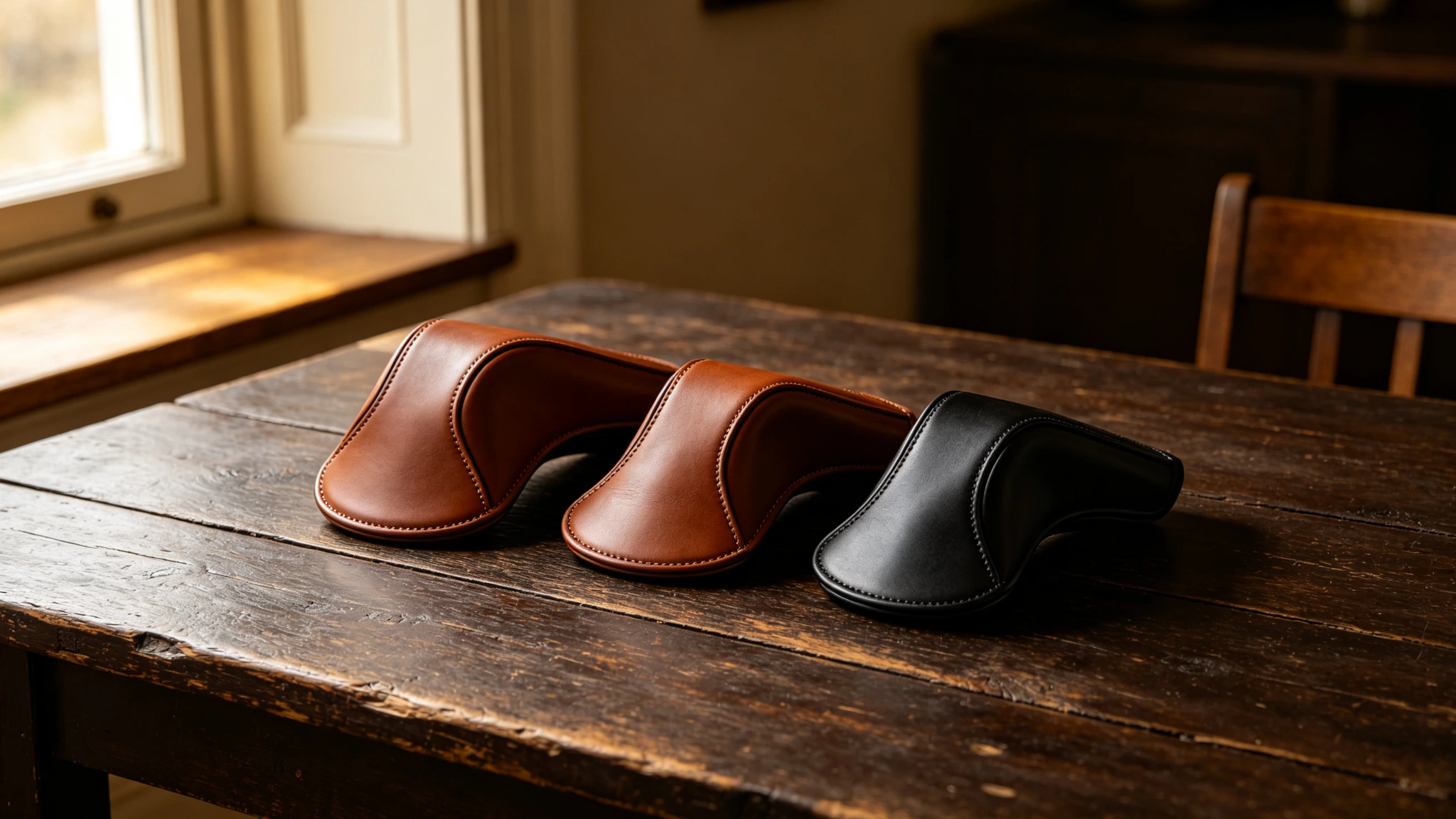
Handling frequency drives the closure decision. A putter cover comes off and on twice per hole minimum, so the action must be one-handed and instant — this is why magnetic flaps dominate the premium tier and why slow, fiddly closures fail at retail regardless of protection. Drop risk drives padding: mallet shells carry 10 mm EVA versus 6 mm in blade envelopes, because the mallet’s flat faces and alignment lines are the damage magnets.
Finish delicacy drives lining. Modern putters wear black PVD, raw carbon, copper and torched finishes that scratch if you look at them twice. Velvet — not the fleece used in wood covers — is the correct lining, because its shorter, denser pile generates less friction across the hundreds of insertions a season brings. One material rule governs the whole category: the lining must always be softer than the finish it touches.
Type 1: The Blade Envelope
The blade putter — Anser-style and its descendants — needs a long, flat envelope, typically 16 × 13 cm, with a slim profile that slides into a crowded bag without fighting the wedges. The architecture is a folded shell: two panels, a welted edge, 6 mm EVA between shell and velvet lining, and a magnetic flap that closes over the top with a satisfying snap.
The details that separate a good blade envelope from a bad one are the flap and the welt. The flap must self-locate — magnet polarity aligned within 2 mm — so it closes without aiming; a flap that needs adjustment after every use is returned within a season. The welt (edge piping) takes the abrasion of thousands of insertions; a bound welt in the shell material outlasts a folded raw edge by years.
Blade covers are the premium tier’s signature product — the leather blade envelope with a debossed crest is arguably the single most recognisable luxury accessory in golf. It is also the highest-volume putter cover we ship, because the blade remains the tour-standard shape and the gift-market default. Our leather cover line leads with it for exactly that reason.
Type 2 and 3: Mid-Mallet and Full Mallet Shells
Mallets changed the cover category. A blade envelope cannot close over a mallet’s deep, square head, so the mallet shell was born: a structured box, typically 14 × 12 × 6 cm padded, that the head drops into from above. Mid-mallets — the half-moon and compact fang shapes — take a shallower shell; full high-MOI mallets need the deepest architecture, sometimes with a shaped insert that cradles the head’s specific footprint.
The closure question splits mallet shells into two schools. Magnetic mouths close instantly and silently — right for premium builds — but on bumpy cart paths a jolted oversize mallet can bounce a purely magnetic mouth open. The belt-and-braces solution adds a snap or hook-and-loop tab over the magnet, at +$0.2-0.5 per unit. Our programme data: magnetic-only for mid-mallets, magnetic-plus-tab for full mallets, is the configuration that minimises both complaints and returns.
Padding in mallet shells steps up to 10 mm EVA on the faces and base, with shaped side panels that stop the head rattling inside the box. A mallet that rattles in its cover is being sanded by its own protection — the velvet lining is soft, but constant motion wears alignment lines over seasons. The fit test is the shake test: head in, cover closed, shake firmly — silence is the spec.
Type 4: Centre-Shaft and Armlock Designs
Centre-shafted putters — and the long and armlock variants that followed the anchoring ban — break the standard architectures because the shaft enters the head’s centre, not its heel. A heel-shaft cover cannot close around a centre shaft; the design needs a top slot with its own closure, or an asymmetric wrap. This is the smallest of the four segments but the most underserved — owners of centre-shaft putters routinely report buying two covers and modifying one.
The correct centre-shaft architecture is a mallet shell with a reinforced top slot: the head drops in, the shaft exits through the slot, and a magnetic or snap bridge closes the slot around the shaft. The slot edges take concentrated wear and must be welted in the shell material, not merely hemmed. Padding mirrors the full mallet spec — 10 mm faces — since most centre-shaft heads are high-MOI mallet geometries.
For OEM buyers, centre-shaft covers are a niche worth owning precisely because competitors ignore it. The tooling cost is one die variant; the segment’s customers are equipment enthusiasts who pay premium prices and write detailed reviews. A brand that offers all four architectures — blade, mid-mallet, mallet, centre-shaft — in one coordinated material story owns the shelf. That full-family logic is how we structure the putter range.
Closures for Putter Covers: The Two-Second Rule
Putter closures live by a harsher standard than wood closures: they operate 60-80 times per round, one-handed, often with a glove on, while the player holds two other clubs. Any closure that breaks that rhythm — zippers that need two hands, flaps that need aiming, hook-and-loop that rasps — gets abandoned. The two-second rule: if the cover cannot come off and go on in two seconds total, one-handed, it fails.
Magnetic flaps pass the rule best. The engineering spec that makes them work: N38-grade rare-earth pairs, sewn-in encapsulation (never glued — glue fails in summer car boots), polarity alignment under 2 mm so the flap self-locates, and pull force tuned to 1.5-2.5 kg — strong enough to stay closed in a rattling bag, gentle enough for one-handed opening. Cycle life beyond 5,000 operations with no measurable force loss is the bench standard.
Hook-and-loop remains legitimate in two places: the secondary security tab on oversize mallets, and value-tier covers where magnet cost is prohibitive. Its failure mode is not the hook side but the loop: lint and grass seeds clog it within a season of course use. If hook-and-loop is specced, use a fine-loop grade and add a lint-resistant top coat — or better, put it only where fingers rarely touch. Zippers, for the record, fail the two-second rule categorically and belong on travel covers, not putter covers.
Materials and Branding for Putter Covers
Putter covers are small canvases with outsized branding value — the putter is the club photographed at every hole’s end, and the cover sits on the bag’s most visible peg the rest of the time. Full-grain leather with a debossed crest owns the premium tier; premium PU with embroidery owns the mid; and the gift market runs on mixed execution — deboss plus foil, embroidery plus woven label.
The branding physics differ from wood covers. Putter cover panels are smaller and more curved, so embroidery must stay under 10,000 stitches on thin shells to avoid puckering, and deboss dies must be scaled to sit 8 mm clear of welts and flap magnets. Foil stamping works beautifully on gift editions but wears on flap flex points — keep foil to flat panels. These placement rules are covered in our branding technology guide, and they apply at cover scale with tighter tolerances.
Limited editions are the category’s commercial accelerant. Major-themed, seasonal and event putter covers sell at 2-4x standard retail and create collection behaviour — players who buy every edition. The manufacturing implication is short-run agility: our lines handle 200-piece limited editions with the same 6–10 day sampling as standard runs, which makes a four-editions-per-year calendar operationally trivial. For character-led and novelty limited editions, our partner customgolfbagsfactory.com covers that specialism; we hold the premium leather and PU side.
OEM Numbers: MOQ, Timeline, Cost Structure
Putter cover OEM economics are the friendliest in golf soft goods. MOQ 200 per design with a 100-piece trial; sampling 6–10 days; bulk 35–50 days; and because putter covers are the smallest goods on the line, capacity is never the constraint — a 1,000-piece run is hours of line time on a plant rated at 200,000 pieces monthly.
Cost structure follows the cover-category rule: materials 35-45%, labour 30-40%, branding and hardware 10-15%, the rest overhead and packing. A premium leather blade envelope lands at $12-20 ex-works and retails $45-80; a PU mallet shell at $7-12 ex-works retails $25-45. Limited editions with mixed branding execution add $1-3 and routinely double the retail. The margin architecture rewards design ambition — this is a category where creativity is cheaper than anywhere else in the bag.
The programme shape we recommend: launch with the blade envelope in your hero material, add the mallet shell in season two (mallets now outsell blades in many markets), and fill mid-mallet and centre-shaft as the range matures. Each addition reuses the material story, the colourways and the customer list — and matched putter covers cross-sell to your wood cover buyers at 25-40% attach rates when merchandised together.
Care: Keeping Putter Finishes Pristine
The cover’s job is protecting the putter; the owner’s job is protecting the cover’s lining. Velvet linings pick up grass seed and sand, which then abrades the very finish the cover guards. The maintenance routine is 30 seconds monthly: turn the cover inside out, brush the lining with a soft clothes brush, and spot-clean the shell. Leather shells get the same conditioning rhythm as leather bags — every two to three months, per our care guide.
The two cover killers are machine washing and trapped moisture. Machine washing delaminates PU, crushes EVA padding, and can unseat glued (non-encapsulated) magnets — hand clean only. Trapped moisture — cover replaced on a wet putter — spots raw carbon and torched finishes; the rule is dry the putter before covering, or leave the cover off until the green dries.
For brands, care instructions are a quality signal worth printing. A care card in the box — brush the lining, hand clean, condition leather, dry before covering — costs cents and measurably reduces one-star "wore out" reviews. The brands that treat aftercare as part of the product are the ones whose covers still look premium in season three, when the customer is ready to buy the next edition.
Storage deserves one final word, because it is where covers die off-course. A putter cover left loose in a car boot through a summer accumulates heat damage that no warranty covers: EVA padding permanently compresses above 60 °C, glued components creep, and leather dries and cracks at the flap fold. The retail-facing advice is simple — store covered clubs indoors, off concrete floors, away from direct sunlight. For OEM programmes we spec storage guidance into the care card as standard, because a cover that survives its first summer is a cover that gets replaced by choice, not by failure — and replacement by choice is the repeat purchase every accessory programme is built on.
The Bottom Line
Putter covers are four architectures, not one product: the blade envelope (16 × 13 cm, 6 mm EVA, magnetic flap), the mid-mallet and full mallet shells (10 mm EVA, magnetic-plus-tab), and the centre-shaft slot design. Match cover to geometry, spec velvet linings for modern finishes, tune magnet pull to 1.5-2.5 kg, and the two-second rule takes care of itself.
The category rewards brands that take it seriously: the highest handling frequency in the bag, the most photographed position, gift-market economics, limited-edition multiples, and OEM terms — MOQ 200, 6–10 day samples, 35–50 day bulk — that make experimentation nearly free. Ignore the centre-shaft niche and you gift it to whoever bothers.
Send the putter models, the material and the logo, and fitted samples come back in days. In a category where the customer touches the product 40 times a round, "good enough" is the only spec that never is.
Build Your Putter Cover Line
Send the putter models and logo. We return fitted samples across blade, mallet and centre-shaft dies in 6–10 days.
Request a Quote →People Also Ask
What are the different types of putter covers?
Four architectures: the blade envelope (flat 16x13cm shell for Anser-style putters), the mid-mallet shell (shallower box for half-moon and compact fang heads), the full mallet shell (deep padded box for high-MOI mallets), and the centre-shaft slot design (top slot for centre-shafted and armlock putters). Each geometry needs its own die — no single pattern protects all four. See our putter cover range.
Will a blade putter cover fit a mallet putter?
No. A blade envelope cannot close over a mallet head’s deep, square profile — it leaves the head exposed and strains the seams. Mallets need a structured shell, typically 14x12x6cm padded, that the head drops into from above. Using the wrong architecture is the most common putter cover purchase mistake and the top reason for returns.
What is the best closure for a putter cover?
A magnetic flap tuned to 1.5-2.5kg pull force: one-handed, silent, self-locating, and cycle-tested beyond 5,000 operations. For oversize mallets used on cart paths, add a secondary snap or hook-and-loop tab against jolting. Zippers fail the two-second usability rule and hook-and-loop alone clogs with grass seed within a season. Our magnetic covers show the premium spec.
How much padding does a putter cover need?
Blade envelopes: 6mm EVA between shell and lining. Mallet shells: 10mm EVA on faces and base, with shaped side panels that stop the head rattling — a mallet that rattles in its cover is slowly wearing its own alignment lines. Padding is what absorbs the cart-path drops that putters suffer more than any other club.
What lining should a putter cover have?
Velvet, not fleece. Modern putter finishes — black PVD, raw carbon, copper, torched — scratch more easily than driver crowns, and velvet’s shorter, denser pile generates less friction across the hundreds of insertions a season brings. The governing rule for all covers: the lining must always be softer than the finish it touches.
Do putter covers protect putters?
Yes — putters are the most-dropped club in the bag, and premium milled finishes scratch on cart paths, benches and wedge contact. A padded cover with a velvet lining absorbs the knocks and prevents finish wear that directly reduces a $400-800 putter’s value. Covers also keep moisture off raw carbon finishes that spot when wet.
What is the MOQ for custom putter covers?
Our standard MOQ is 200 pieces per design with a 100-piece trial for first programmes. Sampling takes 6–10 days including fit testing on real putter geometries; bulk runs 35–50 days. Limited editions run at the same minimums, making a four-editions-per-year calendar operationally simple. Start at our quote page.
How much does a custom putter cover cost to make?
Cost structure: materials 35-45%, labour 30-40%, branding and hardware 10-15%, balance overhead and packing. A premium leather blade envelope lands at $12-20 ex-works (retails $45-80); a PU mallet shell at $7-12 (retails $25-45). Mixed branding execution adds $1-3 and typically doubles limited-edition retail.
Can I get a putter cover with my own logo?
Yes — debossed (the premium leather default), embroidered (under 10,000 stitches on thin shells), foil-stamped (flat panels only, not flex points), or mixed execution. Placement should sit 8mm clear of welts and flap magnets. Send the logo file with your brief and placement is locked in the tech pack before sampling. Options are detailed in our branding guide.
What is a centre-shaft putter cover?
A mallet shell with a reinforced top slot: the head drops in, the shaft exits through the slot, and a magnetic or snap bridge closes around the shaft. Standard heel-shaft covers cannot close over centre-shafted or armlock putters. Slot edges take concentrated wear and must be welted in shell material, not merely hemmed.
How do I clean a putter cover?
Monthly: turn inside out and brush the velvet lining with a soft clothes brush to remove grass seed and sand (which otherwise abrades the putter finish). Spot-clean the shell by hand — never machine wash, which delaminates PU, crushes padding and can unseat magnets. Leather shells want conditioning every 2-3 months; dry the putter before covering to protect raw finishes.
Which sells better: blade or mallet putter covers?
Blade envelopes remain the highest-volume single SKU (tour-standard shape, gift-market default), but mallets now outsell blades in many equipment markets and mallet shells are the faster-growing cover segment. The winning programme shape: launch with the blade envelope in your hero material, add the mallet shell in season two, then fill mid-mallet and centre-shaft as the range matures.
Sources & Authority
Architecture dimensions and padding specifications reflect current putter geometries across the major equipment manufacturers. Cycle-life, pull-force and abrasion figures are from the QUANZHOU JUNYUAN BAGS QC bench under AQL 2.5, SGS-verified (March 2026) under BSCI and ISO 9001:2015 with CE, CPC and RoHS certification. Market segmentation draws on Golf Datatech putter-category tracking.