Fairway Wood and Hybrid Headcover Guide: Sizing, Numbering and OEM Specs
Fairway wood and hybrid headcovers fail when they are treated as small driver covers. The geometries are different — shallower faces, rounder crowns, shorter hosels — so each needs its own die: 28-30 cm for fairway woods, 24-26 cm for hybrid pods. This guide covers the sizing architecture, the numbering systems that survive retail, and the OEM economics, from a plant that fits every die on physical club heads. See the modular range at our fairway wood cover line.
QUANZHOU JUNYUAN BAGS, established 2014 in Quanzhou, Fujian, manufactures through an affiliated factory of 4,950 m², 7 production lines, 149 machines (126 sewing stations) and 137 staff — rated at 200,000 pieces per month, actual output around 150,000. Every order runs AQL 2.5 inspection, MOQ 200 (100-piece trial), sampling 6–10 days, bulk 35–50 days, with BSCI, ISO 9001:2015, CE, CPC and RoHS certifications (SGS audit, March 2026). We serve 200+ brands in 100+ countries.
The Geometry Problem: Why Scaled Patterns Fail
Open any bargain cover set and you will find the same shortcut: one driver pattern, scaled down 15% for the "fairway" cover and 25% for the "hybrid." It photographs acceptably and fits nothing. A fairway wood is not a small driver — its face is shallower, its crown rounder, its hosel shorter and more upright. A scaled driver die on a fairway head bags at the crown, strains at the face edge, and rotates during cart rides until the cover works loose.
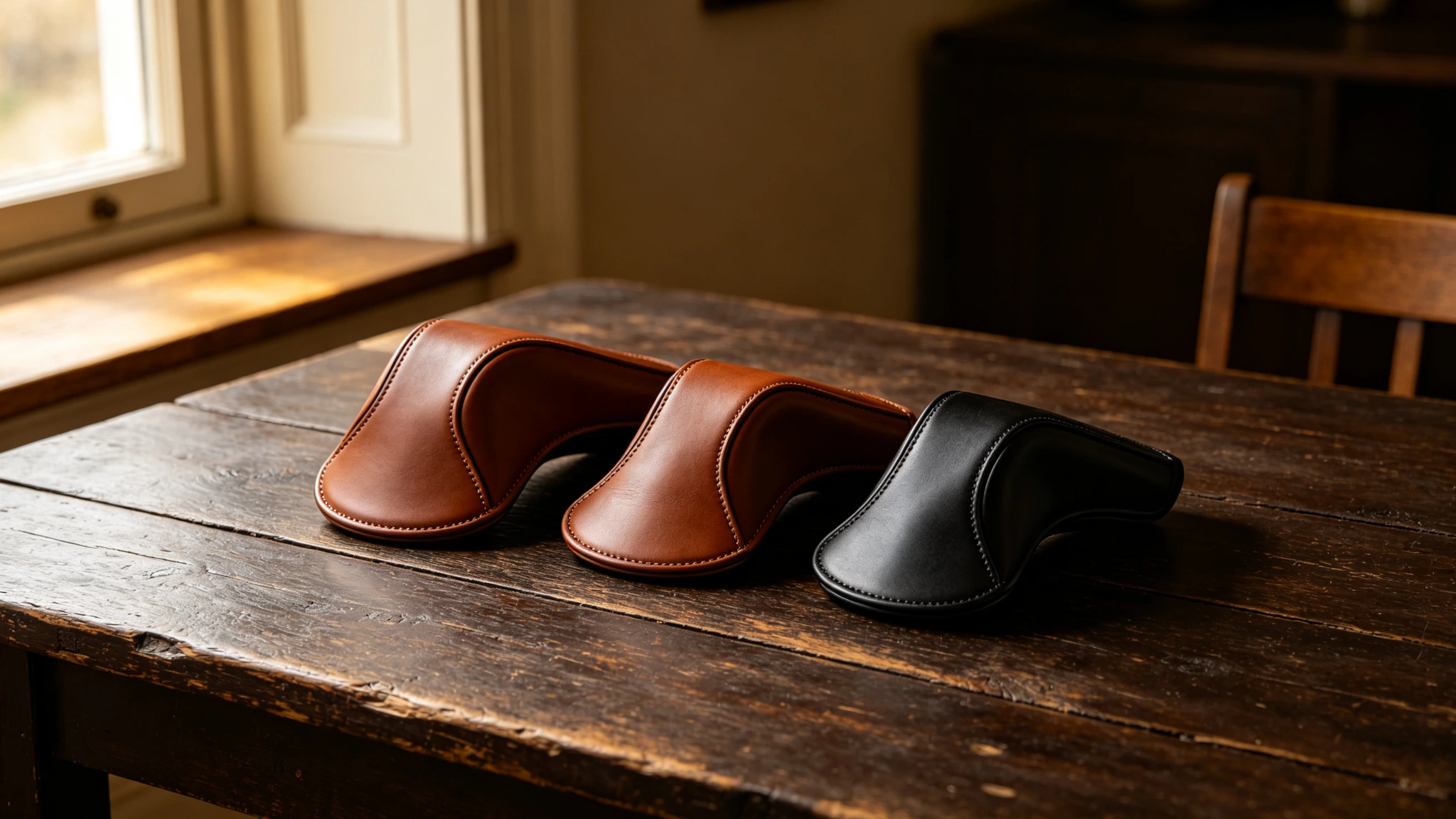
The failure is measurable, not aesthetic. In our fit-lab seating tests, scaled patterns average 6-9 mm of crown play on standard 3-wood geometries — enough movement for the head to abrade against its own padding across a season, dulling the crown paint the cover exists to protect. Purpose-cut fairway dies hold play under 3 mm. That difference is the entire product.
Hybrids make the scaling error worse. A hybrid’s head is shorter and deeper than a fairway wood’s, with a wider sole and a more abrupt crown-to-neck transition. The correct hybrid architecture is not a sock at all but a pod — shorter, squarer, with a wider mouth and often a shaped crown insert. Any range still selling "one shape fits woods and hybrids" is selling the 2010 market a product for a bag composition that no longer exists.
Fairway Wood Sizing: The Numbers
Fairway wood covers run 28-30 cm overall with a slimmer mouth of 11-12 cm, 6-8 mm EVA crown padding, and a proportionally shorter shaft sock of 8-10 cm. The die geometry follows the modern fairway profile: a flatter, wider crown zone than a driver die, with the widest point lower on the head. Tolerances are tighter than driver covers — ±4 mm on length — because the smaller head has less surface friction to hold a loose cover.
Within the fairway family, 3-woods and 5-woods differ enough to matter. A 3-wood (typically 170-180 cc) and a 7-wood (150-160 cc) can share one well-cut die with a stretch mouth; the spread beyond that — strong 3-woods at 190 cc plus, or compact 9-woods — begins to strain. The practical architecture for retail is one fairway die tested across the 150-190 cc band, with the fit lab verifying seat time under two seconds and crown play under 3 mm at both extremes.
Padding can run lighter than driver covers — 6-8 mm versus 8-10 mm — because fairway heads are smaller, lower in the bag, and less exposed to drop energy. But the lining standard does not relax: 280gsm fleece minimum, velvet for dark PVD finishes, always softer than the crown it touches. The full material logic matches our 2026 head cover rankings, where fairway construction grades on the same five QC variables as drivers.
Hybrid Pods: The Fastest-Growing Cover Geometry
The hybrid pod is the newest architecture in the category and the one growing fastest, for a simple reason: bag composition has changed. Across the equipment market, players now carry two or three hybrids where they once carried long irons and extra fairway woods — and every one of those hybrid heads is a compact, expensive, painted crown that bangs against its neighbours without a cover.
The correct hybrid pod runs 24-26 cm with a wider, squarer mouth of 10-11 cm and a shaped crown insert that mirrors the hybrid’s abrupt shoulders. Because hybrid heads sit lower and denser in the bag, pods take more lateral abrasion than wood covers — the spec response is a reinforced side panel and a slightly heavier shell material than the matched fairway pieces. Closure is usually elastic cuff or a short magnetic flap; the pod’s compact size makes either work, but magnets win the premium tier on feel.
The commercial signal for brands is clear: hybrid pods are the attachment sale most ranges miss. A customer buying a driver and fairway set almost certainly games one or two hybrids — offering matched pods at the point of sale lifts basket value 20-30% with zero acquisition cost. Our fairway and hybrid line is built on this modular logic: same material, same colourway, every geometry the customer actually carries.
There is also a fitting-culture argument that retail buyers should not underestimate. Club fitters now steer mid- and high-handicap players toward hybrids as long-iron replacements almost by default, which means the players most likely to buy new clubs are precisely the players accumulating hybrid heads. Those same players are the most cover-loyal segment in golf — they protect new equipment carefully, and they buy coordinated accessories at purchase time. A range without a hybrid pod in 2026 is structurally absent from the fastest-moving part of the fitting bay.
Numbering Systems That Survive Retail
Numbering is where fairway and hybrid covers earn or lose their reviews. Three systems compete, and the bench data separates them. Rotating dial tags (3/5/7/X) promise one-cover flexibility but are the category’s highest-failure component: single-rivet dials loosen, spin free and rattle within a season. Fixed embroidered numbers never fail mechanically but lock each cover to one club. Woven clip-on tags split the difference — replaceable, silent, and surviving roughly three times the rotation cycles of a riveted dial.
Our specification by tier follows the failure data. Premium leather and PU sets get embroidered numbers, or deliberate no-number minimalism with the club shape debossed. Mid-tier PU gets woven clip tags. Value knit gets the only dial execution that passes our 1,000-rotation bench test: double-riveted with a nylon washer between dial and body. Whatever the choice, the tech pack must name the rivet grade and washer — "number tag" as a spec line is how 3% defect rates are born.
Hybrid numbering deserves its own rule because hybrid lofts vary so widely. A rigid 3/5/7 dial misses the 2-hybrid and the 7-wood carriers entirely. The clean solutions: an H/X dial, a blank embroidered patch the player marks, or — best for OEM — numbers matched to the actual bag composition of your target customer, stated on the packaging. "Fits 3H, 4H, 5H" sells; "fits some hybrids" does not.
Materials: Matching the Range Without Cutting Corners
Fairway and hybrid covers should match the driver cover in material story but not blindly in material weight. The leather range carries full-grain shells across all three geometries — consistency is the luxury signal. The PU range runs the same 1.2 mm microfiber-backed shell throughout. But knit sets legitimately lighten the fairway and hybrid pieces: a double-layer knit driver cover with single-layer-accent fairway pieces reads as intentional design, not cost-cutting, when the colourway and cuff quality hold constant.
The corner that must never be cut is the lining. Lining is invisible in photography and decisive in use — the one component touching the crown paint ten thousand times. We have audited competitor sets where the driver lining was 280gsm fleece and the fairway lining 180gsm tricot; under the hand, the set felt cheap, and under a season of use, the fairway crowns showed insertion wear. Every piece in our sets carries the same lining weight, verified at inline QC against the golden sample.
Colour-lot discipline matters more in multi-piece ranges than anywhere else. Hides and PU rolls vary batch to batch; a driver cover cut in March beside a fairway cover cut in May can drift a half-shade that customers read instantly as mismatch. The fix is sourcing discipline: one material PO for the whole set run, one cutting window, Delta-E verification under D65 light. The process is identical to the set-consistency protocol in our head cover set guide.
OEM Economics: The Modular Advantage
Fairway and hybrid covers are the cheapest line extension in golf soft goods. Once the driver die exists, each additional geometry is one die and one sampling cycle — no new materials, no new closures, no new branding execution. Sampling stays at 6–10 days per piece; MOQ stays 200 per design with the 100-piece trial; and because the pieces share material lots, the incremental working capital for a full wood family is a fraction of a standalone launch.
Cost structure follows the small-goods rule: materials 35-45%, labour 30-40%, branding 10-15%. A premium PU fairway cover lands at $4-7 ex-works (retail $15-25), a leather fairway at $10-16 (retail $35-55), and hybrid pods slightly under fairway pieces thanks to smaller material consumption. The margin story improves in sets: coordinated cutting across three geometries from one material lot reduces waste 8-12%, which is why set pricing can undercut singles while holding brand margin.
The programme shape we recommend mirrors the bag the customer actually carries: launch driver plus hybrid pod (the modern must-protect pair), add the fairway piece immediately after, and merchandise all three as one modular family with matched singles for replacements and secondary clubs. Replacement demand is the quiet annuity — covers are lost constantly, and a customer who bought your 2025 colourway returns for the 2027 single only if the colourway still exists. Never orphan a live colourway.
Fit Testing and QC: The Same Gates as Driver Covers
Every fairway and hybrid die passes the same 50-seat protocol as driver dies: seat-and-remove on physical reference heads — current 3-wood, 5-wood, 7-wood and hybrid geometries from the major manufacturers — timed under two seconds, shaken head-down for play under 3 mm, cycled 50 times for binding and seam strain. Scaled patterns fail this test in the first dozen seats; purpose-cut dies pass it casually. That is the entire argument for doing it properly.
Production runs the same three inline gates as the rest of the cover line: post-cutting panel dimensions, post-closing seam and logo placement, post-packing set completeness and barcode accuracy — then AQL 2.5 final inspection before freight. The discipline is documented in our five-stage inspection framework and applies to a $5 hybrid pod exactly as to a $20 leather driver cover.
Buyers auditing a supplier’s fairway and hybrid output can run the same checks without a laboratory. Measure the four key dimensions on three random units per geometry and compare against the tech pack; seat each on the intended club twenty times and watch for binding that worsens; flex every dial tag through fifty rotations and listen for rattle; and hold the full family side by side under daylight for colour-lot drift. A supplier whose covers pass those four field checks is running real process control — and one whose covers fail them will fail your customers the same way, one return at a time.
Certifications travel with the goods: BSCI, ISO 9001:2015, CE, CPC and RoHS, SGS-audited March 2026. For buyers supplying retail chains, the compliance file is what clears vendor onboarding on the first submission — and for junior cover programmes, CPC documentation ships with the order. None of this is overhead; it is the difference between a supplier and a partner.
The Bottom Line
Fairway woods and hybrids are not small drivers. Cut each geometry its own die — 28-30 cm fairway, 24-26 cm hybrid pod — number it with a system that survives retail, line every piece to the same weight, and lock colour lots across the family. Do those four things and the wood family becomes the highest-margin modular extension in the range.
The economics reward the extension: one die and one sampling cycle per geometry, MOQ 200 with a 100-piece trial, 6–10 day samples, 35–50 day bulk, and set-level material efficiency that funds visible customer value. The player’s bag already changed to hybrids; the only question is whose covers are on them.
Send the club list and the colourway, and fitted samples across every geometry come back in days. The bag composition of 2026 is driver, fairway, two hybrids — cover all of it, or watch someone else do it.
Spec Your Wood & Hybrid Family
Send the club list and colourway. We return fitted samples across driver, fairway and hybrid dies in 6–10 days.
Request a Quote →People Also Ask
What size headcover fits a fairway wood?
A purpose-cut fairway wood cover runs 28-30 cm overall with an 11-12 cm mouth, 6-8mm EVA crown padding and an 8-10 cm shaft sock. One well-cut die tested across the 150-190cc band covers 3-wood through 7-wood geometries; beyond that spread, strain begins. Covers scaled down from driver patterns bag at the crown and rotate loose — check for purpose-cut dies.
Do hybrids need different headcovers than fairway woods?
Yes. A hybrid head is shorter and deeper than a fairway wood with a wider sole and abrupt crown shoulders, so the correct architecture is a pod: 24-26 cm, wider squarer mouth, often a shaped crown insert. A fairway sock on a hybrid bags and slides; a hybrid pod on a fairway wood will not seat. Each geometry needs its own die.
What is the best numbering system for fairway covers?
Premium leather/PU sets: embroidered numbers (zero mechanical failure) or debossed club shapes. Mid-tier: woven clip-on tags — replaceable, silent, 3x the rotation life of dials. Value knit: double-riveted dials with nylon washers, the only dial passing a 1,000-rotation bench test. For hybrids use H/X dials or numbers matched to the clubs your customer actually carries.
Can I buy fairway and hybrid covers separately from driver covers?
Yes — matched singles are the correct retail architecture. Our fairway wood cover line sells both in coordinated sets and as singles, because replacement demand (lost covers) and modular demand (the customer carrying two hybrids and no fairway wood) are both real. Singles should run 35-40% of set piece-price.
What is the MOQ for custom fairway wood headcovers?
Our standard MOQ is 200 pieces per design with a 100-piece trial for first programmes. Each geometry is one die and one sampling cycle — 6–10 days for fitted samples, 35–50 days for bulk under AQL 2.5 inspection. Material lots are shared across the family, keeping incremental working capital low. Start at our quote page.
Why do my fairway covers keep slipping off?
Three usual causes: a scaled-down driver pattern (bags at the crown, rotates loose), a mouth with no stretch tolerance, or a fatigued elastic cuff past its roughly 1,500-cycle life. Purpose-cut fairway dies hold crown play under 3mm in shake tests; scaled patterns average 6-9mm. If covers slipped from new, the die was wrong from the start.
How much do custom fairway wood covers cost?
Premium PU fairway covers land at $4-7 ex-works (retail $15-25); full-grain leather at $10-16 (retail $35-55); hybrid pods slightly under fairway pieces due to smaller material consumption. Cost structure follows the small-goods rule: materials 35-45%, labour 30-40%, branding 10-15%. Coordinated cutting across the family reduces waste 8-12%.
Should fairway covers match the driver cover?
Yes in material story and colourway — consistency is the premium signal — but not blindly in construction weight. Knit sets legitimately lighten smaller pieces; leather and PU ranges should carry identical shells throughout. The one component that must never vary is lining weight: 280gsm fleece minimum on every piece, verified against the golden sample at inline QC.
How are fairway wood covers tested for fit?
The same 50-seat protocol as driver dies: seat-and-remove on physical 3-wood, 5-wood, 7-wood and hybrid reference heads, timed under two seconds per seat, shaken head-down for play under 3mm, cycled 50 times for binding and seam strain. Production then runs three inline QC gates plus AQL 2.5 final inspection before freight.
Are iron covers and hybrid covers the same?
No. Hybrid pods are shaped for wood-style hollow heads (24-26 cm, wide mouth, crown insert); iron covers are small flat envelopes for thin clubheads, used mainly in East Asian markets. A hybrid pod will not fit an iron and vice versa. Full-bag sets for Japanese and Korean retail include both; Western sets typically cover woods, hybrids and putter only.
How long does a quality fairway headcover last?
Five to ten seasons for leather or premium PU with a magnetic or woven-tag closure; two to four for value knit with elastic cuffs, whose fatigue point is around 1,500 stretches. The lifespan killers are lining pilling (spec ISO 12945 grade 3-4 fleece), dial-tag rivet failure, and summer car-boot heat, which brittles shells and crushes padding.
Can fairway covers be personalised with names or logos?
Yes — embroidery (under 12,000 stitches on thin shells), debossing on leather, woven labels, or mixed execution. Individual name personalisation runs from the same MOQ 200: names arrive as a spreadsheet, embroidery files auto-generate, and each cover is barcoded to its recipient at packing. Popular for club championships and corporate golf days.
What closure works best on a hybrid pod?
Elastic cuffs and short magnetic flaps both work on hybrid pods because the compact geometry seats positively either way. Magnets win the premium tier on feel and one-handed use; elastic wins value tiers on cost. Avoid long magnetic flaps on pods — the pod’s short body gives the flap little purchase, and the cover can lever open during cart vibration.
Sources & Authority
Sizing specifications reflect physical reference-head measurements across current 3-wood, 5-wood, 7-wood and hybrid geometries from the major equipment manufacturers. Rotation-cycle, seating-time and shake-test data are from the QUANZHOU JUNYUAN BAGS fit lab and QC bench under AQL 2.5, SGS-verified (March 2026) under BSCI and ISO 9001:2015 with CE, CPC and RoHS certification. Bag-composition trends draw on Golf Datatech equipment tracking.