How to Choose a Premium Leather Golf Bag: The Complete Buyer’s Framework
Choosing a premium leather golf bag comes down to five decisions in order: silhouette matched to how you actually play (walk, cart or caddie), leather grade verified by construction tells (full-grain at 1.4-1.6 mm, hand-finished edges, 8-10 stitches per inch), hardware in solid metal, a finish matched to your care temperament, and a price tier where the construction is honest ($450+ hybrids, $900+ full-grain staff). This framework walks each decision with the audit methods that separate genuine quality from leather-look marketing. Our leather programme builds every class discussed.
QUANZHOU JUNYUAN BAGS, established 2014 in Quanzhou, Fujian, manufactures through an affiliated factory of 4,950 m², 7 production lines, 149 machines (126 sewing stations) and 137 staff — rated at 200,000 pieces per month, actual output around 150,000. Every order runs AQL 2.5 inspection, MOQ 200 (100-piece trial), sampling 6–10 days, bulk 35–50 days, with BSCI, ISO 9001:2015, CE, CPC and RoHS certifications (SGS audit, March 2026). We serve 200+ brands in 100+ countries.
Decision One: Silhouette Follows How You Play
The silhouette decision is behavioural, not aesthetic: how do you actually move around a golf course? Walkers carrying their own bag need stand bags — and in leather, that means leather-hybrid construction (leather at collar, pocket faces and handle over technical panels) at 5-7 lbs, because a full-leather stand bag at 9-11 lbs punishes 18 holes of carrying. The hybrid delivers the leather experience where hands and eyes go, at a weight shoulders accept.
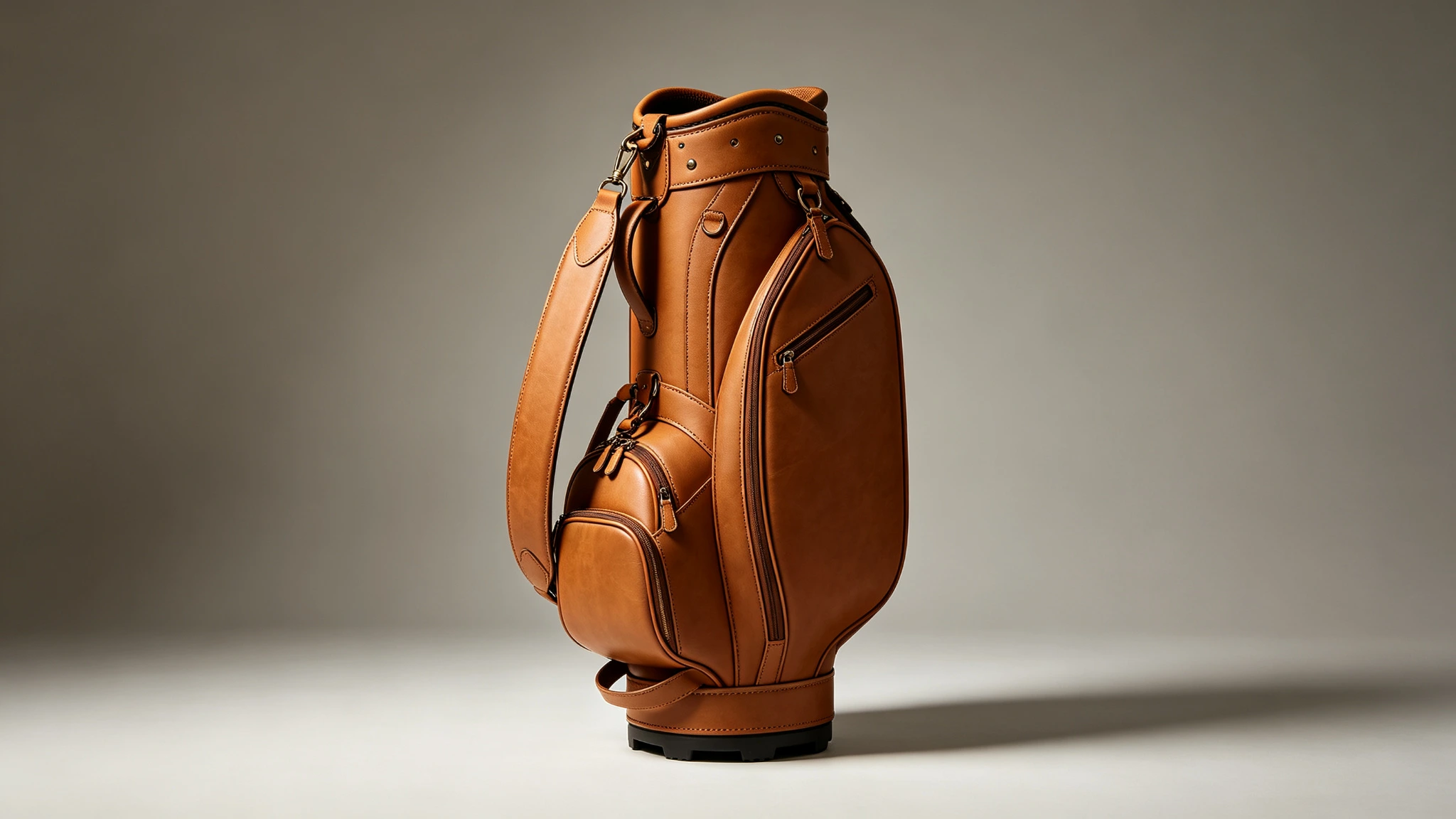
Cart and trolley players choose cart bags: 14-way tops, forward-facing pockets, strap channels — and here leather can go fuller, since weight barely matters on wheels. Caddie-and-car players own the staff silhouette: the 9.5-10.5 inch tour proportion, maximum leather presence, 11-14 lbs of ceremony. Casual and winter golfers add a pencil or Sunday carry: 6-10 clubs, 3.5-5 lbs, the leather purist’s second bag.
The two-bag reality of serious players deserves planning: most committed golfers eventually own a primary bag matched to their usual format plus a secondary for the exceptions — and leather rewards the strategy. A saffiano cart bag for medal play plus a waxed Sunday carry for evening nines covers a season beautifully, and the two bags age in different, equally satisfying directions.
The silhouette decision also carries a storage and transport implication buyers forget: staff bags demand car boots and locker space their 10.5-inch collars actually fit; cart bags must match the trolley or cart system in use (strap channels and base shapes vary by brand); stand bags travel easiest for the flying golfer. Measure the boot, check the trolley, consider the travel schedule — the most beautiful bag is the wrong bag if it does not fit the life around the golf.
Decision Two: Verify the Leather Grade
Leather grade is where premium claims live or die, and the audit is physical. The thumbnail test: press into a hidden zone — full-grain shows natural pore structure and the mark fades as fibres recover; coated splits show mechanically uniform texture and keep the mark. The smell test: full-grain carries tanned-hide aroma; coated composites smell of solvent or nothing. The edge test: hand-finished edges show multiple thin, smooth, flexible coats; cheap edges show single thick coats that whiten or crack when bent.
The vocabulary audit matters as much: "full-grain" is the intact top layer (the only grade that patinas); "top-grain" is lightly sanded (good, not great); "genuine leather" is a legal term for coated splits (the budget class wearing a noble word); "leather" unqualified, on a bag under $400, deserves automatic suspicion. Our grade comparison details the spectrum with cross-section photos.
The spec-level verification for serious buyers: ask for the hide substance (1.4-1.6 mm at panels for bags), the tanning method (vegetable or combination for heritage builds), and the finish family (aniline, semi-aniline, waxed, pigmented, saffiano — each a different ownership experience). Sellers of genuine quality answer these instantly; sellers of leather-look change the subject.
Decision Three: Construction Tells That Predict Decades
Construction decides whether a leather bag reaches year ten, and the tells are visible in any showroom. Stitch density: 8-10 stitches per inch at stress curves in bonded nylon or waxed linen thread, dead straight; budget builds run 5-6 and wander at curves. Stress-point reinforcement: strap anchors, collar rim and base corners should show bar-tacks, backing patches or double rows — the points where cheap leather bags actually fail.
The base deserves its own check: leather bases on cart bags grind against cart frames and trolley brackets, and honest builds run moulded composite or reinforced technical bases at the wear zone with leather above it. A full-leather base on a cart bag is not luxury; it is a design error that announces itself by mid-season. Stand bags similarly need replaceable feet and aluminium legs, not fixed plastic.
The interior tells complete the audit: divider construction (full-length, fabric-wrapped), pocket lining (twill or suede-touch, not crackling film), zipper quality (moulded-tooth or metal, running smooth under one finger — our hardware guide explains why zippers outlive or kill premium bags), and rain hood quality. The interior is where cost hides; premium builds spend there anyway.
The weight-of-evidence point about construction tells: no single tell is decisive, because any one can be faked at the sample level — a factory can finish one golden unit beautifully. The decisive pattern is consistency across tells: when edges, stitching, hardware, interior and base ALL pass, the build system behind them is genuine, because faking all five simultaneously costs more than doing the work. Audit broadly, and the impostors run out of places to hide.
Decision Four: Match the Finish to Your Temperament
Finish choice is temperament choice, honestly assessed. If you want the bag to look at year three exactly as at unboxing, choose engineered finishes: pigmented (maximum consistency, wipe-clean) or saffiano (cross-hatch texture, wax-sealed, scratch-dispersing). If you want the bag to record your golf — every round adding to its story — choose living finishes: waxed pull-up (marks that heal, water that beads, patina that dramatises) or semi-aniline (natural grain, refined patina, moderate forgiveness).
The care-truth table keeps the choice honest: pigmented and saffiano want a damp cloth and nothing else; semi-aniline wants conditioning every 2-3 months and prompt stain attention; waxed wants annual re-waxing and celebrates neglect; full aniline wants a careful owner and rewards one. Choose the finish whose care rhythm you will actually keep — the wrong match converts a premium purchase into a guilt object.
Colour interacts with finish: dark browns and blacks forgive everything and suit every finish; tan and cognac patina most dramatically in waxed and aniline; white exists only as engineered pigmented builds (our white guide explains why); two-tone architectures demand the precision constructions in our two-tone guide. Choose finish first, colour second — the finish decides what the colour does over time.
Decision Five: Price Tiers and What They Should Buy
The honest 2026 tiers: $450-800 buys leather-hybrid stand bags and entry leather-trim builds — genuine leather at the touch points, engineered panels elsewhere; this is the value apex for weekly walkers. $600-1,300 buys full-leather heritage carries, saffiano cart bags and top-grain staff builds. $900-1,500+ buys genuine full-grain staff bags with hand-finished construction. $1,200-5,000+ buys bespoke bench-built commissions.
The sub-$400 warning zone: at this retail, "leather" means coated splits or leather-look PU — legitimate materials with honest 1-3 season lives, marketed with borrowed prestige. The tell is arithmetic: Grade A full-grain hide for a staff bag costs a meaningful share of $400 before any labour. Buy sub-$400 knowingly as a synthetic purchase, or save into the tiers where the word leather means something.
The value metric that resolves every tier comparison: cost per season of expected service. Full-grain at $900 over 15 seasons is $60 per season; coated splits at $250 over 2 seasons is $125 per season — the "expensive" bag costs half as much per year and looks better every one of them. Premium leather is not a luxury purchase; it is an arithmetic one.
The Ownership Reality: Care, Repair and Resale
Premium leather ownership includes a care rhythm — wipe after rounds, condition quarterly, store dry and shaped — that totals perhaps twenty minutes per season. The full protocol is in our care guide. What the rhythm buys: a bag that looks better at year five than at purchase, which no synthetic bag in any tier can claim.
Repairability is leather’s hidden asset: restitching, edge refinishing, hardware replacement and professional reconditioning extend service indefinitely, and a quality maker or leather workshop keeps the bag in play for decades. Synthetics offer no equivalent — their failure modes are terminal. The repair economy is also the sustainability economy: the longest-lasting bag is the greenest one, whatever its material.
And resale: quality leather bags hold 40-60% of retail on secondary markets after years of use, with vintage builds occasionally appreciating. The purchase is closer to an asset than an expense — a consideration no synthetic tier offers. Choose well once, care lightly, and the bag returns value at every stage: daily pleasure, decade service, eventual resale.
The psychological dividend completes the ownership picture: leather owners report a relationship with their bags that synthetic owners do not — the bag becomes the companion of rounds, trips and seasons, accumulating associations with the patina. Golf is a game of rituals and memories, and leather is the only bag material that participates in both. That is not a spec-sheet argument, but ask any ten-year leather bag owner whether they would sell, and watch the answer arrive before the words.
The Bottom Line
The framework in five lines: silhouette follows how you play (hybrid for walkers, full leather for cart and caddie formats); leather grade verified physically (thumbnail, smell, edge tests); construction audited at stitch, base and interior; finish matched to your honest care temperament; price tiered where construction is honest ($450+ hybrids, $900+ full-grain staff).
The meta-lesson: premium leather rewards the literate buyer — the tests in this guide take five minutes in a showroom and filter out 90% of leather-look marketing. Grade, construction and finish are knowable before purchase; only price is negotiable after.
For the brand or club buyer, the same framework scales: our programme builds every silhouette and finish class at MOQ 200 with 100-piece trials, 6–10 day samples, 35–50 day bulk. The quote page starts the conversation — bring the framework, and let us pass every test in it.
And a note on timing the purchase: leather bags reward buying quality once rather than upgrading through tiers — the buyer who purchases a $300 coated-split bag, replaces it at year two with a $500 hybrid, and arrives at full-grain at year five has spent more than the full-grain price and owned disappointment twice. If the framework points you to leather and the budget needs time, the honest advice is to wait and buy once. The bag you save for is the bag you keep.
The framework’s final use is conversational: take it into the showroom and ask the questions aloud. Sellers of genuine quality lean in — the thumbnail test, the grading vocabulary and the finish questions are the language of people who love the material. Sellers of leather-look deflect toward brand and lifestyle. The questions are free, take five minutes, and tell you more about the bag than any review site: the seller’s reaction to informed questions is itself the sixth tell. Bring the framework, ask the questions, and buy with the confidence of a buyer who cannot be fooled — because after this guide, you cannot be.
Choose With Confidence
Send the silhouette and finish direction. We return samples that pass every test in this guide, in 6–10 days, quoted at MOQ 200.
Request a Quote →People Also Ask
How do I choose a premium leather golf bag?
Five decisions in order: (1) silhouette matched to how you play — hybrid stand bags for walkers, full-leather cart and staff bags for riders and caddie formats; (2) leather grade verified by thumbnail, smell and edge tests — full-grain at 1.4-1.6mm; (3) construction audited at stitch density (8-10/inch), base engineering and interior quality; (4) finish matched to your care temperament; (5) price tier where construction is honest ($450+ hybrids, $900+ full-grain staff).
What is the best leather grade for a golf bag?
Full-grain — the hide’s intact top layer: strongest fibre, natural grain, and the only grade that develops patina. Within full-grain, look for Grade A/B+ hides from back and butt zones at 1.4-1.6mm substance. Top-grain is a good second; "genuine leather" (coated splits) is a budget material with a 1-3 season life that borrows the leather name. Our grading guide gives the full audit.
How can I tell if a leather golf bag is real quality?
Five showroom tests: thumbnail (natural pores, fading mark = full-grain; uniform texture, lasting mark = coated), smell (tanned hide versus solvent), edges (multiple thin flexible coats versus single thick cracking coats), stitching (8-10 per inch, straight at curves), and hardware (solid metal’s weight and cold versus plated alloy). Finish with the warranty line — the maker’s own durability estimate in plain print.
Which leather golf bag silhouette should I buy?
Match your real format: carry your own bag weekly → leather-hybrid stand bag (5-7 lbs). Cart or trolley player → full-leather or saffiano cart bag. Caddie/car formats and maximum presence → staff bag (11-14 lbs). Casual nines and winter golf → leather Sunday/pencil carry (3.5-5 lbs). Serious players often run two: a practical primary plus a heritage secondary.
Are expensive leather golf bags worth it?
On cost per season, premium leather is the cheapest option: $900 full-grain over 15 seasons = $60/season versus $250 coated splits over 2 seasons = $125/season. Add patina (aesthetic appreciation), repairability (indefinite service extension) and 40-60% resale retention, and the premium tier returns value at every stage. The expensive bag is the arithmetic choice, not the indulgent one.
What finish should I choose on a leather golf bag?
Match your temperament honestly: want unboxing looks preserved → pigmented or saffiano (wipe-clean, minimal care). Want the bag to record your rounds → waxed pull-up or semi-aniline (living finishes that patina dramatically, with quarterly conditioning). Heirloom-tier with a careful owner → full aniline. The wrong finish-temperament match converts premium purchases into guilt objects; the right one into decade-long relationships.
How much does a good leather golf bag cost in 2026?
Honest tiers: $450-800 leather-hybrid stand bags; $600-1,300 full-leather carries and saffiano cart bags; $900-1,500+ genuine full-grain staff bags; $1,200-5,000+ bespoke commissions. Below $400, "leather" means coated splits or leather-look synthetics — legitimate materials with 1-3 season lives, but buy them knowingly. The full class ranking is in our 2026 best-of guide.
Is a leather golf bag practical for walking?
In hybrid construction, yes: leather at collar, pockets and handle over technical panels runs 5-7 lbs with dual padded straps — genuinely walkable. Full-leather stand bags at 9-11 lbs punish 18 holes of carrying and suit cart conversion or occasional walkers. Leather Sunday carries at 3.5-5 lbs are the lightest leather option. Choose by honest carry reality, not aspiration.
How do I care for a premium leather golf bag?
Wipe with a damp cloth after rounds; pH-neutral leather cleaner monthly in season; condition every 2-3 months with matched conditioner (thin coats, buffed); store dry, shaped, away from heat and sun. Never household cleaners, boot sprays or car-boot summers. Waxed finishes want annual re-waxing only. Twenty minutes per season protects a twenty-season bag — full protocol in our care guide.
Can leather golf bags be repaired?
Extensively — restitching, edge refinishing, hardware replacement, panel patching and professional reconditioning are standard leather repairs that extend service indefinitely. Synthetic bags offer no equivalent: coating failure is terminal. Repairability is leather’s hidden asset for both total cost and sustainability, and a quality maker supports it with parts and service for the product’s life.
What hardware should a premium leather golf bag have?
Solid brass or gunmetal at every touch point — zippers, buckles, D-rings, studs — verified by weight and cold. Zippers deserve specific audit: moulded-tooth or metal, running smooth under one finger, because zipper failure kills more premium bags than leather failure. Plated alloy hardware is the premium-impostor tell: it corrodes green at plating failure within seasons. Detail in our hardware guide.
Should I buy leather or synthetic for my next golf bag?
Leather if: premium positioning matters, you keep bags 5+ seasons, you value patina and repairability, and the budget reaches $450+. Premium synthetic if: wet climate with zero-maintenance priority, tight budget, or aggressive price-point channels. The full data-backed comparison is in our leather vs PU analysis — the honest answer for most brands is both, tiered.
What is the warranty on a quality leather golf bag?
Quality builders warrant leather bags for 2-5 years on construction, with lifetime repair support on leather and hardware — the material deserves and gets long backing. One-year warranties with broad exclusions are the leather-look tell: the maker’s own durability estimate printed in plain sight. Read the warranty before the marketing; it is the most honest line in the listing.
Can I order a custom premium leather golf bag?
Yes: individual bespoke commissions ($1,200-5,000+) for one-off builds, and programme custom for brands, clubs and corporate buyers — MOQ 200 with 100-piece trials, 6–10 day sampling, 35–50 day bulk, with hides, finishes, hardware and branding all to brief. The quote page starts both conversations.
Do leather golf bags make good gifts?
The pinnacle of golf gifting: a leather bag with debossed name or crest is heirloom-grade — chairman’s prizes, executive recognition, member milestones. Choose the recipient’s silhouette honestly (hybrid for walkers, cart bag for riders), include the care card, and the gift compounds for decades. Programme personalisation runs at MOQ 200 with 100-piece trials for clubs and corporate buyers.
Sources & Authority
Framework and tier analysis reflect 2026 premium golf retail observation plus 200+ leather bag programmes at QUANZHOU JUNYUAN BAGS since 2014. Construction standards from our AQL 2.5 QC framework (SGS-verified March 2026), with audit methods from our factory intake and QC protocols.