The Best Leather Golf Bags for 2026: The Definitive Buyer’s Ranking
The best leather golf bags for 2026 share four specs: full-grain hides at Grade A or semi-aniline quality, substance of 1.4-1.6 mm at the panels, hand-finished edges and stress-point stitching, and hardware in solid brass or gunmetal — at retail from $450 for premium stand silhouettes to $1,500+ for hand-built staff bags. Below we rank the five leather bag classes worth buying this year, the construction tells that separate genuine quality from leather-look marketing, and the OEM path for buyers who want a leather bag built to their own spec. Our builds run across the leather bag programme.
QUANZHOU JUNYUAN BAGS, established 2014 in Quanzhou, Fujian, manufactures through an affiliated factory of 4,950 m², 7 production lines, 149 machines (126 sewing stations) and 137 staff — rated at 200,000 pieces per month, actual output around 150,000. Every order runs AQL 2.5 inspection, MOQ 200 (100-piece trial), sampling 6–10 days, bulk 35–50 days, with BSCI, ISO 9001:2015, CE, CPC and RoHS certifications (SGS audit, March 2026). We serve 200+ brands in 100+ countries.
How This Ranking Works
Leather bag rankings elsewhere conflate brand fame with build quality; this one ranks construction. Every class below is judged on five axes: leather grade (full-grain beats top-grain beats corrected, and within full-grain, hide grading decides everything), construction (stitch density, edge finishing, stress-point reinforcement), hardware (solid metal versus plated alloy), aging trajectory (does year three look better or worse than unboxing), and value at its retail tier.
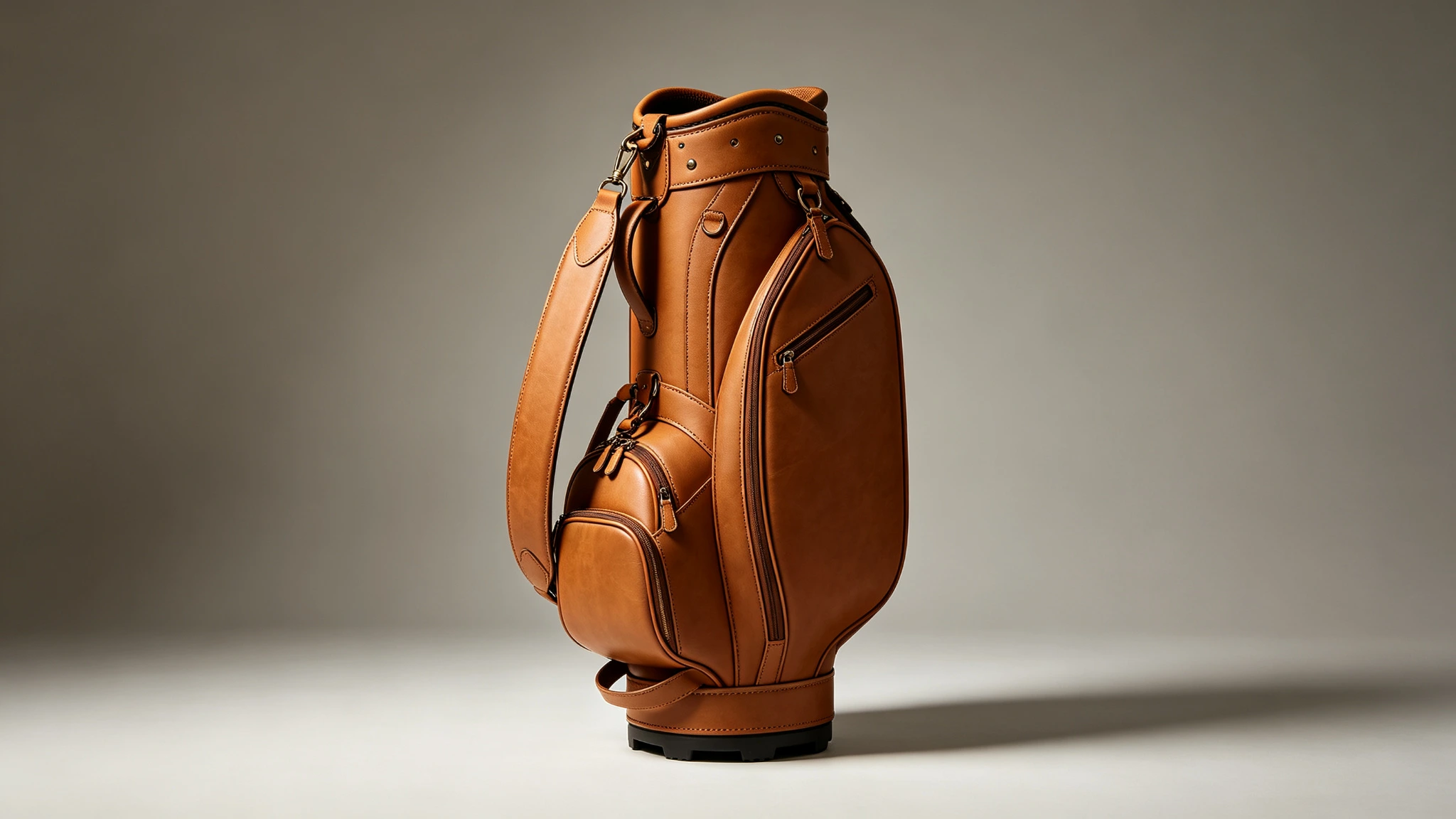
The bias to declare: we manufacture leather golf bags for 200+ brands, so we have seen inside more of this category than any reviewer — the stitched seams, the leather cross-sections, the hardware after three seasons. That factory-floor view is what this ranking offers: not which bag has the best advertising, but which construction choices actually survive golf.
The 2026 context matters: the leather bag market has bifurcated into genuine-craft builds (rising, as premium buyers get more materials-literate) and leather-look marketing (also rising, as "leather" claims drift onto coated splits). The classes below are the genuine article — and each section includes the tells for spotting the impostors in that class.
Class 1: The Full-Grain Staff Bag ($900-1,500+)
The staff silhouette in full-grain leather is the category’s apex: the tour-proportioned 9.5-10.5 inch collar, six-plus pockets, the display panel that dominates golf’s visual culture — executed in hide that will outlive its first owner. The best 2026 builds run Grade A full-grain at 1.5-1.7 mm, semi-aniline or waxed finishes, saddle-stitched stress points, and solid brass or gunmetal hardware throughout.
What separates the top of this class: edge work (hand-painted, multi-coat, flex-tested edges versus single-pass machine edges that crack at the collar fold within a season), the display panel’s hide zone (back/butt leather with tight grain versus flank-sourced panels that stretch and wrinkle), and the internal engineering (a leather staff bag carries 18-22 lbs of clubs; the best builds run hidden composite frames so the leather is the skin, not the structure).
The impostor tell in this class: "full-grain" staff bags under $600 retail. The hide cost alone for a genuine Grade A staff build approaches that figure before a single stitch — sub-$600 "full-grain" is corrected grain or split-based composite wearing the word. Our hide grading guide gives the full audit method.
Class 2: The Premium Leather Stand Bag ($450-800)
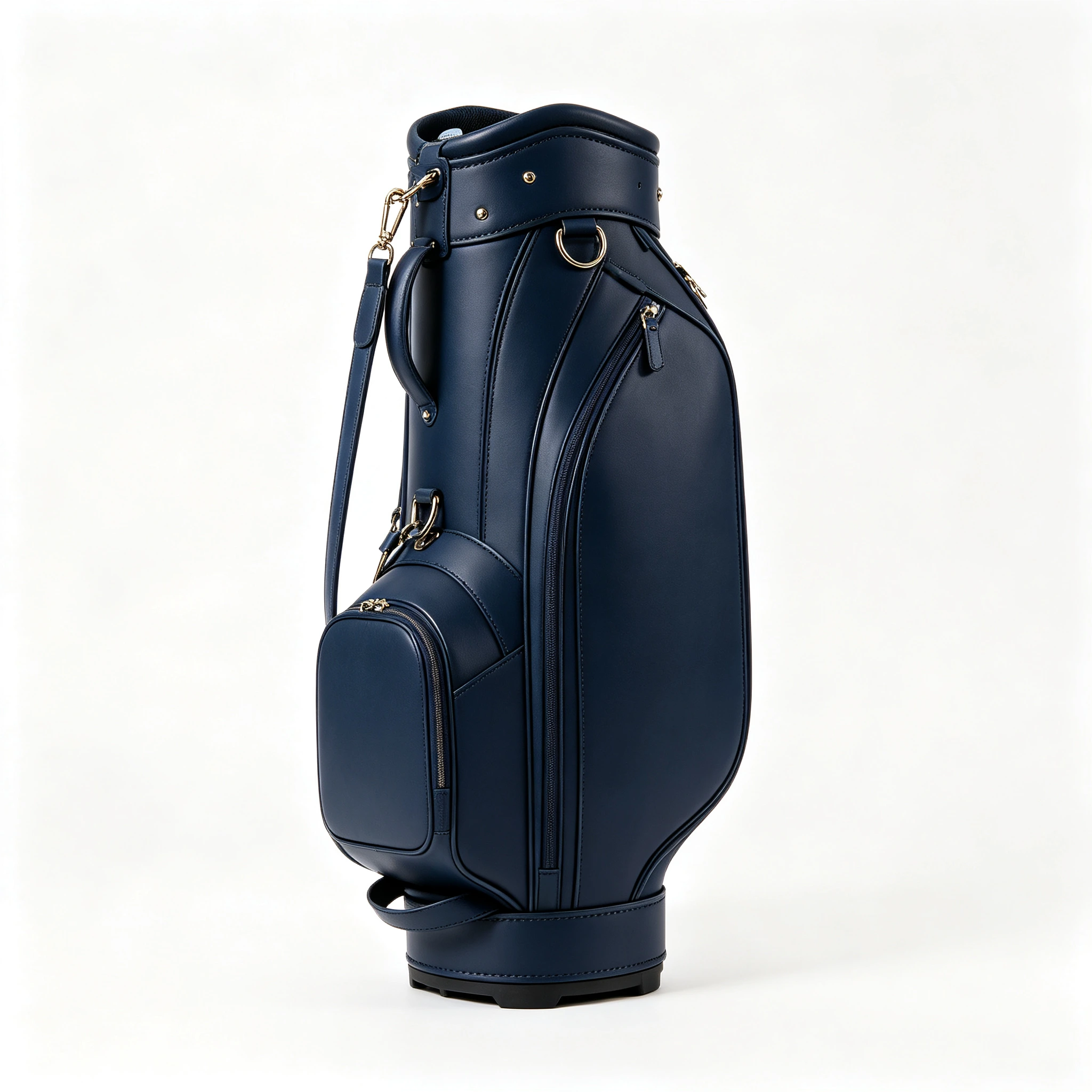
The leather stand bag is 2026’s fastest-growing class: the walking golfer’s silhouette upgraded to leather, typically as a hybrid — leather at the prestige zones (collar, pocket faces, handle, spine) over technical nylon or PU body panels, keeping carry weight at 5-7 lbs where full-leather would run 9-11. The best builds place the leather exactly where eyes and hands go, and engineer the stand mechanism to cart-bag durability standards.
What separates the top: the hybrid junctions (leather-to-fabric seams are the failure point of cheap hybrids — look for reinforced binding and backed stitching), the stand hardware (aluminium legs with replaceable feet versus fixed plastic), and strap systems (dual padded straps with leather reinforcement at the anchor points, where cheap builds tear first).
The honest positioning: a leather-hybrid stand bag at $450-800 delivers 80% of the leather experience at 60% of the weight and half the price of full-leather — for the weekly walker, it is the rational apex of the category. The full-leather stand bag exists for the collector who walks occasionally; the hybrid is for the player who walks always.
Class 3: The Vintage Heritage Carry ($600-1,200)
The vintage class rides 2026’s strongest aesthetic current: Sunday-carry and pencil silhouettes in vegetable-tanned and waxed pull-up leathers, brass hardware, canvas-leather hybrids, minimal pockets, maximum patina. The best builds are the most traditional: veg-tan at 1.6-1.8 mm, saddle stitching in waxed linen thread, solid brass throughout, and zero synthetic content visible anywhere.
What separates the top: leather provenance (named tanneries with heritage credentials versus anonymous "veg-tan"), hardware authenticity (cast solid brass that patinas with the leather versus brass-plated alloy that corrodes green at the plating failure), and pattern fidelity to the era (the 1950s-70s silhouettes have specific collar and pocket geometries; pastiche versions get them wrong). Our vintage trends analysis maps the revival’s design codes.
The ownership proposition is unique in the category: a waxed pull-up heritage carry looks its absolute best at year five, not at unboxing — the purchase is the beginning of the bag’s aesthetic ascent. For the buyer who wants a bag that records their rounds, no other class competes. The impostor tell: "vintage-look" builds in PU with printed patina — the aging is faked at the factory and never develops further.
Class 4: The Luxury Cart Bag ($700-1,300)
The leather cart bag serves the cart-and-trolley player with the silhouette golf actually uses most: 14-way tops, forward-facing pockets, cart-strap channels — executed in leather at the visible architecture with engineered panels underneath. The best 2026 builds pair semi-aniline or saffiano leather display surfaces with technical bases (cart abrasion is leather’s enemy), and run insulated pockets, waterproof valuables pouches and full-length dividers inside the luxury skin.
What separates the top: the base engineering (leather cart bags die at the base — the best builds run moulded composite or reinforced technical bases, not leather, where the cart frame grinds), divider construction (full-length, fabric-wrapped, versus partial dividers that tangle grips), and the strap-channel design that secures the bag without crushing its leather panels.
The saffiano sub-trend deserves note: cross-hatch waxed leather on cart bags is 2026’s contemporary-luxury answer — wipe-clean, scratch-dispersing, structured — for buyers who want leather authority with zero care anxiety. Our finish playbook compares saffiano against the living finishes.
Class 5: The Bespoke Commission ($1,200-5,000+)
The fifth class is not a silhouette but a path: the fully bespoke leather bag, built to one customer’s spec — chosen hides, chosen hardware, hand-stitched throughout, initials or crest worked into the panels. At the top of the market this is the genuine luxury answer: not a bag from a brand, but a bag from a bench. Our hand-stitched craft guide documents what bench-built actually involves.
What separates the real bespoke offer from "customisation": material choice at the hide level (the customer selects from actual hides, not colour swatches), construction choice (saddle stitching versus machine, edge finishing standard, thread and hardware spec), and the maker’s direct involvement (a named craftsman with a bench, versus a "custom programme" that is a monogramming station).
The OEM bridge: brands and clubs can access this class at programme scale — bespoke-spec leather builds at MOQ 200 with 100-piece trials deliver commission-grade construction for member shops, winner’s circles and pinnacle gifting. The gap between one-off bespoke and programme bespoke is logistics, not quality — and closing it is what manufacturing partners are for.
The Construction Tells: Spotting Real Quality
Five checks separate genuine leather quality from leather-look marketing, in any showroom: the edge test (hand-finished edges show multiple thin coats, smooth and flexible; cheap edges show single thick coats that crack when bent), the stitch test (quality runs 8-10 stitches per inch in bonded thread, dead straight at stress curves; cheap runs 5-6, wandering), and the hardware test (solid brass or gunmetal has weight and cold; plated alloy is light and warm).
The leather test: press a thumbnail into an inconspicuous zone — full-grain shows the hide’s natural pore structure and the mark fades; coated splits show uniform texture and the mark stays. And the smell test: genuine leather carries the tanned-hide aroma; coated synthetics smell of solvent or nothing. The nose is the oldest authentication tool in leather goods and it still works.
The warranty tell closes the audit: builders of genuine leather bags warrant them for years (the material deserves it); sellers of leather-look offer 12 months and exclusions. The warranty is the manufacturer’s own durability estimate, printed in plain sight — read it as the most honest line in the listing.
Care: Protecting the Investment
A leather bag’s ranking at year five depends on its owner as much as its builder, and the care rhythm is simpler than its reputation: wipe after rounds (damp cloth, ninety seconds), condition every 2-3 months (matched leather conditioner, thin coats, buffed), and store dry and shaped (dust bag, loosened straps, away from heat and sun).
The mistakes that kill leather bags are all chemistry: household cleaners stripping finishes, waterproofing sprays meant for hiking boots suffocating the grain, and prolonged car-boot storage cooking the fibres in summer heat. The full protocol is in our leather care guide — twenty minutes per season protects a twenty-season bag.
The repairability dividend completes the ownership case: leather bags repair — restitching, edge refinishing, hardware replacement, professional reconditioning — so the ranking at year ten favours leather exclusively. No synthetic class offers a decade view; leather’s total cost per season falls below mid-range synthetics by year six, and the bag keeps improving the whole way.
OEM: Build the 2026 Leather Bag
For brands reading this ranking as a product roadmap: every class above is buildable at programme scale. Full-grain staff and cart builds run MOQ 200 with 100-piece trials; leather-hybrid stand bags engineer the junction discipline into the pattern; heritage carries spec veg-tan lots with named tanneries; bespoke-grade construction scales to member-shop and trophy programmes.
Terms hold across classes: sampling 6–10 days with hide-lot approval, bulk 35–50 days under AQL 2.5, hardware and finish samples approved as physical masters before cutting. The 2026 development calendar rewards early briefs: Q1 sampling lands summer retail; Q3 sampling lands the holiday and spring ranges.
The ranking’s commercial read: leather is the category’s margin and story engine, and 2026’s materials-literate buyer rewards construction honesty over brand noise. Build the bag that passes the five tells, warrant it like leather deserves, and the ranking takes care of itself. Start at our quote page.
The Bottom Line
The best leather golf bags of 2026: full-grain staff bags at the apex, leather-hybrid stand bags for the walking majority, waxed heritage carries for the patina collectors, saffiano-trimmed cart bags for the contemporary player, and bespoke commissions for the pinnacle — every class defined by construction, not by marketing.
The buyer’s toolkit is the five tells: edge work, stitch density, hardware weight, the thumbnail test, the smell test — plus the warranty line that prints the maker’s own durability estimate. Apply them, and leather-look marketing stops working on you.
Whether buying one bag or building a range, the principle holds: in leather, construction is destiny. Choose the hide, the stitch and the hardware like they decide the next decade — because they do. Samples return in 6–10 days from the quote page.
One closing prediction: the leather classes in this ranking will look different in 2030 only in one respect — the materials-literate buyer will be the majority, not the minority. The five tells that now filter connoisseurs will be common knowledge, and the builds that pass them will be the market. Buying into genuine construction in 2026 is not just this year’s best purchase; it is early membership of where the whole category is going.
Build Your 2026 Leather Bag
Send the class and the spec direction. We return construction-grade samples in 6–10 days, quoted at MOQ 200.
Request a Quote →People Also Ask
What are the best leather golf bags for 2026?
Five classes lead: full-grain staff bags ($900-1,500+, Grade A hides, saddle-stitched stress points), leather-hybrid stand bags ($450-800, leather at prestige zones over technical bodies), vintage waxed-leather carries ($600-1,200, veg-tan and solid brass), saffiano-trimmed luxury cart bags ($700-1,300), and bespoke bench-built commissions ($1,200+). The shared specs: full-grain leather, 1.4-1.6mm panels, hand-finished edges, solid hardware, multi-year warranties.
Are leather golf bags worth the price?
On cost-per-season, yes for premium buyers: a $900 full-grain bag over 15 seasons costs ~$60 per season versus ~$75 for a $300 synthetic replaced every 4 seasons — and the leather bag improves aesthetically and retains resale value. Add repairability (leather restitches and reconditions; synthetics die) and the premium is buying the cheapest decade in golf bags, not the most expensive purchase.
What should I look for when buying a leather golf bag?
Five tells: edge work (multiple thin flex-tested coats versus single thick cracking coats), stitch density (8-10 per inch at stress curves), hardware (solid brass/gunmetal by weight and cold), the thumbnail test (natural pore structure fades the mark; coated splits keep it), and smell (tanned hide versus solvent). Then read the warranty — it prints the maker’s own durability estimate.
Full-grain or "genuine leather" — what is the difference?
Everything: full-grain is the hide’s intact top layer (strongest, patinas, lasts decades); "genuine leather" is a legal term covering split hides coated with polyurethane — the leather category’s budget class, serving 1-3 seasons before the coating fails. A $1,200 full-grain bag and a $200 "genuine leather" bag are different materials sharing one word. Our grading comparison details the spectrum.
How much should a good leather golf bag cost?
Retail benchmarks for genuine construction: leather-hybrid stand bags $450-800, full-grain cart and heritage carries $600-1,300, full-grain staff bags $900-1,500+, bespoke commissions $1,200-5,000+. Below $400, "leather" claims deserve the five-tell audit — genuine full-grain hide cost alone approaches that figure on staff silhouettes before construction begins.
Do leather golf bags hold up in rain?
Properly finished leather handles rain rounds well — waxed and pigmented finishes shed water, and the post-round discipline (wipe down, air dry away from heat, condition after wet weeks) keeps the leather healthy for decades. Vintage full-grain bags survive 50 years of weather. The enemies are neglect and car-boot heat, not rain. Full protocol in our care guide.
Are leather golf bags too heavy to carry?
Full-leather staff bags run 11-14 lbs empty — cart and caddie territory, honestly. The walking answer is the leather-hybrid stand bag: leather at collar, pockets and handle over technical panels, at 5-7 lbs with dual straps. Pencil and Sunday carries in leather run 3.5-5 lbs. Choose the silhouette for the carry reality; leather exists at every weight class through hybrid construction.
What is the best leather for golf bags?
Full-grain cowhide at 1.4-1.6mm, Grade A/B+ hides from back and butt zones. Finish by use: semi-aniline for flagship balance, waxed pull-up for heritage patina, pigmented for white and colour-critical builds, saffiano for wipe-clean contemporary luxury. Vegetable or combination tanning for heritage builds; combination for performance-heritage balance. Grading detail in our hide grading guide.
How long do leather golf bags last?
Full-grain builds: 10-20 seasons with basic care, with vintage examples functional at 50 years — the limiting factor is stitching and hardware, both repairable. Top-grain: 6-10 seasons. Coated "genuine leather": 1-3 seasons. The care rhythm that unlocks the full lifespan: wipe after rounds, condition every 2-3 months, store dry and shaped.
Can I get a custom leather golf bag made?
Yes, at two levels: individual bespoke commissions ($1,200-5,000+, one-off builds to personal spec), and programme custom (brands, clubs and corporate buyers at MOQ 200 with 100-piece trials, 6–10 day sampling, 35–50 day bulk) — chosen hides, finishes, hardware and branding built to the brief. Start at our quote page.
Do pros use leather golf bags?
Tour staff bags are predominantly synthetic-coated for weight, weather indifference and sponsor-colour consistency — they are seasonal marketing instruments. But the leather tour-style bag is the heritage-luxury interpretation of that silhouette for the public, and several tour professionals own leather bags personally for member-guest and charity rounds where the bag is part of the occasion.
What is a Sunday or pencil leather bag?
The minimalist carry: slim single-strap silhouettes holding 6-10 clubs, 2-4 lbs, descended from the bags players carried to casual Sunday rounds. In waxed leather with brass hardware they are the vintage revival’s icons — maximum patina, minimal weight, and the purest expression of leather craft in the category. Our vintage trends guide maps the revival.
How do I clean and condition a leather golf bag?
Clean: damp microfiber wipe after rounds; pH-neutral leather cleaner monthly in season, working in sections. Condition: matched leather conditioner every 2-3 months, thin coats, absorbed 20 minutes, buffed. Never: household cleaners, boot waterproofing sprays, direct heat, prolonged sun or car-boot storage. Waxed finishes need only re-waxing annually. The full protocol is on the care card and in our care guide.
Are leather golf bags good for corporate gifts?
The pinnacle tier of golf gifting: a leather bag with recipient name debossed is an heirloom-grade award that synthetic gifts cannot approach — for chairman’s prizes, executive recognition and winner’s circles. Programme terms make it practical: MOQ 200 with 100-piece trials, personalisation built into the panel spec, presentation boxing standard. The retention of a leather gift is measured in decades, not drawers.
What is the MOQ for a custom leather golf bag programme?
MOQ 200 pieces per design with 100-piece trial runs, sampling 6–10 days including hide-lot approval, bulk 35–50 days under AQL 2.5 with intake grading records available. Hardware, finish and branding samples approve as physical masters before cutting. Begin at our quote page.
Sources & Authority
Retail benchmarks and class analysis reflect 2026 premium golf retail observation and 200+ leather bag programmes at QUANZHOU JUNYUAN BAGS since 2014. Construction standards from our AQL 2.5 QC framework (SGS-verified March 2026). Durability statements reference our QC bench testing and archived programme longevity data.