White Leather Golf Bags: The Colourfastness and Care Playbook
White leather golf bags are the highest-drama colourway in the sport — tour-fresh, photography-perfect, and the most technically demanding shade to keep clean. The answer is finish engineering: pigmented top-coat leathers with ISO 105-X12 colourfastness at grade 4-5, stain-resistant surface treatments, and honest care instructions. This guide covers how white stays white, what buyers should demand, and the OEM specs behind white builds. White builds run in our leather colours hub.
QUANZHOU JUNYUAN BAGS, established 2014 in Quanzhou, Fujian, manufactures through an affiliated factory of 4,950 m², 7 production lines, 149 machines (126 sewing stations) and 137 staff — rated at 200,000 pieces per month, actual output around 150,000. Every order runs AQL 2.5 inspection, MOQ 200 (100-piece trial), sampling 6–10 days, bulk 35–50 days, with BSCI, ISO 9001:2015, CE, CPC and RoHS certifications (SGS audit, March 2026). We serve 200+ brands in 100+ countries.
Why White Is the Statement Shade
White golf bags carry a specific prestige: they are the colourway of tour Sundays and trophy ceremonies, the bag that photographs like nothing else in the category. Against green fairways and blue skies, white pops with a clarity no other shade approaches — which is why tour staff bags, winner’s-circle imagery and premium campaign photography lean white so heavily. A white bag says ceremony, confidence and new money in the best sense.
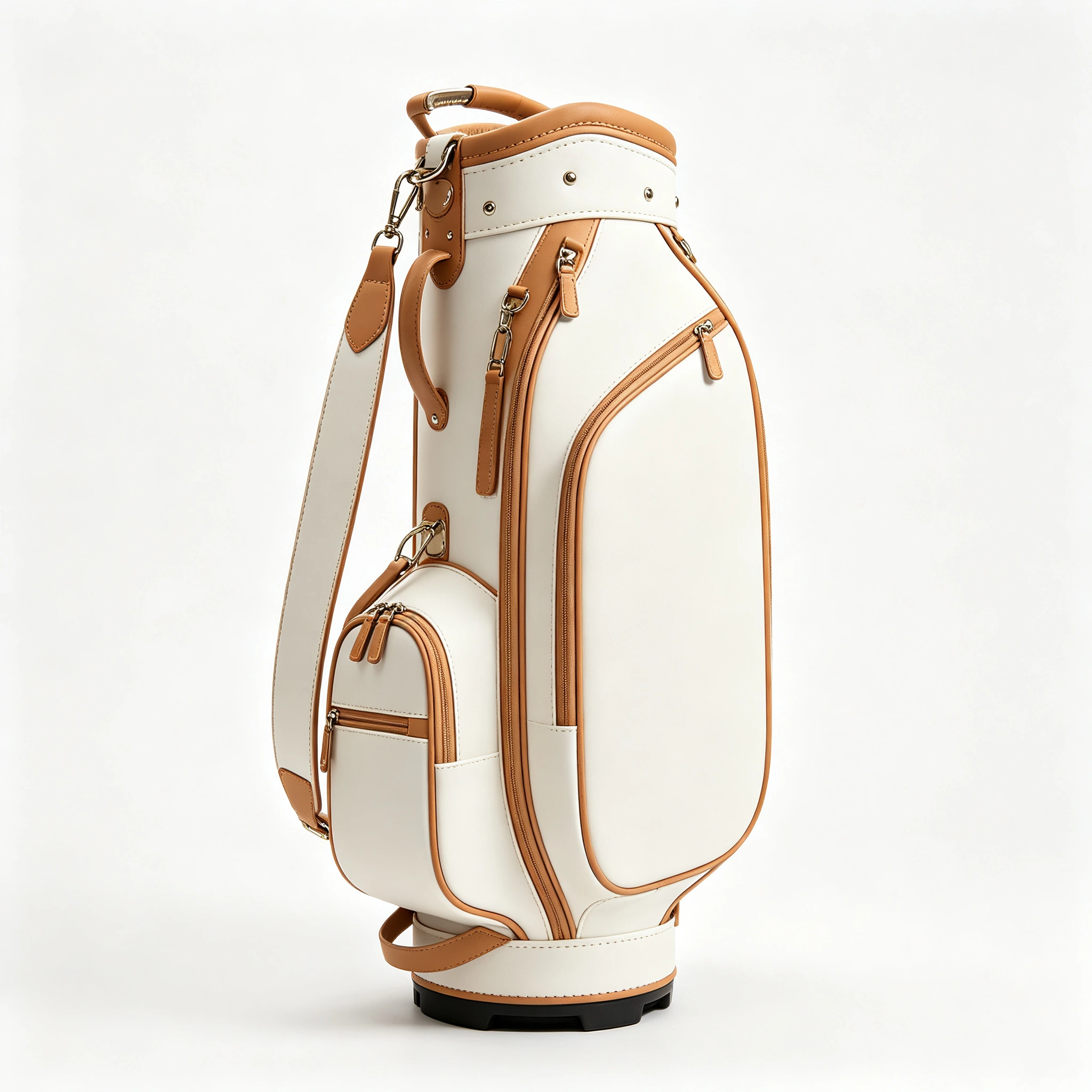
The commercial reality follows the imagery: white is the highest-conversion colourway in premium e-commerce photography and the most-requested shade for limited editions and event builds. It is also the shade with the highest expectation risk — the buyer who falls for white in the photo holds it to showroom standard forever, and white that yellows or stains generates the angriest reviews in the colour spectrum.
So white is a technology conversation before it is a colour conversation. The brands that win white are the ones that spec the finish for the golf course rather than the photo studio — and this guide is that spec: colourfastness grades, stain management, care protocols, and the production disciplines that keep white white.
The Colour Problem: What Attacks White
White leather faces five enemies, and a credible white build defends all five. Dirt and grass: the daily assault — course dust, wet grass stains, mud spray from trolley wheels. Dye transfer: dark clothing, wet towels and navy head covers rubbing colour onto pale panels — the sneakiest stain because it is chemistry, not dirt. UV yellowing: sunlight ambering the finish over seasons, the slow-motion failure.
Skin oils and sunscreen: the handling stains at grips and straps, which darken and shine pale leather exactly where hands work. And water marks: rain spots drying as rings on insufficiently protected finishes. Each enemy has a specific countermeasure, and a white spec that ignores any one of them is a warranty claim on a schedule.
The mindset shift for buyers and brands: white is not fragile, but it is honest — it shows everything, immediately. The correct product promise is not "stays pristine" but "cleans back": a white bag engineered so that everything the course throws at it wipes off again. That promise is achievable, and it is what the finish technology in the next section delivers.
Finish Technology: How White Stays White
White leather that survives golf is pigmented top-coat leather: a full-grain or corrected hide sealed under an opaque white finish coat engineered for cleanability. The finish is the product — it is what stands between the hide and the world. The spec: flexible polyurethane top coats with stain-resistant additives, applied evenly at controlled thickness (too thin wears through; too thick cracks at flex points), over through-dyed pale substrate so any eventual wear does not reveal dark leather beneath.
The laboratory numbers that belong in the tech pack: colourfastness to rubbing ISO 105-X12 grade 4-5 (dry and wet) — the dye-transfer defence, tested both directions (white finish resisting outside dyes, and the finish itself not marking clothing); light fastness ISO 105-B02 grade 5+ for UV yellowing resistance; and flex testing (Bally flex, 50,000 cycles) to prove the finish survives the collar fold and pocket flaps without cracking.
Anti-soiling surface treatments are the third layer: fluorocarbon-free stain guards applied at finishing that make mud and grass wipe off with a damp cloth instead of bonding. The technology is proven (it is the same class of treatment on white leather automotive seats, the hardest-working white leather in the world) — the discipline is specifying it rather than hoping for it. Material grades are mapped in our premium materials library.
Care Protocol: The White Routine
White care is more frequent and less chemical than dark-leather care — little and often beats deep cleans. The after-round routine: damp microfiber wipe-down of the whole bag, attention to the base (trolley and ground contact), the handle zones (skin oils), and any grass-stained panels. Ninety seconds, and the bag never accumulates a patina of grime that later requires chemistry.
The weekly routine for in-season bags: proper wipe with a pH-neutral leather cleaner on a soft cloth, working in sections, drying with a clean towel. The monthly check: inspect high-wear zones (base corners, strap anchors, collar rim) for finish wear, and touch with white colour balm before wear becomes substrate exposure. White balms and creams matched to the bag’s finish are care-kit essentials, not optional extras.
The never-list for white: no household cleaners (they strip the top coat), no magic-eraser melamine sponges on the finish (micro-abrasive — they clean by removing finish), no bleach anything, no prolonged sun storage (UV yellowing is the one enemy that does not wipe off). The full leather care foundation is in our leather care guide; white adds frequency and forbids abrasives.
The seasonal rhythm completes the routine: at season’s end, a thorough clean, a full condition, and a rest in the dust bag away from light; at season’s start, an inspection under good light for any yellowing at stitch lines and piping, where age announces first. Bags stored dirty in autumn emerge stained in spring — the off-season clean is the single highest-value care act of the year. Clubs running white loaner fleets put this on the calendar like course maintenance, and their bags run five seasons looking two.
Stain Triage: What To Do When It Happens
Grass stains: damp cloth immediately; if set, pH-neutral cleaner with a soft brush, working from the stain’s edge inward. Grass is organic and responds well — panic is a bigger risk than the stain. Mud: let it dry, brush off, then damp-wipe — wet mud smears; dry mud lifts. Dye transfer from clothing or covers: the specialist problem — dedicated leather dye-transfer removers exist and work if used promptly; days-old transfer may need professional attention.
Sunscreen: the summer special — wipe immediately with a damp cloth, then cleaner; sunscreen left to bake into finish leaves shiny dark patches that resist later cleaning. Water rings: re-dampen the whole panel evenly, dry slowly away from heat — the tide-line blends as the panel dries uniformly. Ink and marker: professional territory immediately; home remedies spread ink into permanent murals.
The brand-side opportunity: print this triage on the care card and put the card in the box. White buyers who know the triage keep their bags beautiful and their reviews glowing; white buyers who guess at stains create the horror stories. A ¥3 care card protects a ¥3,000 product — the cheapest insurance in the category, and a visible signal that the brand understands its own product.
The dye-transfer emergency deserves its own drill because it is the stain white owners meet most: navy head covers and dark rain gear, damp from a wet round, pressed against white panels for the drive home. The protocol: separate wet dark textiles from the bag before transit (a dry towel between them is enough), and at first sign of transfer, dedicated remover within 24 hours. We print this exact scenario on the white-build care card because it is the one that decides whether a white bag’s first season ends in triumph or in a support ticket.
White in the Range: Where It Wins
White’s commercial roles are specific and powerful. The photography hero: white is the campaign colourway — the shade in the hero shots, the lookbook, the launch imagery — because nothing else photographs with its clarity. The limited edition: white limited runs (majors-themed, anniversary, collaboration) are the segment’s most reliable sell-outs because white reads as event-special by nature.
The two-tone anchor: white panels with black, navy or tan bodies — the tuxedo scheme and its variants — are the highest-drama colour architecture in golf, and white is what makes them work. The tour-tribute build: white staff silhouettes channel Sunday-afternoon imagery directly, and for club and corporate trophy programmes nothing else carries the same ceremony.
The honest channel note: white underperforms in play-every-week volume segments precisely because of its care demands, and brands should weight it accordingly — white is the halo, not the workhorse. Range architecture that positions white as flagship-with-limits sells better and reviews better than white-as-volume. The full colour architecture is in our leather colour guide.
The rental and demo economy adds one more white role: flagship shops and tour-venue rental fleets use white to signal top-tier product, rotating units on a care schedule rather than a failure schedule. A white bag maintained on the 90-second routine survives a full rental season with retail-presentable cosmetics — which is why white dominates the premium demo tier despite its care reputation. Care discipline, not colour, is the variable.
OEM: White-Specific Production Notes
White production is clean-room discipline relative to other shades. The finishing environment must be dust-controlled (every airborne particle is a visible inclusion in white top coat), the sewing room must manage thread-trim and oil discipline (machine oil near white leather is a reject waiting to happen), and packing must be immediate and protective — white bags go from final inspection into individual dust bags and cartons without open-air dwell.
Panel selection for white: the strictest grading we run, stricter even than tan — every hide flaw telegraphs through pale finish, and white bags get display panels from the cleanest hide zones only. Expect lower yield per hide and price accordingly; the buyers who flinch at white’s construction premium are the ones who discover why it exists at the first quality complaint.
Terms: MOQ 200 with 100-piece trials, 6–10 day sampling, 35–50 day bulk, AQL 2.5 with an additional surface-inspection pass under raking light on white runs. White-specific brief fields: finish system (pigmented top-coat with stain guard), colourfastness grades (ISO 105-X12 4-5, ISO 105-B02 5+), care card inclusion, and dust-bag packing. Start the white conversation at our quote page.
The Bottom Line
White leather golf bags are a technology product wearing a colour: pigmented top-coat finishes at ISO 105-X12 grade 4-5, UV-resistant systems at ISO 105-B02 grade 5+, anti-soiling surface treatments, through-dyed pale substrate — and a care protocol printed in the box. Spec those, and white keeps its tour-Sunday promise for years.
White is the halo shade: the photography hero, the limited-edition sell-out, the two-tone anchor, the trophy build. Position it as flagship-with-limits, care-card it honestly, and it returns the highest drama-per-dollar in the colour spectrum.
The final word belongs to expectation-setting: the brands that lose money on white are the ones that sell the photograph and hide the routine; the brands that win it sell both together — the drama and the 90 seconds that protect it. White buyers are not deterred by honesty; they are converted by it, because the customer choosing white has already decided to be seen. Give that customer the engineered finish, the printed triage and the truthful care card, and white becomes the most loyal colourway in the range.
Send the silhouette and the two-tone direction (if any), and white samples — colourfastness-verified, raking-light inspected — come back in 6–10 days. White is not fragile. It is engineered. Spec it that way.
Spec Your White Build
Send the silhouette and finish direction. We return colourfastness-verified white samples in 6–10 days, quoted at MOQ 200.
Request a Quote →People Also Ask
Are white leather golf bags hard to keep clean?
They demand frequency, not heroics: a 90-second damp-cloth wipe after every round, a weekly pH-neutral clean, and prompt stain triage. Engineered white leather (pigmented top-coat with stain guard) is designed to clean back — everything the course throws at it wipes off. The failures come from neglect and from household chemistry that strips the finish, not from the colour itself.
Do white leather golf bags turn yellow?
Cheap finishes yellow from UV exposure; engineered white systems resist it (light fastness ISO 105-B02 grade 5+). Prevention is spec plus storage: UV-stable finish coats, no prolonged sun or car-boot storage, and regular conditioning that feeds the finish. Yellowing is the one white failure that does not wipe off — which is why the spec matters more than the care.
What is colourfastness and why does it matter for white bags?
Colourfastness is a material’s resistance to colour change and transfer, graded by ISO tests. For white bags two directions matter: resisting outside dyes (dark clothing, wet towels rubbing colour onto white panels) and the finish not marking clothing in return. The spec: ISO 105-X12 grade 4-5, dry and wet rub — verified at golden sample, not assumed.
How do you get grass stains out of a white golf bag?
Damp cloth immediately if fresh; if set, pH-neutral leather cleaner with a soft brush, working from the stain’s edge inward. Grass is organic and responds well to prompt, gentle treatment. Never bleach, magic-eraser or household cleaner — they remove the finish along with the stain. Full triage chart is on the care card that ships with our white builds.
Can you use magic eraser on white leather golf bags?
No — melamine foam is micro-abrasive: it cleans by sanding off the finish coat, leaving dulled, vulnerable patches that then stain faster. It is the single most destructive "hack" applied to white leather. The correct chemistry is pH-neutral leather cleaner on soft cloth, with white colour balm for wear zones. Gentle and frequent beats aggressive and rare.
What leather finish is best for white golf bags?
Pigmented top-coat leather: full-grain or corrected hide under an opaque white polyurethane finish with stain-resistant additives, through-dyed pale substrate beneath, and fluorocarbon-free anti-soiling treatment. Lab specs: ISO 105-X12 grade 4-5 rub fastness, ISO 105-B02 grade 5+ light fastness, Bally flex 50,000 cycles. Aniline white does not exist for golf — white is a finish-engineered product.
Is a white golf bag practical for regular play?
With engineered finish and the wipe-down routine, yes — thousands of tour and club players run white bags weekly. The honest caveat: white rewards the owner who enjoys the ritual and punishes the one who wants fit-and-forget. For play-every-week buyers who dislike maintenance, pebbled black or mid browns are the truthful recommendation; white is for those who want the drama and accept the deal.
What is the MOQ for a custom white leather golf bag?
MOQ 200 pieces per design with a 100-piece trial, sampling 6–10 days, bulk 35–50 days under AQL 2.5 with raking-light surface inspection. White runs carry our strictest panel grading (pale finish telegraphs every hide flaw). Brief fields: finish system, colourfastness grades, care card and dust-bag packing. Start at our quote page.
How do you stop dye transfer onto a white golf bag?
Three defences: the finish spec itself (ISO 105-X12 4-5 wet rub resistance), contact management (avoid resting dark wet towels or new indigo clothing against panels), and prompt response (dedicated dye-transfer remover used immediately works; old transfer may need professional help). Navy head covers and dark rain gear are the usual culprits — dry them before contact.
Are white golf bags good for corporate gifts?
Outstanding for ceremony: white photographs best, reads as event-special, and carries metallic and colour branding with maximum clarity. For recipients who will play weekly, include the care card and set expectations honestly; for trophy, display and occasion use, white is unmatched. White limited editions are the most reliable sell-outs in our limited-edition programme data.
What two-tone combinations work with white?
White panels on black (the tuxedo scheme — highest drama), white on navy (yacht-club classic), white on tan (heritage fresh), and white with gold trim (trophy ceremony). White disciplines any partner colour into looking intentional. Two-tone construction demands the highest seam precision in the range — contrast seams expose every millimetre — expect the construction premium and get the precision it buys.
How long does a white leather golf bag last?
Structurally as long as any leather bag — five to ten seasons. Cosmetically, white’s life is defined by finish integrity: engineered top-coat systems hold colour for years under correct care, and white colour balm refreshes wear zones indefinitely. The white bags that fail early are the under-specced ones; a properly finished white build ages into a soft ivory character rather than a shabby grey.
How should a white golf bag be stored off-season?
Cleaned, conditioned, and rested in its dust bag away from light and heat — never in a car boot or sunlit room, where UV yellowing works all winter. Loosen strap tension, stuff pockets lightly to hold shape, and inspect at season start for stitch-line yellowing, where age announces first. Bags stored dirty in autumn emerge stained in spring: the off-season clean is the highest-value care act of the year.
Do white leather golf bags cost more to produce?
Yes — modestly but honestly: stricter panel grading (every hide flaw telegraphs through pale finish), dust-controlled finishing, an extra surface-inspection pass under raking light, and protective packing straight from final inspection. Expect a construction premium in the region of 10-15% over dark equivalents. The buyers who flinch at it discover why it exists at the first quality complaint.
Can white and coloured panels mix in one design?
They are the foundation of two-tone architecture — white panels on black, navy or tan bodies are the highest-drama schemes in golf. The spec doubles in rigour: white panels carry the full colourfastness stack, and adjacent dark panels are tested against them for dye migration (ISO 105-X12 wet rub, panel against panel). The complete architecture is in our two-tone design guide.
Sources & Authority
Colourfastness and finish specifications follow ISO 105-X12 and ISO 105-B02 test standards as applied in QUANZHOU JUNYUAN BAGS material verification, with Bally flex data from our QC bench under AQL 2.5 (SGS-verified March 2026). Channel and edition performance from 200+ OEM brand client programmes.