Leather vs PU Golf Bags: The Honest, Data-Backed Answer
Leather is better for premium positioning, longevity and aging character; PU is better for wet climates, tight budgets and volume channels — and the honest answer for most brands is both, deployed by tier. Full-grain leather lasts 10-20 seasons and appreciates visually; quality PU serves 3-5 seasons at one-third of the ex-works cost. This guide compares the two materials on durability data, aging behaviour, cost structure and channel fit, then maps the two-material range architecture that premium programmes actually run. Both materials run in our product range.
QUANZHOU JUNYUAN BAGS, established 2014 in Quanzhou, Fujian, manufactures through an affiliated factory of 4,950 m², 7 production lines, 149 machines (126 sewing stations) and 137 staff — rated at 200,000 pieces per month, actual output around 150,000. Every order runs AQL 2.5 inspection, MOQ 200 (100-piece trial), sampling 6–10 days, bulk 35–50 days, with BSCI, ISO 9001:2015, CE, CPC and RoHS certifications (SGS audit, March 2026). We serve 200+ brands in 100+ countries.
The Direct Answer
If the question is which material makes the better premium golf bag, the answer is leather — full-grain leather outlasts PU three-to-one, ages from purchase toward beauty instead of toward failure, and carries a perceived value that supports 2-3x retail pricing. If the question is which material makes the better golf bag for every buyer, the answer is: it depends on budget, climate and use pattern — and PU wins real segments honestly.
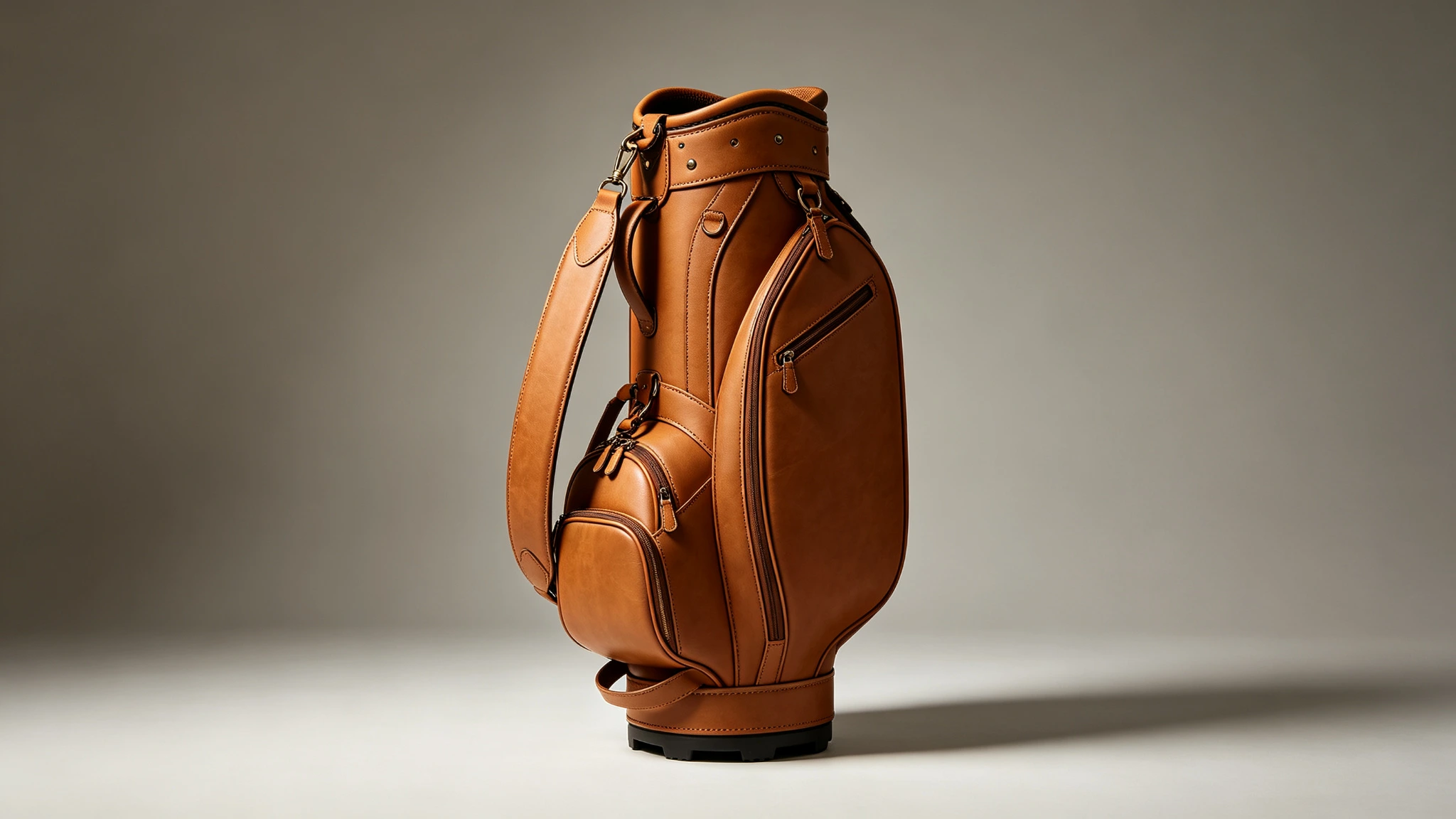
The decision in one paragraph: choose leather when the bag must anchor a premium range, serve a decade, carry a luxury brand or justify a four-figure price; choose PU when the bag must hit an aggressive price point, survive a wet climate with zero maintenance, or serve a volume channel where the customer replaces rather than repairs. Choose both when the range is wide enough to tier — which, for most brands, is the right answer.
What follows is the working comparison behind that answer: the materials’ actual construction, durability numbers from our QC bench, aging curves, cost structures and channel fit — plus the OEM notes for running both materials in one range without confusing the customer.
What Each Material Actually Is
Leather is a biological material: the tanned hide of cattle, its collagen fibre structure preserved and stabilised. Full-grain leather keeps the hide’s dense top layer intact — the strongest, most beautiful part — and its performance comes from that fibre architecture: tensile strength, breathability, and a surface that responds to wear by developing patina rather than deteriorating.
PU "leather" is a composite: a fabric backing (polyester or split-leather base) coated with polyurethane, embossed with a leather-look grain. Its performance comes from the coating’s chemistry: water resistance, colour consistency, surface uniformity. Quality varies enormously — premium microfiber-base PU approaches leather’s hand and exceeds its uniformity; budget PVC-adjacent coatings crack and peel within seasons.
| Dimension | Full-grain leather | Premium PU | Budget PU |
|---|---|---|---|
| Typical lifespan | 10-20 seasons | 3-5 seasons | 1-2 seasons |
| Aging direction | Improves (patina) | Stable, then fades | Cracks, peels |
| Water behaviour | Resistant w/ care | Highly resistant | Resistant until coating fails |
| Ex-works cost index | 100 | 35-50 | 20-30 |
| Retail multiple supported | 2-3x PU | Baseline | Discount channel |
| Maintenance | Condition 2-3 months | Wipe clean | Wipe clean |
The three-way comparison matters because "PU" spans a wider quality range than leather does. When this guide says PU, assume premium microfiber-base PU — the class our premium PU guide covers. Budget PU’s failures (hydrolysis, peeling, cracking) are a different material’s story.
Durability: The Numbers
On our QC bench the durability gap is measurable. Martindale abrasion: full-grain leather exceeds 50,000 cycles without surface failure; premium PU runs 20,000-30,000 before the coating shows wear. Tear strength: leather’s interlocked fibre structure resists propagation — a nick stays a nick; PU coatings, once breached, peel progressively from the breach point. Flex endurance (Bally flex): quality leather passes 100,000+ cycles; premium PU passes 50,000 before micro-cracking at flex lines.
The failure modes differ in kind, not just degree. Leather wears: it scuffs, marks and gradually develops character, with failures arriving as slow edge wear or stitch fatigue — repairable, conditionable, livable. PU fails: hydrolysis (the coating’s chemical breakdown in heat and humidity) arrives on a schedule, typically year 3-5 for premium grades, and presents as peeling, flaking and stickiness — unrepairable, and the end of the product.
The climate caveat cuts both ways: PU’s hydrolysis clock runs fastest in hot, humid storage (a car boot in summer is PU’s worst environment), while leather’s care demands rise in wet playing climates. For a bag living in tropical humidity, neither material is maintenance-free — but leather’s maintenance is possible and PU’s failure is not preventable, only delayed.
Aging: The Diverging Curves
Leather and PU age in opposite directions, and this is the comparison’s deepest point. Full-grain leather’s appearance curve rises for years: patina deepens the colour, handling burnishes the high points, small marks blend into character. A five-year-old full-grain bag in good care is more valuable aesthetically than a new one — the vintage market for old leather golf bags exists because of this curve.
PU’s curve is flat, then falls: the material looks exactly as purchased for its prime years (a genuine advantage — consistency), then the coating begins its decline: fading at UV-exposed zones, micro-cracks at flex points, finally peeling. There is no vintage PU market. The material does not become more itself with time; it becomes less.
The brand implication: leather builds a story the customer participates in (every round adds to the bag), which is why leather bags appear in customers’ social posts years after purchase. PU delivers a product experience that peaks at unboxing. For brands building long-term equity, the material that ages upward is marketing that never stops working; for brands serving transactional channels, PU’s unboxing peak may be exactly the right curve.
Cost Structure: The Full Picture
Ex-works, a full-grain leather bag costs roughly 2-3x its premium-PU equivalent — hide cost, lower cutting yield, slower sewing (leather punishes mistakes permanently), and finishing labour. At retail the multiple holds or grows: leather builds support $400-1,200 retail positions; premium PU serves $150-400. The materials do not compete at the same price point, which is why "which is better" is really "which tier is the brand building".
Cost-per-season reframes the comparison for end buyers: a $900 leather bag over 15 seasons costs $60 per season; a $300 PU bag over 4 seasons costs $75 per season — and the leather bag still has resale value at the end. The leather customer who understands this arithmetic is the premium market’s core; the PU customer who prioritises the $300 outlay is the volume market’s core. Both are rational; they are buying different things.
For brands, the margin structures differ too: leather carries higher absolute margin per unit at lower volume; PU carries percentage margin at volume with faster turns. A balanced range runs both — leather for the flagship and the margin story, PU for the entry tier and the volume engine — with clear material communication so the tiers reinforce rather than cannibalise.
Where PU Honestly Wins
Wet climates: quality PU shrugs off rain rounds with zero aftercare — no drying discipline, no conditioning, no water-spot anxiety. For the UK, Pacific Northwest and tropical markets, PU’s weather indifference is a genuine performance advantage that leather’s care routine cannot match for the maintenance-averse player.
Price-locked channels: big-box retail, promotional programmes, high-volume corporate gifting at tight per-unit budgets — channels where the price ceiling is fixed before the conversation starts. PU delivers a presentable, consistent product inside ceilings leather cannot reach. Colour-critical branding: PU’s coating takes exact Pantone-matched colour with perfect batch consistency, where leather’s natural surface always carries variation — for brand-colour-exact programmes, PU is the controllable material.
And zero-maintenance buyers: the customer who will never condition a bag exists in large numbers and deserves a product engineered for them. That product is quality PU, honestly marketed with a 3-5 season expectation — not leather sold with care instructions the customer will never read.
Where Leather Is Untouchable
Premium positioning: no synthetic carries leather’s authority in the $500+ tier — the material itself is the price justification, legible to every customer. Heritage and story: brands trading on tradition, craft and legacy cannot tell those stories in PU; the material contradicts the message. Patina-driven loyalty: the customer who buys leather joins a years-long relationship with the product, and that relationship is retention marketing no synthetic replicates.
Longevity economics: for clubs, resorts and rental fleets buying for service life, leather’s 10-20 season curve beats PU’s replacement cycle on total cost despite the higher entry price. And the gift/pinnacle tier: a leather bag is an heirloom-grade gift; a PU bag is merchandise. For awards, memberships and executive programmes, the material is the message.
The repairability dimension seals it: leather bags are repairable — restitching, edge refinishing, hardware replacement, professional reconditioning — extending service life indefinitely. PU’s failure modes are terminal. Sustainability-minded buyers increasingly read repairability as the core environmental metric, and on that metric leather stands alone among bag materials.
OEM: Running a Two-Material Range
The architecture that works: leather anchors the flagship tier (2-3 builds: the staff bag, the premium stand bag, the signature silhouette), premium PU serves the volume tier (the play bags, the colour programme, the entry price points), and the tiers share design DNA so the range reads as one family at two altitudes. Material communication is explicit everywhere — the worst outcome is a customer discovering PU where they assumed leather, which converts a tiering decision into a trust event.
Spec notes for running both: PU and leather versions of one silhouette are separate engineering, not a material swap — leather needs structure (it is heavy and gains character with firmness), PU needs weight management (coatings over fabric want different reinforcement). Sampling runs in parallel: 6–10 days per material, MOQ 200 each with 100-piece trials, bulk 35–50 days. Our leather OEM guide and PU quality guide cover each material’s programme detail.
The tiering metrics to watch: leather tier sells on story and photography (invest in both); PU tier sells on price-point and colour (invest in colour accuracy and channel terms). Brands that measure the tiers separately discover they serve different customers — which is the point. Begin the two-material conversation at our quote page.
The Bottom Line
Leather versus PU is not a contest with one winner — it is a tiering decision with two. Leather wins premium positioning, longevity (10-20 seasons), aging character, repairability and resale value. PU wins wet climates, price-locked channels, colour-exact branding and zero-maintenance buyers.
The data-backed answer for most brands: run both. Leather flagship at 2-3x PU’s ex-works cost carrying the margin and the story; premium PU volume tier carrying the channel coverage — with explicit material communication and design DNA shared across tiers.
Send the range plan and the channel mix, and we return both material stories as physical samples in 6–10 days. The question was never leather or PU. It is which customer each material serves — and whether the range serves both.
The final filter is time: if the product decision is judged at unboxing, PU and leather tie — both present beautifully. Judged at year one, leather pulls ahead on feel and character. Judged at year five, the comparison is no longer close: the leather bag is hitting its aesthetic prime while the PU bag approaches its replacement date. Brands that plan in years choose accordingly; brands that plan in quarters should price accordingly.
Build the Two-Material Range
Send the range plan and channels. We return leather and PU samples in 6–10 days, quoted at MOQ 200 per material.
Request a Quote →People Also Ask
Is a real leather golf bag worth the money?
For premium buyers, yes — the arithmetic favours leather: a $900 full-grain bag over 15 seasons costs about $60 per season, while a $300 PU bag over 4 seasons costs $75 per season, and the leather bag retains resale value. Add patina (the bag improves aesthetically for years), repairability and the premium experience, and leather justifies its price for buyers who value longevity. For budget-locked or zero-maintenance buyers, quality PU is the rational choice.
How long does a PU golf bag last compared to leather?
Premium PU: 3-5 seasons before the coating degrades (hydrolysis — peeling, flaking, stickiness — arriving on a schedule, fastest in hot humid storage). Budget PU: 1-2 seasons. Full-grain leather: 10-20 seasons with basic care, improving aesthetically for most of that life. Leather wears and recovers; PU fails terminally. Lifespan ratio is roughly three-to-one in leather’s favour.
Is PU leather actually leather?
Not in the material sense: PU "leather" is a fabric or split-leather backing coated with polyurethane and embossed with a grain pattern. Split-base PU contains some leather fibre but its performance comes from the plastic coating. Full-grain leather is the hide itself, its fibre structure intact. The terms are regulated differently by market — in the EU and US, "PU leather" must be labelled as coated/synthetic material, not leather.
Which is better for rainy climates, leather or PU?
PU, honestly: quality PU coatings shrug off rain with zero aftercare, while leather needs drying discipline and regular conditioning to stay healthy in wet use. For the maintenance-averse player in the UK, Pacific Northwest or tropics, premium PU is the practical choice. For players who accept the care rhythm, properly finished leather handles rain rounds well — our builds survive seasons of wet play with the wipe-and-dry routine.
Why are leather golf bags so expensive?
Material and yield: full-grain hides cost 3-5x PU materials per square foot, Grade A grading cuts 30-45% of the hide away as unusable, leather sewing is slower (mistakes are permanent), and finishing is hand-labour. Ex-works, leather runs 2-3x premium PU — a gap that holds at retail. What the price buys: 3x the lifespan, upward-aging aesthetics, repairability and premium positioning no synthetic matches.
Does PU leather peel?
Yes — peeling is PU’s characteristic end-of-life failure: hydrolysis (chemical breakdown of the coating in heat and humidity) causes the surface to flake and peel, typically at year 3-5 for premium grades, year 1-2 for budget. It is unrepairable. Hot car boots and humid storage accelerate it. Leather never peels — it has no coating to fail; it wears, marks and patinas instead.
Can you repair a leather golf bag?
Extensively: restitching, edge refinishing, hardware replacement, panel patching and professional reconditioning are all standard leather repairs, extending service life indefinitely. PU bags are effectively unrepairable — coating failure is terminal and sewing splits the coating. Repairability is increasingly the metric sustainability-minded buyers weigh, and on it leather stands alone among bag materials.
Do leather golf bags smell?
Quality leather carries the distinctive tanned-hide aroma — vegetable-tanned leather especially, a rich, sweet-earthy scent that leather buyers consider part of the product’s luxury. It softens over months but never fully leaves. PU has a neutral-to-chemical smell at unboxing that fades quickly. For the premium customer, leather’s scent is a feature; it is the smell of the material being real.
What is the most durable golf bag material?
For pure service life: full-grain leather (10-20 seasons, repairable). For abuse-per-dollar in synthetic: 1680D ballistic nylon and Cordura (covered in our ballistic nylon analysis). Premium PU serves 3-5 seasons. Durability has two axes — resisting damage and recovering from it — and leather wins the second axis outright: it is the only bag material that repairs and improves with age.
Which material is better for a custom logo golf bag?
Both, differently: leather takes debossing, embossing and foil with heirloom-grade elegance (our branding guide covers the executions); PU takes printing, embroidery and exact brand-colour matching with perfect batch consistency. Luxury programmes brand on leather; volume colour-critical programmes brand on PU. Many ranges run both, tiered.
Is leather or PU better for the environment?
Complicated, honestly: leather is a food-industry by-product with 10-20 year service life (impact amortised per year of use is low) but carries tanning chemistry and methane-linked supply chains; PU avoids animal products but is fossil-derived plastic with a 3-5 year life and no biodegradation. On longevity — the metric that matters most — leather wins. The full analysis is in our eco materials guide.
What is the MOQ for leather vs PU custom golf bags?
Identical terms both materials: MOQ 200 pieces per design with 100-piece trials, 6–10 day sampling, 35–50 day bulk under AQL 2.5. Many brands sample both materials of one silhouette in parallel and let the channel response decide the production mix. Start at our quote page.
Do tour players use leather or synthetic bags?
Tour staff bags are predominantly synthetic-coated (PU-class) for weight, weather indifference and sponsor-colour consistency — tour bags are marketing instruments replaced seasonally, not heirloom purchases. The leather tour-style bags sold to the public are the heritage-luxury interpretation of that silhouette: same drama, built to last decades rather than a season.
Can leather and PU mix in one bag design?
Yes — the hybrid architecture: leather at touch points and prestige zones (handles, collar, pocket faces, trim) over PU or nylon body panels. It captures leather’s hand-feel and visible luxury at 40-60% of full-leather cost, with weight and weather benefits. Hybrids need careful material-junction engineering (different flex and aging rates at the seams) — a standard build pattern on our lines.
How do I choose between leather and PU for my brand?
Four questions: What retail tier? ($400+ wants leather; $150-400 wants premium PU.) What channel? (Big-box volume wants PU; specialty and direct want leather.) What brand story? (Heritage and craft require leather; colour and energy suit PU.) What customer? (Collector-player wants leather; practical weekly player may want PU.) Most brands above two tiers should run both — flagship leather, volume PU, shared design DNA.
Sources & Authority
Durability figures from Martindale, tear and Bally flex testing at the QUANZHOU JUNYUAN BAGS QC bench under AQL 2.5 (SGS-verified March 2026). Cost structures and channel analysis from 200+ OEM programmes across leather and synthetic builds since 2014. The three-material view appears in our leather-vs-PU-vs-nylon comparison.