Tan leather golf bags are the safest, most versatile entry into the premium leather category — a warm, neutral, patina-rich shade that pairs with almost any hardware and is the single most ordered colourway. For OEM/ODM programs, QUANZHOU JUNYUAN BAGS — established 2014 in Quanzhou, Fujian — coordinates an affiliated factory of 4,950 m² running 7 production lines with 149 machines (126 sewing stations) and 137 staff, rated at 200,000 bags per month (actual run-rate around 150,000). Standard terms are MOQ from 200 pieces (100-piece trial), sampling 10–20 days, mass production 45–60 days, and AQL 2.5 final inspection, serving 200+ brand clients across 100+ countries. According to the National Golf Foundation, the United States alone has roughly 26 million active golfers, which sustains steady year-round demand for premium leather equipment from new and established brands alike.
Why Tan Is the First Colour B2B Brands Order
Tan leather golf bags are the safest, most versatile entry into the premium leather category because the shade sits between warm brown and neutral beige, photographs beautifully, ages with a rich patina, and pairs with almost any hardware and apparel colour. It is the single most requested colourway on our leather programme, ahead of black, chocolate and saddle. For a brand launching a first leather line, tan de-risks the launch: it has broad shelf appeal across North America, Europe and Asia, it reads as heritage rather than trendy, and it forgives small colour variations between hides that would be obvious on black or cream.
What Does “Tan” Actually Mean in Leather?
In leatherwork, “tan” is not one colour but a family of warm mid-browns produced by dyeing chrome- or vegetable-tanned cowhide. The shade runs from pale honey tan (sometimes called “natural” or “pull-up”) through to a deeper whiskey or cigarette tan that leans almost orange. In golf bags, the most common retail shade is a medium warm tan in the Pantone 7509–7513 range: not too yellow, not too red, with enough pigment to hide natural hide variation but enough transparency to show the grain. We work with our tannery partners to hold a standard tan burn-in sample that every production batch is matched against, with a Delta E tolerance below 1.0.
The word “tan” is also confused with the tanning process itself (chrome tanning vs vegetable tanning). In retail, “tan leather golf bag” refers to colour, not tanning method. We can produce the same tan colour on chrome-tanned hides for a softer, more flexible bag or on vegetable-tanned hides for a stiffer, more heritage finish. The buyer’s aesthetic and price point decide which hide to use, not the colour.
Why Tan Sells Better Than Black or Brown
Dark brown and black leather bags read formal and conservative. Tan reads warm, handcrafted and approachable. On a retail shelf, a tan bag stands out against the sea of black and navy nylon bags without shouting. On a golf course, tan photographs well against green fairways and grey cart paths, which matters because most premium golf marketing now happens on Instagram and product pages. Tan also shows scuffs and patina as a feature rather than a flaw: a black bag that has been scuffed looks tired; a tan bag that has developed a lighter patch at the cart-strap channel looks loved.
For B2B buyers, the commercial argument is equally strong. Tan leather bags sell across genders, across age groups and across price points from mid-premium ($250 retail) to flagship ($700+ retail). Black leather sells to a narrower, more traditional buyer; cream and off-white sell to a small but high-margin niche. Tan is the volume workhorse that pays for the range. Read our colours page for a full comparison of tan, black, brown, olive and cream.
Material Grades That Make a Tan Bag Look Expensive
Full-Grain Tan Cowhide
Full-grain is the grade that justifies a $450+ retail price. The natural grain remains unsanded, so the hide’s own texture — the small veins, the stretch marks, the pore structure — is visible under the tan dye. These marks are not defects; they are proof that the hide was not corrected and printed. Full-grain tan will darken and develop a satin sheen where hands and straps touch it, and it can be sanded and reconditioned if it scuffs. We book-match hides across the body panels so the grain flows around the bag, and we reject any hide with loose grain or open scars on panel centres.
Top-Grain Tan
Top-grain tan has been lightly sanded and given a uniform pigment finish. It is more consistent hide-to-hide, which makes colour matching easier across a 1,000+ piece run, and it costs less than full-grain. The trade-off is that it will not develop the same deep patina; the surface wears evenly but does not age in an interesting way. Top-grain is the right choice for a brand that needs predictable colour at a $250–$350 retail point.
Pull-Up and Oily Tan
Pull-up tan hides are treated with oils and waxes that migrate when the leather flexes, creating a lighter “pulled” colour at bend lines. This is the material behind many vintage-style tan bags: it looks broken-in on day one and continues to age. Pull-up is more forgiving of scratches because a light scratch can be rubbed back into the surrounding oil. It is also softer than full-grain, which makes it a good choice for a tan leather stand bag where panel stiffness matters less than comfort.
Saddle Tan
Saddle tan is a denser, stiffer full-grain traditionally used for horse tack. It is 1.8–2.2 mm thick, holds its shape, and breaks in over months of use. It is the material behind many of the most recognised heritage staff bags on tour. Saddle tan sits at the premium end of the tan family and is covered in depth on our dedicated saddle leather golf bags page.
| Grade | Thickness | Patina | Best for | Relative cost |
|---|---|---|---|---|
| Full-grain tan | 1.6–2.0 mm | Strong, warm | Staff / vintage / flagship | 100 |
| Pull-up / oily tan | 1.4–1.8 mm | Very strong, lived-in | Stand / vintage | 90 |
| Saddle tan | 1.8–2.2 mm | Very strong, structured | Staff / limited edition | 110–120 |
| Top-grain tan | 1.2–1.6 mm | Minimal | Cart / mid-premium | 60–70 |
| Vegan / microfiber tan | 1.0–1.4 mm | None | Stand / weight-sensitive | 35–45 |
Hardware and Trim That Pair With Tan
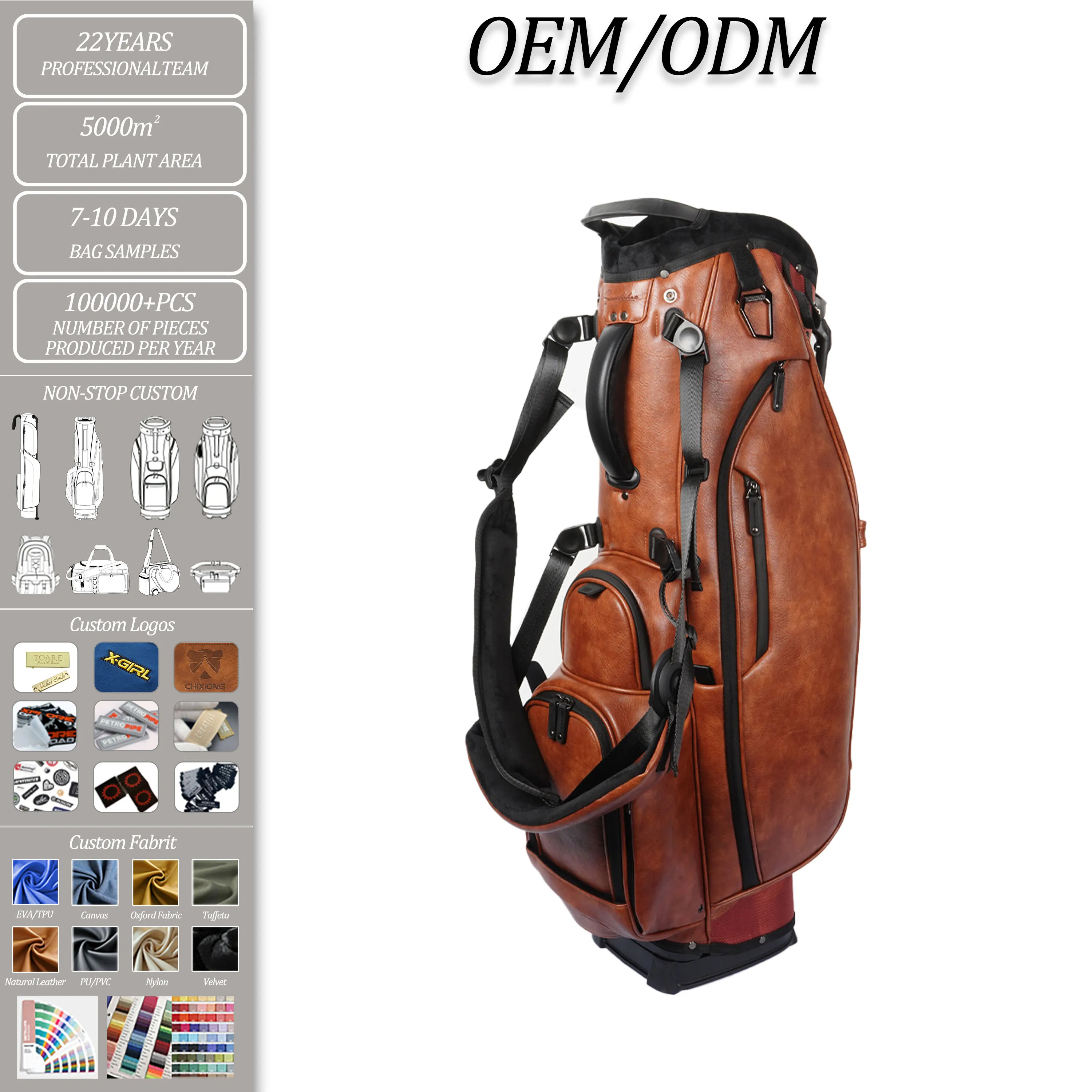
The hardware finish on a tan bag does more than hold the bag together; it sets the tone of the product. Brass and antique brass are the classic pairings. Brass ages to a warm patina that echoes the leather, and antique brass already looks lived-in on day one, which suits vintage positioning. Gunmetal and matte black read contemporary and pair well with a more minimalist brand identity. Nickel and chrome are brighter and can look cold against tan; we generally recommend them only on corporate-gift or co-branded club orders where the club crest already uses silver hardware.
Thread choice is the second lever. Natural beige or cream waxed thread on tan is quiet and expensive-looking; contrast dark-brown or black thread pops and defines panels; contrast red or navy is a heritage tour look that works on limited editions. We spec 6–7 stitches per inch on tan builds because the lighter colour shows every uneven stitch. Edge paint should be a slightly darker tone than the leather — a tan with a medium-brown edge line reads more finished than a bag with raw or matching edge.
Tan Bag Construction: What Changes on the Line
Building a tan leather bag is not the same as building a black one. Light-coloured hide shows every glue mark, every fingerprint and every panel mismatch, so the production floor runs differently. Our operators wear cotton gloves when handling tan hides after the dying stage. Cutting is done single-layer on a clean mat; any stray glue is cleaned with a damp rag before the panel leaves the cutting table. Edge painting on tan requires two thin coats rather than one thick coat, because a thick coat will look glossy and plastic under studio light.
Lining selection also matters. A tan bag lined in cream or natural canvas looks open and premium; lined in black it reads formal but heavy. We recommend a light beige 210D polyester or cotton-twill lining for tan builds, with a dark 420D nylon only where the clubs slide (the top interior) to hide graphite scuff marks. The divider system inside a tan staff bag is usually 14-way full-length on EVA board, wrapped in the same light lining. The contrast between the warm outside and the light inside is a detail customers notice when they first open the bag.
Care, Aging and After-Sales for Tan
Tan leather responds well to a consistent care routine and visibly rewards it. Wipe with a dry cloth after each round to remove grass and sand. Once or twice a season, feed with a neutral wax-based conditioner — not a coloured cream, because coloured creams will stain the hide unevenly. Store in the included dust bag away from direct UV; sunlight fades tan faster than any other leather colour because the dye is transparent enough to show the fibre underneath. If the bag gets wet, let it dry naturally away from a heater or car dashboard; heat tightens the grain and can crack the edge paint.
The after-sales story on a tan bag is part of the brand value. A 5-year-old tan staff bag that has been conditioned will look richer, not worn; a neglected one will look dry and grey. We include a care card in every private-label tan bag hangtag and offer a co-branded care kit (30 ml neutral wax tin + lint cloth) as a SKU uplift. For brands, this small touch reduces warranty claims by keeping customers on a maintenance routine and improves unboxing reviews.
B2B Sourcing: MOQ, Sampling and Lead Time
Tan is a standard colour on our private-label programme. MOQ is 200 pieces with a 100-piece trial option for first collaborations. Sampling takes 10–20 days because the tan burn-in sample is already approved; custom Pantone tan shades require a dedicated dyelot at the tannery, which extends sampling to 20–30 days and usually requires a higher MOQ. Bulk production runs 45–60 days from approved pre-production sample. Our affiliated factory runs seven production lines with 149 machines (126 sewing stations), rated at 200,000 bags per month (actual run-rate around 150,000), and is SGS-audited with BSCI, ISO 9001:2015, CE, CPC and RoHS documentation.
| Project step | Duration | Buyer deliverable |
|---|---|---|
| RFQ and spec review | 1–3 working days | Quotation with tan grade and hardware options |
| Swatch shipment | 3–5 working days | Hide swatches in 2–3 tan shades + hardware samples |
| Sample development | 10–20 days | 1–2 physical samples |
| Sample revisions | 5–10 days per round | Revised samples |
| Bulk production | 45–60 days | Photo/video QC at cut, panel and finish |
| Final inspection (AQL 2.5) | 5–7 days | Inspection report and packing photos |
The Tan Colour Family: Honey, Whiskey, Cognac, Saddle
“Tan” covers a spread of shades that brands mix up in spec sheets. Getting the shade right on a first sample avoids three or four revision rounds, so it is worth being precise. Honey tan is the palest end of the family — warm, almost yellow, with lots of natural grain showing. Whiskey tan runs richer and slightly orange, like a bourbon barrel, and is the shade most associated with American heritage brands. Cognac tan sits between whiskey and red-brown, with a touch of rose that reads more European. Saddle tan is deeper still, with an oily, waxy finish. Each shade photographs and ages differently, and each suits a different brand story.
| Shade | Pantone range | Character | Typical brand positioning |
|---|---|---|---|
| Honey / natural tan | 7508–7510 | Pale, warm, very grain-forward | Scandinavian minimalist, women’s premium |
| Classic tan | 7511–7513 | Mid warm brown, balanced | Heritage staff bags, club pro shop |
| Whiskey tan | 7516–7518 | Rich, orange-brown | American classic, limited editions |
| Cognac tan | 7521–7523 | Red-brown, European | Italian luxury, boutique brands |
| Saddle tan | 4625–4635 | Deep, oily, structured | Heritage tour, flagship |
We recommend buyers request physical swatches in at least three shades before locking a spec, because a screen cannot communicate how the tan reads under clubhouse lighting, on a sunlit fairway, or against a dark cart. Our swatch pack ships within 3–5 working days and includes thread, edge paint and hardware finishes so the buyer can assemble the full look on a single card.
Common QC Issues on Tan Builds
Tan hides are less forgiving than black, so three quality issues come up more often on tan builds than on dark-coloured ones. The first is colour inconsistency panel to panel. Because tan dye is translucent, a hide that is slightly thinner in one area will take the dye differently, producing a patch on a side panel. We grade hides by thickness before cutting and book-match panels from the same hide; we also hold a Delta E tolerance of 1.0 across a batch. The second issue is glue and fingerprint marks. They show up as dark smudges on light hide and are hard to remove without altering the colour. Operators on tan lines wear cotton gloves and use solvent-free water-based adhesives where possible. The third is edge paint bleed on the panel face. Tan edge paint must be applied in thin coats; a heavy coat will bleed onto the grain and leave a dark line that cannot be polished out.
Inspectors on our tan builds check every bag under a colour-corrected 5,500K light at three angles. We reject any bag with a visible glue mark on a front panel, a panel-to-panel colour mismatch above Delta E 1.0, or edge paint that bleeds more than 0.5 mm onto the face. These standards are written into our AQL 2.5 inspection checklist and shared with buyers before production so expectations are clear.
Retail Display and Photography for Tan Bags
Tan bags photograph differently from black or navy. They read best against a neutral or green background — fairways, wooden clubhouse interiors, brass fixtures — rather than against a white studio backdrop that washes the colour out. For e-commerce, we recommend daylight side lighting to bring out the grain, and close-up shots of the cart-strap channel, the deboss and the edge paint. The patina story is part of the sell: a two-shot sequence (new vs 2-year-old) is one of the highest-converting content formats for tan leather bags on our clients’ product pages. We supply neutral studio hero shots and lifestyle images on request as part of the packaging quotation, because many small brands cannot shoot their own product photography at the quality premium buyers expect.
Pairing Tan Bags With the Rest of a Brand Range
A tan bag should not stand alone in a catalogue. The most successful tan programmes we run include matching leather head covers in the same tan grain and thread, a value pouch or ball pouch in the same hide, and a tan cart bag or stand bag to flank the staff bag. This family look lifts average order value on the retail floor and gives the brand a recognizable visual identity. We cut all pieces from the same hide batch where possible so the grain and tone match across the range, and we hold a small safety stock of offcuts for replacement head covers after the main run ships.
For vintage and heritage brands, tan is the natural canvas. Our vintage and classic bags line is built largely on tan full-grain and pull-up, with linen thread, edge paint and brass hardware. For premium contemporary brands, tan pairs well with matte black hardware, clean typography on the deboss, and a single contrast stitch line. The same hide can go two very different directions depending on the hardware, thread and deboss; our design team can show both directions on a single sample so buyers pick the aesthetic before locking bulk.
People Also Ask
Why are tan leather golf bags so popular?
Tan is the most versatile premium leather colour because it reads as classic rather than trendy, pairs naturally with brass and antique hardware, and develops a warm patina that improves with age. It sells well across staff, cart and stand builds and photographs better than dark brown or black on retail imagery — see our leather colour guide for how tan compares.
What is the difference between tan and saddle tan leather?
Tan is a warm mid-brown chrome- or veg-tanned cowhide in the 1.2–1.6 mm range. Saddle tan is a denser, stiffer full-grain traditionally tanned for horse tack, 1.8–2.2 mm, with a more golden, oily finish. Saddle tan looks more heritage; tan reads more contemporary.
Do tan leather golf bags darken over time?
Yes. Full-grain tan darkens and warms where hands, straps and cart straps touch it, and lightens slightly on panels kept covered. This patina is desirable — it is the signature of full-grain leather, explained in our materials guide. Top-grain and corrected-grain tan will not patina as deeply and may show wear as discoloration rather than character.
How do I keep my tan leather golf bag from fading?
Store out of direct UV when not in use, use a rain hood in wet weather, and condition once or twice a season with a neutral wax. Avoid silicon sprays and saddle soap on modern chrome-tanned hides. Re-waterproofing with a neutral leather balm every six months slows UV fade — see our leather bag care guidance for the full routine.
Is tan leather hard to match with other golf gear?
No. Tan pairs cleanly with brass, antique brass, gunmetal and matte black hardware, and it works with navy, olive, white or grey apparel. It is the most forgiving leather colour in a brand range because it sits between warm brown and neutral beige — see our colour pairing guide.
Can I get a tan leather golf bag as a custom order?
Yes. Tan is a standard colour on our private-label programme, MOQ 200 pieces with a 100-piece trial option. Sampling runs 10–20 days and bulk 45–60 days. Custom Pantone tan shades require a dedicated dyelot and extend lead time — discuss your shade with our team on the contact page.
How much does a tan leather golf bag cost wholesale?
Wholesale FOB prices for a tan full-grain staff bag typically range from USD 85 to 160 depending on hardware, pocket count and packaging. A tan leather stand bag lands lower at USD 65–120. Retail multiples of 2.5x–3.5x are standard for premium leather golf bags.
For brands evaluating tan as a first leather colour, our recommendation is straightforward: start with a single full-grain classic tan staff bag or cart bag, build a matching set of tan head covers and a small value pouch, and photograph the range before committing to a wider palette. Tan de-risks the launch because it has the broadest shelf appeal, the clearest patina story, and the most forgiving hide matching. Once the tan line is selling, black, chocolate and olive can be added as limited runs on the same tooling. Our design team can produce tan sample mock-ups in both a heritage and a contemporary direction so buyers compare the two aesthetics on a single visit.
Start Your Tan Leather Bag Range
MOQ 200 pieces, samples in 10–20 days, bulk in 45–60 days. Tan is a stock colour on our programme.
Get a Quoteservice@junyuanbags.com · WhatsApp +86 17750020688