Leather stand bags give walking golfers the full-grain leather look at a carry weight of 2.5–3.5 kg, pairing premium aesthetics with a stable aluminium or fibreglass leg mechanism. For OEM/ODM programs, QUANZHOU JUNYUAN BAGS — established 2014 in Quanzhou, Fujian — coordinates an affiliated factory of 4,950 m² running 7 production lines with 149 machines (126 sewing stations) and 137 staff, rated at 200,000 bags per month (actual run-rate around 150,000). Standard terms are MOQ from 200 pieces (100-piece trial), sampling 10–20 days, mass production 45–60 days, and AQL 2.5 final inspection, serving 200+ brand clients across 100+ countries. According to the National Golf Foundation, the United States alone has roughly 26 million active golfers, which sustains steady year-round demand for premium leather equipment from new and established brands alike.
What Is a Leather Stand Golf Bag
A leather stand golf bag is a carry bag with an integrated aluminium or fibreglass leg frame, built on thin full-grain, pull-up or microfiber leather panels instead of nylon. It weighs 2.5 to 3.5 kg empty, stands stably on the fairway, and gives walking golfers the premium leather look at a weight close to a top-tier nylon stand bag. It is the fastest-growing subcategory in our leather programme because walking golfers are the most style-conscious segment of the game and they want a bag that looks as good on their back as it does on the cart.
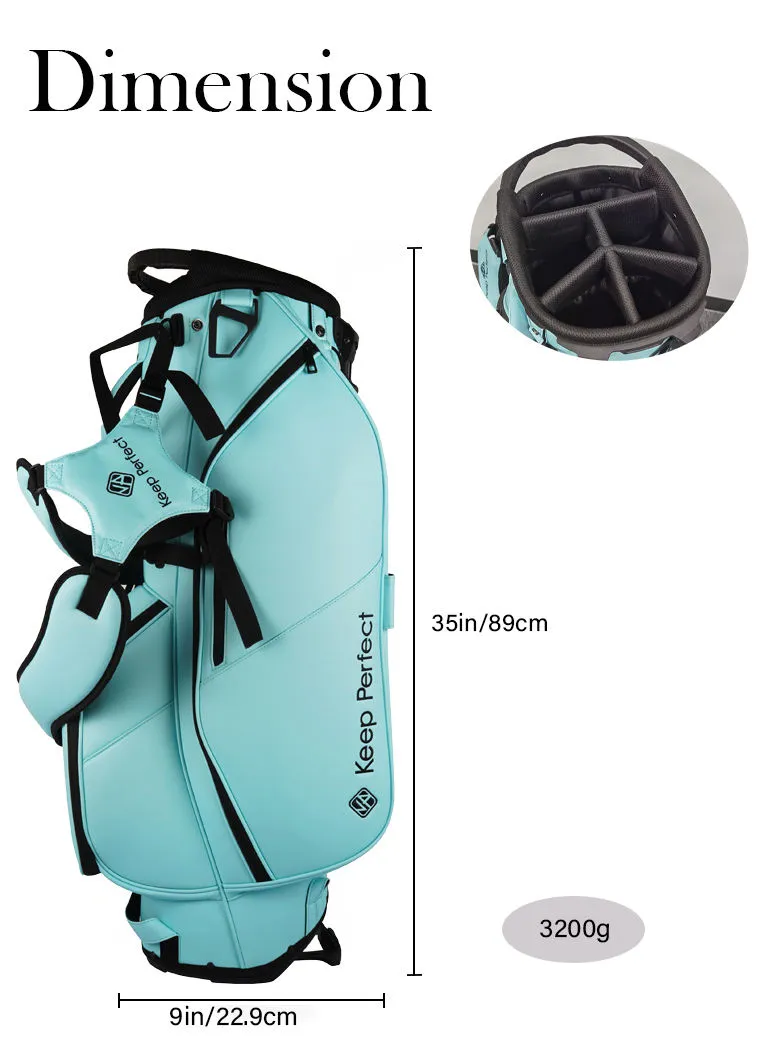
Why Buyers Are Moving Into Leather Stand Bags
For a decade, stand bags were almost exclusively nylon. The segment was dominated by lightweight, colourful technical builds aimed at golfers who walked 18 holes and cared about every gram. That is still the mainstream, but a parallel market has opened up: walking golfers who want a bag that reads as a premium accessory rather than a piece of athletic equipment. These golfers play resort courses, use a push cart some days and carry others, and are willing to accept a bag that weighs 300–500 g more in exchange for leather aesthetics, brass hardware and a bag that ages well. Brands that launched leather stand bags in the last three years have found that the line sells through at a higher margin than their nylon stand bag range, even at half the unit volume.
The commercial logic for B2B buyers is straightforward. A leather stand bag retails between USD 250 and USD 500, versus USD 150–250 for a premium nylon stand bag. The material cost delta is smaller than on a staff bag because the panel area is smaller, so the gross margin on a leather stand bag is often stronger than on a nylon one. The category also photographs beautifully — leather against fairways, brass against green — which matters for social commerce. Our affiliated factory has produced leather stand bags for 200+ brands across 100+ countries; the construction lessons are hard-won and documented below.
Why Not Just Use a Nylon Stand Bag With Leather Trim?
Many brands test the water by putting leather trim on a nylon stand bag. That is a reasonable first step, but it reads as a compromise on close inspection: the leather panels look stuck on, the hardware does not match, and the bag does not have the coherent material story that a full leather build does. A full leather stand bag uses leather on every visible panel — body, hood, pocket flaps, strap grips — with the nylon hidden only in the lining and divider. The visual difference on a retail shelf is immediate. For brands ready to commit, the full leather build is the product that earns the premium price point; the trim version is a bridge product.
Material Choices for a Leather Stand Bag
The stand bag is the most demanding leather build in the range because the panel has to flex with the body, support a loaded set of clubs, and not crack at the leg attachment points. Thick saddle leather is wrong here; it is too stiff and heavy. The four materials that work are listed below, with their trade-offs.
| Material | Thickness | Empty weight | Flex behaviour | Best for |
|---|---|---|---|---|
| Thin full-grain cowhide | 1.2–1.4 mm | 3.0–3.5 kg | Forges slowly, breaks in | Heritage / premium |
| Pull-up / oily full-grain | 1.2–1.5 mm | 2.9–3.4 kg | Very flexible, lived-in look | Vintage / walking |
| Microfiber leather | 1.0–1.2 mm | 2.4–2.9 kg | Consistent flex, very strong | Lightweight / all-weather |
| Coated PU (premium grade) | 0.9–1.2 mm | 2.3–2.8 kg | Flexible, coating degrades | Value / entry-premium |
Thin Full-Grain
Thin full-grain is the flagship choice. We specify a 1.2–1.4 mm hide for stand builds — thinner than the 1.6–2.0 mm we use on staff bags — because the panel has to wrap around the body and follow the leg frame when it opens. The thinner hide still carries the full-grain patina and the hand-feel customers expect, but it flexes enough to survive repeated stand deployment. The trade-off is weight: a thin full-grain stand bag still lands around 3.0–3.5 kg empty, 400–600 g more than a nylon bag. Most walking golfers accept that for the material story.
Pull-Up Leather
Pull-up leather is treated with oils and waxes that migrate when the panel flexes, creating lighter “pulled” colour lines at bend points. On a stand bag, this is a happy coincidence: the natural bend where the bag flexes as the legs deploy creates a lived-in, broken-in look from day one. Pull-up is also more forgiving of scratches because a light scuff can be rubbed back into the surrounding oil. It is the material behind many of the most popular vintage-style leather stand bags on the market. We cover the shade and finish options in more detail on our tan leather page.
Microfiber Leather
Microfiber leather uses a non-woven microfiber substrate impregnated with PU. It behaves much more like natural hide than coated PU, with a fibrous structure that flexes and tears consistently. It is lighter than full-grain, more colour-consistent hide-to-hide, and performs well in wet climates because it does not absorb water the way natural hide does. It is the right choice for brands that want the leather look at a lower weight, or that sell into humid tropical markets where natural leather can mildew. Microfiber is covered in depth on the vegan leather golf bags page, which compares microfiber, PU and plant-based materials side by side.
Coated PU (Premium Grade)
Premium coated PU is the entry point to a leather stand bag at a lower price. It looks like leather on day one, weighs less than full-grain, and costs roughly 35–45% of full-grain. The catch is lifespan: PU coating hydrolyses over 4–7 years, especially in humid climates, and it cannot be reconditioned. It is the right material for a first leather-look stand bag at a $200 retail point, but it will not deliver the decade-long ownership story that full-grain does. Our pillar guide leather vs PU vs nylon golf bags covers the full engineering comparison.
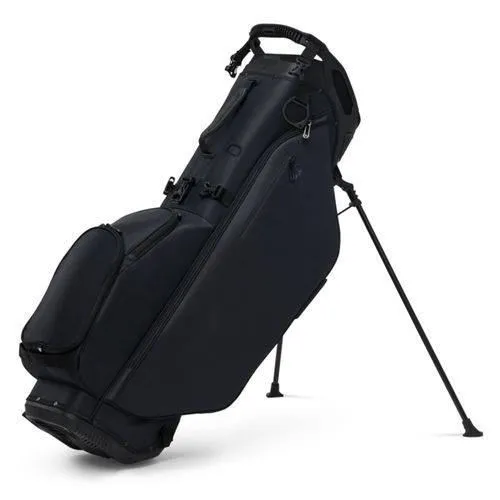
Construction: What Makes a Leather Stand Bag Work
The Leg Frame
The leg frame is the heart of any stand bag, and on a leather build it has to be engineered around a stiff, non-stretching panel. We use aluminium legs on premium builds and fibreglass on value builds, with a spring-loaded cross-brace that opens and closes the legs. The legs attach to reinforced leather patches on the lower body; without the patch, the leather would tear around the attachment holes within a season. The base geometry is a 5-point wide footprint so the bag sits stably even on sloping tee boxes. We test every production batch by opening and closing the legs 500 times and checking for frame wobble or panel stress.
The Strap System
A leather stand bag lives on a golfer’s back for 4–5 hours at a time, so the strap system matters. We spec a padded double strap with neoprene or foam padding under a leather outer, adjustable length, and a rotation point at the top so the bag sits level on the back. The strap anchors are reinforced with a leather patch and webbing cross-stitch; they are the highest-stress points on the bag. A single-strap option is available for minimalist Sunday builds but we do not recommend it for a full 14-club set. The leather on the strap outer should be the same hide as the body for a coherent look.
The Body and Divider
A leather stand bag typically runs a 4-way, 5-way or 6-way top with a 7-inch or 8-inch cuff. Full-length dividers are optional on a stand build because they add weight; most walking golfers prefer a 4-way with a short divider to save grams. The lining is 210D or 420D polyester, with EVA board or PE foam for body structure. The leather panel is stitched to the lining and board, but with enough slack to flex as the legs deploy. Over-tight panels crack at the cuff when the bag opens.
Pockets and Hardware
Leather stand bags typically carry 4–6 pockets: a valuables pouch with a soft lining, a ball pocket, an apparel pocket, a water-bottle sleeve and a tee pocket. Zippers should be YKK coil for smooth operation; metal-tooth zippers can cut the leather tape over time. Hardware on premium builds is solid brass or antique brass; on value builds, zinc alloy with a brushed nickel finish. Debossed logo on the front pocket flap is standard; hot foil and hand-stitched monograms are upgrades.
Weight Comparison
| Build | Empty weight | Weight with full set | Walk 18h feel |
|---|---|---|---|
| Ultralight nylon stand | 2.0–2.4 kg | 9.5–11 kg | Very light |
| Premium nylon stand | 2.5–2.9 kg | 10–11.5 kg | Light |
| Microfiber leather stand | 2.4–2.9 kg | 10–11.5 kg | Light |
| Coated PU leather stand | 2.3–2.8 kg | 10–11 kg | Light |
| Thin full-grain leather stand | 3.0–3.5 kg | 11–12 kg | Moderate |
| Pull-up leather stand | 2.9–3.4 kg | 11–11.8 kg | Moderate |
For buyers whose engineering team wants to dive deeper into the leg mechanisms, strap geometry and material testing on stand bags more broadly, our sister factory at Golf Stand Bag Factory publishes a technical library on stand-bag frame design, weight engineering and testing protocols.
B2B Sourcing: MOQ, Sampling and Lead Time
Leather stand bags run on the same commercial terms as our other leather builds. MOQ is 200 pieces with a 100-piece trial order for first collaborations. Sampling takes 10–20 days because the leg frame is tooled once and reused across colourways; the variable work is the leather panel, pockets and strap. Bulk production runs 45–60 days from approved pre-production sample. Our affiliated factory runs seven production lines with 149 machines (126 sewing stations), rated at 200,000 bags per month (actual run-rate around 150,000), SGS-audited in March 2026, and holds BSCI, ISO 9001:2015, CE, CPC and RoHS documentation.
| Stage | Duration | Buyer deliverable |
|---|---|---|
| RFQ and spec review | 1–3 days | Quotation with material, frame and hardware options |
| Swatch and frame sample | 5–7 days | Hide swatches, strap sample, frame prototype |
| Sample development | 10–20 days | 1–2 physical samples |
| Sample revisions | 5–10 days per round | Revised samples |
| Bulk production | 45–60 days | Photo/video QC at cut, panel and finish |
| Final inspection (AQL 2.5) | 5–7 days | Inspection report and packing photos |
Designing a Leather Stand Bag for Different Golfer Profiles
Not every walking golfer wants the same bag. We design leather stand bags for three distinct buyer profiles, and the spec changes with each. The first is the resort walking golfer: plays 2–3 times a month, uses a push cart half the time, values the leather look over every gram. This buyer wants full-grain or pull-up, brass hardware, a small number of thoughtfully designed pockets, and a bag that photographs well on holiday. Empty weight of 3.2–3.5 kg is fine. The second is the serious walking golfer: walks 4–5 times a month, carries every round, cares about weight and strap comfort. This buyer wants microfiber or thin full-grain, aluminium legs, a padded double strap, and a bag under 3.0 kg. The third is the weekend hacker / fashion buyer: wants the leather aesthetic but plays fewer rounds, often drives. This buyer is happy with coated PU and a price point under $250 retail. Matching the material to the buyer profile is the single most important spec decision.
Weather and Climate Considerations
Leather stand bags sell into very different climates. In sunny, dry markets (Arizona, Southern California, Australia), natural full-grain holds up beautifully and develops a warm patina. In humid, rainy markets (South-east Asia, the UK, the Pacific Northwest), natural leather absorbs moisture at the seams and can mildew if not dried properly. For those markets we recommend microfiber leather, which does not absorb water and does not need conditioning, or waxed pull-up leather that sheds rain on the surface. We also spec taped seams on the pocket zippers for humid markets, and a water-resistant lining treatment. Buyers selling across multiple climates should stock both a full-grain SKU for dry markets and a microfiber SKU for wet markets rather than trying to make one material work everywhere.
Branding and Personalisation
Leather stand bags are high-touch products, so branding should be subtle rather than loud. Blind debossing on the front pocket flap is the most premium look; it reads as quiet and expensive. Hot foil stamping in matte gold or silver works for corporate gifts and club pro-shop commissions. Hand-stitched monograms on the strap grip are a limited-edition option. We recommend avoiding large, centered chest logos on a leather stand bag — they look athletic rather than premium, and they date quickly. A smaller debossed crest on the lower front panel, or a woven leather patch on the strap, ages better. The same branding logic applies to matching leather head covers; a coherent family look across the bag and the head covers lifts the whole range.
Pairing a Leather Stand Bag With the Rest of the Range
A leather stand bag should not be an island. The most successful programs pair it with matching leather head covers in the same hide and thread, a small leather valuables pouch, and a cart bag or staff bag for days in a buggy. We cut all pieces from the same hide batch so the grain and tone match. For brands with a walking-first identity, the stand bag is the hero product; the staff bag and cart bag are supporting SKUs. Our leather head covers programme runs on the same MOQ and lead time so the range launches together. For vintage positioning, the stand bag pairs naturally with our vintage and classic bags line on pull-up and tan full-grain.
Care and After-Sales
A leather stand bag takes more abuse than a staff bag because it lives on the ground, on a shoulder and in a trunk. The care routine is the same as for any leather bag — wipe after wet rounds, condition once or twice a season, store out of UV — but the wear points are different. The leg attachment patches, the base corners and the strap anchors are the zones that see the most friction. We specify double-layer reinforcement at these points and include a small tube of leather balm in the hangtag so customers can touch up scuffs as they appear. Warranties on leather stand bags are commonly 2 years against manufacturing defects; the expected service life is 6–10 years with proper care, shorter than a staff bag simply because the walking lifestyle is harder on the hardware.
People Also Ask
Are leather stand golf bags comfortable to carry?
Yes, when built on thin full-grain or microfiber leather over a padded double strap — see our leather bag collection for current stand builds. A well-designed leather stand bag weighs 2.5–3.5 kg empty, close to a premium nylon stand bag, and the leather straps break in to the wearer's shoulder over time.
How much does a leather stand bag weigh?
A full-grain leather stand bag typically weighs 2.8–3.5 kg (6.2–7.7 lb) empty. A microfiber or coated PU leather stand bag weighs 2.3–3.0 kg. A comparable premium nylon stand bag weighs 2.0–2.7 kg.
Do leather stand bags stand stably?
Yes. Stability comes from the leg frame and base geometry, not the shell material. We spec aluminium or fibreglass legs, a 5-point base and a wide bottom footprint. Leather panels do not flex like nylon, so the bag actually holds its open stance more consistently than a nylon build — explore our leather range for stand and cart builds.
What is the best leather for a stand bag?
Thin full-grain (1.2–1.4 mm), pull-up leather or microfiber leather work best — see our materials guide for thickness options. Thick saddle leather is too stiff and heavy for a stand build. The panel must flex with the body without cracking at the leg attachment points.
Can a leather stand bag hold up in rain?
It is water-resistant, not waterproof. Waxed full-grain (similar to our saddle leather finish) beads rain well, but seams and zipper tracks will admit moisture over a long wet round. Use a rain hood and dry the bag naturally. Avoid soaking the leg attachment points, where water can wick into the backing board.
What is the MOQ for a custom leather stand bag?
MOQ is 200 pieces with a 100-piece trial order. Sampling takes 10–20 days and bulk production 45–60 days. The leg frame and divider are tooled once and reused across colourways — request a tooling sheet via our contact page.
Are leather stand bags good for walking 18 holes?
Yes, provided the strap system is padded and the empty weight is kept under 3.5 kg. Many walking golfers prefer leather stand bags because the material wears better than nylon in the cart-strap channel and ages into a personal patina — see our vintage and classic collection for heritage builds.
For buyers new to leather stand bags, we recommend starting with a single material (thin full-grain for dry climates, microfiber for humid ones), a single colourway, and a matched set of head covers before expanding. The leg frame and divider are tooled once and reused, so adding a second colourway on the same tooling is fast and inexpensive. This phased launch lets a brand test the category with a modest inventory commitment before committing to a full range. Our design team can produce samples in both a heritage and a contemporary direction so buyers compare aesthetics on a single visit, and our QC team sends photo and video updates at cut, panel and finish stages so the buyer never has to trust a photo alone.
Source Your Leather Stand Bag Line
MOQ 200 pieces, samples in 10–20 days, bulk in 45–60 days. BSCI / ISO 9001:2015 certified.
Get a Quoteservice@junyuanbags.com · WhatsApp +86 17750020688