Leather outlasts PU and nylon and commands a retail premium; PU matches the leather look at far lower cost for 3–5 years; nylon wins on weight, weather resistance and price for performance bags. For OEM/ODM programs, QUANZHOU JUNYUAN BAGS — established 2014 in Quanzhou, Fujian — coordinates an affiliated factory of 4,950 m² running 7 production lines with 149 machines (126 sewing stations) and 137 staff, rated at 200,000 bags per month (actual run-rate around 150,000). Standard terms are MOQ from 200 pieces (100-piece trial), sampling 10–20 days, mass production 45–60 days, and AQL 2.5 final inspection, serving 200+ brand clients across 100+ countries. According to the National Golf Foundation, the United States alone has roughly 26 million active golfers, which sustains steady year-round demand for premium leather equipment from new and established brands alike.
The Short Answer
Leather vs PU vs nylon is not a question of which is “best”; it is a question of which trade-off matches the product. Full-grain leather lasts 8–15 years, ages into a patina and retails at a premium, but weighs more and costs more to build. PU leather looks like leather for 3–5 years at 60–80% lower cost, but hydrolyses in humidity and cannot be repaired. Nylon is the lightest, toughest and most water-resistant, but does not read as premium and cannot be embossed the way leather can. Spec leather for flagship and heritage builds, PU for mid-premium leather-look, and nylon for performance, waterproof and travel bags. This guide walks through the engineering and the numbers.
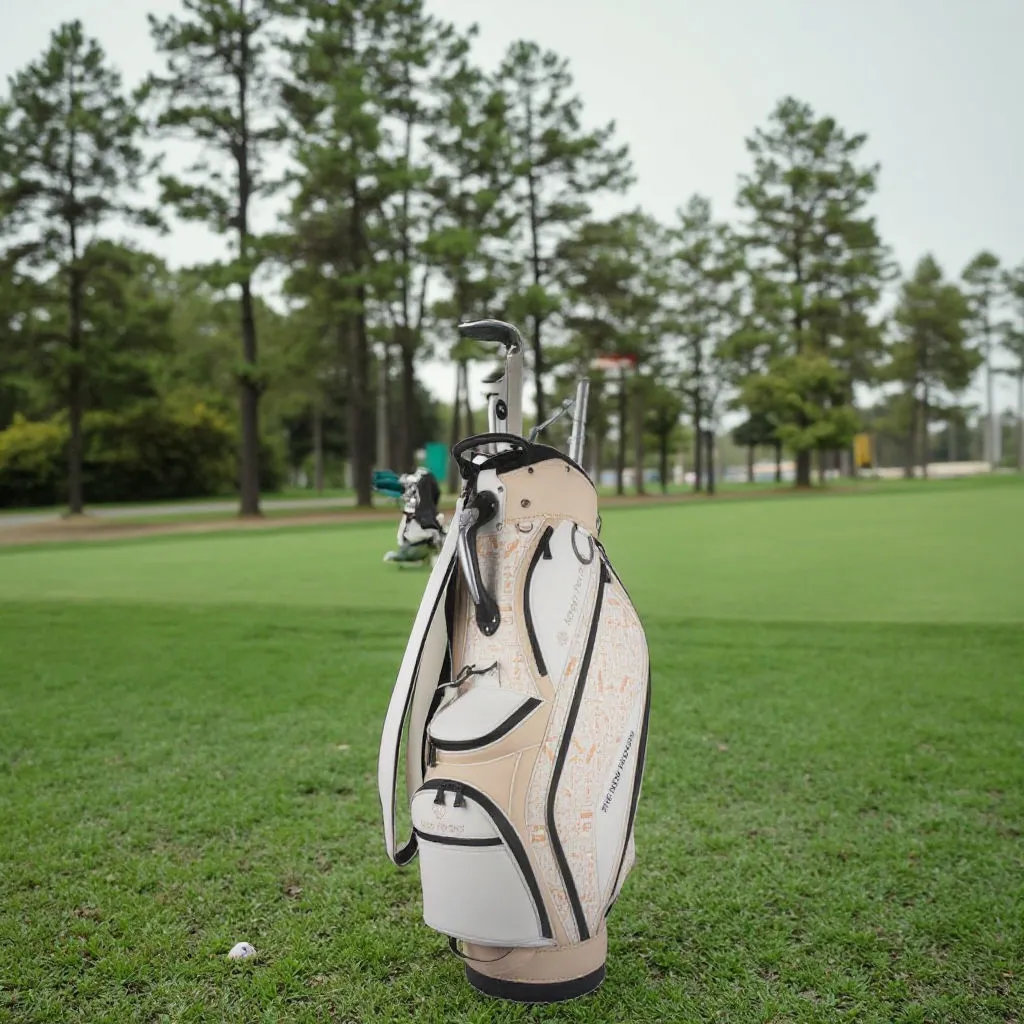
Executive Comparison Table
| Attribute | Full-Grain Leather | PU / Microfiber | Nylon / Polyester |
|---|---|---|---|
| Empty weight (staff bag) | 5.0–6.5 kg | 3.8–5.0 kg | 3.0–4.2 kg |
| Expected service life | 8–15 years | 3–7 years | 3–6 years |
| Water behaviour | Resistant (with wax) | Resistant | Resistant, or waterproof if taped |
| Abrasion on cart channel | Slow, repairable | Medium, peels | Fast, exposes weave |
| Patina / aging | Strong | None | Fades, no character |
| Repairability | Sand, re-oil, restitch | Surface scuffs only | Patch or panel replace |
| Branding options | Deboss, hot stamp, hand stitch | Hot stamp, print | Print, embroidery |
| Relative material cost | 100 | 25–65 | 15–30 |
| Typical retail (staff) | $400–$900+ | $150–$350 | $80–$200 |
| Best bag type | Staff, cart, vintage | Stand, mid-premium | Stand, travel, waterproof |
What Each Material Actually Is
Full-Grain Leather
Full-grain leather is the outermost layer of a cowhide, taken from the back and shoulder, left unsanded and uncorrected. It retains the natural fibre structure, which is what makes it strong, repairable and able to develop a patina. In golf bags, full-grain is typically 1.6–2.0 mm thick, chrome- or vegetable-tanned, and finished with a wax or oil that beads rain off the surface. It is the material behind flagship staff bags, vintage builds and limited editions. It is also the most expensive: the hide alone can account for 25–35% of the unit cost of a leather bag. For a deeper material breakdown, see our leather golf bags hub.
PU and Microfiber Leather
PU leather is a polyurethane coating on a fabric backing, embossed with a leather grain. Premium PU uses a thick coating (0.6–0.8 mm) over a woven polyester substrate; economy PU uses a thin coating over a knitted backing that feels plasticky. Microfiber leather upgrades the substrate to a non-woven microfiber mat impregnated with PU, which gives it a fibrous structure that behaves like hide. Both are non-animal, colour-consistent and cheaper than full-grain. Their failure mode is hydrolysis: the polyurethane breaks down in warm, humid air, turning tacky, then cracking, then peeling. Premium grades resist this for 5–7 years; economy grades fail in 2–3. Our vegan leather golf bags page covers PU, microfiber and plant-based materials in detail.
Nylon and Polyester
Nylon (usually nylon 6,6 in deniers from 420D to 1680D) and polyester (600D to 1200D) are woven fabrics coated with a polyurethane or PVC layer for water resistance. They are the workhorse of the golf bag industry: light, tough, cheap to produce, and easy to print and embroider. Nylon is stronger and more abrasion-resistant; polyester is cheaper and more colour-fast. Neither material develops a patina, and neither can be debossed the way leather can. They are the right choice for performance stand bags, waterproof cart bags and travel covers where weight and weather matter more than aesthetic.
Engineering Comparison
Weight
Weight is the first thing B2B buyers ask about, and it matters most on carry and stand builds. A full-grain leather staff bag weighs 5.0–6.5 kg empty, about 1.5–2 kg more than a comparable nylon staff bag. On a staff bag that lives in a cart, the weight penalty is rarely felt. On a stand bag that walks 18 holes, it is decisive. That is why leather stand bags use thinner hides (1.2–1.4 mm) or microfiber (1.0–1.2 mm), landing at 2.8–3.5 kg empty — close to a premium nylon stand bag at 2.5–2.9 kg. The weight comparison below breaks it down by bag type.
| Bag type | Nylon | PU / Microfiber | Full-grain leather |
|---|---|---|---|
| Staff bag | 3.0–4.2 kg | 3.8–5.0 kg | 5.0–6.5 kg |
| Cart bag | 2.5–3.5 kg | 3.0–4.0 kg | 4.0–5.5 kg |
| Stand bag | 2.0–2.7 kg | 2.3–3.0 kg | 2.8–3.5 kg |
| Pencil / Sunday | 0.8–1.3 kg | 1.0–1.5 kg | 1.3–2.0 kg |
Durability and Abrasion
Durability on a golf bag is not about tensile strength; it is about how the contact surfaces hold up over years of cart straps, club slides and base rubs. Leather wins on repairability: a scuff can be sanded and re-oiled, an edge paint line can be refreshed, a stitch can be restitched. Nylon wins on raw abrasion resistance: a 1680D nylon panel will outlast a 1.6 mm leather panel on a friction-heavy zone, but when it fails it fails by fraying the weave, which cannot be repaired. PU sits in between: it abrades slower than nylon on day one, but once the coating wears through the substrate shows and the panel looks done. We test all incoming materials on a Taber abrasion wheel; the pass threshold is 500 cycles without visible wear on the contact face.
Water Behaviour
None of the three materials is fully waterproof on its own. Water performance comes from coating, seam sealing and zipper construction, not the base material. Full-grain leather with a wax or oil finish beads surface water but admits moisture through seams and stitch holes over a long wet round. PU is similarly water-resistant; it does not absorb water the way hide does, but the coating can crack and let water in. Nylon is the base material of choice for waterproof bags because it can be seam-taped and laminated to a waterproof membrane. If water performance is the spec, nylon with a taped seam is the answer, regardless of how it looks. Our waterproof testing page covers hydrostatic head ratings and seam-sealing standards in more detail.
Flex and Fatigue
A golf bag flexes every time it is lifted, strapped into a cart or stood on its legs. Flex fatigue is the silent killer of all three materials. Leather flexes and recovers; it actually gets more flexible with use. PU flexes fine for a few thousand cycles, then the coating develops micro-cracks that grow over time. Nylon flexes indefinitely, which is why it dominates stand bags where the panel opens and closes hundreds of times per round. We flex-test incoming materials to 50,000 cycles on a Bally flexometer; leather and microfiber pass comfortably, economy PU often fails before 20,000.
UV and Humidity
UV fades colour and degrades coatings. Humidity drives hydrolysis in PU. A PU bag stored in a garage in Florida for three summers will be tacky and cracked; the same bag in a dry climate will last twice as long. Full-grain leather resists UV better than PU but fades if left in direct sun; it also mildews if it stays wet. Nylon is the most stable across climates. Buyers selling into humid tropical markets should either spec microfiber rather than PU, or steer customers to a care routine that includes drying and conditioning.
Manufacturing Comparison
The three materials require different production lines, different operator skills and different QC standards. This matters for buyers choosing a factory: a plant that is excellent at nylon bag assembly may be mediocre at leather, and vice versa.
Cutting
Nylon can be stacked 8–10 layers and die-cut in minutes. PU cuts single-layer to avoid surface adhesion, but can run 2–3 layers on premium grades. Leather cuts single-layer on a clean mat, with book-matching across panels to keep the grain consistent around the body. Leather cutting is the slowest and most wasteful: hide has natural defects that must be worked around, and yield on a good hide is 80–85% versus 95%+ on a woven roll.
Sewing
Nylon sews on standard lockstitch machines with general-purpose thread. PU requires Teflon or roller presser feet to stop the coating sticking, and larger needles to avoid puncturing the coating cleanly. Leather requires walking-foot machines, waxed thread and slower stitch speeds; the needle holes are permanent and every stitch is visible. Operator training on leather lines is 4–6 weeks; on nylon lines it is 3–5 days. Our affiliated factory runs leather and nylon on separate production lines, which protects quality on both.
Edge Finishing
This is where leather builds earn their cost. Raw cut leather exposes a fibre cross-section that must be painted with 3–6 coats of flexible edge paint, hand-buffed between coats. PU edges are hot-melt banded or single-coated. Nylon edges are taped or folded. Edge finishing alone can take 30–45 minutes per leather bag, versus 5 minutes for a nylon bag. Buyers comparing FOB quotes should ask specifically how many edge-paint coats are specified, because it is the easiest place for a supplier to under-deliver.
QC Standards
Visual QC is much stricter on leather and PU than on nylon. A glue mark or fingerprint that disappears into a woven nylon weave shows up as a dark smudge on tan or cream leather. We run 100% visual inspection on all visible panels of leather and PU bags under colour-corrected 5,500K light; nylon bags are inspected at AQL 2.5 like any other sewn product. Colour tolerance on leather is Delta E 1.0 across a batch; on PU it is Delta E 1.5; on printed nylon it is Delta E 3.0. These tolerances are written into our AQL 2.5 inspection checklist.
Cost and Retail Margin
The commercial case for each material is as important as the engineering. The table below shows typical FOB unit cost and retail band for a staff bag build.
| Material | FOB unit cost (staff) | Typical retail | Retail multiple | Margin profile |
|---|---|---|---|---|
| Economy nylon (600D) | USD 18–30 | USD 60–120 | 3.0x–3.5x | Volume, thin margin |
| Premium nylon (1680D) | USD 30–55 | USD 120–250 | 3.5x–4.0x | Volume, healthy margin |
| Economy PU | USD 35–55 | USD 120–200 | 3.0x–3.5x | Value leather-look |
| Premium PU / microfiber | USD 55–85 | USD 200–350 | 3.5x–4.0x | Mid-premium |
| Full-grain leather | USD 85–160 | USD 400–800 | 4.0x–5.0x | Flagship, highest $/unit |
| Saddle leather | USD 110–220 | USD 600–1,200 | 4.5x–5.5x | Heritage flagship |
The dollar margin per unit is highest on leather; the percentage margin is often strongest on premium PU because the material cost is lower while the retail price is close to full-grain. Nylon wins on volume and cashflow because the lower unit cost lets buyers stock more SKUs at less inventory risk. Most brands run a mix: a nylon entry product, a PU mid-premium product, and a leather flagship, rather than betting the range on one material.
Branding and Aesthetic
Leather accepts branding finishes that nylon cannot. Blind debossing presses a logo into the hide; hot foil stamping adds a metallic layer; hand-stitched crests add a high-touch detail. None of these read the same on nylon, where branding is limited to print, embroidery and woven patches. PU accepts hot stamping and embossing but not hand stitching. The branding finish is part of the product’s perceived value: a debossed crest on tan leather reads expensive; a printed logo on nylon reads athletic. This is why leather anchors a premium brand range and nylon sits at the performance end.
For matching across a range, leather lets a brand cut a bag and matching leather head covers from the same hide batch, so the grain and tone match. Nylon head covers match by fabric colour, which is easier but less tactile. The visual coherence of a full leather family is one of the strongest retail displays in the category.
Sustainability
Sustainability claims on golf bags are easy to overstate. The honest comparison is nuanced. Full-grain leather is a by-product of the meat industry and can last 10–15 years, which gives it a strong per-year footprint if the bag is cared for. But tanning is chemical-intensive, and chrome tanning in particular generates effluent. We work with tanneries rated by the Leather Working Group at silver or gold. PU is petroleum-based and not biodegradable; recycled PU on rPET backing has a lower footprint but is still plastic. Nylon is also petroleum-based and not biodegradable, but recycled nylon (rPET) is mature and widely available. The longest-lived product is still usually the lowest-footprint over a decade, which is the strongest argument for full-grain leather on a sustainability scorecard — provided the buyer communicates it honestly and does not overclaim.
Matching Material to Bag Type
The fastest way to choose is to match the material to the bag type and the buyer, not to ask which material is “best.”
Staff / Tour Bags
Full-grain or saddle leather. The bag lives in a cart, so weight matters less; the premium aesthetic matters most. Retail $500+.
Cart Bags
Leather panels on wear zones, nylon lower body. Balances weight, cost and aesthetics. Retail $250–$450.
Stand / Carry Bags
Thin full-grain, microfiber or nylon. Weight is decisive. Leather stand bags retail $250–$450; nylon $150–$250.
Waterproof Bags
Nylon with taped seams. Leather and PU cannot be seam-taped reliably; do not spec them for a waterproof claim.
Travel / Padded Bags
Ballistic nylon. The abrasion and impact demands of air travel exceed what leather can justify.
Corporate Gifts
Black PU or black full-grain with a clean deboss. Price, branding and uniformity matter more than patina.
Testing and QC Standards
For B2B buyers writing a spec sheet, the test standards matter more than the material name. We run the following tests on every incoming material batch and share reports on request:
- Flex crack resistance: Bally flexometer, 50,000 cycles minimum for PU and microfiber, 100,000 for leather.
- Hydrolysis resistance: 70 C / 95% humidity, 240 hours; premium PU must show no tackiness after the test.
- Abrasion: Taber wheel, 500 cycles without visible wear on the contact face.
- Crocking and rub fastness: 500 rubs, no dye transfer.
- Colour fastness to light: Xenon arc, 40 hours, Delta E below 3.0.
- Seam strength: minimum 80 N pull-out on thread seams, per ASTM D1683.
- Hardware salt spray: 48 hours on zippers and buckles, no red rust.
These tests follow SATRA, ISO and ASTM standards that our in-house lab runs daily; third-party lab reports from SGS or Intertek are available on request. Final inspection on every production run follows AQL 2.5 for visual and functional checks, with photo and video updates at cut, panel and finish stages for the buyer.
Sourcing: MOQ, Sampling and Lead Time
All three materials run on the same commercial terms at QUANZHOU JUNYUAN BAGS. MOQ is 200 pieces with a 100-piece trial order for first collaborations. Sampling takes 10–20 days (10–15 for PU and nylon, 15–20 for full-grain and saddle). Bulk production runs 45–60 days from approved pre-production sample, with saddle leather extending to 50–60 days because of edge-paint drying. Our affiliated factory runs seven production lines with 149 machines (126 sewing stations), rated at 200,000 bags per month (actual run-rate around 150,000), SGS-audited in March 2026, and holds BSCI, ISO 9001:2015, CE, CPC and RoHS documentation. The full sourcing path is laid out on our leather golf bags hub.
How to Choose: A Decision Tree
If you are a B2B brand deciding which material to spec, work through these questions in order:
- What retail price point? Under $150: nylon. $150–$300: PU. $300–$600: full-grain or microfiber. $600+: saddle or full-grain flagship.
- What climate will the bag sell in? Humid tropical: avoid economy PU; choose microfiber or nylon. Dry sunny: full-grain is fine. Wet rainy: nylon with taped seams.
- Who carries the bag? Walking 18 holes: keep empty weight under 3.5 kg; choose thin full-grain, microfiber or nylon. Cart-only: weight is irrelevant; choose leather.
- What is the brand story? Heritage / vintage: full-grain or saddle. Contemporary / minimalist: black PU or microfiber. Performance / athletic: nylon. Ethical / vegan: microfiber or plant-based.
- What is the inventory risk? First collaboration: 100-piece trial order in one material. Proven brand: run a nylon entry, a PU mid-premium and a leather flagship as a range.
Common Mistakes Buyers Make
Three errors come up repeatedly. The first is specifying “PU leather” without a grade. The material spans USD 8 to USD 25 per metre; a supplier that quotes the cheapest PU will deliver a bag that fails in two years. Specify coating thickness, substrate and hydrolysis rating. The second is specifying leather on a stand bag without weight engineering. Thick saddle leather on a stand frame produces a 4 kg bag that nobody walks with. Use thin full-grain or microfiber. The third is over-claiming sustainability. “100% biodegradable vegan leather” is not true for any commercial PU on the market today; accurate claims are “animal-free”, “recycled content X%” or “lower footprint than cowhide”, each backed by supplier documentation.
Deep Dive: Failure Modes by Material
Understanding how each material fails tells a buyer what to inspect at final QC and what to tell customers in the care guide. The failure modes below are what we see most often on returned bags and warranty claims.
Leather Failure Modes
Leather fails slowly and visibly. The first sign is usually edge paint cracking at the cart-strap channel, where the panel flexes every round. This is repairable by re-painting the edge. The second sign is dryness: the hide loses its oil, goes grey and stiff, and develops surface cracks at bend points. This is reversible with wax conditioning if caught early. The third sign is mould, which appears as black or green spots on panels that stayed wet; it can be cleaned with a dilute anti-fungal solution but leaves a mark. The irreversible failure is loose grain, where the fibre structure separates after years of flex, producing a soft, wrinkled panel that cannot be fixed. A well-cared-for leather bag reaches this point at 10–15 years; a neglected one reaches it at 4–6.
PU Failure Modes
PU fails suddenly and unpredictably. The first sign is usually a tacky or sticky surface in warm weather, which signals that the polyurethane is hydrolysing. The coating then begins to crack at flex points — typically the handle, the pocket edges and the cart channel — and the cracks spread over weeks. Once cracking starts, the bag cannot be restored; the coating has structurally broken down. The second failure mode is delamination at edges, where the PU separates from the woven backing. This is usually a sign of cheap edge sealing rather than coating failure. The third is colour transfer from dark clothing, which appears as a dye stain that cannot be wiped off. Premium PU resists all three failures for 5–7 years; economy PU starts at 2–3.
Nylon Failure Modes
Nylon fails predictably. The PU coating on the outside scuffs and wears through at the cart channel, exposing the white or grey weave underneath. Zippers fail before the fabric does. Seams fray at stress points if the thread was under-spec. The lining splits where clubs slide in and out. None of these failures is a material crisis; they are all repairable by patching or replacing a panel. Nylon does not develop character as it fails; it just looks tired. This is why nylon bags tend to be replaced rather than repaired, and why their perceived service life is shorter than leather even when the raw material is technically sound.
How We Test Each Material on Our Production Floor
Our quality lab runs the following tests on every incoming batch of leather, PU and nylon before it is approved for production. Buyers are welcome to request the actual reports for the material grade being quoted.
- Thickness gauge: leather measured across the hide at 20 points; tolerance ±0.15 mm. PU and nylon measured per roll at 5 points.
- Tear strength: tongue tear test per ASTM D2261; minimum 30 N for leather, 20 N for PU, 40 N for nylon.
- Seam slippage: load a sewn seam to 80 N; thread must not break and seam must not open more than 3 mm.
- Zipper cycle test: open and close 5,000 times; slider must not jam and teeth must not jump.
- Base drop test: loaded bag dropped from 1 metre onto a concrete floor; base must not split and dividers must not shift.
- Colour check: spectrophotometer against burn-in sample; Delta E below 1.0 for leather, below 1.5 for PU, below 3.0 for printed nylon.
These tests are part of our ISO 9001:2015 quality management system and are audited by SGS, most recently in March 2026. Buyers using a third-party inspector (BV, Intertek, SGS) on our floor should allow an extra 3–5 days in the production schedule so the inspector can attend both the panel stage and the finished-goods stage.
The Buyer’s Checklist: What to Spec on a Tech Pack
A well-written tech pack removes 80% of sample revisions. The following spec items are the ones most often missing from first-time buyer RFQs, and they drive most of the arguments at final inspection.
- Material grade, not just material name: “1.6–2.0 mm full-grain cowhide, chrome tanned” rather than “genuine leather”.
- Coating thickness on PU: “0.6–0.8 mm PU over woven polyester, hydrolysis-resistant”.
- Denier and coating on nylon: “1680D ballistic nylon, PU coating 0.10 mm, taped seams”.
- Edge finish: “3+ coats flexible edge paint, hand-buffed” rather than “finished edges”.
- Thread and stitch density: “waxed polyester, 6–7 stitches per inch, back-tack at stress points”.
- Hardware brand and finish: “YKK coil zipper, antique brass, 48-hour salt spray”.
- Colour tolerance: “Delta E 1.0 across batch, matched to burn-in sample”.
- Weight target: “Empty weight 3.0 kg ± 0.2 kg” rather than “lightweight”.
- Packaging: dust bag, carton grade, hangart, care card, barcode placement.
Our design team can turn a rough reference image into a complete tech pack within 3–5 working days, including material swatches, hardware samples and a costed BOM. This is included in the quotation at no extra charge for first inquiries.
Conclusion: Spec to the Buyer, Not to the Trend
The leather vs PU vs nylon debate has no universal winner. It has a correct answer for a specific brand, at a specific price point, selling in a specific climate, to a specific buyer. Leather wins on longevity, patina and margin; PU wins on cost, weight and consistency; nylon wins on performance, weather and volume. The most successful brands we work with run all three as a range rather than choosing one. Our design team can produce samples in each material so buyers compare the look, the weight and the hand-feel on a single visit, and our QC team validates every batch to the standards above. Reach out through our contact page to start the conversation.
People Also Ask
Leather vs PU: which is better for a golf bag?
For a premium bag built to last 8–15 years, leather is better: it patinas, repairs and outlasts PU. For a lighter, cheaper bag built for 3–5 years, PU is better. PU is 60–80% cheaper and 30–50% lighter; leather commands a higher retail margin and a stronger brand story. See our leather golf bags for the premium build.
Is PU leather better than nylon for golf bags?
PU leather looks more premium and accepts debossing, but it hydrolyses in humidity and cannot be repaired. Nylon is lighter, more water-resistant and tougher on abrasion, but it does not read as premium. PU suits mid-premium retail; nylon suits performance and travel. Compare grades in our materials guide.
Does leather add too much weight to a golf bag?
A full-grain leather staff bag weighs 5.0–6.5 kg empty, 1–2 kg more than nylon. Thin full-grain on a stand bag weighs 2.8–3.5 kg, close to a premium nylon stand bag. The weight penalty is acceptable on staff and cart builds; it matters more on carry and stand builds. See our leather stand bag for weight spec.
Which material lasts longest on a golf bag?
Full-grain leather lasts 8–15 years and can be reconditioned. Saddle leather lasts 10–20 years. Nylon and polyester last 3–6 years before coating or lining failure. PU lasts 3–5 years (premium) or 2–3 years (economy) before hydrolysis. Read our leather care guide.
Is leather golf bags waterproof?
No. Full-grain and saddle leather are water-resistant, not waterproof. Seams and stitch holes admit moisture over a long wet round. PU is similarly water-resistant. Nylon is the most water-resistant if coated and seam-taped, which is why it dominates waterproof ranges. Read our care and waterproofing guide.
Which material has the best retail margin?
Leather bags retail at 4.0x–5.0x FOB and carry the strongest margin, but cost the most to build. PU bags retail at 3.0x–3.5x at lower unit cost. Nylon bags retail at 2.5x–3.0x. The strongest dollar margin per unit is leather; the strongest percentage margin is often PU. Explore our premium luxury range.
Can I mix materials on one golf bag?
Yes. Most premium bags mix leather panels on wear zones (cart channel, pocket flaps) with nylon lower panels and lining. This balances weight, cost and aesthetics. Full leather on every panel is a flagship choice; leather trim is a value compromise. See our material options.
What is the minimum order for a custom golf bag?
MOQ is 200 pieces with a 100-piece trial order at QUANZHOU JUNYUAN BAGS. Sampling takes 10–20 days and bulk production runs 45–60 days, regardless of whether the material is leather, PU or nylon. Start a free quote.
Compare Materials on Your Next Bag
MOQ 200 pieces, samples in 10–20 days, bulk in 45–60 days. We supply material swatches and test reports before you commit.
Get a Quoteservice@junyuanbags.com · WhatsApp +86 17750020688