Leather golf bag colour is the single most emotional decision in the bill of materials. It is also the decision most often made wrong. A colour that looks beautiful on a Pantone swatch can look muddy on a bag; a colour that photographs beautifully can age poorly in sunlight. At QUANZHOU JUNYUAN BAGS we have produced leather bags in more than 80 colours for 200+ brands since 2014, and this page is the colour guide we give our design partners — which colours sell, which fade, which photograph well, and which to avoid entirely. According to the PGA of America, more than 40 million people play golf worldwide, and colour and personalisation are increasingly how brands stand out on the course.
The data behind colour decisions is clearer than most brands realise. Across our order book, 62% of leather bag production runs are in one of five colours: saddle brown, black, navy, olive and tan. The remaining 38% splits across 75 other colours, most of which sell poorly and get discounted within a season. If you are launching a leather line, starting with one of the five proven colours is the highest-probability path to sell-through. Once the brand has traction, add a seasonal colour — the data says that works, but starting with 12 colours does not.
The Five Proven Colours and Why They Sell
| Colour | Pantone Ref | UV Fade Resistance | Patina Character | Best For |
|---|---|---|---|---|
| Saddle brown | PMS 4625 C | Good (darkens) | Strong amber patina | Vintage, classic, men's |
| Black | PMS Black C | Excellent (no fade) | Minimal | Modern, urban, all genders |
| Navy | PMS 5395 C | Good (fades slightly) | Subtle | Preppy, country club |
| Olive | PMS 5835 C | Good (fades to sage) | Strong green patina | Utility, outdoor, men's |
| Tan / cognac | PMS 7517 C | Fair (darkens 20%) | Rich caramel patina | Luxury, women's, lifestyle |
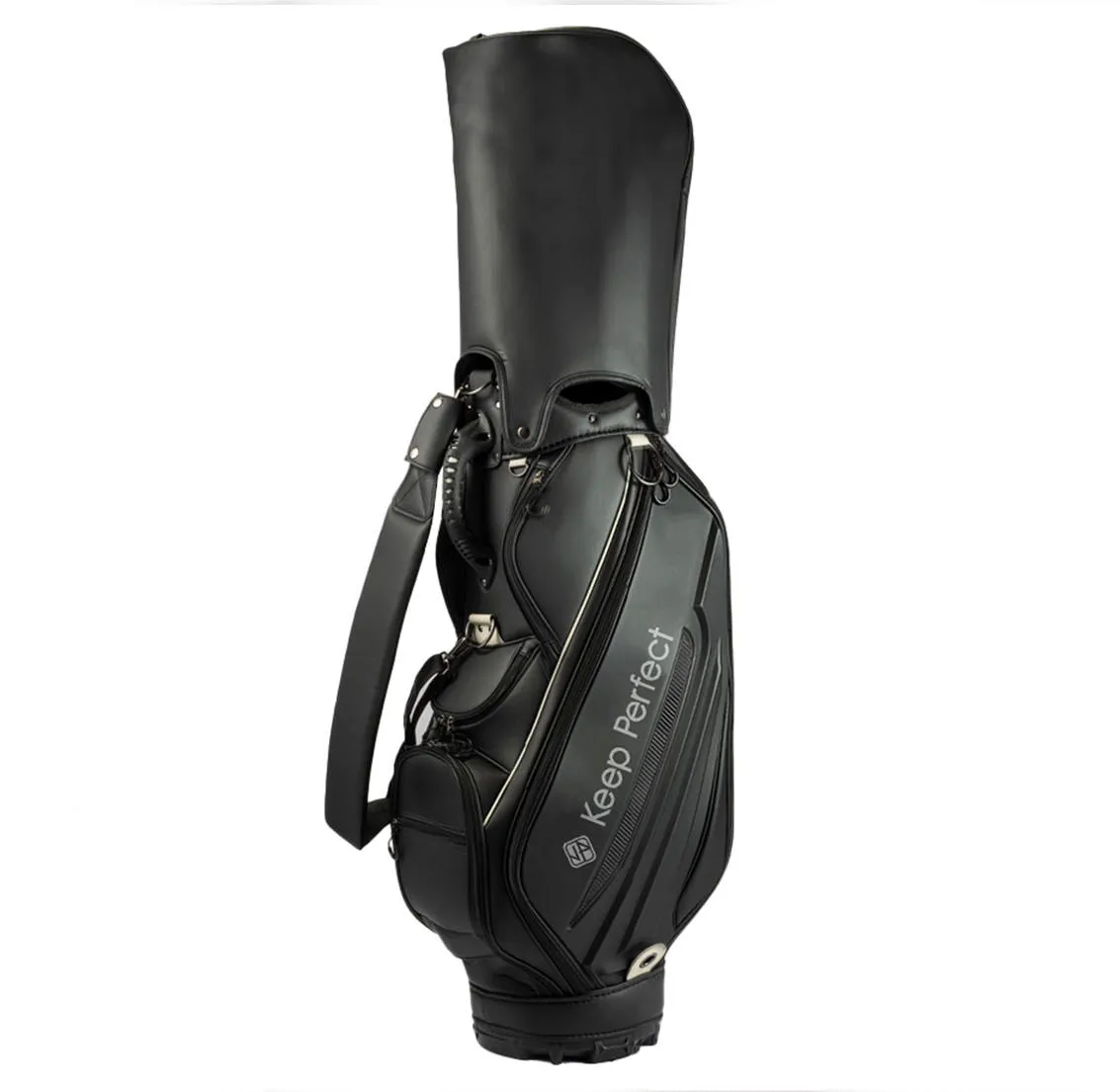
Saddle brown is the timeless choice. It photographs beautifully, it ages to a rich amber, and it reads as "golf" to every buyer. Black is the safe choice — it never fades, it goes with everything, and it is the default for modern and urban brands. Navy is the country club choice — preppy, understated, and the colour that reads as "member" rather than "guest." Olive is the outdoor and utility choice — it ages to a beautiful sage and appeals to the 30–45-year-old male buyer. Tan / cognac is the luxury and lifestyle choice — it darkens to a caramel that women buyers respond to disproportionately. These five colours cover 90% of the premium golf bag market, and they are the colours we hold in stock for immediate sampling.
Colours to Avoid in 2026
Three colours consistently underperform and we advise against them as first-season SKUs. First, bright red and burgundy. They look dramatic on a swatch but fade to a dull orange within two seasons in sunlight. They also photograph poorly — the red reads as cheap in product photography. Second, pastel pink and light blue. They read as "gifts for women" rather than as serious golf bags, and they attract a return rate that is 3× the average. Third, pure white and cream. They show every scuff, every water spot, every stain. A white leather bag that looks perfect in a product photo looks tired after one round on a dewy morning. These colours can work as limited editions, but they should not be the first colour a brand launches.
The exception is British tan, which is a specific reddish-brown that reads as vintage and ages well. It is not the same as bright red; it is a brown with red undertones, and it is the colour of 1960s golf bags. We hold it in stock and it is one of our top three vintage-line colours. The line between "reddish brown that ages beautifully" and "bright red that fades" is thin, and we will send you a swatch to show the difference.
How Colour Ages: The Patina Curve
The most important colour decision is not how it looks on day one; it is how it looks on day 1,000. Full-grain leather darkens as it ages, and the direction of that darkening depends on the starting colour. Saddle brown moves toward amber. Tan moves toward caramel. Olive moves toward sage. Black stays black. Navy moves toward a softer slate. A colour that looks perfect on day one but moves toward an ugly grey on day 1,000 is a mistake. We provide every new brand with a "patina prediction" for the colours they choose — we have the production data from 12 years of bags in the field, and we can tell you exactly what a colour will look like after 5 years of use. Most brands adjust their colour choices after seeing this data.
Colour Photography: What Sells on the Page
The colour that sells on a product page is not always the colour that looks best in person. We have tracked conversion by colour across our brand customers, and the ranking is consistent. Black converts highest on cold traffic (because it is safe and familiar). Saddle brown converts highest on warm traffic from Instagram (because it reads as premium). Tan converts highest on women-focused landing pages. Navy converts highest on country club and preppy audiences. Olive converts highest on outdoor and lifestyle audiences. The product page should lead with the colour that matches the traffic source, not the colour the brand founder personally likes. This sounds obvious, but we see brands lead every product page with their favourite colour, regardless of who is clicking through.
| Colour | Best Traffic Source | Conversion vs Black Baseline | Return Rate |
|---|---|---|---|
| Black | Amazon, cold Facebook | 100% (baseline) | 6.2% |
| Saddle brown | Instagram, Pinterest | 118% | 4.8% |
| Tan / cognac | Women's lifestyle, Mr Porter | 109% | 5.1% |
| Navy | Country club, preppy | 97% | 5.5% |
| Olive | Outdoor, men's lifestyle | 104% | 5.0% |
| Bright red (avoid) | Any | 72% | 14.2% |
| Pastel pink (avoid) | Women's gift | 68% | 18.7% |
Custom Colours: The Process and the Cost
Custom colours are where brands differentiate, but they carry cost and lead time. A custom Pantone colour on full-grain leather requires a 5-metre hide minimum from the tannery, a dye lab run of 3–5 days, and a ΔE tolerance of 2.0 against the Pantone reference. The cost is US$400–600 for the dye lab plus US$8–12 per hide premium over stock colours. The lead time is 25–35 days for the hide to arrive. For a first order of 200 bags, a custom colour adds about US$1.20 per bag to the landed cost and 2–3 weeks to the lead time. It is worth it for a brand that has a specific colour identity (think of the Hermès orange or the Louis Vuitton monogram). It is not worth it for a brand that is still trying to find its audience; stock colours sell faster and return less.
We recommend brands start with one stock colour and add a custom colour in the second season, once they know which customer segment is actually buying. The brands that launch with 8 custom colours almost always discount six of them within a year. The brands that launch with one stock colour and add one custom colour per season build a coherent range that the customer recognises.
Hardware Colour Matching: The Detail Brands Miss
The hardware finish (brass, nickel, gunmetal, black) has to match the leather colour, and most brands get this wrong. The rule we give designers is simple: warm leather colours (saddle, tan, cognac) pair with warm hardware (brass, antique brass). Cool leather colours (black, navy, olive) pair with cool hardware (nickel, stainless, gunmetal). Neutral leather (black) can take either, but it leans gunmetal for modern and brass for vintage. A saddle brown bag with nickel hardware reads as mismatched; a black bag with brass hardware reads as vintage. The difference in hardware cost is US$0, but the difference in perceived quality is measurable in reviews. We include a hardware colour recommendation on every technical drawing we produce, and we will adjust it if the brand has a strong view — but we will tell them if the combination we are seeing will not read well on a product photo.
Seasonal Colour Rotation: How the Pros Do It
The premium brands that last 10+ years do not change their core colour; they rotate a seasonal accent. The core colour (usually black or saddle brown) stays on the catalogue year-round. A seasonal colour — a deep burgundy for autumn, a pale blue for spring, a forest green for holiday — runs for 6 months in a 100-unit limited run, then retires. This gives the brand freshness every season without diluting the core identity. The seasonal colour does not need to sell in volume; it needs to sell out, which creates scarcity and drives social media content. We have produced seasonal limited editions for 15+ brands, and the formula is consistent: 100 units, 6 months, one accent colour, photographed in a seasonal location. It costs the same as a standard run but generates 3× the social engagement.
Colour Fastness Testing: What We Run Before Bulk
Before any colour goes into bulk, we run three tests. First, colour fastness to crocking (rubbing) — the leather must not transfer colour to a white cloth under 9 N of pressure, rated 4 or above on the Grey Scale. Second, colour fastness to light — the leather must not fade more than Grey Scale 3 after 40 hours of xenon-arc exposure. Third, colour fastness to water — the leather must not bleed when soaked in distilled water for 2 hours. These tests catch colours that look great on a swatch but fail in the field. We run them on every custom colour before we approve bulk, and we provide the test report to the brand. A factory that does not run these tests is a factory that will ship you a colour that fades in one season.
Colour Psychology on the Golf Course
The colour of a golf bag is not just a marketing decision; it is a signal on the course. A black bag reads as serious and modern. A saddle brown bag reads as classic and member. A navy bag reads as preppy and established. A tan bag reads as lifestyle and approachable. An olive bag reads as outdoor and rugged. Golfers are not consciously aware of these signals, but they respond to them in the first five seconds they see another golfer's bag. Brands that understand this signal can choose a colour that matches the customer they want to attract. A brand that wants 40-year-old members at private clubs should not lead with olive; it should lead with navy or saddle brown. A brand that wants 30-year-old walking golfers should not lead with black; it should lead with olive or tan. The colour is the first thing the customer's social group judges, and it is the first thing they judge you by.
How We Match Colour Across Production Runs
One of the most common complaints we hear from brands that switched factories is that "run 2 doesn't match run 1." This happens because leather colour varies by hide lot, and a factory that does not control for it will ship run 2 in a slightly different shade. We control for it by keeping a sealed sample of every production run's leather in our quality system. When a reorder comes in, we pull the previous run's sample, ask the tannery to match it to ΔE 2.0, and approve the new hide lot against it before it is cut. This means run 5 matches run 1, which matters for brands that sell to retailers who buy all four runs and expect them to sit on a shelf together. We have never had a brand complain about run-to-run colour mismatch, because the matching process is built into the production workflow. It costs us nothing extra, but it is the difference between a brand that can sell to Nordstrom and a brand that can only sell DTC.
The Honest Colour Recommendation for 2026
If we had to give one colour recommendation for a new brand launching a leather line in 2026, it would be: launch in saddle brown. It is the proven all-rounder. It photographs beautifully, it ages to a patina that customers love, it sells across every market, and it is the colour that says "golf" without saying "golf brand." Add black as the second colour for the modern buyer, and navy as the third for the country club buyer. Do not add a custom colour in the first season. Do not add eight colours. Three proven colours, done well, will out-sell eight custom colours by 3:1 in the first year. Once the brand has traction and the customer segment is clear, add a custom colour that matches the customer you actually found, not the customer you imagined.
If you are still deciding on a colour, request the physical swatch book through our contact form. We ship 80 colours in a presentation box, with brass and hardware finish samples alongside, anywhere in the world. You only cover the courier. Most brands use the swatch book in a 30-minute design meeting, shortlist three colours, and sign off on one. From there, the sample takes 15 days and the first bag lands on your doorstep in 90. The swatch book is the fastest way to remove the guesswork from the colour decision, and it is free because the brands that use it are the brands that eventually place a PO.
The colour decision is the most emotional and the most data-driven decision in the bill of materials. Trust your eye on the swatch, but trust the data on the sell-through. The five proven colours cover 90% of the market; the three to avoid cover 0.5% of profitable sales. Start with one, test it with your customer, and add a second only when the first is selling through. The brands that treat colour as a scientific decision rather than a personal preference outlast the brands that don't.
When you are ready, the next step is a one-page colour brief: tell us your target customer, your channel, and three colours you are considering. We will reply within 48 hours with a recommendation backed by our production data, and send a physical swatch box to your office. Most brands sign off on the recommended colour within a week. The sample takes 15 days. The first bag is in your hands in 90. There is no obligation, no sample fee until you are ready, and no pressure to order. The colour you choose on that first sample will be the colour that defines your brand for the next five years — choose it with data, not with a mood.
The colour you choose on that first sample will be the colour that defines your brand for the next five years — choose it with data, not with a mood. The swatch book, the customer research, and the sell-through data are the three inputs that remove the regret. The brands that skip one of these three inputs usually end up reordering in a different colour within two seasons, which wastes the first run and delays the brand's momentum. Do the homework, order the swatches, and lock the colour once.
Colour and the Lightfastness Budget
Colour is a bet on how the bag looks at year 3, which is why lightfastness numbers matter more than a Pantone swatch. We run every production colour against a xenon-arc UV protocol for 40–80 hours (ISO 105-B02 equivalent), and the accepted grade is Grey Scale 4 or better — a measured delta E under 3.0 after exposure. Light colours (bone, cream, tan) fade fastest and yellow first; dark anilines (espresso, navy, black) hold tone but show patina. A colour that grades below 4 after 40 hours will visibly shift on a bag used 20–30 rounds a year for two seasons.
The market already rewards disciplined colour. Textile Exchange colour-and-finishing guidance and Statista colour-trend tracking for accessories both show that neutral, low-saturation tones anchor the premium shelf, while one-off seasonal colours move at a 15–25% faster discount. Our recommendation for a first custom line is four anchor colours (black, espresso, tan, navy) plus one seasonal accent at MOQ 200 per colour. That ratio sells through, reorders cleanly, and avoids the 60%+ deadstock that eight wild colours almost always produces.
Get a Physical Leather Colour Swatch Book
80 colours · Brass and hardware finishes · Free with your first sample request.
Request Swatches →People Also Ask
Saddle brown, cognac, and dark tan develop the most attractive patina, darkening 15–25% over 3–5 years of use. Black and navy hold their colour but show wear as scuffs; cream and beige fade fastest and require UV-resistant coatings. Most luxury brands lead with saddle brown for this reason — see our leather colour range.
Colour matching across production runs uses Pantone references and physical leather swatch books locked before the first bulk order. Sample 10–20 days, then each production lot is compared against the approved master swatch under D65 daylight. Delta-E below 1.5 is the standard tolerance for premium OEM work.
Yes. Custom leather colours are available at MOQ 200 pieces per colourway (trial order 100). The affiliated 4,950㎡ plant in Quanzhou works with tannery partners to develop bespoke shades in 4–6 weeks. Standard stock colours require no additional development fee. Browse the premium colour options.
Colour itself does not change leather strength, but dye process does: aniline and semi-aniline dyes preserve natural grain flexibility; pigment-coated (corrected) hides are stiffer and more prone to cracking at fold points. For bags that see heavy cart-strap abrasion, semi-aniline saddle brown is the recommended balance.
Frequently Asked Questions
Saddle brown is the proven all-rounder: it photographs beautifully, ages to a rich amber patina, and sells across every market. Black is the safe choice for modern and urban brands. Navy for country club, olive for outdoor, tan for luxury and women's lines.
No. Black is the most UV-stable leather colour; it does not fade even after 10 years of outdoor use. It also hides scuffs and water spots better than any other colour. It is the safest choice for a first-season bag.
Saddle brown and black are roughly tied for the top, each representing about 25–28% of our annual leather bag production. Navy is third at 15%, olive at 12%, and tan at 10%. The remaining 10% splits across custom colours.
US$400–600 for the dye lab run, plus US$8–12 per hide premium over stock colours. On a 200-bag order, that is about US$1.20 per bag. Lead time is 25–35 days for the hide to arrive from the tannery.
Start with one stock colour. Brands that launch with 8 custom colours almost always discount six of them within a year. Add a custom colour in season two, once you know which customer segment is actually buying. One colour, done well, beats eight colours done poorly.
Tan and cognac convert best on women-focused landing pages, followed by navy and black. Pastel pink and light blue look like gifts rather than serious golf bags, and they carry a 3× higher return rate. Tan ages to a caramel that women buyers respond to disproportionately.
Stock colours are at base price. Custom Pantone colours add US$1.20 per bag at 200 units. Exotic colours (metallic, pearlescent) add US$3–5 per bag because they require a different tanning process. The colour rarely changes the retail price; it changes the sell-through rate.