The Luxury Leather Golf Bag OEM Programme: Architecture, Calendar and Terms
A luxury leather golf bag OEM programme runs on five pillars: a tiered product architecture (flagship, premium, heritage), a development calendar working backward from retail windows (16-20 weeks first season), material tiers with documented provenance, QC gates matched to connoisseur customers, and commercial terms that price handwork honestly. This guide maps the full programme — from first brief to repeat-season operations — for brands building or ascending into the leather tier. The programme runs at MOQ 200 with 100-piece trials through our leather programme.
QUANZHOU JUNYUAN BAGS, established 2014 in Quanzhou, Fujian, manufactures through an affiliated factory of 4,950 m², 7 production lines, 149 machines (126 sewing stations) and 137 staff — rated at 200,000 pieces per month, actual output around 150,000. Every order runs AQL 2.5 inspection, MOQ 200 (100-piece trial), sampling 6–10 days, bulk 35–50 days, with BSCI, ISO 9001:2015, CE, CPC and RoHS certifications (SGS audit, March 2026). We serve 200+ brands in 100+ countries.
Programme Architecture: The Tier System
Luxury leather programmes succeed as architectures, not products: a flagship tier (the full-grain staff or signature silhouette — the margin and imagery engine), a premium tier (leather-hybrid stand bags and cart bags — the volume of the luxury line), and a heritage tier (waxed carries, vintage builds — the story and the collector customer). Each tier serves a distinct customer, price point and channel, and the tiers reinforce rather than cannibalise when the architecture is explicit.
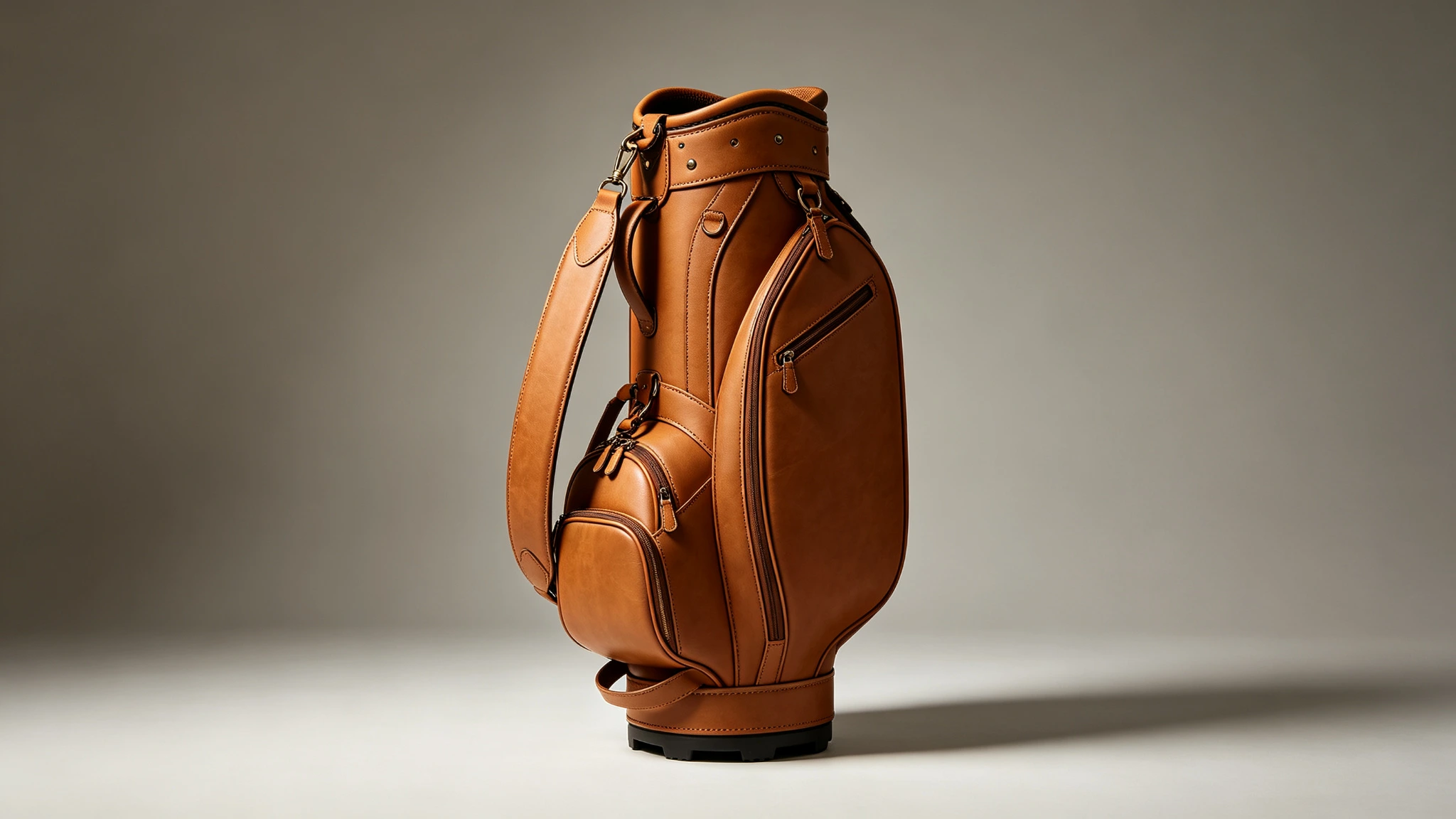
The architecture disciplines: shared design DNA across tiers (one collar language, one hardware finish family, one branding system — the range reads as a family at three altitudes), explicit material communication (the customer must always know which tier they hold), and price spacing wide enough to prevent tier-blur (40-60% steps between tiers is the proven rhythm).
The anti-pattern worth naming: the single-product "luxury launch" — one beautiful bag with no tier beneath it and no story beside it. Single products force every customer to one price decision and give the range no room to grow; the architecture gives the curious customer a premium-tier entry, the committed customer a flagship destination, and the collector a heritage reason to return. Tiers are not upselling machinery; they are how a range meets customers where they actually stand.
The build sequence that works: flagship first (it defines the DNA and the photography), premium second (it inherits the DNA into the volume silhouette), heritage third (it extends the story to the collector). Brands that launch all three simultaneously divide their imagery; brands that sequence build a narrative the market can follow. Our leather OEM guide covers the single-build foundation this architecture extends.
The Development Calendar
First-season development runs 16-20 weeks from brief to warehouse, and the calendar is best planned backward from the retail window. Weeks 1-2: brief and material kit (leather, hardware, finish samples presented physically). Weeks 3-6: engineering prototype and first revision — the pattern work where golf engineering meets brand design. Weeks 7-9: golden sample and approval — the standard the production will be measured against.
Weeks 10-12: 100-piece trial run — the production-proving step that separates programmes from gambles, validating yield, workmanship consistency and packing at real line speed. Weeks 13-18: bulk production on dedicated lines with per-gate QC. Weeks 19-20: final inspection, packing and freight buffer. Repeat seasons compress to 8-10 weeks: patterns proven, materials locked, only colourways and refinements cycle.
The seasonal rhythm for leather specifically: Q1 briefs land summer/autumn retail; Q3 briefs land holiday and spring. Leather adds one calendar note of its own — hide sourcing for heritage specs (specific tanneries, vegetable tanning schedules) carries its own lead time, and the best programmes lock hide lots one season ahead. The calendar is the programme’s first deliverable; we build it in the first meeting.
The calendar discipline that saves programmes: approval gates with named owners and deadlines. Development calendars fail not at manufacturing but at approval — the golden sample waiting two weeks on a brand’s decision, the colourway confirmation arriving after the material window closed. Every calendar we build includes the brand’s approval dates beside our production dates, because the 16-20 week promise is a shared one: we control the line; only the brand can control its own calendar.
Material Tiers and Provenance
The programme’s material architecture mirrors its product tiers: flagship hides at Grade A full-grain from named tanneries (lot-documented, per our grading guide), premium tiers at top-grain or hybrid leather-plus-technical constructions, heritage tiers at vegetable-tanned and waxed pull-up lots with tannery provenance stated on the hangtag — the provenance is part of the product story.
Hardware follows the same discipline: solid brass and gunmetal from named foundries at flagship and heritage, quality plated at premium entry where honest, with the hardware finish family consistent across the range. Zippers, thread, lining and edge systems are specified per tier in the programme material bible — the document that keeps season three consistent with season one.
The provenance paper trail is a luxury programme’s quiet asset: tannery certificates, intake grading records, lot traceability from hide to panel, retained swatches archived per run. When the brand’s customer asks where the leather comes from — and luxury customers ask — the programme answers from records. Our intake discipline is audited annually under BSCI and ISO 9001:2015 systems, SGS-verified March 2026.
QC Gates for Connoisseur Customers
Luxury QC assumes the end customer inspects like an expert: 100% surface inspection on leather runs (not sampling), raking-light finish passes that expose what overhead light hides, stitch-line verification at ±0.5 mm on contrast-adjacent panels, magnified embroidery and branding checks, hardware cycle and torque testing per batch, and the final unboxing audit — packaging, presentation, first-touch — evaluated exactly as the customer will experience it.
The gate structure: intake (hide grading verification, hardware lot checks), in-line (pattern-room measurement, sewing gate checks at collar and stress points), final (100% surface, function, cosmetics), and pre-ship (AQL 2.5 sampling as the statistical floor over the 100% inspection). Every gate records; every record traces to lot and line.
The rejection philosophy defines the standard: our leather lines reject at 3-5x volume rates — panels re-cut for acceptable-elsewhere flaws, edge coats stripped for minor waviness, units pulled at final for defects the volume market would never find. Rejection is not waste in luxury QC; it is the standard made physical, and the rejection rate is the number we show clients first. The factory audit guide turns these gates into the buyer’s checklist.
Branding and Personalisation Systems
Luxury programmes live on branding executed at the material’s level: debossing and foil on leather panels (the elegant standards), embroidery at adjusted density for leather, metal badges cast with the brand’s mark, and interior labels woven to the brand’s spec. The executions and their minimum-detail rules are mapped in our branding guide.
Personalisation extends the programme into its highest-margin territory: recipient-name debossing for corporate and club builds, member numbers and tournament dates for event editions, and monogram systems for direct retail. The production discipline: personalisation data flows as structured files (never handwritten lists), with per-unit verification at the branding station and a final name-check against the manifest before packing.
Limited editions complete the branding architecture: numbered runs with certificates, edition-specific materials (special hides, foundry hardware, collaboration textiles), and edition packaging that makes the unboxing an event. Editions are where luxury leather programmes compound — the same pattern, a new story, at margins that fund the next season’s development.
Commercial Terms and the Honest Arithmetic
Programme terms: MOQ 200 per design with 100-piece trials (sized for luxury volumes, which are naturally smaller than volume programmes), sampling 6–10 days with hide-lot approval, trial runs 3-4 weeks, bulk 35–50 days on dedicated leather lines. Payment: 30% deposit with order, 70% against shipment documents — standard terms, unchanged since our first programme in 2014.
The pricing conversation is arithmetic, not negotiation theatre: provenance materials (named-tannery hides at 2-4x volume leather cost), handwork labour (saddle stitching, hand edges, at multiples of machine rates), 100% inspection QC, and the yield cost of strict panel selection — itemised so the brand chooses where the craft spending matters most. Luxury pricing is honest or it is nothing; we show the numbers.
The programme support that wraps the terms: dedicated project engineer per account, development calendar management with milestone alerts, material library access with physical kits, factory tours and remote video audits on request, and post-shipment support (spare hardware, repair guidance, care documentation) for the product’s service life. Begin the brief at our quote page.
Scaling: Repeat Seasons and Range Extension
Repeat seasons are where leather programmes compound: patterns proven, materials locked, QC history established — development compresses to 8-10 weeks, and the conversation shifts from engineering to strategy: new colourways on proven silhouettes, the next tier’s launch, edition planning around the retail calendar. The programme’s second year is its most profitable; the calendar discipline of the first year buys it.
Range extension follows the architecture: adjacent silhouettes on shared DNA (the flagship staff bag’s language into cart and stand builds), material line extensions (the heritage waxed finish onto the accessories range — head covers, pouches, scorecard holders, where our head cover programme keeps the leather story consistent at small-goods scale), and channel-specific builds (tournament editions, resort exclusives, corporate programmes).
The long-view economics: luxury leather programmes mature into annuities — standing reorders on evergreen builds, seasonal edition drops with proven mechanics, and a customer base whose lifetime value justifies the tier’s entire development cost. The brands that stay five seasons own their niche; the architecture, calendar and QC gates in this guide are how staying is engineered.
The measurement rhythm keeps scaling honest: sell-through by tier each season (which architecture leg is carrying), return and warranty data by construction element (where craft spending earns its premium), and edition performance against evergreen (how much scarcity the market rewards). Programmes that review these numbers annually adjust the architecture with evidence; programmes that do not repeat the first season’s guesses at rising cost. Data is the quiet sixth pillar of the programme.
And the customer data completes the loop: reviews read for construction language (the market describing your QC back to you), resale prices watched as the brand’s secondary-market health, and the photography customers post unprompted — the surest signal that the product is earning its tier. Luxury programmes are judged in public, permanently; the brands that listen to the judging scale faster than the brands that only talk.
The Bottom Line
The luxury leather OEM programme in five pillars: tiered architecture with shared DNA and 40-60% price steps; a 16-20 week first-season calendar planned backward from retail; material tiers with lot-level provenance; QC gates at connoisseur standard with rejection rates that prove them; and commercial terms that itemise the handwork honestly.
The programme’s real product is not the bag but the system: architecture, calendar, materials, QC and terms working as one machine that produces luxury reliably, season after season. The machine is what a manufacturing partner is for.
Open the brief with the tier architecture and the target retail window, and material kits plus a development calendar come back within days. Samples in 6–10 days; golden samples at week nine; the leather tier, built properly, from the quote page.
The parting observation from 200+ programmes: luxury leather programmes rarely fail on craft — the craft is auditable, and this guide gives the audit. They fail on architecture (one product instead of a range), on calendar (approvals drifting past material windows), or on honesty (pricing that hides the handwork until the invoice). Build the architecture, hold the calendar, itemise the arithmetic — and the craft does what it has done for two centuries: it turns hide into objects people keep.
Open Your Programme Brief
Send the tier plan and retail window. We return material kits and a development calendar within days, samples in 6–10 days.
Request a Quote →People Also Ask
What is a luxury leather golf bag OEM programme?
A standing manufacturing partnership for leather builds: tiered product architecture (flagship / premium / heritage), a development calendar from brief to warehouse (16-20 weeks first season), material tiers with documented provenance, connoisseur-grade QC gates, and commercial terms itemising handwork honestly. It differs from project-based ordering by compounding — patterns, materials and QC history carry season to season, compressing development and deepening quality.
What is the MOQ for a luxury leather golf bag programme?
MOQ 200 pieces per design with 100-piece trial runs — sized for luxury volumes, capsule drops and limited editions. Sampling 6–10 days with hide-lot approval, trial runs 3-4 weeks, bulk 35–50 days on dedicated leather lines. Payment 30/70 against shipment documents. Open the brief at our quote page.
How long does a first-season leather programme take?
16-20 weeks brief to warehouse: weeks 1-2 brief and material kits, 3-6 engineering prototype and revision, 7-9 golden sample, 10-12 the 100-piece trial run, 13-18 bulk with per-gate QC, 19-20 inspection and freight buffer. Repeat seasons compress to 8-10 weeks. Heritage hide sourcing may add lead time — the best programmes lock hide lots a season ahead.
What materials does a luxury leather programme use?
Tiered provenance: Grade A full-grain from named tanneries at flagship (lot-documented), top-grain or leather-hybrid constructions at premium, vegetable-tanned and waxed pull-up at heritage — with solid brass and gunmetal hardware, specified zippers, thread and linings per tier in a programme material bible. Tannery certificates, intake grading records and lot traceability archive per run. See our grading guide.
What QC standards apply to luxury leather bags?
100% surface inspection on leather runs (not sampling), raking-light finish passes, ±0.5mm stitch-line verification on contrast panels, magnified branding checks, hardware cycle and torque testing, and a final unboxing audit — over an AQL 2.5 statistical floor. Leather-line rejection runs 3-5x volume rates by design; the rejection rate is the first number we show clients. Our audit guide converts the gates into a buyer checklist.
How is a luxury leather programme priced?
As honest arithmetic, itemised: provenance materials (named-tannery hides at 2-4x volume leather cost, solid hardware at 3-5x plated alloy), handwork labour (saddle stitching and hand edges at multiples of machine rates), 100% inspection QC, and yield cost from strict panel selection. The itemisation lets the brand choose where craft spending matters most — luxury pricing is transparent or it is nothing.
Can the programme handle personalisation and limited editions?
Yes — both are core programme territories: recipient-name debossing, member numbers and monogram systems with structured data flow and per-unit verification; numbered limited editions with certificates, edition-specific materials and event-grade packaging. Personalisation and editions are the programme’s highest-margin activities and compound across seasons on standing patterns.
What is the difference between OEM and ODM for leather golf bags?
OEM builds to the brand’s design and spec (the brand owns the product); ODM adapts the factory’s proven patterns to the brand’s materials and branding (faster, cheaper development, shared architecture). Luxury programmes typically run OEM for flagship and heritage (distinctive design is the point) and may run ODM at premium entry (proven silhouettes, brand materials). Most of our programmes mix both by tier.
How do leather hybrids fit a luxury programme?
As the premium tier’s engineering answer: full-grain leather at prestige zones (collar, pocket faces, handle, spine) over technical panels — leather presence at walkable weights (5-7 lbs) and accessible price points. Hybrids are separate engineering, not material swaps: junction reinforcement, weight redistribution and differential aging at the seams are all spec items. Done properly, hybrids carry the luxury DNA into the volume silhouette.
What certifications support a luxury leather programme?
BSCI social compliance and ISO 9001:2015 quality systems, SGS-verified operations (March 2026), tannery-level LWG ratings and OEKO-TEX chemistry documentation on materials, and test-lab data for performance claims (ISO 105 colourfastness, flex, abrasion). Client audit standards — including annual maison supplier audits — are welcomed and passed; the paperwork is part of the programme.
Can a programme start small and scale?
The 100-piece trial exists for exactly this: prove the product, the market and the partnership at minimum risk, then scale to MOQ 200 production and multi-tier architecture as sell-through justifies. Many standing programmes began as single-silhouette trials. Scaling adds tiers and silhouettes on shared DNA — the architecture is designed to grow without redesign.
What leather finishes can a programme specify?
The full family: aniline and semi-aniline (transparent luxury), waxed and pull-up (living heritage), pigmented (engineered consistency, white builds), saffiano (contemporary structure) and embossed textures (croc, monogram). Finish samples approve as physical masters with raking-light photography, and variation windows agree at golden sample. The finish playbook compares the families.
How are reorders and evergreen builds handled?
Standing patterns with locked materials: evergreen reorders run 35–50 days without re-sampling (golden samples archive for the programme’s life), with per-lot material verification maintaining consistency against the master. Colourway refreshes cycle through sampling only for the changed elements. The reorder discipline is what turns a programme into an annuity — season three’s consistency with season one is engineered, not hoped for.
What support comes after shipment?
Spare hardware availability, repair guidance and workshop referrals for the product’s service life, care documentation for retail inclusion (the care card is part of the spec), sell-through review meetings that plan the next season on data, and warranty support on construction defects. A luxury programme’s relationship with its manufacturer should outlast any single season — the support structure is built for decades, like the bags.
Why manufacture luxury leather golf bags with us?
One line of credentials: SGS-verified since 2014, BSCI and ISO 9001:2015 certified, 200+ brand programmes, dedicated leather lines with 100% inspection, lot-level provenance, 6–10 day sampling, and terms unchanged since our first programme — MOQ 200, 100-piece trials, 30/70 payment. The factory tour shows the rest. Open the brief at our quote page.
Sources & Authority
Programme architecture, calendar and terms reflect luxury leather OEM operations at QUANZHOU JUNYUAN BAGS (SGS-verified March 2026; BSCI, ISO 9001:2015), across 200+ brand programmes since 2014. Development timelines from current programme management records; QC standards from our AQL 2.5 leather-line protocols.