Black Leather Golf Bags: The Premium Power Shade, Specced Properly
Black is the power shade of leather golf bags — the colour of boardrooms, tour bags and tuxedo-formal equipment — and the least forgiving of poor execution. Matte, gloss, pebbled and embossed finishes each behave differently, show wear differently, and photograph differently. This guide maps the black finishes, their scratch and care realities, and the OEM specs that keep black looking expensive instead of exhausted. Black builds anchor our leather colours hub and the wider leather range.
QUANZHOU JUNYUAN BAGS, established 2014 in Quanzhou, Fujian, manufactures through an affiliated factory of 4,950 m², 7 production lines, 149 machines (126 sewing stations) and 137 staff — rated at 200,000 pieces per month, actual output around 150,000. Every order runs AQL 2.5 inspection, MOQ 200 (100-piece trial), sampling 6–10 days, bulk 35–50 days, with BSCI, ISO 9001:2015, CE, CPC and RoHS certifications (SGS audit, March 2026). We serve 200+ brands in 100+ countries.
Why Black Is the Power Shade
Black leather occupies a unique position in the bag market: it is simultaneously the most formal colour, the most tour-authentic colour (the staff bags of Sunday afternoon are overwhelmingly black-panelled), and the most commercially international colour — black sells in every market without translation. A black leather bag reads as serious equipment in Tokyo, Texas and Turin alike.
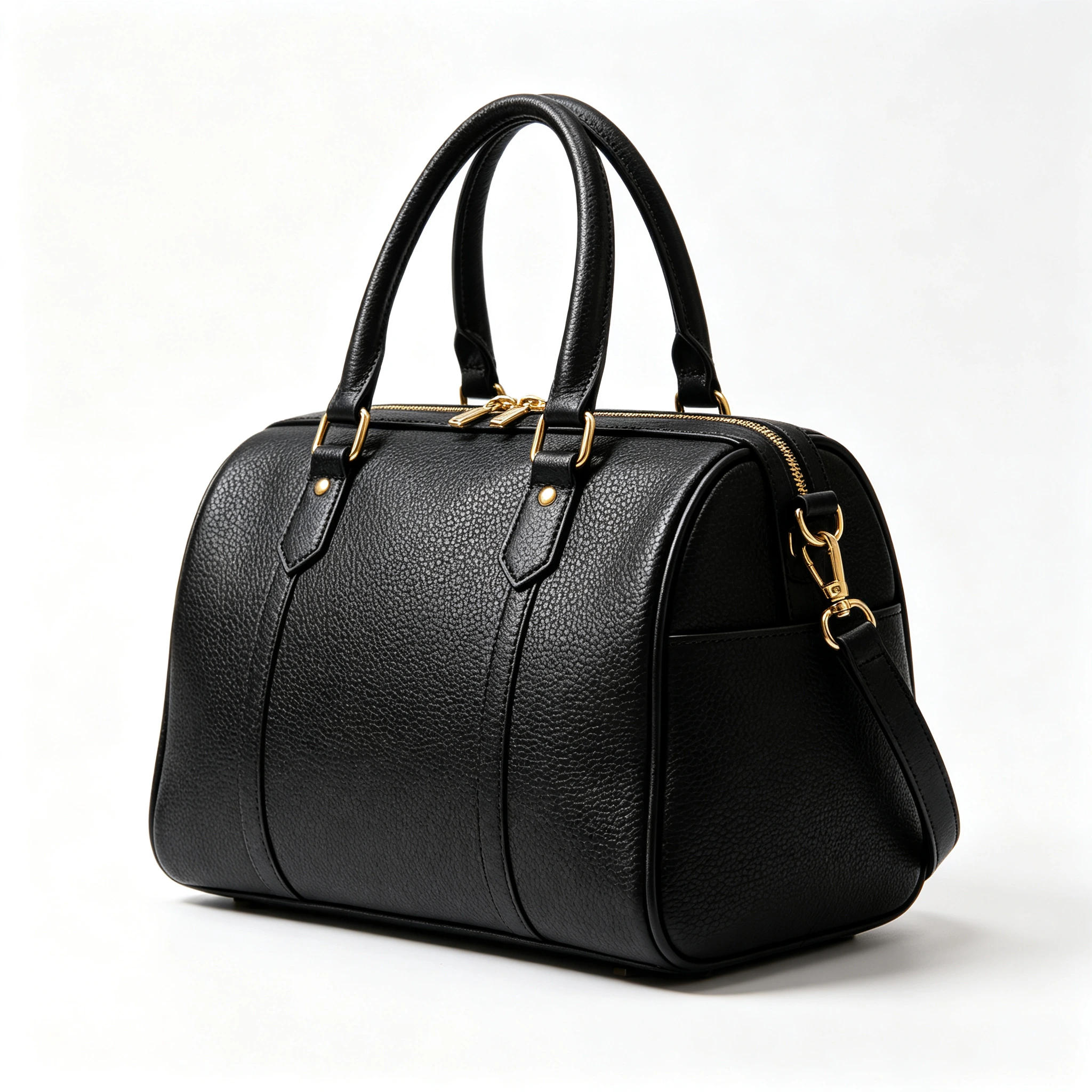
Black is also the shade that flatters branding most. Gold, silver, white and contrast-colour marks on black achieve maximum legibility and maximum luxury signal — the reason premium automotive and watch industries run black-flagship playbooks. For club crests and corporate programmes, black is the shade that makes the logo look expensive.
But black is the least forgiving shade in leather. Every scuff, dust film and fingerprint shows; poor-quality black leather reads as plastic; and cheap black finishes grey at flex points within a season. Black done properly is the pinnacle of the range; black done cheaply is the fastest way to look bargain. This guide is the "properly" spec.
The tour connection deserves expansion because it is black’s deepest commercial asset. Professional golf’s visual language was built on black staff bags with white and gold panels — and that imagery is embedded in every golf consumer’s sense of what "serious" looks like. A black bag borrows that authority instantly and free of charge. Brands launching without heritage can manufacture none faster than with a credible black staff silhouette; it is the silhouette-colour combination that reads as established even when the label is new.
The Four Black Finishes
Black leather resolves into four finishes with distinct characters. Matte black — the modern luxury standard: soft, light-absorbing, contemporary, and the best backdrop for metallic branding. Gloss/patent black — the formal statement: high-shine, boardroom-dramatic, and the highest-maintenance finish in leather (every touch prints). Pebbled black — the workhorse: textured grain that hides scuffs and fingerprints, the most practical black for real golf.
Embossed black — croc, lizard or saffiano textures pressed into the hide: the fashion-luxury lane, visually rich and naturally scratch-disguising. Each finish has its place: matte for contemporary premium lines, pebbled for play-every-week bags, embossed for statement and gift pieces, gloss for formal and trophy builds only.
| Finish | Character | Scratch behaviour | Maintenance | Best use |
|---|---|---|---|---|
| Matte | Modern luxury | Shows scuffs, buffs well | Moderate | Contemporary premium |
| Gloss / patent | Formal drama | Shows everything | High | Trophy, display |
| Pebbled | Practical texture | Hides wear best | Low | Play bags, volume |
| Embossed | Fashion luxury | Texture disguises marks | Moderate | Statement, gift |
The finish decision should follow the bag’s real life, not the photo shoot: a black gloss bag is magnificent for a week and maddening for a season, while pebbled matte quietly looks expensive for years. Brands that merchandise finish honesty — "built for play" versus "built for ceremony" — earn the reviews that sell the next season.
Black and Light: The Scratch and Dust Reality
Black leather’s defining behaviour is optical: it shows everything that contrasts with it. Dust and lint (pale) show on black more than any shade; fine scratches reveal lighter leather beneath dark finishes; water spots on aniline black dry as visible rings. None of this disqualifies black — it simply makes finish and care the whole conversation.
The finish answers: pigmented and semi-aniline blacks with through-dyed hides (colour struck through the full thickness) keep scratches dark rather than revealing pale substrate — the single most important black-leather spec, and one to verify at sample stage by flexing a panel and examining the crease. Surface-dyed blacks look identical new and betray themselves at the first scuff.
The care answers are simple but non-negotiable: microfiber wipe-down after rounds (dust is black’s daily enemy), conditioning every two to three months with a black-appropriate cream (some conditioners temporarily cloud dark finishes — test on the base first), and a colour-matched black balm for the scuffs that happen anyway. The full routine is in our leather care guide, with black-specific notes worth printing on the care card.
Display and storage deserve black-specific mention because dust is the shade’s standing enemy at retail as well as at home. Black bags on open shop shelving need weekly wipe-downs to photograph and sell as they should — a dusty black bag reads as old stock. For e-commerce, black photography wants controlled lighting and a lint-free set: the same surface sensitivity that punishes owners punishes product photography, and the brands that master black imagery earn visibly higher conversion on the shade.
Hardware and Branding on Black
Black is the most versatile hardware partner in leather — and the most consequential. Gunmetal on black is the contemporary power combination: monochrome, technical-luxury, the choice of modern premium lines. Gold on black is the classic luxury signal — magnificent when the gold is warm and restrained, cheap when bright and abundant. Aged silver and nickel suit black’s cool register. Brass reads muddy against true black; bright chrome reads rental-car.
Branding on black achieves maximum legibility: white, gold, silver and contrast-colour marks all read at distance, and black panels are the tour-standard branding canvas for exactly this reason. The executions that shine on black: gold or silver foil on flat panels (gift and trophy builds), white or contrast embroidery, and — the connoisseur’s choice — blind deboss, where the mark appears only as shadow and light. Blind deboss on matte black is the quietest flex in golf branding.
The restraint rule applies doubly on black: because every mark reads maximally, too many marks shout. One panel, one mark, one metallic — black rewards confidence and punishes anxiety. Branding execution options are mapped in our branding guide.
Thread and lining complete the black build’s discipline. Tonal black thread is the invisible default; contrast white or gold topstitching is the deliberate statement — powerful on matte black, but it magnifies every stitching inconsistency, so it belongs only on builds whose sewing can stand the scrutiny. Lining on black bags should stay tonal or classic-patterned (black watch tartan, houndstooth, subtle pinstripe): a bright lining flashing from an open pocket breaks the formal register that is black’s entire reason for being.
Black in the Range: The Anchor Shade
Every leather range needs black, and the question is only which black in which silhouette. The proven role assignments: black matte staff bag as the range flagship (the tour-authentic hero), black pebbled carry or stand bag as the volume premium (the play-every-week answer), and black embossed or gloss limited editions as the gift and statement lane.
Black’s commercial behaviour differs from brown’s: it is less seasonal (sells year-round evenly), more corporate (the default for logo programmes), and more international (no market reads black wrong). Launch allocations should weight black accordingly — it is rarely the most photographed shade but frequently the most reordered one.
Black also behaves differently across leather types, and the pairing deserves thought at architecture stage. Black on smooth full-grain reads formal and Continental; black on pebbled hides reads sporty-premium; black on pull-up leather is rare and striking (the two-tone effect in black registers as charcoal-grey flashes at creases). Black corrected grain is the riskiest pairing in leather: flat, uniform and lifeless, it is the specific combination that reads as plastic from across the shop. Whatever the silhouette, black wants full-grain character beneath it — the shade amplifies both quality and its absence.
Black also anchors two-tone architectures: black-and-white (the eternal tuxedo scheme), black-and-cognac panels, black with contrast piping in cream or gold. Two-tone on black is the highest-drama architecture in the colour playbook, and it works precisely because black disciplines it. The full colour architecture is in our leather colour guide.
OEM: Black-Specific Production Notes
Black hides are the easiest to dye consistently and the hardest to finish well — paradox explained: black dye lots hold Delta-E tightly, but black surfaces expose every finishing flaw (uneven gloss, roller marks, dust inclusions in the finish coat). Black production therefore wants the cleanest finishing environment and the most disciplined final inspection; our black runs get an additional gate-three inspection pass under raking light, which reveals surface flaws invisible under flat light.
Through-dyed verification goes in the tech pack for black: a flex test at golden sample, examining creases for pale substrate. Panel grading matters differently for black than brown — colour variation is rarely the issue; surface perfection is. The cleanest panels go to display faces, and any panel with finish inclusions is rejected outright rather than repositioned.
Commercial terms hold: MOQ 200 with 100-piece trials, 6–10 day sampling, 35–50 day bulk, AQL 2.5. Black corporate programmes (logo plus recipient name) are the highest-volume black play and re-order predictably — locked black specs reorder in 5-7 weeks with no colour re-approval needed, one of black’s quiet operational advantages. Start at our quote page.
A note on black two-tone production, since black anchors most contrast architectures: panel joins between black and light colours demand the highest cutting and sewing precision in the range — a millimetre of waviness at a black-white seam reads as a quality failure instantly, where the same wobble in a tonal build disappears. Two-tone black builds get our most experienced sewing teams and a 100% seam-line inspection at gate two. Buyers pricing two-tone should expect the construction premium; it is buying exactly the precision the design exposes.
The Bottom Line
Black leather golf bags are the power play of the colour spectrum: tour-authentic, internationally legible, branding-flattering — and utterly unforgiving of cheap execution. The spec that keeps black expensive: through-dyed hides, finish matched to use (matte for modern, pebbled for play, embossed for statement, gloss for ceremony), gunmetal or gold hardware, one confident mark.
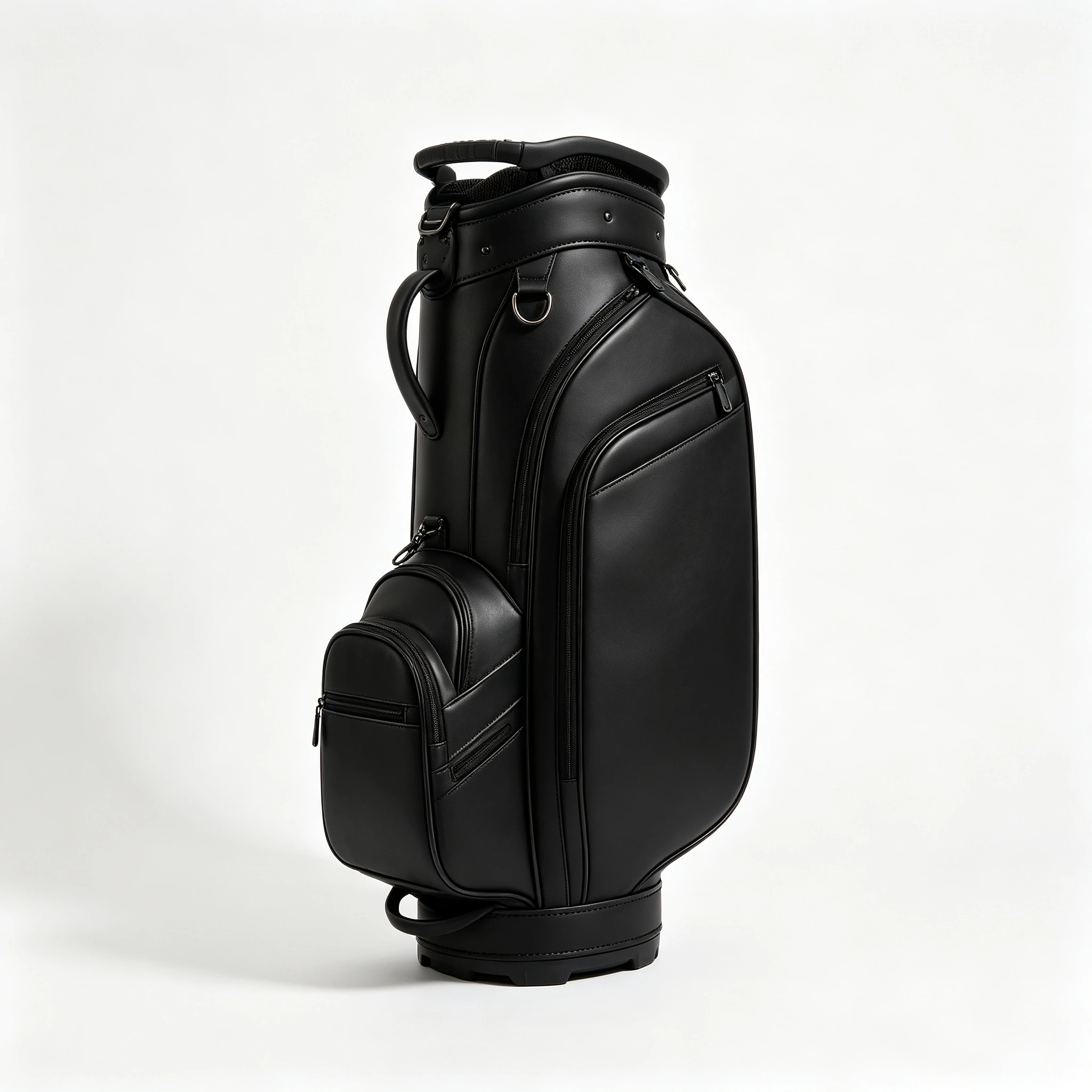
Black’s demands are daily: dust wiped, scuffs balmed, conditioning on rhythm. Brands that print the care card and spec the finish honestly earn the shade’s full commercial power; brands that treat black as default discover it is actually the shade with the highest standards.
Send the silhouette and the hardware direction, and black samples — raking-light inspected, through-dyed verified — come back in 6–10 days. Black is not the easy shade. That is exactly why it is the power shade.
Spec Your Black Build
Send the silhouette and hardware direction. We return finish-verified black samples in 6–10 days, quoted at MOQ 200.
Request a Quote →People Also Ask
Are black leather golf bags a good choice?
Yes — black is the power shade: tour-authentic (Sunday staff bags are overwhelmingly black), maximally branding-legible, internationally universal, and year-round commercial. Its demands: quality through-dyed hides, the right finish for the bag’s use, and daily dust discipline. Done properly it is the pinnacle of a range; done cheaply it reads as plastic. See our colour range.
What finishes do black leather golf bags come in?
Four: matte (modern luxury standard, best branding backdrop), gloss/patent (formal drama, highest maintenance), pebbled (textured workhorse, hides wear best, ideal for play bags), and embossed — croc, lizard or saffiano textures (fashion luxury, naturally disguises marks). Choose by the bag’s real life: pebbled for weekly play, matte for contemporary premium, gloss for ceremony.
Do black leather golf bags show scratches?
Black shows contrast, so scratches reveal lighter substrate — unless the hide is through-dyed (colour struck through the full thickness), which keeps scratches dark. Verify through-dyeing at sample stage with a flex test: examine the crease for pale substrate. Pebbled and embossed finishes disguise wear best; gloss shows everything.
What hardware looks best on a black leather golf bag?
Gunmetal for contemporary monochrome power (the modern premium default), warm restrained gold for classic luxury, aged silver or nickel for cool registers. Avoid brass (muddy against true black) and bright chrome (rental-car register). One finish across the whole set, from one batch, verified against a sealed reference.
How do you clean a black leather golf bag?
Microfiber wipe-down after every round — dust is black’s daily enemy. Condition every 2-3 months with a black-appropriate cream (test first: some conditioners temporarily cloud dark finishes). Treat scuffs with colour-matched black balm. Never household cleaners or silicone sprays. Full routine in our leather care guide.
Is matte or gloss black better for a golf bag?
Matte for nearly everything: contemporary, light-absorbing, the best backdrop for metallic branding, and it buffs scuffs well. Gloss/patent is a ceremony finish — magnificent for trophy and display pieces, maddening for weekly play since every touch prints. Pebbled matte is the practical champion for bags that see real rounds.
What branding works on black leather golf bags?
Maximum-legibility executions: gold or silver foil on flat panels (gift and trophy), white or contrast embroidery, and blind deboss on matte black — the connoisseur’s choice, where the mark appears only as shadow. Because every mark reads maximally on black, restraint rules: one panel, one mark, one metallic. Options in our branding guide.
Do black leather bags fade in sunlight?
Quality through-dyed black hides hold colour well; cheap surface-dyed blacks grey at flex points and UV-exposed zones within seasons. Prevention is spec (through-dyed, quality finish coat) plus care (regular conditioning feeds the finish; UV-protective leather creams help bags stored near windows). Sustained car-boot storage in summer sun is the fade accelerator to avoid.
What is the MOQ for a custom black leather golf bag?
MOQ 200 pieces per design with a 100-piece trial, sampling 6–10 days, bulk 35–50 days under AQL 2.5 with an extra raking-light surface inspection on black runs. Black corporate programmes with logo plus recipient names are the highest-volume black play. Start at our quote page.
Can black and brown leather be combined in one range?
Yes — the proven architecture runs black as the anchor (staff flagship, pebbled volume) with a three-brown family (light heritage, mid classic, dark formal) beside it. Black and espresso share buyers; differentiate them by finish and hardware rather than letting them cannibalise. Two-tone black-and-cognac panels are a proven statement architecture within the same range.
Are black leather golf bags good corporate gifts?
The best in the category: black is the boardroom shade, branding on black achieves maximum legibility, and recipient name embroidery is standard at MOQ 200. Black corporate programmes reorder predictably — locked specs reorder in 5-7 weeks with no colour re-approval, one of black’s operational advantages for programme buyers.
Why does my black leather bag look grey at the creases?
Surface-dyed leather: the black finish coat sits on pale substrate, and flexing cracks it to reveal the lighter layer beneath. The fix is spec-level: through-dyed hides where colour strikes through the full thickness, verified by flex test at golden sample. Existing greying can be improved with black balm and conditioning, but prevention through material spec is the real answer.
Is black leather hotter to carry in summer?
Marginally — black absorbs more solar heat than pale colours, and a black bag left in direct sun warms faster at the surface. In play the difference is minor and brief (the bag is shaded by the body and cart most of the round), but avoid long car-boot storage in summer sun: heat above 60°C damages leather, padding and adhesives regardless of colour, and black accelerates the exposure.
Can black leather bags be embossed with croc texture?
Yes — croc, lizard and saffiano embossing on black is the fashion-luxury lane and one of the best wear-disguising finishes available: the texture hides scuffs and fingerprints that flat black displays. Embossed black suits statement and gift builds at $400+ retail. Embossing specs (plate depth, alignment across panels) are locked at golden sample like any branding execution.
How do black leather bags photograph for e-commerce?
They demand the most controlled setup of any shade: soft directional lighting to reveal grain (flat light turns black into a void), lint-free set and gloves during handling, and slight overexposure compensation so detail survives. Matte black is the easiest finish to shoot; gloss the hardest. Brands that master black imagery see visibly higher conversion — the shade sells on perceived quality, and photography is where that perception is built.
Is black a safe colour for a first leather bag launch?
The safest: year-round demand, no market translation needed, the corporate default, and the most forgiving of trend cycles. Its only trap is quality exposure — black amplifies both good leather and bad. Launch black on full-grain hides with disciplined finishing and it is the most reliable first colourway in the category; launch it on corrected grain and it announces the shortcut.
What lining works best inside a black leather bag?
Tonal black or charcoal for the seamless luxury read, or classic heritage patterns — black watch tartan, houndstooth, subtle pinstripe — for character. Avoid bright technical colours: a vivid lining flashing from an open pocket breaks the formal register that is black’s entire reason for being. The lining shows every round; it should continue the story, not interrupt it. Weight matters too: 210D or heavier twill holds pocket shape over years of use.
Sources & Authority
Finish and scratch behaviour reflect production inspection data (including raking-light surface inspection protocols) at the QUANZHOU JUNYUAN BAGS affiliated plant, AQL 2.5, SGS-verified March 2026. Colour and channel analysis from 200+ OEM brand client programmes and Golf Datatech premium-category tracking.