The Classic Tour Bag: Heritage Design, Modern Engineering
The classic tour staff bag — 9.5-10 inch collar, tall straight profile, one bold branding panel — is golf’s most prestigious silhouette, and its modern reissue keeps the look while cutting the weight from 6-7 kg to 3.5-4.5 kg. This guide covers the heritage design, the internal engineering that makes it carryable, the branding architecture that makes it valuable, and the OEM path to building one. The silhouette anchors our vintage range, and its professional-duty cousin is detailed in our staff bag features guide.
QUANZHOU JUNYUAN BAGS, established 2014 in Quanzhou, Fujian, manufactures through an affiliated factory of 4,950 m², 7 production lines, 149 machines (126 sewing stations) and 137 staff — rated at 200,000 pieces per month, actual output around 150,000. Every order runs AQL 2.5 inspection, MOQ 200 (100-piece trial), sampling 6–10 days, bulk 35–50 days, with BSCI, ISO 9001:2015, CE, CPC and RoHS certifications (SGS audit, March 2026). We serve 200+ brands in 100+ countries.
The Silhouette That Means Golf
Every sport has an object that stands for the whole game. Golf’s is the tour staff bag: tall, straight, white-panelled, carrying a name across the fairway. It appeared with professional golf’s television age and never left — the bag behind the 18th green on Sunday is the same silhouette that stood there in 1965. For brands, that permanence is the asset: the staff bag is the one golf product whose meaning requires no explanation to any golfer anywhere.
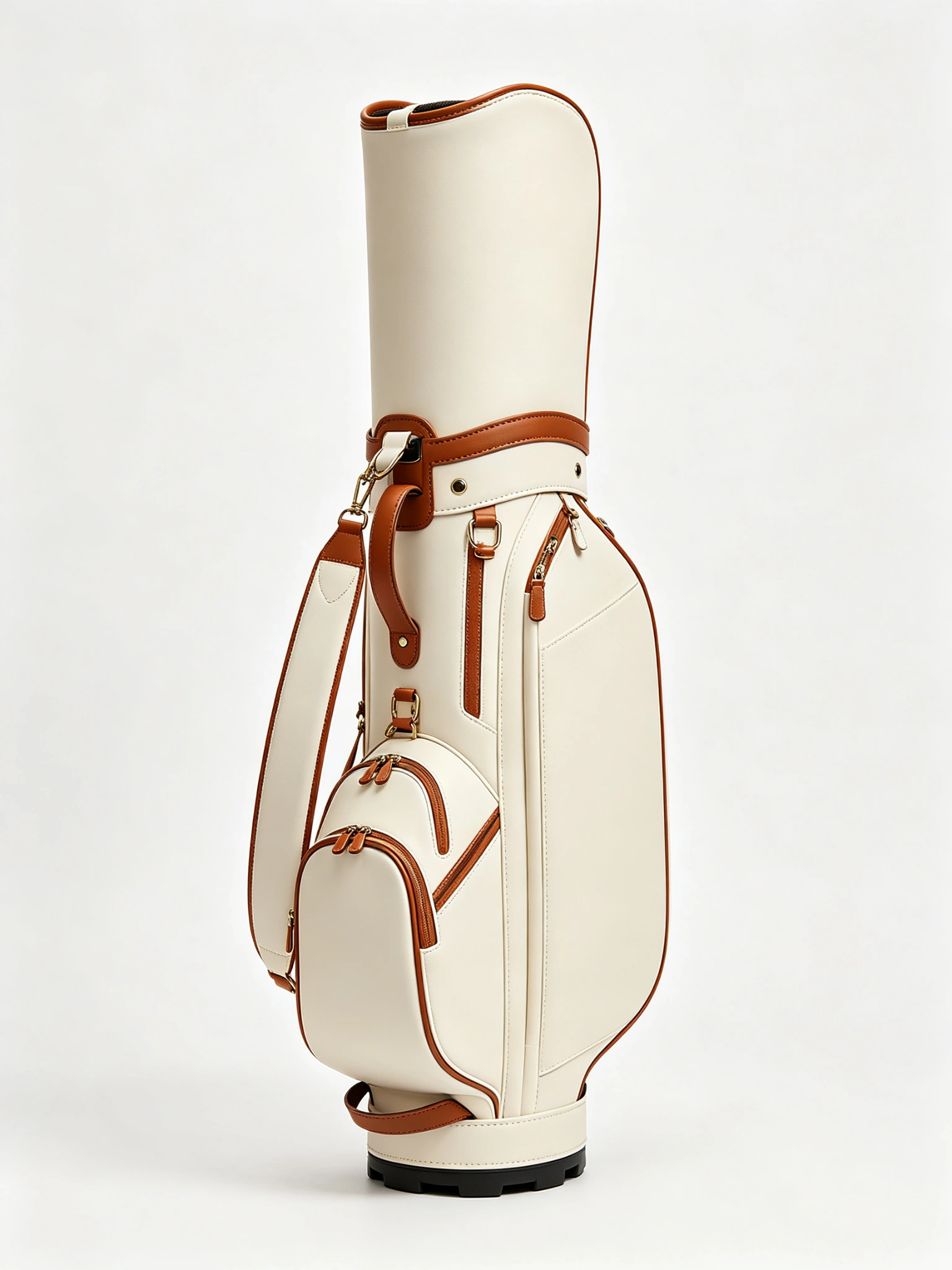
The silhouette’s elements are fixed by tradition: the 9.5-10 inch collar (the tour standard), the tall straight body at 88-92 cm, the six-pocket layout (apparel, balls, valuables, accessories, and the signature large side panel), the single carry strap, and the branding panel that turns the whole display face into one mark. Deviating from these is not innovation; it is a different product.
The classic tour bag’s modern opportunity is the reissue: the heritage silhouette executed with today’s materials and engineering, sold not to tour vans but to collectors, clubs, corporate programmes and style-driven consumers. The reissue market rewards fidelity and punishes shortcutting — this guide is the fidelity spec.
It is worth naming what the silhouette does for a brand beyond margin. A staff bag is the only golf product that reads as professional equipment and luxury object simultaneously — it legitimises a range the way a flagship sedan legitimises a car line. Brands that add a credible tour reissue to their range report a halo effect across their entire catalogue: the carry bags sell better because the staff bag exists. That halo, not the unit volume, is often the real business case for building one.
Heritage Proportions: The Numbers Behind the Look
The staff silhouette is a system of ratios, and the eye knows them even when the buyer cannot name them. Total height 88-92 cm. Collar 20-25 cm of tall, straight, largely untapered profile — roughly a quarter of total height. Branding panel beginning immediately below the collar, filling the upper half of the display face. Pocket stack low and vertical. Body diameter 25-28 cm — fuller than a carry bag, never bloated.
The top cuff is the proportion most often fumbled. Original staff bags carried simple 4-6 way tops under tall wrapped collars; modern reissues hide 5-14 way divider systems inside the same profile. The rule: the divider may be modern, but its visible rim must read heritage — wrapped in shell material, contrast-piped, with no naked injection-moulded plastic showing. A tech-moulded top on a heritage body is the single most common reissue failure.
Base and stance complete the proportions: a shaped, slightly flared base (staff bags stand, they do not lean) with a scuff-proof panel in leather or durable coated material, and base studs in the range’s hardware finish. The standing posture of a staff bag is part of its presence — it should stand on a shop floor like a piece of furniture, because to its buyer, it partly is one.
Engineering the Weight Out
Original staff bags were caddie equipment: 6-7 kg of leather and steel, carried by professionals for whom the bag was a workplace. The modern reissue buyer carries their own — and 6 kg ends the romance by the fourth hole. The engineering task of the reissue is preserving the silhouette at 3.5-4.5 kg, and it is achieved component by component.
The weight map of a modern reissue: aluminium stay frame replacing steel (saves 600-800 g), synthetic ripstop lining replacing cotton duck (300-400 g), modern divider cuff replacing wrapped solid partitions (400-600 g), considered pocket count and hardware selection (300-500 g), and — on full-leather builds — panel engineering that places 1.6-1.8 mm hide only where structure requires it, with lighter splits in low-stress zones.
The carry system gets the same treatment: a wide leather or cotton-webbing strap with a hidden ergonomic pad, anchored to the frame rather than the shell. Some reissues add a convertible double-strap option, hidden or styled to invisibility — a legitimate modern mercy as long as it does not read technical. The rule throughout: modern comfort, period appearance, and no visible component that could not have existed in 1965.
Weight verification is a golden-sample discipline, not a promise. We weigh every reissue sample empty and loaded (14 clubs, balls, apparel, full pockets) and record both figures against the spec sheet. The empty figure sells the bag; the loaded figure determines whether it gets carried or becomes furniture. A reissue that crosses 5.5 kg loaded has failed its engineering brief regardless of how beautifully it stands — and that failure is discovered at sample stage or at review stage, never anywhere cheaper.
The Branding Panel: Golf’s Biggest Canvas
The staff bag’s branding panel is the largest single branding surface in golf equipment — 25-35 cm wide and 40-60 cm tall of uninterrupted display — and its treatment defines the product. Heritage execution is one mark, one typeface, one or two colours, big enough to read across a fairway. The panel background often carries the bag’s contrast colour, making the architecture itself the brand statement.
Execution options at panel scale: embroidery (the classic — large-format multi-head machines handle panels with stitch-perfect consistency), debossed and colour-filled leather panels (the premium leather-build execution), and felt appliqué (the varsity-heritage look). Foil accents work for limited editions on flat panels. The failures at panel scale are the failures of ambition: too many marks, too many colours, type too small to read at twenty paces.
The panel is also the reissue’s commercial engine. Club crest editions, corporate logo programmes, major-championship commemoratives and numbered limited editions all live on that panel — each a product variant with the same bag beneath. One tooling investment, infinite editions: the branding panel is why staff reissues are the most programme-able product in the heritage range. Branding execution specs are in our branding guide.
Materials: Leather, Canvas and the Hybrid Builds
Three material architectures carry the silhouette. Full leather — the prestige build: full-grain vegetable-tanned or pull-up hides, 1.6-1.8 mm structural panels, the $600-800+ retail band and the collector market. Canvas and leather — the heritage standard: waxed canvas body panels with full-grain leather collar, base, welts and handle wraps, at $350-500 retail. Premium PU — the accessible reissue: 1.2 mm microfiber-backed PU with leather-look grain, at $200-300, serving clubs and corporate programmes at volume.
Each architecture has its production truth. Full leather demands the top 15-20% of each hide for display panels and the slowest construction — it is priced by panel selection as much as by material. Canvas-and-leather is the most forgiving to build and the most authentic in ageing. PU reissues are the volume play: consistent, colour-exact, and the correct answer for 100-piece club programmes where every member gets the same bag.
Material consistency across editions is the programme discipline: a club crest edition and a corporate edition sharing hardware, palette and lining read as one brand family. Colour-lot locking — one material PO per run, Delta-E verification under D65 light — follows the same protocol as our cover set discipline.
The Programmes: Clubs, Corporate, Collector
The classic tour reissue sells through three distinct programmes, each with its own logic. Club editions: member-guest gifts, centenary commemoratives, captain’s prizes — crest on the panel, club colours, runs of 50-200 pieces. The economics work because the audience is captive and the product is permanent: a member does not discard a bag with the club crest.
Corporate programmes: the executive gift that outclasses every crystal award. Logo on the panel, recipient name embroidered below it (name personalisation from a spreadsheet is standard at MOQ 200), gift-boxed with a care kit. Tournament and hospitality editions — the event mark on the panel, year on the collar — turn the bag into a kept memento rather than event merchandise.
Collector and limited editions: numbered runs (200 exactly, matching MOQ, is the elegant play), major-championship colourways, collaboration panels with artists or brands. Collector editions sell at 2-4x standard retail and build the brand story that sells everything else in the range. The edition calendar — two to four drops per year — is the rhythm that keeps a heritage brand in conversation.
Across all three programmes, the same commercial truth holds: the staff bag is bought as a permanent object, not a consumable. Nobody buys a tour reissue expecting to replace it in three years — they buy it expecting to keep it for thirty. That expectation is the segment’s pricing power and its quality demand in one: the bag must be built for the decades the buyer is imagining. Programmes that respect the permanence earn referral sales years after the original purchase — the slowest, cheapest, most valuable marketing channel in the category.
OEM Spec: The Tour Reissue Brief
A tour reissue brief adds heritage fields to the standard bag spec: collar height and profile, divider count (hidden modern top), material architecture (full leather / canvas+leather / PU), hardware finish, branding panel execution, strap spec, and edition plan. With those, sampling runs 6–10 days; the tall collar and panel work add no time, only precision.
The QC gates that matter most on this silhouette: collar straightness and piping exposure (gate two), panel branding registration against the golden sample (gate two), frame rigidity and stand posture (gate three), and full-bag proportion check against the archived silhouette (final AQL 2.5). The discipline framework is documented in our five-stage inspection guide.
Commercial terms: MOQ 200 per design with 100-piece trials (club programmes of 50-100 pieces are served on the trial tier — ask), bulk 35–50 days, reorders 5-7 weeks. Edition extensions after the first run are the fast lane: panel and colourway changes re-sample in days because the bag architecture is locked. Start the conversation at our quote page.
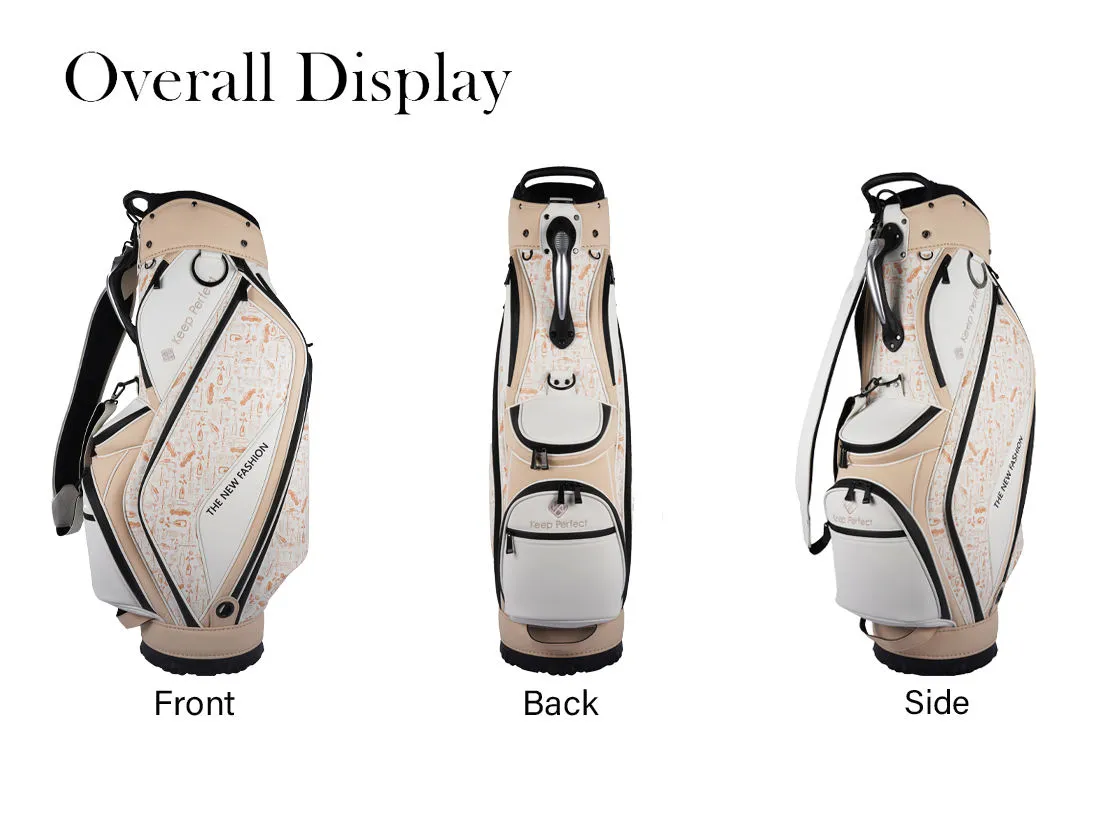
One development note specific to this silhouette: the tour bag’s tall collar and structured body demand a pre-production sample that is stood up, loaded and photographed before sign-off, not merely measured on the bench. Proportion failures — a collar a centimetre too short, a panel placed a hand-width too low — are obvious when the bag stands and invisible on a cutting table. Our sampling room photographs every tour sample against the archived silhouette reference as standard; buyers should demand the same comparison from any factory offering heritage builds.
The Bottom Line
The classic tour bag is golf’s permanent prestige object, and the modern reissue formula is exact: heritage proportions (quarter-height straight collar, bold panel, standing base), modern weight (3.5-4.5 kg through frame and component engineering), period-visible surfaces over contemporary internals, and one confident mark on golf’s biggest branding canvas.
The commercial structure is equally exact: one tooling investment, then club editions, corporate programmes and collector drops off the same architecture — each panel variant a new product, each edition a new margin event. No other bag silhouette programme-ables this well.
Send the crest, the colours and the edition plan, and a tour reissue sample comes back in 6–10 days. The silhouette has meant golf for sixty years — put your name on it properly.
Build Your Tour Reissue
Send the crest, colours and edition plan. We return a tour-spec sample in 6–10 days, quoted at MOQ 200 with trial tiers.
Request a Quote →People Also Ask
What is a classic tour staff bag?
Golf’s prestige silhouette: 9.5-10 inch collar, tall straight body at 88-92 cm, six-pocket layout, single strap, and one large branding panel on the display face. Originating as professional caddie equipment, it is now built as heritage reissues for collectors, clubs and corporate programmes — modern internals at 3.5-4.5 kg replacing the 6-7 kg originals. See our vintage range.
How much does a classic tour bag weigh?
Original leather staff bags ran 6-7 kg — caddie equipment. Modern reissues run 3.5-4.5 kg through aluminium stay frames, synthetic linings, modern divider cuffs and considered pocket counts. The silhouette is preserved; the hernia is not. Weight reduction is the core engineering task of any credible reissue.
What size collar does a tour staff bag have?
The tour standard is 9.5-10 inches (24-25 cm diameter), with a tall straight profile of 20-25 cm — roughly a quarter of the bag’s total height. The collar is built over a wrapped, contrast-piped top cuff; modern reissues hide 5-14 way dividers inside the same heritage profile. A naked moulded top on a heritage body is the most common reissue failure.
How is the branding panel on a tour bag made?
Three heritage executions: large-format embroidery (the classic), debossed colour-filled leather panels (the premium leather build), or felt appliqué (varsity heritage). One mark, one typeface, one or two colours, sized to read across a fairway. The panel typically measures 25-35 cm wide by 40-60 cm tall — golf’s largest branding surface. Specs in our branding guide.
What materials are classic tour bags made from?
Three architectures: full-grain leather (prestige, $600-800+ retail), waxed canvas with leather trim (heritage standard, $350-500), and premium 1.2mm PU (accessible reissue, $200-300, the volume play for club and corporate programmes). All share antique-finish hardware, bonded thread and period-correct linings.
Can a tour bag have modern dividers and pockets?
Yes — that is the reissue formula: modern 5-14 way divider cuffs, waterproof seam-sealed pockets and insulated compartments hidden inside the heritage shell. The rule is invisibility: every modern component must be wrapped, piped or styled so no visible surface reads as technical. 1965 outside, 2026 inside.
What is the MOQ for a custom tour staff bag?
MOQ 200 per design with a 100-piece trial; club and corporate programmes of 50-100 pieces can be served on the trial tier. Sampling runs 6–10 days; bulk 35–50 days; edition extensions (new panel or colourway on the locked architecture) re-sample in days. Start at our quote page.
Are classic tour bags good corporate gifts?
The best in golf: the branding panel carries the corporate mark at fairway scale, the recipient’s name embroiders below it (spreadsheet personalisation is standard), and the bag is kept for decades rather than shelved like crystal. Tournament and hospitality editions with the event mark and year turn merchandise into mementos. MOQ 200 with trial tiers.
What is a numbered limited edition tour bag?
A collector drop: a numbered run (200 pieces exactly matches production MOQ elegantly), special colourway or collaboration panel, certificate and edition packaging. Collector editions sell at 2-4x standard retail, sell out rather than down, and build the brand story that lifts the whole range. Two to four drops per year is the proven rhythm.
How do clubs order crested tour bags for members?
Send the crest artwork, club colours and quantity. We return a panel layout within 2 working days and a golden sample in 6–10 days. Club editions of 50-200 pieces run on trial or MOQ tiers with crest, club colours and member personalisation as required. Centenary and captain’s-prize editions are the most common briefs we receive.
Do tour-style bags work for everyday amateur play?
The modern reissue does: at 3.5-4.5 kg with a padded strap (hidden double-strap conversion on many builds), full-length dividers and waterproof pockets, it carries like a premium cart bag. It prefers trolley or cart life over 36-hole walking days, but for club golf, society days and the car park impression, nothing else in the bag market makes the same statement.
How long does a custom tour bag take to produce?
Panel layout in 2 working days, golden sample in 6–10 days, bulk in 35–50 days under AQL 2.5 with collar, piping, panel registration and posture checks at inline gates. Edition reorders on the locked architecture compress to 5-7 weeks. Timelines are detailed in our sample timeline guide.
What divider count should a tour reissue have?
Heritage originals ran 4-6 way tops; the modern reissue sweet spot is 5-6 way for authenticity or 14-way for full organisation — both hidden inside the wrapped, piped heritage collar. The divider is the one modern feature buyers actively want; the rule is that it must never be visible as moulded technology from outside the bag.
Can tour reissues be made in women’s or junior sizes?
The silhouette scales, but carefully: proportion is the product, so a scaled reissue must preserve the quarter-height collar ratio and panel placement, not merely shrink every dimension. Scaled heritage builds are a real niche for club family programmes — brief the scale at the architecture stage so proportions are redrawn, not photocopied down.
What is the resale value of a classic tour bag?
Strong for quality builds: heritage staff bags from credible makers hold value in collector communities because the design does not obsolete. Numbered limited editions from known programmes frequently trade above retail. Condition and patina quality drive price — which circles back to materials: full-grain leather and real waxed canvas appreciate visually; coated substitutes merely wear out.
Sources & Authority
Proportions and silhouette references are drawn from documented tour bag examples (1960s-present) in the QUANZHOU JUNYUAN BAGS sampling archive and current tour observation. Weight and construction figures reflect production builds at our SGS-audited affiliated plant (March 2026: BSCI, ISO 9001:2015). Programme economics from 200+ OEM brand client programmes.