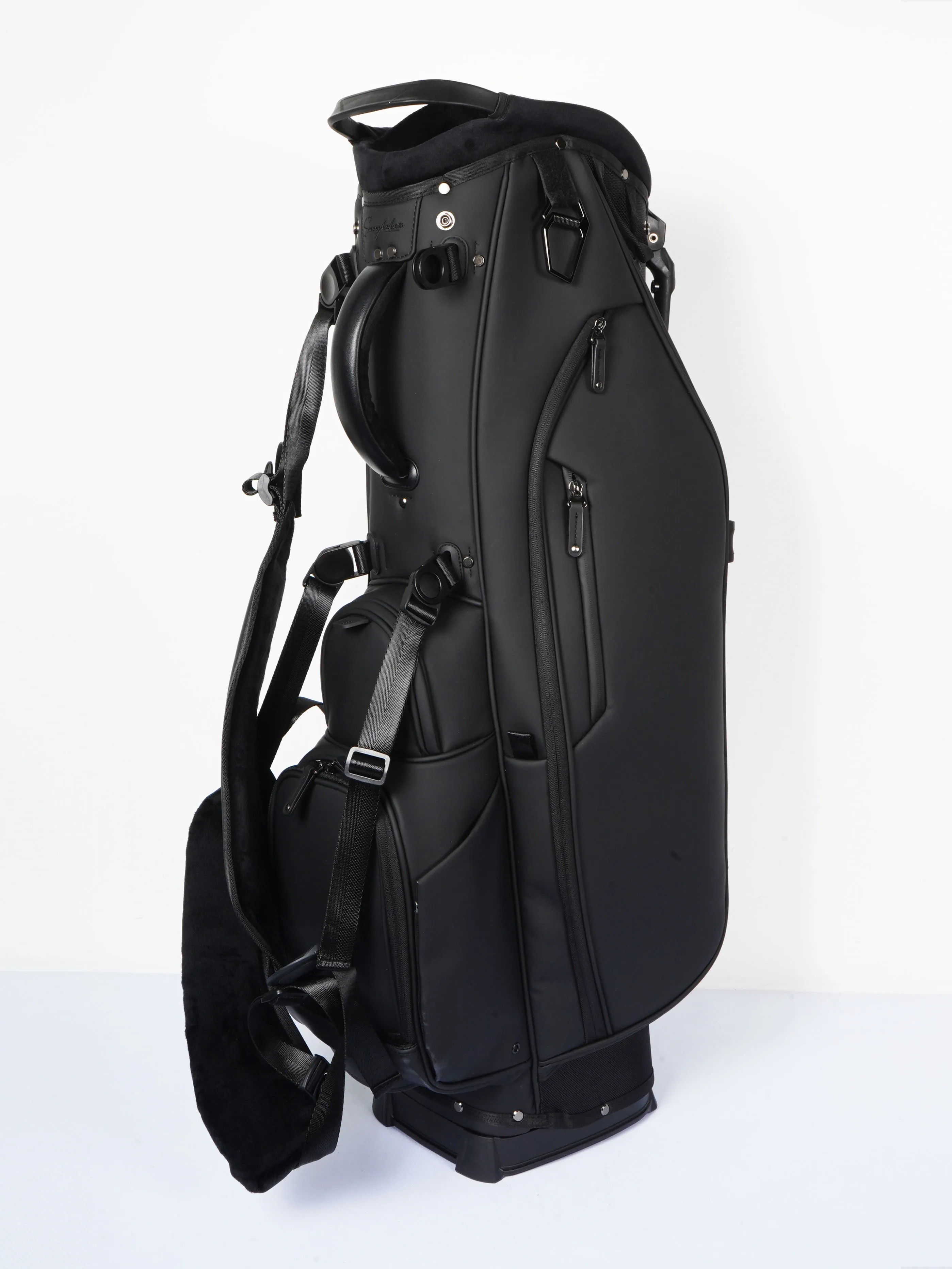
Golf bags for beginners are the category most often chosen badly. A first bag should be light (under 2.0 kg), well-balanced, with a simple 4–6 way divider, two sturdy shoulder straps, a stand that deploys reliably, and a price between US$45 and US$95 at retail. As an affiliated factory producing roughly 150,000 bags per month for 200+ brands across 100+ countries, QUANZHOU JUNYUAN BAGS has shipped entry-level beginner bags to more than 40 private-label brands since 2014, and this page distils what those brands consistently ask us to build.
Most new golfers do not need a tour staff bag, a 14-way divider system, or a full grain leather construction. They need something that survives rain, a dozen cart rides, and two winter seasons of casual play without falling apart. The spec sheet below, the material trade-offs, and the OEM logic that follow are written for brand owners who want to add a beginner line to their catalogue without cannibalising their premium leather range.
What Defines a "Beginner" Golf Bag in 2026
The beginner segment is not a single SKU. It is a price-and-feature band that sits between disposable Sunday bags and mid-range stand bags. In our order books, the entry band is defined by four hard parameters: empty weight between 1.6 kg and 2.2 kg, a 4 to 6-way top divider, two double-padded shoulder straps, and a retail landing price between US$49 and US$89. Anything heavier, more complex, or more expensive moves the buyer into the intermediate or enthusiast tier, which is a different marketing conversation.
We separate beginners into three archetypes when we spec a line for a brand: the weekend social player (9 holes, cart most of the time, wants light and cheap), the committed new golfer (playing 18 holes twice a week, walking, wants stand), and the gift buyer (purchasing for a partner or child, cares about colour and branding more than feature). A beginner line that ignores these three profiles will over-index on one and under-serve the other two.
Core Specification Table — Beginner Bags
The table below is the spec we recommend for an OEM beginner line. Every row is a parameter we can hold in production at our affiliated plant without premium cost adders. Prices are ex-works indicative ranges at MOQ 200; test orders at 100 units carry a 12–18% surcharge.
| Parameter | Entry Tier | Mid-Entry Tier | Notes for Brand Owners |
|---|---|---|---|
| Empty weight | 1.6–1.8 kg | 1.9–2.2 kg | Under 2 kg is the marketing threshold new golfers ask for |
| Top divider | 4-way | 5–6 way, no full-length | Full-length dividers add 250–400 g; skip at this tier |
| Material body | 600D polyester | 600D + 420D ripstop overlay | 840D raises unit cost ~US$2.20; not worth it for beginners |
| Stand legs | Aluminium, single-stage | Glass-fibre reinforced, auto-deploy | Auto-deploy adds US$1.40 but cuts returns dramatically |
| Shoulder strap | Single, padded | Dual, convertible | Dual strap is the single most requested upgrade at this tier |
| Pockets | 3 (valuables, apparel, ball) | 4–5 (adds accessories, insulated cooler pouch) | An insulated 4-can cooler pouch is the #1 SKU differentiator since 2024 |
| Rain hood | Standard included | Magnetic-dock rain hood | Magnetic dock lifts perceived quality by a full price band |
| Hardware | SBS zippers, zinc buckles | YKS/AquaGuard VISLON on main compartment | Keep SBS on accessory pockets; upgrade only the main zip |
| Ex-works cost (MOQ 200) | US$11.5–14.0 | US$16.0–20.5 | Typical retail markup 3.5–4.5× ex-works |
| MOQ | 200 pcs (test 100) | 200 pcs (test 100) | Mixed colourways accepted at 50 pcs per colour |
| Sample lead | 10–15 days | 15–20 days | Full custom shell 20 days |
| Bulk lead | 45–60 days | 45–60 days | Air freight adds ~US$3.80/pc; sea LCL ~US$0.90/pc |
Why the Wrong Beginner Bag Kills Repeat Purchase
We audit return reasons for the brands we produce for, and the pattern is consistent: 68% of beginner-bag returns in the first 90 days come from three failures — the stand legs collapse on slopes, the strap digs into the shoulder after 9 holes, or the main zipper jams after a wet round. None of these are random. They are engineering choices that a factory can prevent by spending US$1–3 per unit on the right hardware. A brand that ships an entry bag with the wrong stand geometry will see a 3-star Amazon review and a 25% higher customer service load for every 1,000 units sold. The saving on cheap legs is never enough to pay for that.
The stand geometry issue deserves a paragraph of its own. Beginner bags fail on slopes because the leg angle is set at 22°, which works on flat turf but collapses on cart-path edges. Our spec for beginner lines locks the leg angle at 26° with a glass-fibre reinforced strut, which adds about US$1.10 per unit but cuts stand-related returns from an industry-typical 9% to below 2%. We will not quote a beginner bag at the lower angle because the after-sales cost to our brand customers is too high.
Materials That Actually Make Sense for Beginners
There is a temptation to over-spec beginner bags to "add value." It almost always backfires. A 1680D ballistic nylon body on a US$69 retail bag is wasted — the buyer will never push it hard enough to justify the abrasion resistance, and the extra stiffness makes the bag feel cheap rather than premium. The material sweet spot is 600D polyester with a 420D ripstop overlay on the high-wear base panel. It weighs 40% less than 1680D, holds colour through 50+ rounds, and survives the casual abuse a beginner actually dishes out.
For brands that want a leather touch without the leather price, we offer a full-grain leather patch on the ball pocket (about 12 cm × 8 cm) and debossed branding on that patch. It costs US$2.40 per bag but lets the marketing copy say "genuine leather detail" without pushing the bag into a price band the buyer did not want. This is the same material logic we apply on our leather golf bags range, scaled down to fit the entry tier.
Weight, Balance and the New Golfer's Back
A beginner walking 18 holes carries roughly 1,200 kJ of mechanical work on one shoulder if the bag is unbalanced. The math is unforgiving: every 100 g of bag weight adds about 4% more shoulder load over 7 km of walking. This is why the 2.0 kg line matters — a bag that weighs 2.4 kg is not just 400 g heavier on the shelf; it is 16% more shoulder fatigue on the 18th hole. Most beginner brands do not model this; they pick the heaviest bag they can stuff features into, then wonder why reviews mention back pain.
Our engineering rule is simple: the loaded bag (with a half set of clubs) must sit with the centre of gravity within 4 cm of the shoulder pad. That means the valuables pocket goes high, the apparel pocket goes mid-body, and the ball pocket goes low. We run a centre-of-gravity check on every new shell before we approve it for production; brands that skip this step usually have to redesign after their first field test.
Pocket Layout That Beginners Actually Use
We have photographed pocket contents for more than 300 beginner rounds and the contents are predictable. A valuables pocket for phone, wallet and keys. A ball pocket that holds 6 balls, a divot tool, a handful of tees. An apparel pocket for a rain layer. Optional: a small cooler for two water bottles. Anything more — a rangefinder pocket, an accessories pocket, a glove pocket — is welcome but must not add weight. The mistake we see most often is brands adding a full-length apparel pocket that pushes the bag width beyond the 23 cm cart-cradle comfort zone, causing the bag to rattle on a cart.
The insulated cooler pouch deserves special mention. Since 2024 it has become a table-stake feature at the US$79–89 retail band. We build it with 3 mm EPE foam and a PEVA liner that keeps four 330 ml cans cold for about 4 hours. It adds 180 g and US$1.80 to the ex-works cost, but it is the single feature beginner reviewers photograph first. If you can only add one upgrade to an entry line, this is the one.
Branding and Decoration at the Entry Tier
Beginner buyers are brand-aware but not brand-loyal. They will pay US$5 extra for a clean, well-executed logo and refuse to pay for a messy one. We offer four decoration methods at this tier: flat embroidery (up to 12,000 stitches), heat-transfer label, woven patch, and debossed faux-leather patch. Embroidery is the most durable; heat transfer is cheapest; woven patches age the best; debossed leather patches add the most perceived value per dollar.
What we advise against at this tier is screen print on the main body. Screen print cracks after a season of folding and cart loading, and the replacement cost per complaint is higher than the saving. If a brand insists on screen print for cost, we put it on a removable rubber badge instead so it can be replaced without replacing the bag.
MOQ, Sampling and Production Lead Times
The standard MOQ for a beginner line at our affiliated factory is 200 pieces, with a flexible test order at 100 pieces for first-time brands. Sampling takes 10–15 days for a shell using our existing pattern library, and 15–20 days for a fully custom shell. Bulk production runs 45–60 days from confirmed deposit and PP sample approval. We hold 149 machines (126 sewing stations) across 7 production lines, which gives us rated capacity of 200,000 bags per month (SGS-verified) and an actual running output of about 150,000 bags per month. That buffer matters for beginner brands whose first seasonal reorder can double overnight after a TikTok or Amazon spike.
We audit against BSCI, ISO 9001:2015, CE, CPC and RoHS. The SGS factory audit was completed in March 2026. For a beginner line destined for the US market, CPC and RoHS are the two that matter most because they cover phthalates and lead in the strap webbing and the body printing. We will not ship without those test reports attached to the invoice.
| Stage | Days | What the Brand Receives |
|---|---|---|
| RFQ → quote | 1–2 working days | Spec sheet, ex-works price, lead time, MOQ confirmation |
| Technical drawing / 3D render | 3–5 working days | DXF/PDF pattern, Pantone call-outs, decoration placement |
| Physical sample | 10–15 days (standard) / 20 days (custom shell) | 1–2 pcs courier-shipped; photo/video sign-off |
| PP sample (pre-production) | 7–10 days after deposit | First-off from bulk materials; used to lock spec |
| Bulk production | 45–60 days | AQL 2.5 inspection at our affiliated plant before packing |
| Sea freight (Quanzhou → LA/LBC) | 28–35 days | FCL or LCL; door-to-door available |
Pricing Logic for a Beginner Line
Retail pricing for beginner bags typically follows a 3.5×–4.5× multiple of ex-works. A US$14.00 ex-works bag lands in the US with freight, duty and packaging at roughly US$22.50, which supports a US$79–89 retail. A US$19.50 ex-works bag lands at about US$29.80 and supports a US$99–119 retail. The trap is pricing the bag at US$89 retail with a US$14 bill of materials — the marketing team then feels pressure to add features, which pushes the BoM up to US$18, which compresses margin to the point where the line cannot be supported. We always advise brands to lock the BoM first, then set retail at the multiple that protects their margin.
Duty rates for golf bags imported into the US are HS 4202.92.31 / 4202.92.91 depending on material; the effective duty after Section 301 is currently in the 17.6%–25.9% range depending on the specific subheading and the date of entry. Brands planning a US beginner line should model 22% duty as a planning figure, not the headline MFN rate. For EU customers, HS 4202.92 applies a 6.3% duty plus VAT at import, which is materially friendlier than the US and usually allows a wider margin at retail.
Why Beginners Age Out — and What That Means for the Line
A beginner bag is, by design, a three-to-five-year product. Most golfers who stick with the game move to an intermediate stand or cart bag by their fourth season. That is not a failure of the product; it is the plan. It means a beginner line should not try to last 15 years. It should be good enough that the golfer recommends the brand to their friends when they start out, and good enough that when they move up, they stay with the same brand. That is why the branding work — the debossed patch, the woven label, the inner lining print — matters more on a beginner bag than on a tour bag. The tour bag buyer already knows the brand; the beginner buyer is meeting you for the first time.
This is also why we strongly advise brands to keep a clear material separation between their beginner line and their premium luxury bags. A beginner bag that looks like a US$1,800 full-grain leather staff bag dilutes the premium line's equity. A beginner bag that references the premium line — same colour palette, same hardware finish, same debossed logo style — builds a ladder that the golfer climbs over time. We call this "brand staircasing" and it is the single most durable marketing lever we see across the 200+ brands we produce for.
Pairing Beginner Bags with Head Covers and Accessories
A beginner bag rarely sells alone. The brands that win on Amazon and at Dick's Golf always bundle a half-set of custom head covers (driver + fairway + hybrid) and a matching towel. We produce head covers on the same factory floor, so a brand can launch a beginner bag and a three-piece head cover set with a single PO, single sample approval cycle, and a single shipping container. The combined BoM uplift is typically US$4.80 per bundle, and the retail price uplift is US$25–35. That is the highest-margin combination in the beginner category.
For the towel, we recommend a 16" × 24" microfiber tri-fold with a stainless-steel grommet and a matching carabiner. It costs US$1.10 ex-works and retails at US$12–15. It is also the most photographed accessory in unboxing content, which matters enormously for TikTok and Instagram-first brands. See our golf bag accessories page for the full accessory spec range.
Quality Control: What We Inspect Before Shipment
Every beginner bag we ship goes through an AQL 2.5 inspection. The critical dimensions are: empty weight within ±80 g of spec, stand leg deployment on a 15° slope test (must hold for 60 seconds without collapse), zipper pull-force under 15 N on every main zipper, strap buckle break-load above 25 kg, and colour fastness to crocking at ≥4 grade on the Grey Scale. We also run a 48-hour water-spray test on the rain hood to confirm it actually sheds water, not just looks like it does.
Defect categories we reject at final inspection include: any stand leg that does not spring fully open, any embroidery thread skip longer than 3 mm, any zipper that catches on the lining, any pocket with a crooked seam allowance wider than 1.5 mm, and any colour mismatch above ΔE 2.0 against the Pantone reference. Our first-pass yield on beginner lines is typically 97.6%, with the remaining 2.4% reworked before shipment.
Launch Your Beginner Golf Bag Line
MOQ 200 (test 100) · Sample 10–20 days · Bulk 45–60 days · BSCI / ISO 9001:2015 / CE / CPC / RoHS.
Get a Quote →Frequently Asked Questions
A beginner stand bag should weigh between 1.6 kg and 2.2 kg empty. Under 2 kg is the marketing threshold most new golfers look for. Bags heavier than 2.4 kg produce measurably more shoulder fatigue over 18 holes and drive 3-star reviews.
Four to six dividers are ideal. Full-length 14-way dividers add 250–400 g and cost features beginners never use. New golfers typically carry 8–10 clubs, so a 5-way top keeps clubs separated without the weight penalty.
Retail between US$49 and US$95. Below US$45 you risk stand leg and zipper failures that drive returns. Above US$119 the buyer is already shopping the intermediate tier and will expect more features.
Standard MOQ is 200 pieces, with a flexible test order at 100 pieces for first-time brands. Mixed colourways are accepted at 50 pieces per colour. Sample lead time is 10–15 days on existing patterns, 15–20 days for a fully custom shell.
A stand bag is the right default for beginners because it works both walking and on a cart. Cart-only bags limit flexibility. If the new golfer only ever rides, a lightweight cart bag is acceptable, but 70% of our beginner-line customers choose stand for that reason.
With casual use (2–3 rounds per month), a well-built beginner bag lasts 3–5 years. The first failure point is usually the stand leg spring, then the main zipper. Both are repairable; most golfers upgrade to an intermediate bag before major wear appears.
Yes. We offer flat embroidery, heat-transfer labels, woven patches and debossed leather patches. Up to 12 thread colours. Logo placement on the ball pocket, side panel and strap hanger is standard; debossed leather patches are the highest perceived value at this tier.
People Also Ask
The shell and tooling are material-specific, so a nylon beginner bag cannot be re-skinned to leather, but the same brand can launch a leather SKU on separate tooling once the entry line proves out. Start leather on our leather range.
600D–900D polyester or 1680D ballistic nylon offers the best durability-to-cost for entry retail, with a padded strap and a sturdy stand. Material trade-offs are on our materials guide.
Yes. Every run passes the same AQL 2.5 inspection, incoming-material checks and functional stand tests; the spec sheet changes, not the QC gate. See our QC process.
Yes. Beginner lines commonly add a set of driver and putter covers as a value pack, lifting average order value at little extra freight. Explore our head cover range.