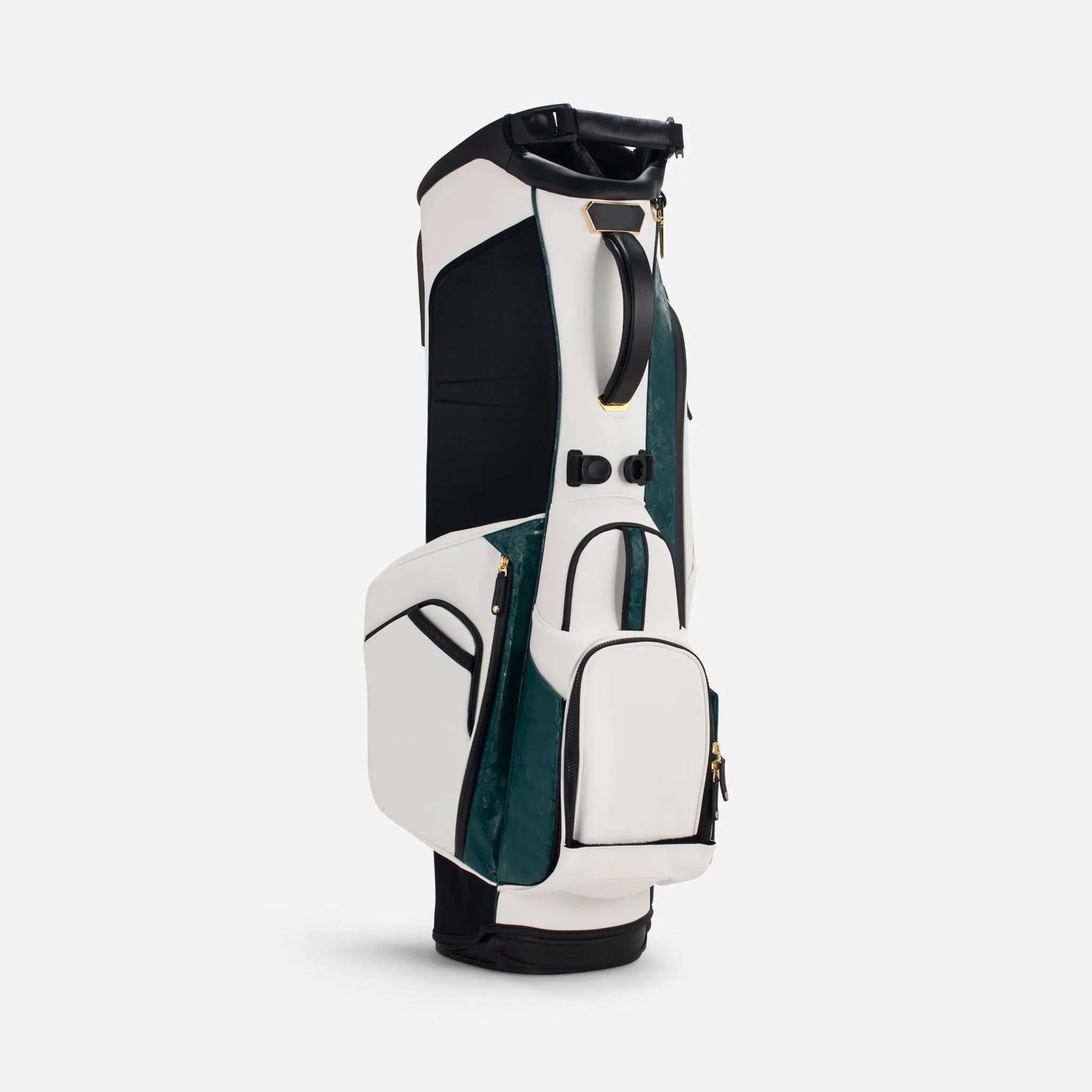
Sourcing wholesale leather golf bags in 2026 is a different process than it was five years ago. Alibaba is no longer a reliable filter for actual factories; trading companies dominate the search results, and the brands that win are the ones that can distinguish a direct factory from a middleman in the first call. At QUANZHOU JUNYUAN BAGS we have been the affiliated factory behind 200+ brands since 2014, and this page is the wholesale sourcing playbook we wish someone had given us when we started — how to find a real factory, how to vet it, how to negotiate, and how to avoid the six mistakes that cost new brands US$20,000 or more on their first order. According to IMARC Group, the global golf bags market is growing at a CAGR of roughly 4–5%, making wholesale leather sourcing a strategic category for importers and distributors.
The wholesale leather golf bag market in China centres on three clusters: Quanzhou (where we are, in Fujian province), Guangzhou (Guangdong), and Dongguan (Guangdong). Quanzhou is the historic leather-goods cluster; Guangzhou is the trading and design hub; Dongguan is the high-precision manufacturing hub. Each has different strengths, and the cluster you source from determines the price, the quality, and the kind of brand you can build. This page focuses on what we know from the Quanzhou cluster, with notes on when to look elsewhere.
Where to Actually Search: Beyond Alibaba
Alibaba is the first place every new buyer starts, and it is the worst place to shortlist a factory. The top-ranked listings are almost always trading companies with paid ad spend, not the factories with the best production lines. The better search paths are: trade shows (PGA Show in Orlando, Spoga in Cologne, the Canton Fair in Guangzhou), industry referrals (ask other brand owners who they produce with, under NDA), and direct Google searches for factory names with "factory audit" or "BSCI" in the query. We recommend every new buyer attend at least one trade show before placing a first order; the cost is US$1,500–2,500 including travel, and the face-to-face conversations filter out 90% of the trading companies in one weekend.
For buyers who cannot travel, the next-best path is a video factory audit. Ask every shortlisted factory for a live video walkthrough of the production floor, with the date visible in the corner. A real factory can do this on the same call. A trading company will deflect, delay, or send you a stock video. The video walkthrough shows the machine count, the sewing stations, the QC bench, and the finished goods warehouse. If the video shows fewer than 50 machines, it is not a factory; it is a workshop or a trading company.
How to Vet a Factory in One Call
There are seven questions that separate a real leather bag factory from a trading company on the first call. First: "How many machines and sewing stations do you have?" The answer should be a specific number (ours is 149 machines, 126 sewing stations). A trading company will say "we work with many factories" or give a vague range. Second: "When was your last SGS or BSCI audit?" A real factory has a dated audit report; a trading company does not. Third: "What is your monthly capacity, rated and actual?" A real factory knows both (ours is 200,000 rated, 150,000 actual). Fourth: "Can you walk me through your QC process?" A real factory describes AQL 2.5, pull tests, colour fastness; a trading company says "we check quality." Fifth: "What is your MOQ and sample lead time?" Real factories have consistent answers (ours is MOQ 200, sample 10–20 days). Sixth: "Can you show me a sample of a bag you produced in the last 90 days?" A real factory ships a photo within 24 hours. Seventh: "What is your company structure — are you the factory or a trading company?" A trading company will not answer this directly; a real factory will say "we are the affiliated factory" without hedging.
| Question | Real Factory Answer | Trading Company Answer |
|---|---|---|
| Machine count | Specific number (149 machines) | "We work with many factories" |
| Last audit | Dated SGS/BSCI report | "We have partners certified" |
| Monthly capacity | Rated and actual (200k / 150k) | "We can handle any volume" |
| QC process | AQL 2.5, pull tests, fastness | "We check quality" |
| MOQ and lead | 200 / 10–20 days | "Flexible, fast" |
| Recent production sample | Photo within 24 hours | Deflects or sends stock photo |
| Company structure | "Affiliated factory" | Hedges or deflects |
Negotiating the First Order: What Is Actually Negotiable
New buyers over-negotiate the wrong things. The unit price is the least negotiable number on a quote; the factory knows its cost structure and will not go below it without sacrificing quality. What is negotiable: the sample fee (waived on first PO of 200+), the tooling fee (waived on repeat designs), the payment terms (30% deposit, 70% before shipment is standard; 30/70 against B/L copy is available for repeat customers), and the packaging (branded hangtags, care cards, and printed boxes at US$0.50–1.50 per unit). What is not negotiable: the MOQ (200, with 100 test order), the sample lead time (10–20 days), and the bulk lead time (45–60 days). A factory that discounts the unit price below its cost is either using cheaper materials (which shows up in warranty) or planning to make it back on the reorder. The cheapest quote is rarely the best quote.
For first orders, we advise brands to ask for a price breakdown, not a single number. A transparent quote shows material, hardware, labour, packaging, tooling and overhead as separate line items. A transparent factory shares this; a trading company gives a single number that hides the markup. The breakdown lets you see where the cost is, and it lets you negotiate specific line items (e.g. "can we switch this hardware from stainless to brass and save US$2?") rather than haggling over the total. We provide a full cost breakdown on every quote; brands that ask for one are the ones we prefer to work with, because they understand the product.
Sampling: The Step That Makes or Breaks the Relationship
The sample is the most important step in the sourcing process, and it is the step most new buyers rush. We produce the sample on the same production line as bulk, with the same materials and hardware. The sample costs US$180–350 depending on complexity, and it is shipped by DHL in 3–5 days worldwide. We ask brands to take two weeks with the sample, use it on the course, photograph it in natural light, and send back a marked-up list of changes. Most samples need one revision — usually a strap width, a pocket position, or a logo placement. We produce the second sample in 7–10 days. We do not start bulk until the brand has signed off on a PP (pre-production) sample made from bulk materials. The PP sample costs US$80–120 and prevents the single most common sourcing disaster: bulk production that does not match the approved sample.
For brands that want to be rigorous, we recommend a destructive test on the sample. Cut a corner, look at the cross-section, pull the zipper 50 times, load the strap with 25 kg. If the sample survives these tests, the bulk will too. If it fails, you have caught the problem at sample stage instead of at 200 units. We encourage this; it builds confidence and it catches issues before they cost real money.
Freight, Duty and Landed Cost
The ex-works price is not the landed cost. For a 200-unit leather bag order to the US, the additional costs are: sea freight LCL US$1.80–2.50 per bag, duty at 22% of customs value (plan at 22%, not the MFN rate of 6–8%), customs brokerage US$150 per shipment, and US inland trucking US$0.80–1.50 per bag. The landed cost is typically 35–45% above ex-works. Brands that model at ex-works and then get hit with landed cost at 40% over are the ones that panic and renegotiate. We provide a full landed cost estimate on every quote, including the duty calculation, so there are no surprises. For DDP (Delivered Duty Paid) shipments, we handle all of this and charge a flat US$4.50–6.50 per bag; it is the simplest path for brands new to importing.
| Cost Element | Amount per Bag | Notes |
|---|---|---|
| Ex-works (leather staff bag, MOQ 200) | US$120–180 | At MOQ 200 |
| Sea freight LCL (US West Coast) | US$1.80–2.50 | 28–35 days |
| US duty (HS 4202.92) | ~22% of customs value | Plan at 22%, not MFN |
| Customs brokerage | US$0.75 per bag | US$150 per shipment |
| US inland trucking | US$0.80–1.50 | Port to warehouse |
| Packaging (box + hangtag) | US$1.50–3.50 | Depends on tier |
| Landed cost | US$155–230 | Ex-works + freight + duty + packaging |
| Recommended retail | US$1,200–2,400 | 3.5–4.5× landed cost |
The Six Mistakes That Cost New Brands US$20,000
After 12 years and 200+ brands, we see the same six mistakes repeat. First, choosing the cheapest quote. The cheapest quote is almost always a trading company marking up another factory's price, and the first quality issue will be unresolvable. Second, skipping the PP sample. Brands sign off on the first sample and start bulk, then discover bulk materials look different. Third, under-ordering the first run. Brands order 100, sell out in 6 weeks, and wait 90 days for a reorder. Fourth, ignoring duty. Brands model at 6% and get hit with 22%. Fifth, over-designing the first bag. Brands add 12 features, push the BoM to US$200, and cannot sell at retail. Sixth, treating the factory as a vendor rather than a partner. Brands that send drawings and wait for a quote get commodity product; brands that have a design call with the production team get product that actually works.
Quanzhou vs Guangzhou vs Dongguan: Which Cluster?
The three Chinese golf bag clusters each have a distinct character, and the right one depends on the product you are building. Quanzhou, where we are based, is the historic leather-goods cluster. The tanneries, the hardware suppliers, and the sewing workforce are all within a 30-minute drive. It is the lowest-cost cluster for leather products, and the workforce has 30+ years of leather-goods experience. The downside is that Quanzhou is not a design hub; brands that want design support need to bring their own or use our in-house team. Guangzhou is the design and trading hub. It has the showrooms, the sample rooms, and the English-speaking sales teams. It is 10–15% more expensive than Quanzhou, and the actual production is often subcontracted to factories in Quanzhou or Dongguan anyway. Dongguan is the high-precision manufacturing hub. It does the injection-moulded hardware, the carbon-fibre parts, and the tight-tolerance components. It is the right cluster for technical bags with carbon fibre frames or precision-machined hardware, but it is 20–25% more expensive for a standard leather bag.
For a standard premium leather bag, Quanzhou is the right cluster. The leather supply chain is the shortest, the labour is the most experienced, and the cost is the lowest. We see brands that try Guangzhou first for the design support, then move to Quanzhou for production once the design is locked. We can do both under one roof: our affiliated design team produces the three-silhouette concept, and the affiliated factory produces it at Quanzhou prices. It is the same result, one less handoff.
Payment Terms: What to Expect and How to Protect Yourself
The standard payment terms for a first order with a new factory are 30% deposit on PO confirmation, 70% balance before shipment (or against B/L copy for repeat customers). The 30% deposit locks material pricing for 60 days and pays the factory to buy the hide lot and hardware. The 70% balance is due before the container is loaded, which means the brand pays before it sees the goods. This is standard, but it is also the point at which things go wrong if the factory is unreliable. The protection steps are: first, use a letter of credit (L/C) for orders over US$50,000; second, require a third-party inspection report before paying the balance; third, keep the deposit under US$10,000 on the first order until the relationship is established. For repeat customers, we offer 30/70 against B/L copy, which means the brand pays the balance against the bill of lading, not before loading. It is a trust signal we extend to brands that have completed three or more clean orders.
Building a Long-Term Relationship: What Changes After Year One
The first order is a test. The second order is a relationship. After three clean orders, the terms change: sample fee is waived permanently, tooling is kept in the vault at no cost, payment terms move to 30/70 against B/L, and the factory allocates production priority. Brands that treat the relationship as transactional (order by order, always comparing prices) never get these benefits. Brands that treat the factory as a partner (sharing forecasts, giving 90-day visibility, paying on time) get production priority in peak season, design support at no cost, and first access to new materials. We have 20+ brands that have been with us for 8+ years; they all started the same way — one PO of 200 bags, then a second, then a forecast. The relationship compounds over time, and the brands that stay are the ones that invested in it from the first call.
If you are reading this and you are a founder about to place your first wholesale order, the next step is simple: fill in our one-page brief, attach three reference images, and send it through the contact form. We will reply within 24 hours with a feasibility assessment and a transparent cost breakdown. If the fit is right, we will book a 45-minute call, walk you through the seven questions above, and send you a physical sample in 15 days. If it is not right, we will tell you and point you to a factory that is. There is no obligation, no sample fee until you are ready, and no pressure to order. We have built this relationship with 200+ brands since 2014, and the ones that stay with us are the ones that started with the same one-page brief you are about to write. The sourcing process is not complicated; it just requires patience, transparency, and a willingness to ask the seven questions that filter out the trading companies. Do that, and you will find a factory that lasts as long as the brand you are building.
Every great golf brand started with one PO of 200 bags from a factory they trusted. The ones that are still around in ten years are the ones that treated the first order as the start of a relationship, not a transaction. We are ready when you are. Send the brief, ask the seven questions, and let the data decide.
Every great golf brand started with one PO of 200 bags from a factory they trusted. The ones that are still around in ten years are the ones that treated the first order as the start of a relationship, not a transaction. We are ready when you are. Send the brief, ask the seven questions, and let the data decide. The worst that happens is we tell you we are not the right fit, which saves you a year of working with the wrong factory. The best that happens is we build the line that defines your brand for the next decade. Either outcome is better than spending three months negotiating with a trading company that will not be on your side when the first quality issue hits.
Start Your Wholesale Sourcing the Right Way
First call free · Sample in 15 days · MOQ 200 · Transparent cost breakdown.
Book a Call →People Also Ask
Standard MOQ is 200 pieces per style per colourway. Trial orders of 100 are accepted for first-time buyers. Sample development is 10–20 days; bulk production 45–60 days. Larger orders (500+) attract 5–10% unit price reductions. See our wholesale leather range.
Request BSCI audit report, ISO 9001:2015 certificate, and a SGS or Intertek factory audit. Confirm physical address and video-call the sewing floor. A legitimate OEM will show 100+ employees, multiple production lines, and existing export references. Avoid trading companies that refuse factory floor access.
Standard terms are 30% T/T deposit, 70% before shipment. Larger or repeat buyers negotiate 30/60/10 (balance split 60% pre-shipment, 10% after QC acceptance). L/C at sight is available for orders above US$50,000. PayPal is not standard for production orders.
Yes. Exclusive tooling rights are typically granted after 500–1,000 cumulative units ordered. Before that, the factory may produce the same style for other buyers. Sign an NDA and tooling ownership clause in the OEM agreement. The affiliated Quanzhou plant serves 200+ brands across 100+ countries.
Frequently Asked Questions
MOQ is 200 pieces, with a flexible 100-piece test order for first-time brands. Mixed colourways are accepted at 50 pieces per colour. Sample and tooling are waived on the first PO of 200+.
Ask for a live video walkthrough of the production floor with the date visible. Ask for machine count, last SGS/BSCI audit date, rated and actual monthly capacity, and your QC process. A real factory answers all seven questions; a trading company deflects.
Sample 10–15 days on existing patterns, 15–20 days for custom shell. PP sample 7–10 days after deposit. Bulk 45–60 days. Sea freight to US West Coast 28–35 days. Total door-to-door from first call: 90–120 days.
Ex-works US$120–180 + freight US$2 + duty ~22% + packaging US$2–3.50 = landed US$155–230 per bag at 200 pieces. Retail at 3.5–4.5× landed is US$1,200–2,400.
Go direct. A sourcing agent adds 8–15% to the unit price and has no control over QC. For a first order, a direct factory relationship is worth the extra 30 minutes per call. Use an agent only if you are sourcing across multiple categories and need someone to consolidate.
Ask for a transparent cost breakdown: material, hardware, labour, packaging, tooling, overhead as separate line items. Ask for MOQ, sample lead, bulk lead, payment terms, and a list of certifications. A transparent factory shares all of this; a trading company gives a single number.
Three steps: (1) approve a PP sample made from bulk materials, (2) run a destructive test on the PP sample, (3) require a third-party inspection (SGS, BV, Intertek) at our affiliated plant before container loading. The third step costs US$200–300 and prevents US$20,000 mistakes.