1. Why the Premium Segment Is the Place to Be
Most new entrants to the golf bag market make the same strategic mistake: they try to compete on price. They design a "good enough" nylon stand bag, find the cheapest factory, and enter a race to the bottom against established brands with scale, retail distribution and decades of buying power. That fight is winnable only by companies with the lowest cost structure in the world — and a new brand is not one of them.
The premium segment is different. It is a market of differentiation, not cost. A vintage leather staff bag or a luxury head-cover set competes on aesthetics, materials, craft and story — exactly the variables a small, design-led brand can control. There is no "cheapest" full-grain leather bag; there is only "the one with the best look, the best story, and the best-feeling hide." That is a contest where taste and execution beat scale.
This playbook is the operating manual for that contest. It distills what we have learned manufacturing premium, vintage and luxury golf bags for 200+ brands across 100+ countries — what works, what fails, and how to sequence it all.
2. The Market Data Behind the Trend
The case for the premium segment is not anecdotal. Industry tracking consistently points the same way. The National Golf Foundation reports that roughly 26 million adults play golf in the United States each year, with the US golf economy remaining well above pre-pandemic participation levels and a large base of engaged, affluent golfers. Grand View Research values the global golf equipment market at multiple billions of dollars, and Statista estimates the personal luxury goods market at well over €300 billion annually — the affluent pool a premium leather bag targets. Golf Datatech's annual consumer tracking shows price growth and strongest demand sitting in the aspirational and design-led tiers, while commodity bags stagnate. The takeaway: the market is not shrinking — it is polarizing, and the upper pole is where new brands can win.
A second data point is channel shift. Direct-to-consumer e-commerce and social commerce have removed the old gatekeepers. A brand no longer needs a distribution deal with a major retailer to reach a customer; a strong Instagram presence, a well-built store, and great product photography are enough to start. That has lowered the barrier to entry for design-led brands at the exact moment demand for differentiated product is rising.
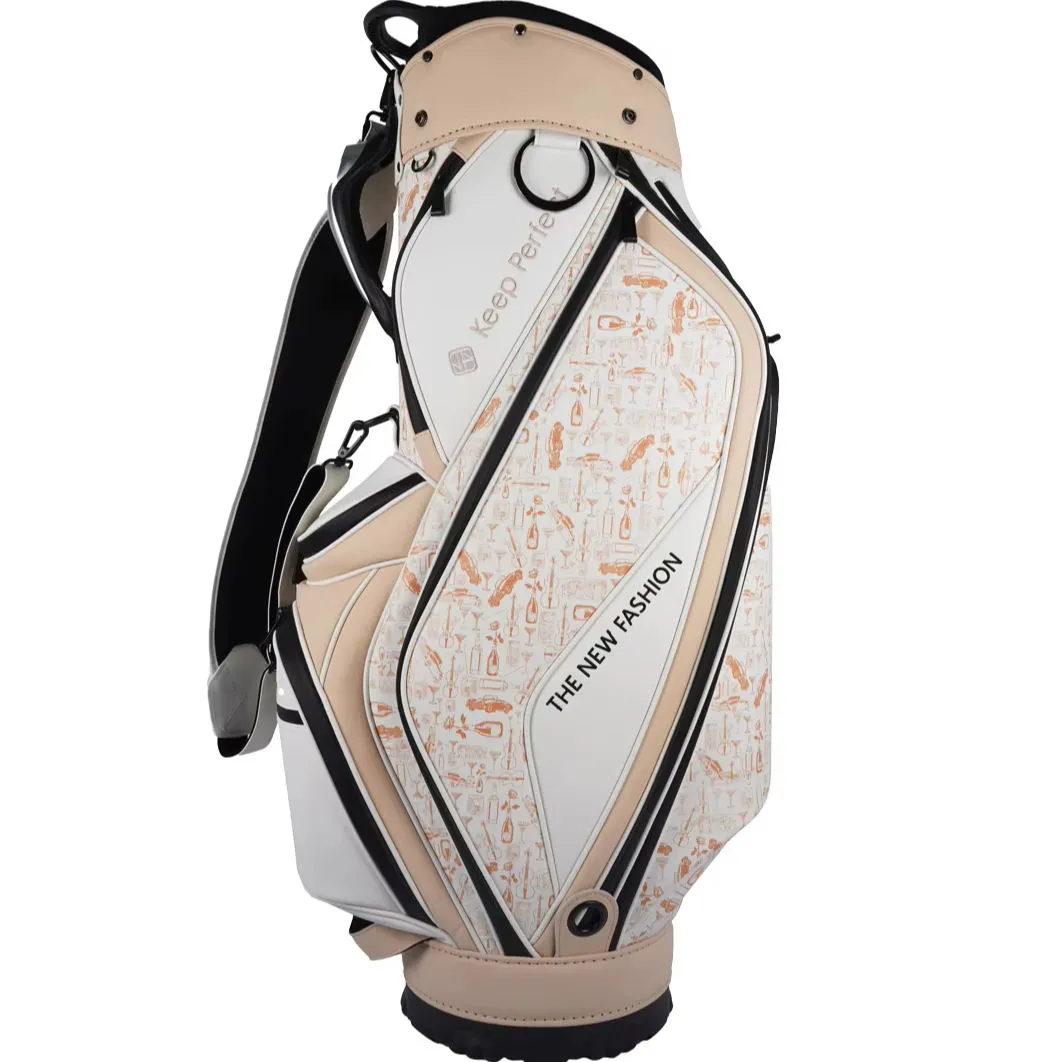
3. Who Actually Buys Vintage & Luxury Bags
Before designing anything, define the customer. Three buyer groups dominate the premium segment, and they buy for different reasons.
The Design-Conscious Enthusiast
Typically 30–55, plays once or twice a week, and treats equipment as an extension of personal style. This buyer reads reviews, compares materials, and is active on Instagram and YouTube. They want a bag that looks deliberate, not generic. They are your core early customer.
The Gifters & Corporate Programs
Country clubs, resorts and companies buying embossed bags for members, tournaments and executive gifts. This buyer cares about cresting, packaging and reliability more than the latest spec, and they place repeat orders. The vintage & classic aesthetic is a natural fit here.
The Collector / Heritage Buyer
A smaller but passionate group that values patina, provenance and craftsmanship, and actively buys and resells vintage golf goods. They reward authentic material and are the most likely to advocate for a brand.
Designing for all three at once is a trap. Most new premium brands succeed by leading with the design-conscious enthusiast — they are the most reachable and the most likely to spread the word — and layering in gifting as a stable second revenue stream.
4. Product Architecture: Your First-Season SKU Plan
The most common failure is launching too many SKUs. A focused range sells through faster and costs less to sample. We recommend a tight first season built around cross-sell.
| SKU | Role | Material Build | Margin Profile |
|---|---|---|---|
| Flagship staff bag | Hero / hero-shot product | Full-grain, antique brass, emboss | Highest |
| Compact carry bag | Entry to range | Top-grain, lighter, lower price | High, wider reach |
| Driver + fairway head covers | Accessory cross-sell | Matching hide, emboss | Very high, giftable |
| Valuables pouch / tee case | AOV add-on | Offcut hide | High, near-zero waste |
This is roughly 4–6 SKUs across one coherent aesthetic. It lets a brand show a complete lifestyle in photography without the sampling and inventory complexity of a dozen lines. The head covers — produced in the same hide as the bag through our head cover program — are the quiet profit center: low cost to make, high sell price, and the item customers buy most often as a gift.
5. Pricing & the Margin Math
Premium pricing is not a guess. Work backward from a target retail price and engineer the product to leave a healthy margin. For a full-grain luxury staff bag built with us, indicative FOB sits around $110–180; add shipping, duties and packaging to reach a landed cost, then price at roughly 3–5x landed for a DTC premium brand.
| Line | Indicative Range | Notes |
|---|---|---|
| FOB unit cost | $110–180 | Full-grain, hand-stitched, emboss |
| Shipping + duty (per unit) | $15–30 | Sea freight amortized |
| Landed cost | $130–210 | Before marketing |
| Recommended DTC retail | $480–750 | ~3–4x landed |
| Gross margin | 60–70% at DTC | After COGS, before ads |
The strategic point: at these margins, a brand can afford to spend meaningfully on product photography, creative and customer experience — the very things that justify the premium. At commodity margins, there is no budget for craft or brand, which is why the price war is self-defeating. Detailed material options for each tier are on our premium materials guide.
6. Materials and Positioning
Material is the entire product story. A brand cannot claim luxury and ship shiny PU. Get the hide grade right — full-grain for the flagship, top-grain for the accessible tier, suede as overlay and lining, and embossed or crocodile-texture panels for the couture accent. Match hardware tone to hide: warm leather calls for antique brass or matte zinc, never bright chrome.
Positioning follows the material. "Quiet luxury" — clean full-grain, minimal logos, monochrome hardware — is the dominant read in 2026 and ages best. Heavily distressed, costume-style aging has peaked. Build the flagship to quiet-luxury standards, and the brand will not look dated next season.
7. Marketing a Premium Brand on a Budget
Premium buyers are research-led and aesthetic-led. Your marketing should mirror that.
- Lead with material and craft in product copy — describe the hide, the hand-stitch, the edge paint — then list specs. Emotional reason first, specification second.
- Photograph the patina. Show the bag new, then after months of use. A deepening tan tells a durability story no spec sheet can.
- Build the list before stock arrives. A landing page and wait-list seeded on Instagram means launch day is not a silent event.
- Send samples to creators. Golf content creators value a genuinely beautiful object; a well-made bag earns honest coverage.
- Publish useful content. Buyers research before buying; helpful material and care content builds authority and drives organic traffic over time.
8. Channels: DTC, Pro Shops and Resorts
Most healthy premium brands blend two channels. Direct-to-consumer holds the highest margin (60–70% gross) and full brand control, and should be the launch channel. Pro shops and resort pro shops add credibility and the gifting volume, but expect wholesale terms (you sell at roughly half MSRP) and smaller per-shop reorders. Start DTC, prove sell-through, then approach a curated set of clubs rather than chasing broad distribution too early.
9. Manufacturing & Supply Chain Reality
A premium product lives or dies on consistency. Build with a partner who controls the line, not a middleman who aggregates capacity monthly. At QUANZHOU JUNYUAN BAGS we coordinate production through our affiliated factory in Quanzhou: founded 2014 (founder in the trade since 2004), 7 lines, 149 machines (126 sewing stations), 137 staff, a 4,950 m² plant, and rated capacity of 200,000/month (SGS-audited March 2026) against ~150,000 actual — enough headroom for a new program. MOQ is 200 (100 trial), sampling 10–20 days, production 45–60 days, with BSCI and ISO 9001:2015 certification. That locked tooling and material consistency across reorders is what makes a premium brand credible season after season. For the full evaluation method, read our companion guide, Choosing a Premium Golf Bag Manufacturer.
10. Risks, Pitfalls and a 12-Month Roadmap
The recurring failures are predictable. Over-promising "leather" on PU. Launching ten SKUs instead of four. Under-buying the reorder buffer and stocking out of a winner. Approving color on a screen. Choosing price over consistency. Avoid these, and you are already ahead of most entrants.
A realistic 12-month plan: Months 1–2 define the brand, audience and first-season SKU plan, and brief the factory. Months 2–4 sampling and golden-sample approval. Months 4–6 mass production and launch prep (store, photography, email list). Months 6–8 launch DTC with creator seeding. Months 8–12 read sell-through, reorder the winners, and plan season two with proven SKUs. Our own retail expression of this premium philosophy is at KEEPPErfect.
The Competitive Landscape: Where a New Brand Wins
It helps to know who you are competing against. The premium golf bag shelf has three kinds of incumbent, and each leaves an opening for a focused new brand.
The tour giants sell performance and sponsorship. Their bags are technically excellent but visually interchangeable — a sea of black nylon. They are slow to react to aesthetic trends and constrained by tour contracts. A brand with a confident leather look can occupy the aesthetic space they ignore.
The established luxury luggage houses make beautiful leather goods but treat golf bags as an afterthought, priced for their name rather than their function. They leave room for a specialist that understands golf-specific needs — dividers, club protection, strap comfort — wrapped in a luxury finish.
The direct-to-consumer pioneers have already proven the model: a new brand can charge $400–700 for a well-designed bag by winning on product, photography and community rather than distribution. They are the proof, not the ceiling. Their success signals a market that rewards design-led entrants.
The opening is therefore clear: a brand that combines genuine leather craft, a coherent aesthetic, and golf-specific function — marketed directly to the enthusiast — competes on turf the incumbents neglect. This is precisely the niche our premium & luxury manufacturing program is built to serve.
Unit Economics: Model It Before You Order
A premium brand can look like a success on revenue and quietly lose money. The fix is a simple unit-economics model built before the first PO. Track three numbers:
| Metric | Healthy Benchmark | Watch If |
|---|---|---|
| Gross margin (after COGS) | 60–70% DTC | Below 50% means pricing or materials off |
| Customer acquisition cost (CAC) | < 25% of lifetime value | Rising ad spend with flat conversions |
| Sell-through by season | > 70% of first run | Markdowns eating margin |
The mental model is simple: manufacture a bag that costs $130–210 landed, sell it DTC for $480–750, and spend the healthy margin on the photography, creative and service that justify the price. If your gross margin is below half, either your FOB is too high (wrong materials for the tier) or your price is too low (lacking brand justification). Fix one of those two before you scale ad spend.
Brand Storytelling: The Premium Difference
A premium product needs a credible narrative, and the story must match the object. "Heritage since 19XX" reads hollow on a nylon bag and inevitable on a full-grain one. The physical product is the proof point for the story, not a footnote to it. The strongest premium brands tell three kinds of truth consistently:
- Material truth: exactly what leather grade, exactly how it is made, exactly how it ages. Verifiable claims build trust; exaggerated ones get exposed.
- Craft truth: the hand-stitched handle, the edge paint, the embossed crest. Show the detail, close-up, and let the buyer feel the quality.
- Use truth: how the bag performs on a real course — weight, comfort, club protection, weather. Premium does not mean impractical.
Product photography is where this lives. A bag shot against a neutral backdrop in soft light, with close-ups of the leather grain and hardware, sells the material. A bag in a grassy, clubhouse setting sells the lifestyle. Use both: the studio shot for detail, the lifestyle shot for the dream. This is the visual language the vintage & classic aesthetic rewards.
Unboxing & the First 48 Hours
Premium buyers judge a product partly in the first two minutes of ownership, and that moment is under our control. A dust bag in matching suede, a rigid gift box with the embossed crest, a care card explaining the leather and how it will age — these cost a few dollars but materially raise the perceived value and the likelihood of a photo being shared. In a DTC business, that unboxing moment is free marketing: customers post it, and the next customer trusts it.
We offer two packaging tiers deliberately: a standard poly-bag for stockist shipments, and a gift box + dust bag for direct-to-member DTC. The same finished bag, presented differently, serves two margins. For a premium brand, the DTC unboxing should be the priority — it is the moment the customer's price expectation is confirmed.
A Seasonal Calendar for a Premium Brand
Golf retail is seasonal, and planning against the calendar beats reacting to it.
| Window | Focus | Action |
|---|---|---|
| Q4 (prior year) | Plan & sample | Brief factory, approve swatches, lock golden sample |
| Q1 | Produce & build list | Mass production, store build, photography, wait-list |
| Q2 | Spring launch | DTC launch, creator seeding, paid acquisition |
| Q3 | Sell-through & gifting | Read data, reorder winners, corporate gifting push |
| Q4 | Holiday & season two | Limited colorways, gift sets, plan next collection |
Working backward from a spring launch, the production order lands the previous autumn. That lead time — brief, sample, produce, ship — is why "I need bags in three months" is rarely feasible for a premium build. Plan to a season, not to a panic.
Risks to Manage Before They Manage You
Premium launches usually fail for predictable reasons. Naming them here is the cheapest risk insurance you will get.
- Inventory risk: over-ordering first season and being stuck with unsellable stock. Mitigate with a 100-piece trial and conservative first runs.
- Consistency risk: a reorder that does not match the original. Mitigate by locking tooling and material swatches with the factory.
- Claim risk: marketing "full-grain" or "eco" without documentation. Mitigate by substantiating every claim with supplier paperwork.
- Cashflow risk: paying for a full run before revenue. Mitigate with pre-orders and wait-list deposits where possible.
- Single-product risk: one hero SKU carrying everything. Mitigate with the head-cover and accessory cross-sell.
Choosing a Manufacturing Partner That Scales With You
The strategy above only works if the factory can execute it consistently. A premium brand is a multi-year relationship with a supplier, not a single transaction, so choose on criteria that survive the second and third order, not the first quote. Four criteria matter most.
First, control of the line. A partner that coordinates production through its own affiliated plant — rather than aggregating factory-by-factory — will build your reorders on the same tooling and the same approved hides. That consistency is invisible until it breaks, and breaking it destroys trust faster than any marketing can repair.
Second, auditable capability. You should be able to verify the entity, the certifications and the capacity. QUANZHOU JUNYUAN BAGS is BSCI and ISO 9001:2015 certified, with an SGS production-capacity audit from March 2026 validating a rated 200,000 bags per month against ~150,000 actual — real headroom, not an inflated headline figure.
Third, honest minimums and timelines. A serious program quotes MOQ around 200 pieces (with a 100-piece trial), sampling in 10–20 days, and mass production in 45–60 days. Beware the factory quoting "MOQ 10" for genuine full-grain leather; that volume rarely justifies hide sourcing and tooling, and the quality will tell.
Fourth, range breadth. A partner that can build bags, head covers and small leather goods in matching hides lets you execute the cross-sell architecture in this playbook without managing three vendors. That is why we pair bags with our head covers and leather bag range under one roof.
Scaling Beyond the First Collection
The first collection proves demand; the second is where a brand becomes durable. With sell-through data in hand, season two is easier than season one because it is informed. Double down on the winning SKU, retire the quiet ones, and extend the aesthetic rather than invent a new one. New colorways of a proven bag are low-risk; a totally new category is high-risk until the brand has the cashflow to absorb it.
Accessories are the safest extension. A new driver cover colorway, a limited gift set, a travel accessory in the same hide — these reuse approved tooling and material, carry very high margin, and keep the brand visible between bag drops. The most stable premium brands treat accessories as a continuous revenue layer and bags as the seasonal hero that drives it.
By year two or three, the question shifts from "can we make a bag people want?" to "can we tell the story to enough people?" That is when paid acquisition, retail partnerships and possibly a curated wholesale program become relevant — but only after DTC economics are healthy. Scaling marketing onto a weak unit economy just spends money faster.
Putting the Playbook to Work
The premium golf bag segment rewards a specific, disciplined approach: a tight SKU range anchored by a flagship leather bag, honest materials that match the price, photography that sells craft, and a manufacturing partner that reproduces the product faithfully across reorders. It does not reward the generic, the cheapest, or the over-ambitious first season. The brands that win are the ones that pick a point of view, execute it beautifully in a small range, and let customers discover the quality.
If this playbook resonates, the next step is concrete: gather your references, define your target retail and volume, and brief a manufacturing partner who specializes in the premium end. We have written the companion detail on how to evaluate that partner in Choosing a Premium Golf Bag Manufacturer: Quality, Finish & Craft, and our material choices are laid out on the premium materials guide. Read both, then start the conversation.
The Gifting & Corporate Channel: A Quiet Revenue Pillar
Beyond the individual enthusiast sits a revenue stream many premium brands underplay: gifting. Country clubs emboss member gifts, resorts present bags to guests and members, and corporations order branded bags for tournaments, hospitality and executive recognition. These buyers are less price-sensitive than DTC shoppers, reorder on a seasonal or annual cycle, and value reliability and cresting more than the latest spec.
The vintage and classic aesthetic is a natural fit for this channel. A tan leather staff bag with an embossed club crest reads as timeless and institutional in a way a loud technical bag never does, and the gift-box packaging discussed earlier converts especially well here. For a manufacturer, the corporate channel also simplifies the brief: one approved crest, consistent runs, and packaging tuned to gifting rather than shelf.
We recommend treating gifting as a deliberate second pillar alongside DTC, not an afterthought. List a "club or corporate" enquiry path on your site, prepare a cresting and packaging sample, and price the gift-box tier separately. A handful of recurring club accounts can stabilize cashflow while the DTC brand builds — and they rarely compete with your consumer customer, because they buy for a club, not for resale.
Your Next Step
The gap between a plan on paper and a product in a customer's hands is execution, and execution always starts with a single conversation. You do not need a finished business plan or a bank of capital to begin — you need a clear point of view on the look you want, a sense of your target price and volume, and a manufacturer who can turn that into a sample you can actually hold. The rest of the plan falls into place once the first golden sample exists.
So this is the invitation at the end of the playbook: gather the references you love, sketch the bag in your head, and send them over. Tell us the tier you are aiming for and the season you want to launch into. We will come back with a realistic tech pack, a material shortlist and a quote that matches your margin — not a vague promise. That is how every one of the 200+ brands we work with started, and it is how your premium collection can too. The window in the premium segment is open; the brands that act on the playbook are the ones who own the shelf when it closes. The advantage goes to the brand that moves with a clear point of view rather than the one that waits for perfect certainty, because by then the aesthetic has already been claimed.
People Also Ask
Start with a physical swatch and hardware set (leather grade, colour, brass finish, thread colour). Confirm a sample in 10–20 days before bulk. MOQ 200 per style with trial 100. Most first-time premium brands launch one hero SKU in 2 colours. The vintage starter kit covers this flow.
Budget US$25,000–45,000 for a first production run: tooling and samples US$2,000–5,000, 200 bags FOB US$15,000–25,000, photography and brand launch US$5,000–10,000. Payment terms are typically 30% deposit / 70% before shipment via T/T or irrevocable L/C.
Full-grain vegetable-tanned cowhide (1.4–2.0mm), solid brass hardware, YKK Excella zippers, cotton or hemp lining, and hand-finished edge paint. Bonded leather, PU, and plastic buckles signal mid-market regardless of retail price. Check our materials comparison for a grade-by-grade breakdown.
Retail pricing targets 3.0–4.0x landed FOB cost. A bag that lands at US$80–120 wholesale retails at US$350–550 DTC. Ultra-premium limited editions with hand-stitching and named leather grades retail US$800–1,500. Gifting and corporate channels add 15–25% premium for logo debossing.
Frequently Asked Questions
Build Your Premium Collection With Us
Vintage & luxury OEM/ODM. MOQ 200 · sampling 10–20 days · production 45–60 days · BSCI & ISO 9001:2015.
Request a Quote →Material is the entire product story, and the premium shelf rewards brands that treat it with respect. Whether you are launching a first flagship or extending an established label, the same discipline applies: a tight range, honest hides, photography that proves the craft, and a manufacturing partner that reproduces it faithfully. The playbook does not guarantee success, but it removes the avoidable mistakes that sink most new entrants before they find their market. Everything else is execution and time. Start the conversation, hold the sample, and build the bag your customer has been waiting for.