1. The Short Answer: How to Choose a Premium Golf Bag Manufacturer
To choose a premium golf bag manufacturer, define your requirements first, then shortlist 3–5 partners and judge them on evidence rather than promises. Verify the entity and certifications (BSCI, ISO 9001:2015, and a third-party audit such as SGS), demand and physically evaluate samples, confirm an honest MOQ (around 200, with a 100-piece trial) and realistic lead times (sampling 10–20 days, production 45–60 days), and inspect the QC process. Visit or audit the factory if at all possible. The cheapest quote is almost never the one that protects your brand — consistency, materials honesty and documentation are.
This guide walks through each step in the order that protects a buyer from the most common mistakes. It is written from the factory side, which means it tells you exactly what a serious partner should be able to show you — and what to run from. According to the National Golf Foundation, roughly 26 million adults play golf in the United States each year, and Grand View Research values the global golf equipment market at multiple billions of dollars, with the premium and design-led segments growing fastest — a large, affluent pool that makes choosing the right manufacturing partner a genuinely high-leverage decision.
2. Step 1 — Define Your Requirements Before You Quote
You cannot evaluate a quote until you know what you are actually buying. Vague briefs produce vague quotes that later collapse. Before contacting any factory, pin down:
- Product type and aesthetic: staff bag, carry bag, head covers; vintage, classic, or modern luxury. See our vintage & classic and premium definitions.
- Materials: full-grain, top-grain, suede, embossed or crocodile texture. Our materials guide helps you choose.
- Target retail price and target FOB.
- Estimated first-run and annual volume.
- Logo technique: emboss, deboss, hot-stamp, embroidery.
- Destination market: drives the certifications you need.
With this brief, a serious partner returns a tech pack and a quote you can compare apples-to-apples. Without it, every supplier is quoting a different product, and comparison is meaningless.
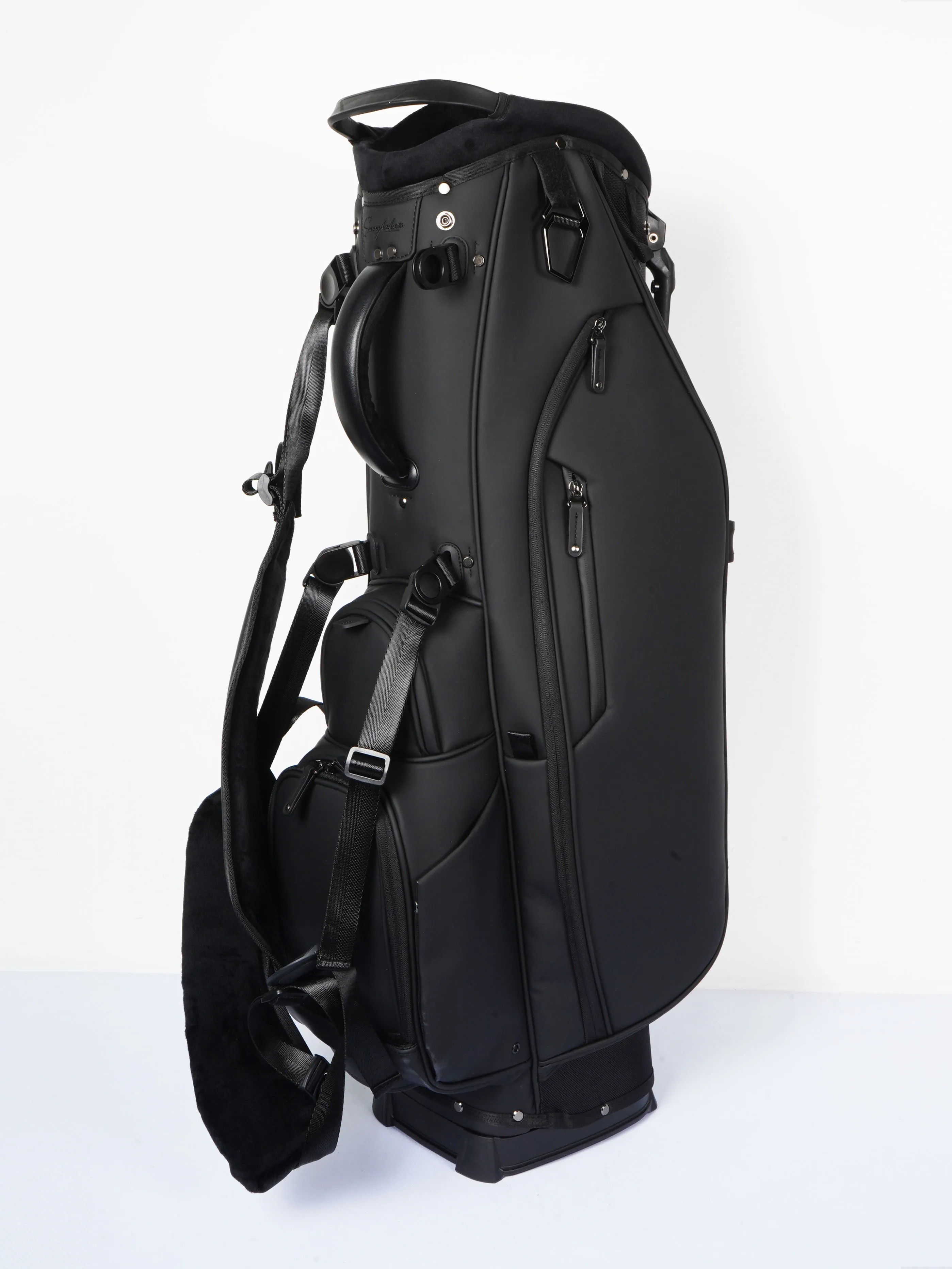
3. Step 2 — Manufacturer vs Trading Company
The single most useful question you can ask is simple: are you a manufacturer or a trading company? The answer changes everything about consistency. A manufacturer — or a brand that coordinates production through its own affiliated plant — controls the line, the tooling and the material approvals. A trading company aggregates capacity from whichever factories have space that month, which means your "luxury" bag may be built by a different line every reorder.
For a premium brand, that drift is fatal. A reorder that does not match the original hide tone, stitch or emboss is a quality failure customers notice immediately, and it arrives after you have already built a brand on consistency. Prefer a partner that can show you the actual plant, the lines and the equipment — not a polished website and a middleman.
| Signal | Manufacturer / Affiliated Plant | Trading Company |
|---|---|---|
| Repeat-order consistency | Same tooling & hides | May vary by factory |
| Problem resolution | Direct to production | Relayed through layers |
| Custom hardware / hides | Feasible at lower MOQ | Often outsourced, costly |
| Audit transparency | Welcomes factory visits | Vague about the plant |
4. Step 3 — Verify Entity & Certifications
Premium brands are increasingly audited by their own retail buyers, so your supplier's documentation becomes your documentation. Demand the actual certificates, not claims on a website.
- BSCI social-compliance audit — expected for any export to Western retail.
- ISO 9001:2015 quality management system — proves a systematic, repeatable QC process.
- Third-party audit of capacity, e.g. SGS — validates the "200,000/month" type claims rather than accepting them at face value.
- Market compliance: CE, CPC and RoHS as relevant to the US and EU.
At our affiliated factory, these are all on record: BSCI and ISO 9001:2015 certification, and an SGS capacity audit from March 2026 validating a rated 200,000 bags per month against ~150,000 actual. We share this documentation under NDA with serious buyers. Ask any shortlisted partner the same — if they hesitate, that tells you something.
5. Step 4 — Judge the Sample, Not the Photo
Product photographs lie. They cannot show edge paint, stitch tension, the feel of a hide, or the depth of an emboss. Always approve a physical golden sample before mass production, and expect 2–3 sample rounds to perfect the details. When the sample arrives, inspect it the way a customer will:
- Run a finger along the edges — burnished, smooth, no drips.
- Check stitching on curves — even length, no skipped stitches.
- Feel the hide — is it the grade you specified, or a thinner substitute?
- Test hardware — zips slide, feet are flush, plating is consistent.
- Look at the emboss — legible but not cut through the leather.
- Stand the bag up empty — it should hold its shape.
6. Step 5 — MOQ & Lead Time Reality
Premium manufacturing has honest economics, and unrealistic numbers are a warning sign. Expect a serious program to quote MOQ around 200 pieces, with a 100-piece trial option, sampling in 10–20 working days, and mass production in 45–60 working days. Add sea freight (3–6 weeks depending on destination) and customs to get a realistic total timeline.
| Stage | Realistic Window | Watch Out For |
|---|---|---|
| MOQ | 200 (100 trial) | "MOQ 10" for full-grain leather — unsustainable |
| Sampling | 10–20 days, 2–3 rounds | Promised "3 days" means rushed, wrong samples |
| Mass production | 45–60 days | Promised "20 days" for hand-stitched luxury — unrealistic |
| Shipping | +3–6 weeks sea | Forgetting duty and clearance |
Beware the supplier quoting MOQ 10–20 for a genuine full-grain, hand-stitched bag. That volume does not justify hide sourcing, custom tooling and the labor a luxury build requires — so either the materials are substituted, or the price jumps when you reorder. A sane minimum is a sign of an honest partner.
7. Step 6 — Audit the QC Process
Quality is not a promise; it is a process. Ask how QC actually runs on the floor. A serious partner checks at multiple points, not just at the end.
- In-line inspection at each workstation, so problems are caught during production, not after.
- Final AQL inspection (Acceptable Quality Level, typically Level II) on the finished run.
- Third-party inspection available — SGS, Bureau Veritas or Intertek — if your brand requires it.
- Photo documentation at production stages, so you can see progress without flying out.
This is the difference between a factory that hopes for quality and one that manages it. An ISO 9001:2015 system exists precisely to make QC repeatable — ask to see how it is applied to leather grading, edge paint and emboss depth, not just the certificate on the wall.
8. Step 7 — Cost Transparency
A single number quote hides everything. Ask what the price is built from: how much is leather, how much hardware, how much labor and craft. For premium builds, leather and materials typically drive 40–50% of FOB, hardware 12–18%, and hand-work (stitching, edge paint, embossing) 20–28%. If a partner cannot break this down, they cannot explain why the price moves when you change a material — and they will be opaque on reorder pricing.
Also understand the Incoterms. Most premium programs quote FOB, with CIF or DDP available for a delivered price. Know whether your quote includes packaging, whether the gift-box upgrade is extra, and how duties are handled at your end. Transparency at the quote stage predicts transparency throughout the relationship.
9. Red Flags Checklist
Walk away — or at least pause — if any of these recur across a supplier:
- Refuses or delays sending physical samples.
- No verifiable certificates, or certificates that do not match the company name.
- Prices far below market for the materials specified.
- Vague about the actual factory, lines and equipment.
- Pressures you into a large order before you have tested quality.
- Cannot describe a QC process beyond "we check everything."
- Slow, generic communication that avoids specific questions.
- Overstates material claims (PU marketed as full-grain, "eco" with no documentation).
A reliable partner welcomes scrutiny. They will send samples, show you the plant on a video call, share certificates under NDA, and explain trade-offs honestly — because they want a repeat relationship, not a one-off sale.
10. What a Serious Partner Looks Like
To make this concrete, here is the profile of the partner you are looking for — and the profile we hold at QUANZHOU JUNYUAN BAGS. Coordinating production through our affiliated factory in Quanzhou since 2014 (our founder has been in the trade since 2004), we run 7 production lines with 149 machines (126 sewing stations), 137 staff and a 4,950 m² main plant. Rated capacity is 200,000 bags per month (SGS-audited March 2026), actual output around 150,000 — real headroom for a new program. We serve 200+ brands across 100+ countries, hold BSCI and ISO 9001:2015 certification, and quote MOQ 200 (100 trial), sampling 10–20 days, production 45–60 days.
We build leather bags, premium and luxury lines, vintage and classic collections, and matching head covers in one roof. If you have worked through this checklist and want to talk, reach us at service@junyuanbags.com or service@junyuanbags.com, or on WhatsApp +86 17750020688. Our own retail expression of this craft is at KEEPPErfect.
Negotiation & Payment Terms That Protect You
Once you have a shortlist and a good sample, the commercial terms decide whether the relationship stays healthy. Premium manufacturing deals usually follow a predictable structure, and knowing it keeps you from overpaying or from accepting terms that transfer all the risk to you.
The norm is a deposit against the order, with the balance before shipment rather than on delivery. A typical split is 30% deposit on confirmation and 70% against the finished goods before dispatch. This is reasonable: it commits you to the production run and covers material buy-in, while keeping the balance in your hands until you have inspected the goods. Be cautious of partners asking for 100% upfront with no inspection rights, or of those offering absurdly long credit terms that signal they need your cash to fund production.
On price, expect movement, but negotiate structure not just number. Ask whether the quote includes packaging, whether the embossing tooling fee is one-off, and how reorder pricing changes as volume grows. A partner who lowers unit price at higher annual volumes is investing in the relationship; one who holds price flat forever is protecting a fat margin. Tooling — the die for an emboss or a molded panel — is usually a one-off cost on the first order, and should be itemized separately so you own the clarity that it is your tooling.
Tooling, Artwork & Who Owns What
A premium product involves physical and intellectual property: the embossing die, the tech pack, the logo artwork, and the approved golden sample. Before production, be explicit about who owns what, because this is where relationships sour quietly.
Your logo, brand identity and tech pack are yours, full stop. A professional partner signs an NDA and will not reuse your design for another customer. The tooling you pay for — the embossing die, any custom mold — should be identifiable as yours, stored by the factory against your future orders, and not reused for a competitor. The golden sample becomes the production benchmark and should be documented so that every reorder is measured against the same physical reference.
This matters most when a brand eventually changes factories. A partner that treats your tooling and files as hostage — "stay with us or lose your emboss die" — is a partner to leave early. The right partner hands over your artwork and acknowledges your ownership, because they want to keep you on service rather than lock you in on leverage. Get this in writing before the first PO, however casual the relationship feels.
Visiting or Auditing the Factory
If you can visit, do. Nothing substitutes for standing on the floor. But even a planned visit needs a structure, or you will be shown a clean showcase corner and miss the real production line. Here is what to look at.
- The floor itself: are lines running, and do they look busy and orderly? Idle or chaotic lines tell you about scheduling and quality discipline.
- The cutting and material area: how are hides stored and graded? Is there visible offcut management? Material discipline starts here.
- The sewing stations: count them and see if they match the claims (our affiliated plant runs 126 sewing stations across 149 machines).
- The QC station: is it a real, manned checkpoint with records, or a token gesture?
- The staff: how many people, how organized, and do they look stable?
If you cannot travel, ask for a live video walkthrough. A partner willing to tour the factory over video on a working day is as transparent as most buyers need; one who only sends curated photos is hiding something. Combine that with the certificate verification and a physical sample, and you have a surprisingly complete picture without boarding a flight. This is also exactly the scrutiny the BSCI and ISO systems are designed to withstand — a certified factory should not be afraid of it.
Building the Timeline for First Production
Even with the right partner, timing fails when it is assumed rather than planned. A realistic first program looks like this, and you should hold your supplier to each gate.
| Gate | Activity | Typical Window |
|---|---|---|
| 1. Brief | Tech pack, material list, quote | Days 1–7 |
| 2. Sampling | 2–3 sample rounds, golden sign-off | 10–20 days |
| 3. Tooling | Emboss die, hardware setup | Concurrent with sampling |
| 4. Mass production | 7 lines, inline QC | 45–60 days |
| 5. Final inspection | AQL-II, third-party option | End of production |
| 6. Shipping | Sea freight + clearance | +3–6 weeks |
Add it up and a first program from brief to stock on hand is realistically 4–6 months. Plan to a launch season, not to a deadline, and build a buffer around sea freight — a container delayed at customs should not derail a launch you spent a year preparing. Repeat orders compress toward the faster end of production because tooling and materials are already locked, which is one more reason consistency from the first run pays off.
After the Order: The Relationship That Follows
The first order is not the end of due diligence — it is the start. Once production lands, treat the received goods as the first data point on your supplier, not the conclusion of the search. Audit what actually arrived against the golden sample. Is the hide the same? The edge paint clean? The emboss at the right depth? If the bulk matches the sample, you have a reliable partner; if it drifts, flag it immediately while there is still leverage.
Then plan the reorder before the stock sells through. A partner worth keeping can lock your approved leather swatches and tooling so the second run is identical to the first, compressing lead time as confidence grows. The premium brands that last are not the ones who found the cheapest quote; they are the ones who found one consistent factory and built a decade of repeat orders on it. Choose accordingly on day one, and the relationship compounds in your favor.
A One-Page Scorecard to Rank Your Shortlist
After running the steps above across 3–5 partners, it helps to score them consistently rather than deciding on gut feel. Build a simple table and weight what matters for a premium brand. This is the same framework many of our clients use internally before awarding an order.
| Criterion | Weight | What "5/5" Looks Like |
|---|---|---|
| Sample quality | 30% | Edge paint, stitching, hide and emboss all match the spec |
| Consistency proof | 20% | Owns the line, shows repeat-order references |
| Certifications & audits | 15% | BSCI + ISO 9001:2015 + third-party audit, shareable |
| MOQ & lead time honesty | 15% | MOQ ~200, sampling 10–20d, production 45–60d |
| QC process | 10% | In-line checks + AQL-II, third-party on request |
| Communication | 10% | Responsive, English-capable, specific, sends photos |
Weighted this way, sample quality and consistency dominate — exactly where cheap quotes lose. A supplier can be cheapest on the page and still score poorly once the sample is in your hand. Run the numbers and you will usually find the partner that felt "slightly more expensive" was the better value all along.
The Questions to Ask on the First Call
Speed up due diligence by asking these in the first conversation. The answers separate serious manufacturers from traders within minutes.
- "What is the exact entity, and can you share the BSCI and ISO certificates under NDA?" A manufacturer can produce them; a trader deflects.
- "Do you run your own affiliated lines, and how many sewing stations?" Look for a specific, confident number rather than "we have many factories."
- "What is your rated capacity versus what you actually produce?" Two figures show honesty and headroom; one inflated figure is marketing.
- "Can you send 2–3 physical samples before I commit?" If no, stop there.
- "What does your QC process look like, and can I use a third-party inspector?" Defensiveness here is disqualifying.
- "What is the MOQ, sampling window and production window in working days?" Compare to 200 / 10–20 / 45–60.
- "Who owns the tooling and my artwork?" A professional answer reassures; a vague one is a warning.
Run this list and you will know within an hour whether a prospect belongs on the shortlist. Pair their answers with a physical sample and a certificate check, and you have done better due diligence than most first-time buyers ever manage. That diligence is cheap insurance against the far more expensive mistake of building a brand on the wrong factory.
Five Mistakes That Sink a Premium Sourcing Project
After walking many buyers through this process, the same five mistakes recur. Naming them here is the cheapest risk insurance available.
- Choosing on price alone. The cheapest quote usually substitutes material or hides craft, and the defect shows up in customer reviews, not on the invoice. Judge total quality, not unit price.
- Skipping the physical sample. Ordering from photos is gambling. A golden sample is the single highest-value step in the whole process.
- Vague brief. "Make it look premium" invites whatever the factory feels like making. A precise brief gets you what you actually want in half the rounds.
- No reorder plan. Running out of a proven best-seller wastes the marketing that created the demand. Plan the second PO before the first sells through.
- Ignoring IP and tooling. Not clarifying who owns the die and artwork early creates leverage problems later. Get it in writing.
Avoid these five and you will have outperformed the majority of buyers who source premium bags. They are not exotic edge cases; they are the ordinary errors that turn a promising product into a frustrating experience. The good news is that each one is preventable with the discipline this guide lays out.
The Verdict
Choosing a premium golf bag manufacturer is less about finding the "best" factory in the abstract and more about finding the right fit for your brand — one that controls its line, documents its quality, and treats your product as a long-term relationship. Verify the entity, hold the sample, audit the QC, watch the red flags, and score your shortlist on what actually protects your reputation. Do that, and the decision stops being a leap of faith and becomes a straightforward comparison.
If you want to put this checklist to work against a real partner, we are ready to be measured by it. Send us your references, your target retail and your volume, and we will return a tech pack, a transparent quote and — most importantly — a physical sample you can judge by the standards above. That is the whole test: hold the product, and decide. Reach us at service@junyuanbags.com or service@junyuanbags.com, or on WhatsApp +86 17750020688.
After the award, the work is not over but the hard part is done. You will have chosen a partner on evidence, not a sales pitch, and that choice compounds: every reorder gets faster, every sample gets closer to instinct, and the brand you are building becomes consistent across seasons. That is the quiet reward of disciplined sourcing — a factory you stop worrying about, and a product your customer recognizes as the same excellent bag every time. Start with the sample, run the scorecard, and let the evidence make the decision for you. Time spent on due diligence now is the cheapest insurance you will ever buy, because every season that follows is built on the foundation you set today. Choose the partner who survives this checklist, and the rest of the product journey becomes straightforward. There is no substitute for holding a genuine full-grain sample in your hands, feeling the edge paint run smooth under your thumb, and knowing the factory behind it can reproduce that exact feel for the next five years. That is the standard. Hold every prospect to it.
People Also Ask
Premium factories control edge paint, stitching tension and emboss depth in-house and inspect every unit at AQL 2.5. See our QC process.
Compare material grade, hide origin and build details rather than the logo; full-grain leather and brass hardware justify the cost. Review our premium materials.
Yes, but keep the runs separate; our plant builds luxury leather and value nylon lines on distinct tooling. Explore our premium collection.
A small deposit against an approved golden sample, with balance against pre-shipment inspection photos and an AQL 2.5 report. discuss terms.
Budget 10 to 20 days for samples and 45 to 60 days for production, then sea freight to your market. See our premium timeline.
Frequently Asked Questions
Get the Sample, Not the Sales Pitch
Premium OEM/ODM bags & head covers. MOQ 200 · sampling 10–20 days · production 45–60 days · BSCI & ISO 9001:2015.
Request a Quote →