3D-Printed Golf Bag Components: The Manufacturing Revolution of 2026
Table of Contents
- Introduction: Additive Manufacturing Meets Golf Bag Production
- Current State of 3D Printing in Golf Bag Manufacturing
- Which Golf Bag Components Are Being 3D Printed
- Advanced Materials for Golf Bag Applications
- Rapid Prototyping and Product Development Workflow
- Cost Analysis: 3D Printing vs Traditional Manufacturing
- The Future: Mass Customization and Hybrid Manufacturing
- How Our Factory Integrates 3D Printing
Introduction: Additive Manufacturing Meets Golf Bag Production
The golf bag manufacturing industry is undergoing a technological transformation that would have seemed impossible just a decade ago. Three-dimensional printing, also known as additive manufacturing, has evolved from a niche prototyping tool into a production-capable technology that is fundamentally changing how golf bag components are designed, tested, and manufactured. In 2026, forward-thinking golf bag manufacturers are leveraging 3D printing to accelerate product development cycles, reduce tooling costs, and create complex geometries that were previously impossible to produce using traditional methods.
At our certified manufacturing facility, we have integrated 3D printing technology across multiple stages of our golf bag production workflow. From initial concept prototyping to functional testing fixtures to limited-edition production components, additive manufacturing has become an indispensable part of our manufacturing toolkit. This comprehensive guide explores every aspect of 3D printing technology as it applies to golf bag manufacturing, providing insights for brand owners, product developers, and industry professionals who want to understand how this technology is reshaping the landscape.
The global 3D printing market in the sporting goods sector is projected to reach 4.8 billion dollars by 2027, growing at a compound annual growth rate of 21.3 percent. Golf equipment manufacturers, including golf bag producers, are among the fastest adopters of this technology because the industry demands frequent design iterations, customization options, and rapid time-to-market capabilities that 3D printing uniquely enables. Understanding how to leverage additive manufacturing for golf bag production is no longer optional for competitive manufacturers and brands; it has become essential.
Current State of 3D Printing in Golf Bag Manufacturing
The adoption of 3D printing in golf bag manufacturing has progressed through distinct phases over the past decade. Initially limited to concept models and display prototypes, the technology has advanced to produce functional components that withstand the rigors of daily golf use. Today, in 2026, we are witnessing the third phase: selective production of end-use components and the emergence of hybrid manufacturing systems that combine additive and traditional processes.
Evolution from Prototype to Production
In the early 2010s, 3D printing in the golf bag industry was confined to producing visual prototypes that helped designers and brand managers evaluate form factors, proportions, and aesthetic details before committing to expensive tooling. These early prototypes were printed in basic ABS or PLA materials using Fused Deposition Modeling technology, producing parts that looked the part but lacked the mechanical properties needed for functional testing.
The introduction of Selective Laser Sintering with nylon-based powders changed the game entirely. Suddenly, 3D-printed parts could withstand the same stress tests as injection-molded components. Multi Jet Fusion technology from HP further accelerated adoption by producing parts with superior surface finish, consistent mechanical properties, and production throughput that made small-batch manufacturing economically viable. By 2024, our factory had deployed four industrial-grade 3D printing systems dedicated to golf bag component production and development.
Technology Adoption Across the Industry
Major golf bag brands have embraced 3D printing at different levels. Premium tour bag manufacturers were early adopters, using the technology to produce custom fittings and one-off components for professional golfers. Stand bag brands leveraged rapid prototyping to reduce development cycles from 12 weeks to under 3 weeks. Cart bag manufacturers discovered that 3D printing was ideal for producing custom divider tubes and organizational inserts that differentiated their products in competitive retail markets.
The technology has also democratized golf bag design. Smaller brands and startups that previously could not afford the minimum tooling investments required for injection molding can now produce fully functional prototypes and limited production runs using 3D printing. This has led to an explosion of innovative golf bag designs entering the market, with novel pocket configurations, unique stand mechanisms, and creative closure systems that push the boundaries of what golf bags can do.
Which Golf Bag Components Are Being 3D Printed
While 3D printing has not replaced traditional sewing and assembly processes for the main body of golf bags, it has made significant inroads into component manufacturing. Understanding which parts are suitable for additive manufacturing and which remain better served by traditional methods is critical for optimizing production efficiency and cost.
Buckles, Clips, and Fastening Systems
Custom buckles represent the most successful category of 3D-printed golf bag components. The ability to produce complex geometries with integrated living hinges, snap-fit features, and ergonomic grip surfaces makes 3D printing ideal for buckle production. Our facility prints buckle prototypes in SLS nylon PA12, producing parts that pass the same 500-cycle latch testing required of injection-molded equivalents. For limited production runs of 50 to 500 units, we produce end-use buckles directly from 3D printers, eliminating the need for 5,000 to 15,000 dollar mold investments.
Magnetic closure systems, ball valve fasteners, and proprietary quick-release mechanisms all benefit from 3D printing prototyping. Brand clients can evaluate multiple design iterations within days rather than weeks, enabling rapid convergence on optimal designs before committing to production tooling. This capability has reduced our average buckle development timeline from six weeks to ten business days.
Divider Tubes and Internal Structures
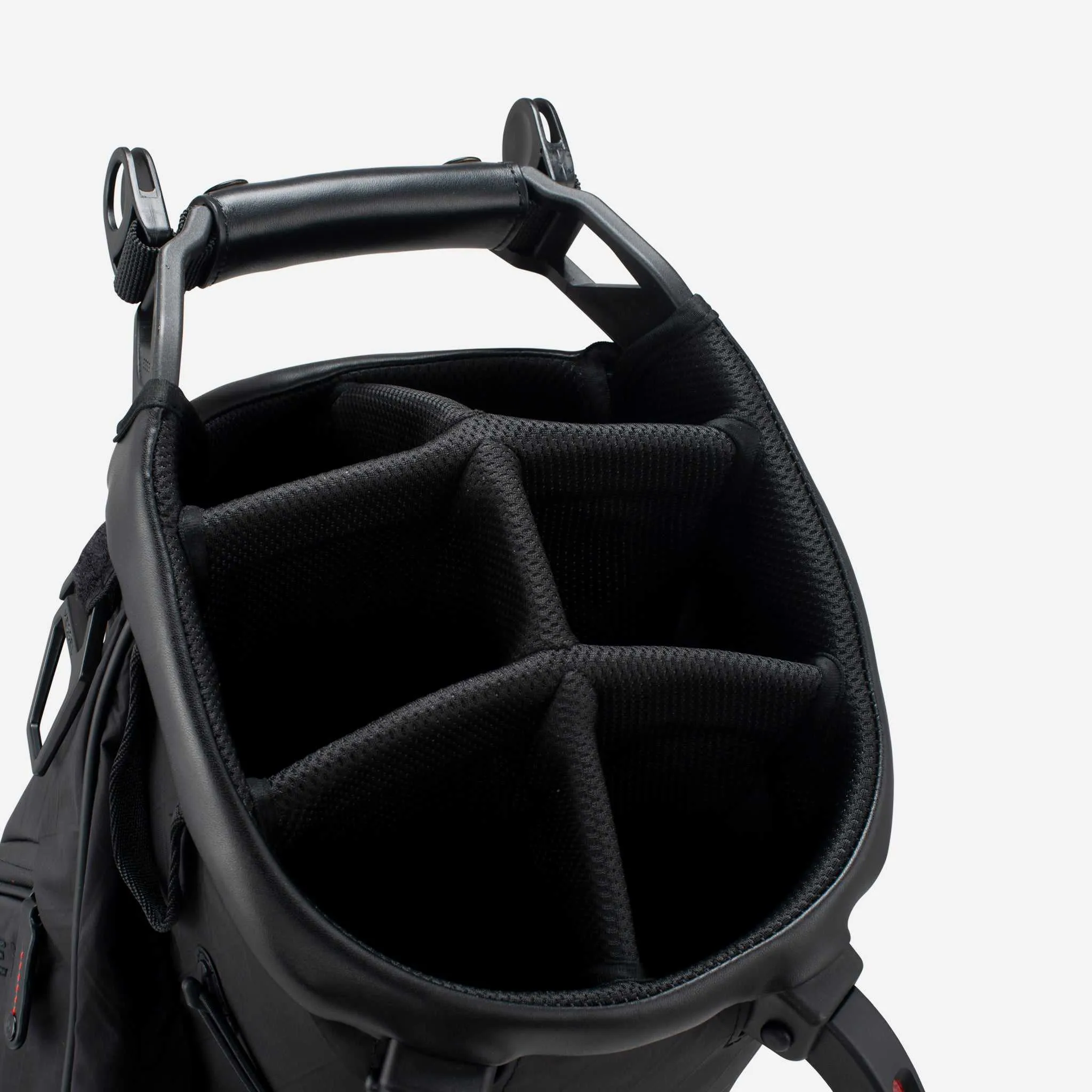
Full-length divider tubes represent a significant opportunity for 3D printing innovation. Traditional divider tubes are produced by extruding PVC or ABS profiles, then cutting and assembling them into the bag structure. 3D printing enables monolithic divider systems with integrated support ribs, custom tube diameters for oversized putter grips, and complex internal geometries that prevent club tangling more effectively than conventional designs.
Our engineering team has developed 3D-printed divider prototypes featuring variable wall thickness that provides additional rigidity at stress points while reducing weight in low-load areas. These topology-optimized designs cannot be produced through extrusion or injection molding, giving brands that adopt them a genuine competitive advantage in club protection performance. Carbon-fiber-reinforced nylon divider prototypes have demonstrated a 23 percent weight reduction compared to standard ABS divider assemblies while maintaining equivalent structural rigidity.
Stand Mechanism Brackets and Hinges
The stand mechanism is one of the most mechanically complex components of a golf stand bag, requiring precise pivot points, spring integration, and load-bearing surfaces that can support the bag at a stable angle. 3D printing enables rapid iteration of stand bracket designs, allowing engineers to test multiple geometries and mounting configurations before finalizing production designs. Functional prototypes printed in glass-fiber-reinforced nylon can withstand the dynamic loads of 2,000 stand-and-fold cycles during testing.
In 2026, we are also seeing the emergence of 3D-printed stand leg connectors and feet that integrate anti-slip textures directly into the part geometry, eliminating the need for separate rubber overmolding. These mono-material designs simplify assembly, reduce part count, and provide consistent performance across temperature ranges that would challenge traditional two-material assemblies.
Decorative Elements and Brand Identity Features
Three-dimensional printing excels at producing detailed decorative elements that establish brand identity on golf bags. Custom logo plates, textured surface panels, embossed patterns, and signature design features can be 3D printed in high-resolution resin or nylon materials and attached to the bag body during assembly. These elements provide the premium visual differentiation that brands need to stand out in retail environments without the cost of creating custom molds for each design variation.
For seasonal color collections and limited-edition releases, 3D-printed decorative elements enable manufacturers to produce design variations in quantities as small as 25 units without incurring tooling costs. This capability supports just-in-time manufacturing strategies and reduces inventory risk for brands that need to respond quickly to market trends.
Advanced Materials for Golf Bag Applications
The materials available for 3D printing have expanded dramatically, and selecting the right material for each golf bag component is crucial for achieving the desired balance of strength, flexibility, weight, surface finish, and cost.
Nylon-Based Powder Bed Fusion Materials
PA12 nylon remains the workhorse material for functional golf bag components produced through Selective Laser Sintering or Multi Jet Fusion. With tensile strength of 48 megapascals, elongation at break of 20 percent, and excellent chemical resistance, PA12 produces buckles, brackets, and structural clips that perform identically to injection-molded nylon equivalents. The material is available in gray, black, and white base colors, and can be dyed post-processing to match brand-specific color requirements.
Glass-fiber-filled PA12 variants increase stiffness by 60 percent while reducing weight by 15 percent compared to unfilled nylon. These composites are ideal for load-bearing bracket applications where rigidity is critical. Carbon-fiber-filled variants offer even higher stiffness-to-weight ratios, making them suitable for structural frame components and high-performance divider systems.
Flexible TPU Materials
Thermoplastic polyurethane materials with Shore hardness ranging from 85A to 95A are ideal for producing protective bumpers, grip surfaces, and vibration-damping components for golf bags. 3D-printed TPU parts can replicate the function of traditionally overmolded rubber grips and edge protectors, but with the advantage of complex geometries that include internal lattice structures for tuned cushioning characteristics.
Our development team has used TPU 3D printing to produce prototype zipper garage protectors that integrate a progressive compression zone, providing smoother zipper engagement and better protection for golf club grips. These prototypes were validated through user testing before committing to production tooling, saving an estimated 12,000 dollars in potential redesign costs.
Resin-Based SLA and DLP Materials
For applications requiring exceptional surface finish and detail resolution, stereolithography and Digital Light Processing resin printers produce components with surface quality that approaches injection-molded parts straight from the tool. Standard resins are used for visual prototypes and fit-check models, while engineering-grade resins with ceramic-filled or toughened formulations produce functional components for low-stress applications such as decorative trim, logo plates, and pocket label inserts.
Clear and translucent resins enable the production of light-diffusing panels and indicator windows for smart golf bag concepts, where LED status indicators might show battery charge levels or compartment lock status. These optical-grade resin prototypes allow brands to evaluate the visual effect of integrated lighting before committing to production materials.
Rapid Prototyping and Product Development Workflow
Integrating 3D printing into the golf bag product development workflow requires a systematic approach that maximizes the technology strengths while maintaining quality standards throughout the design-to-production pipeline.
Concept-to-Prototype Timeline Compression
Traditional golf bag development follows a sequential process: industrial design, engineering design, prototype tooling, sample production, design refinement, production tooling, and production samples. Each iteration cycle takes 3 to 6 weeks, and most designs go through 3 to 5 iterations before finalizing, resulting in total development timelines of 4 to 8 months.
With 3D printing integration, our development workflow compresses dramatically. Industrial design concepts are converted to 3D models within 24 hours. Functional prototypes of individual components are printed within 48 hours. Complete assembly prototypes with 3D-printed components are available for review within one week. This compressed timeline enables 8 to 12 design iterations in the time previously required for 2 to 3, resulting in more refined final designs and significantly reduced risk of costly errors in production tooling.
Design Validation and Testing Protocols
3D-printed prototypes undergo the same testing protocols as production samples. Our quality control laboratory performs load testing, cycle testing, drop testing, and environmental exposure testing on 3D-printed components to validate that they meet performance specifications before approving designs for production tooling. This early-stage testing catches design flaws when they are least expensive to fix, typically during the digital design phase rather than after production tooling has been manufactured.
For structural components like stand brackets and base plates, we use a graduated testing approach. Initial prototypes are printed in standard nylon for fit and function validation. Secondary prototypes are printed in glass-fiber-reinforced material for mechanical testing. Final validation samples are produced in the exact material specification planned for production, ensuring that test results directly predict production performance.
Cost Analysis: 3D Printing vs Traditional Manufacturing
Understanding the economic dynamics of 3D printing compared to traditional manufacturing methods is essential for making informed production decisions. The cost equation changes significantly depending on production volume, component complexity, and material requirements.
Prototyping Cost Comparison
The cost advantages of 3D printing for prototyping are overwhelming. A custom golf bag buckle prototype costs between 5 and 25 dollars using 3D printing, compared to 500 to 2,000 dollars for a CNC-machined prototype or the 3,000 to 15,000 dollars required for a prototype injection mold. For a complete golf bag development project requiring 20 to 30 prototype components across multiple iterations, 3D printing reduces prototyping costs from 25,000 to 50,000 dollars down to 500 to 1,500 dollars.
These savings are not just about reduced direct costs. The ability to produce prototypes quickly and affordably enables more design exploration, leading to better optimized final designs. Brands that leverage 3D printing prototyping consistently report higher satisfaction with final product quality because they explored more design alternatives before committing to production.
Production Cost Break-Even Analysis
For production volumes, the economic equation shifts. Three-dimensional printing has no tooling cost, but per-unit cost remains relatively constant regardless of quantity. Injection molding requires significant upfront tooling investment, but per-unit cost drops dramatically with volume. The break-even point depends on component complexity, material costs, and production volume.
For simple components like flat clips, injection molding becomes more economical at approximately 2,000 units. For complex components with undercuts, living hinges, and internal features that require multi-piece molds, the break-even point extends to 5,000 or even 10,000 units. For limited-edition products, custom team bags, and regional market variants, 3D printing production often remains the more economical choice across the entire relevant volume range.
The Future: Mass Customization and Hybrid Manufacturing
The trajectory of 3D printing technology points toward increasingly significant roles in golf bag manufacturing. Several emerging trends are worth monitoring for brands and manufacturers planning their technology investments.
Mass Customization for Individual Golfers
The concept of mass customization, producing goods tailored to individual customer requirements at scale, is becoming feasible through 3D printing. Imagine a future where golfers can order a stand bag with divider tubes customized to their exact club set, handle grips molded to their hand measurements, and stand mechanism tension calibrated to their preferred leg deployment speed. This level of personalization was economically impossible with traditional manufacturing but becomes viable with additive manufacturing.
Our research and development team is actively developing systems that integrate body scanning data with parametric golf bag design models, enabling customized bag configurations to be produced directly from customer measurements. While full custom production remains in the development phase, we currently offer custom color combinations, personalized embroidery, and bespoke pocket configurations through our OEM program, with 3D-printed custom elements planned for 2026 launch.
Hybrid Manufacturing Systems
The most likely near-term evolution is hybrid manufacturing, where 3D-printed components are integrated with traditionally manufactured parts to create assemblies that leverage the strengths of each production method. Examples include 3D-printed bracket inserts that are overmolded with traditional injection molding to create multi-material assemblies, or 3D-printed custom divider systems that are installed into traditionally sewn bag bodies.
Hybrid approaches allow manufacturers to introduce 3D printing benefits without completely restructuring their production infrastructure. Our factory has already implemented hybrid processes for premium tour bag lines, where 3D-printed custom fittings and decorative elements are combined with traditionally manufactured bag bodies to create products that offer both customization and production efficiency.
On-Demand Spare Parts and Repair Components
One of the most promising applications of 3D printing in golf bag manufacturing is on-demand spare parts production. Traditional spare parts programs require manufacturers to maintain inventory of every component for every product they have ever produced, tying up capital and warehouse space. With 3D printing, spare parts can be produced on demand from digital files, eliminating inventory costs and enabling support for discontinued products indefinitely.
Forward-thinking brands are already building digital spare parts libraries, storing 3D models of every custom component used in their product lines. When a customer needs a replacement buckle, zipper pull, or bracket, the file is sent to a 3D printer and produced within hours. This model reduces warranty fulfillment costs, improves customer satisfaction through faster service, and extends the usable life of golf bags by making replacement components available for products that are no longer in production.
How Our Factory Integrates 3D Printing
Our BSCI and ISO 9001:2015 certified manufacturing facility has invested significantly in 3D printing technology, operating a dedicated additive manufacturing center within our 15,000 square meter production facility. Our 3D printing capabilities serve three primary functions within our overall golf bag manufacturing operation.
Product Development Support
Our product development team uses 3D printing extensively during the design and engineering phases of every new golf bag project. Brand clients receive functional prototypes of custom components within one week of design approval, enabling rapid design validation and iterative refinement. This capability has been instrumental in reducing our average new product development timeline from 6 months to 3.5 months, giving our brand partners faster time-to-market for their new product launches.
Production Tooling and Fixtures
Beyond component prototyping, we use 3D printing to produce custom jigs, fixtures, and assembly aids that improve production efficiency and consistency. Custom sewing guides ensure pocket placement accuracy within 1 millimeter tolerance. Assembly fixtures hold components in precise positions during adhesive curing. Inspection gauges verify critical dimensions on production parts. These production aids, printed in durable nylon materials, typically pay for themselves within the first production run through reduced assembly time and improved quality consistency.
Limited Production Components
For select premium product lines and custom orders, we produce end-use components directly through 3D printing. Custom team bag logos, limited-edition buckle sets, and bespoke decorative elements are printed in production quantities ranging from 25 to 500 units. This capability enables us to offer customization services that traditional factories cannot match, while maintaining the quality standards our BSCI and ISO certifications demand.
Our commitment to technological advancement ensures that we remain at the forefront of golf bag manufacturing innovation. With over 200,000 bags produced annually and a dedicated research and development team continuously exploring new applications for additive manufacturing, we offer brand partners the combined benefits of traditional manufacturing scale and cutting-edge technology capabilities. Contact us via WhatsApp at +8617750020688 or email at service@junyuanbags.com to learn how our 3D printing capabilities can accelerate your next golf bag development project.
Frequently Asked Questions
What golf bag components can be 3D printed?
Common 3D-printed golf bag components include custom buckle prototypes, zipper pull tabs, divider tubes, base plates, handle grips, stand mechanism brackets, and decorative trim elements. Full structural frames using carbon-fiber-reinforced nylon are also being prototyped for next-generation lightweight designs.
How does 3D printing reduce golf bag prototyping time?
Traditional prototyping for a custom golf bag buckle or bracket requires CNC machining or injection mold creation, taking 2 to 6 weeks. 3D printing produces functional prototypes in 24 to 72 hours, reducing the prototyping cycle by up to 90 percent and saving thousands of dollars in tooling costs.
Can 3D-printed golf bag parts match injection-molded strength?
Modern industrial 3D printers using SLS nylon, MJF polyamide, or carbon-fiber-filled materials produce parts with tensile strength comparable to injection-molded equivalents. For production runs exceeding 5,000 units, injection molding remains more cost-effective, but 3D printing excels for prototyping and low-volume custom orders.
What 3D printing materials are used for golf bags?
The most common materials include SLS nylon PA12 for buckles and brackets, TPU flexible filaments for protective bumpers and grip surfaces, carbon-fiber-reinforced PETG for structural components, and resin-based SLA materials for high-detail decorative elements and fit-check models.
Is 3D printing used in mass production of golf bags?
Currently, 3D printing is primarily used for prototyping, custom one-off orders, and limited-edition production runs. For mass production of 10,000 or more units, traditional injection molding and sewing processes remain more economical. However, the technology is rapidly advancing toward hybrid manufacturing models.
How much does 3D printing add to golf bag development cost?
3D printing typically reduces overall development costs by 40 to 60 percent compared to traditional prototyping. A single prototype buckle costs between 5 and 25 dollars via 3D printing versus 500 to 2,000 dollars for CNC-machined equivalents. This makes iterative design exploration affordable for brands of all sizes.
What is the future of 3D printing in golf bag manufacturing?
The future includes fully 3D-printed bag frames using continuous carbon fiber, custom-fitted components based on individual golfer body scans, on-demand spare part production, and hybrid manufacturing where 3D-printed inserts are overmolded with traditional materials for integrated multi-material assemblies.
Ready to Start Your Custom Golf Bag Project?
Partner with a BSCI & ISO 9001:2015 certified factory producing 200,000+ premium golf bags annually. MOQ just 100 pieces.
Get a Free Quote Today