3D Printed Golf Bag: Custom Parts, Lightweight Design & Production Guide
3D printed golf bag parts that actually work: printable components, materials, print orientation & strength, splitting oversized parts, durability tests, and a complete stand-bracket case study.
Last updated: April 2026
3D printed golf bag parts can reduce development time from weeks to days — but only if you design parts that respect layer orientation, real load paths, and how a golf bag is actually used (lifting, dragging, stand cycles, travel impacts, UV/heat). This guide is written as a do-it-now production tutorial: parts you can print, how to orient them, how to split oversized parts, and how to test durability before you scale.
.webp)
Quick Navigation
- Where 3D Printing Fits
- Printable Parts (What Actually Makes Sense)
- Material Selection (PETG/ABS/Nylon/CF-Nylon)
- Print Orientation vs Strength (Critical)
- Splitting Oversized Parts + Assembly Methods
- Slicer Settings (Fast Defaults)
- Post-Processing & Inserts
- Durability Tests (Prototype → Functional)
- Complete Case: Stand-Bracket Prototype
- Downloads
Where 3D Printing Fits in Golf Bag Development
Most brands do not print an entire bag. The best ROI is printing rigid components that touch tubes, bases, top dividers, straps, and travel-impact zones. You use 3D printing to prove geometry, then decide whether to keep printing (low volume) or move to injection molding (high volume).
| Stage | What You Print | What You Learn | Decision Output |
|---|---|---|---|
| Fit prototype | covers, brackets, connectors | holes, clearances, assembly order | CAD revision list |
| Functional prototype | hinge/bracket in PETG/nylon | strength & deformation | orientation + material choice |
| Pre-tool validation | final geometry with inserts | cycle life + failure points | tooling readiness |
What Golf Bag Parts Can Be 3D Printed?
These are realistic parts with clear value in golf bag OEM development (stand, cart, staff, and travel covers):
| Part | Why It’s Printed | Load / Environment | Typical Failure | Design Hint |
|---|---|---|---|---|
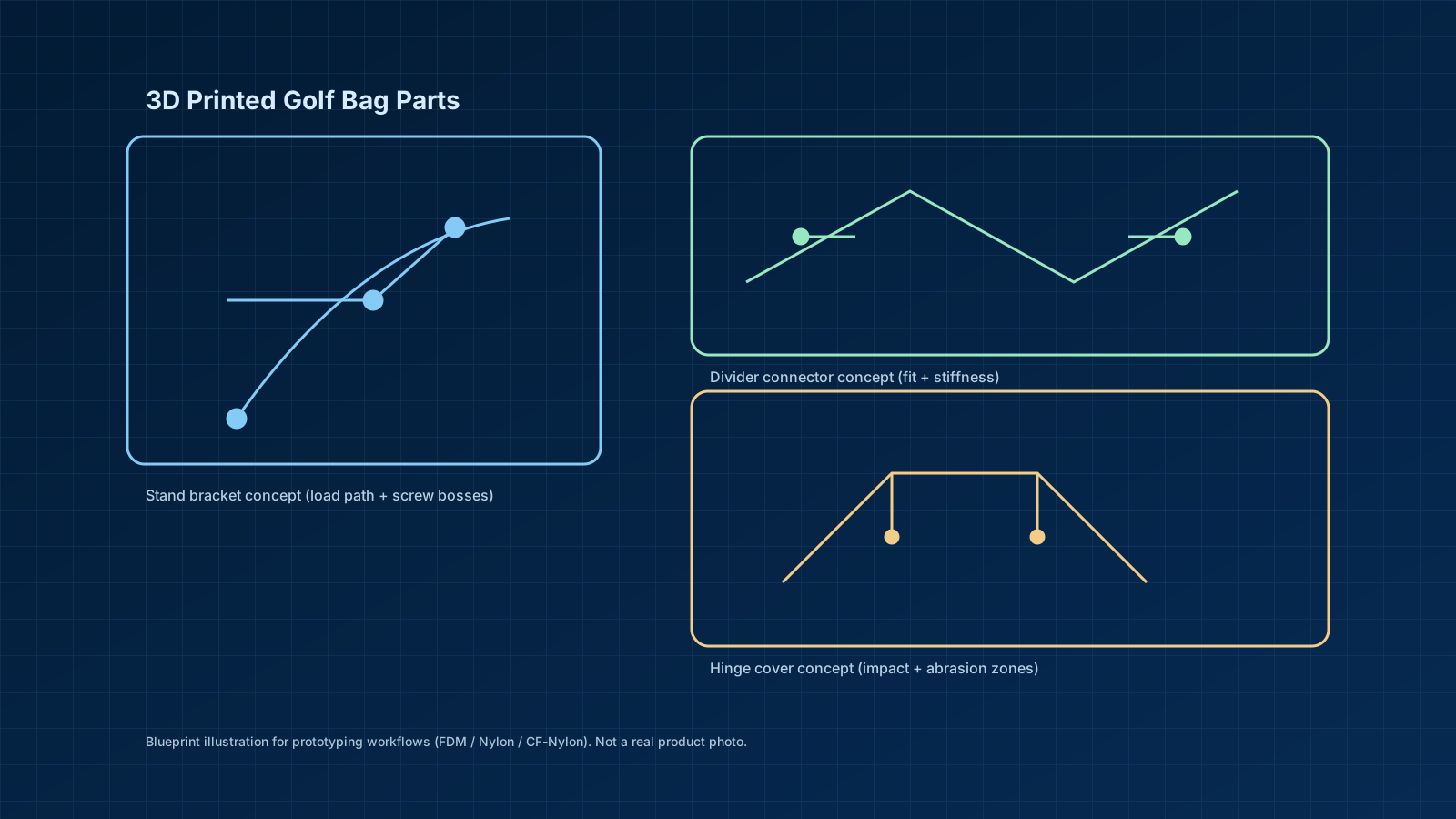
| Stand leg hinge cover / housing | fast fit + cycle test | impact + repeated cycles | crack at boss | fillets + inserts + correct orientation |
| Top divider connector | prove divider geometry | compression + bending | warping | ribs + more perimeters |
| Corner protector (travel) | rapid iteration | drop/impact + abrasion | brittle fracture | nylon/CF-nylon + thicker corners |
| Handle bracket | ergonomics + mount holes | pull force + vibration | layer split | align layers with pulling direction |
| Logo badge base / nameplate | low-volume branding | scratch + UV | surface wear | texture + coating plan |
Material Selection: PETG vs ABS vs Nylon vs CF Composites
For golf bag parts, impact resistance and layer adhesion matter more than “tensile strength on a datasheet”. Use this as a practical decision tool.
| Material | Layer Adhesion | Impact | Heat | Notes for Golf Bag Parts | Best Use |
|---|---|---|---|---|---|
| PETG | Good | Good | Medium | Fast and forgiving. Great for fit + first functional runs. | clips, mounts, mid-load brackets |
| ABS/ASA | Medium | Medium | High | Better heat resistance. Needs enclosure and tuned settings. | outdoor housings, heat-exposed parts |
| Nylon (PA) | Very good | Excellent | High | Strong and tough, but moisture-sensitive. Dry filament is mandatory. | hinges, load-bearing brackets |
| CF-Nylon | Good | Good | High | Stiffer and lighter; more brittle than pure nylon. Use for stiffness/weight goals. | lightweight structural parts |
| PLA | OK | Poor | Poor | Good for quick fit only. Avoid for real functional tests in summer heat. | fit checks |
Practical workflow: PETG (fast fit) → nylon (tough functional) → CF-nylon (stiff lightweight) depending on the load case.
Print Orientation vs Strength (Critical)
The most common failure in functional 3D printed golf bag parts is layer separation. If the force tries to pull layers apart, the part fails early even if the material itself is strong.
Use this mental model:
- Good: force runs along the layer lines (layers act like continuous fibers).
- Bad: force runs through the layer stack (layers peel apart).
Rule of thumb for stand brackets: print so the “arm” that takes bending load has layers running along the arm. Then increase perimeters (walls) before increasing infill.
Splitting Oversized Parts + Assembly Methods
Some golf bag parts exceed a typical printer’s build volume (especially long covers, large housings, or wide top-dividers). Splitting is normal — but you need to split for strength and repeatable assembly.
| Split Strategy | Best For | How to Add Alignment | Assembly Method | Notes |
|---|---|---|---|---|
| Flat split + pins | covers, shells | 2–4 alignment pins | CA + accelerator / epoxy | fast, but not best for high load |
| Tongue-and-groove | housings, brackets | interlocking tongue | epoxy + clamps | better shear strength |
| Dovetail split | structural parts | dovetail rail | screws + inserts | serviceable and strong |
| Bolted flange | stand components | flange + bolt pattern | machine screws + inserts | best for repeated load testing |
Assembly recommendation: if you expect repeated testing (cycle tests, drop tests), use screws + inserts. Adhesive-only joints are fine for fit models but can hide real failure modes.
Slicer Settings (Fast Defaults That Work)
These defaults are tuned for functional plastic parts — not miniature models. Adjust based on your printer and filament.
| Parameter | Prototype (fast) | Functional test (strong) | Why It Matters |
|---|---|---|---|
| Layer height | 0.24–0.28 mm | 0.16–0.20 mm | lower layers improve fit and consistency |
| Walls/perimeters | 3 | 5 | walls carry most load |
| Top/bottom layers | 4 | 7 | prevents crack initiation |
| Infill | 15–20% | 25–35% | increase walls first, then infill |
| Infill type | gyroid | gyroid/triangles | consistent strength in multiple axes |
| Heat-set inserts | optional | recommended | repeated assembly without stripped holes |
Post-Processing & Inserts
Post-processing is where prototypes become “presentation-ready”. For golf bag parts, also consider long-term friction and abrasion with fabric panels and foam.
- Deburr edges that touch fabric (prevents wear-through)
- Sand/contact polish mating surfaces for accurate fit
- Install heat-set inserts for repeated screw cycles
- Coat/paint if the part is customer-facing (UV + appearance)
- Test-fit with real materials (fabric + foam + tubes), not CAD-only
Durability Tests (Prototype → Functional)
You do not need a full lab to get meaningful results. You need repeatable tests that mimic golf bag loads. Below are simple tests we use during development; treat results as engineering signals, then validate with your final production method.
| Test | Setup | What It Reveals | Pass Criteria (Practical) |
|---|---|---|---|
| Static load | hang 5 kg for 72 hours | creep + layer separation | no crack; <1–2 mm permanent deformation |
| Cycle test | open/close hinge 500–1,000 cycles | fatigue near bosses | no progressive cracking |
| Drop/impact | 1 m drop onto corner | impact brittleness | no catastrophic fracture |
| Heat soak | 50–60°C in a closed car / chamber | softening & warping | geometry stays within assembly tolerance |
| Abrasion | rub against fabric for 2,000 strokes | surface wear | no sharp edges or fabric damage |
Example prototype notes: PLA often fails heat soak and impact tests. PETG is much better for early functional checks. Nylon typically performs best for impact, but needs dry filament and careful settings.
Complete Case: Printing a Stand-Bracket Prototype
This mini case shows a full “CAD → print → test → revise” loop for a stand-bracket style part (typical in stand bag leg mechanisms and rigid support structures). The goal is not to claim a universal design; it is to show the workflow so you can repeat it with your geometry.
1) Define the load path
For stand brackets, the critical loads are: (1) bending when the bag stands, (2) shock load when the bag drops, and (3) screw boss stress from assembly torque and repeated cycles.
2) Choose orientation first (then settings)
Orient the bracket so the main bending force follows the layer lines. Increase perimeters (walls) to build a strong “skin”, then tune infill.
3) Print a fast fit model, then a functional model
- Fit model: PETG, 3 perimeters, 20% gyroid, verify holes/clearances.
- Functional model: nylon/CF-nylon, 5 perimeters, 30% gyroid, add inserts.
4) Run the durability checks
Start with static load and a simple cycle test. If it fails, revise fillets, boss thickness, and orientation before changing filament.
5) Decide scale path
If the geometry is stable and you need volume, transition to tooling. If you need small batches or highly customized components, keep printing and refine surface finishing.
Downloads
- 3D Printed Golf Accessories Design Standard (Markdown)
- Sample STL: stand-bracket demo (for orientation/testing)
- Sample STL: strap clip prototype
Related Guide
If your printed parts are going into an exported batch, use the import checklist here: Golf Bag Import Guide USA 2026. If you want to source the full product, browse our wholesale golf stand bags.
About the author: David Park — product engineer focused on polymer parts and rapid prototyping for softgoods hardware, including test planning and DFM handoff for tooling.
Need help? Email cco@junyuanbags.com or use the contact form.
.webp)
.webp)
.webp)