Golf Bag Logo Design: Creating Brand-Ready Artwork
How to design logos that look great on golf bags — file specs, placement, and best practices.
Executive Summary
This guide is written for practical decision-making: clear steps, measurable requirements, and buyer-friendly checklists you can apply immediately.
This page is designed to be scannable and actionable: tables, checklists, and short sections that answer the questions buyers actually ask.
Logo Design for Golf Bags: A Technical Guide
Golf bags are three-dimensional, curved, textured surfaces that challenge logo design in ways that flat paper or screen applications don't. A logo that looks perfect in a design mockup may look stretched, distorted, or illegible when applied to an actual golf bag. This guide covers the technical requirements for creating golf bag-ready logo artwork.
Understanding Golf Bag Logo Placement
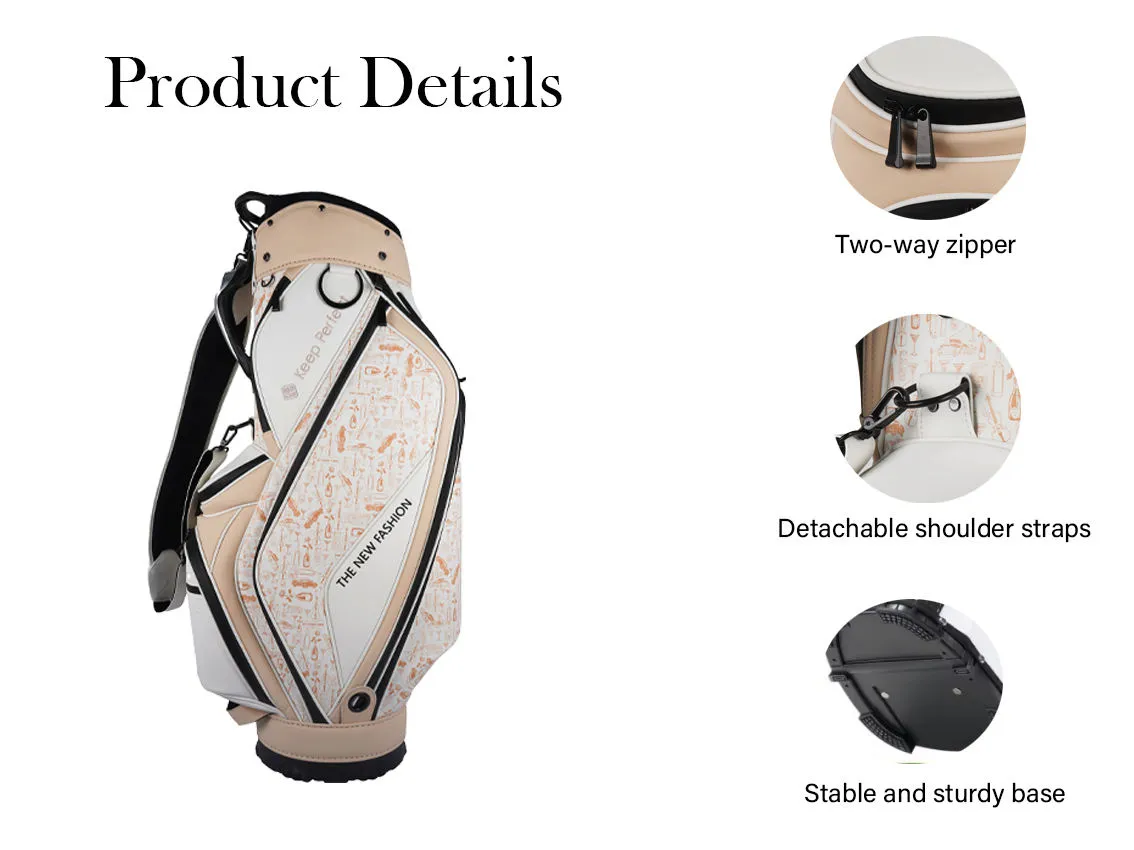
Primary Placement (Most Visible): The front panel of the bag body (typically 4-6 inches wide, 3-4 inches tall area); top cuff band (around the top opening, 1-2 inches tall); and shoulder strap face (if logo applied to strap).
Secondary Placement: Pocket fronts (smaller logos in 2-3 inch areas); ball pocket (internal or external); and rain hood (when deployed, this provides high-visibility logo exposure).
Placement Considerations: Consider how logo appearance changes when bag is: standing on legs (angle of view); carried on shoulder (may be partially obscured); mounted on cart (may be covered by strap).
File Format Requirements
Vector Files (Preferred): AI, EPS, or SVG formats at minimum 300 DPI at actual size. Vector files scale without quality loss and are required for: screen printing (multiple screens require separation); embroidery digitizing; and laser etching or embossing.
Raster Files: PNG or PSD at minimum 300 DPI at actual size. Use for: sublimation printing (dye-sublimation requires high-resolution raster artwork); and direct print applications where vector is unavailable.
Color Files: Provide artwork in: PMS (Pantone Matching System) spot colors for screen print and embroidery; CMYK for full-color process print; and grayscale or black-only for single-color applications.
Design Best Practices for Golf Bag Application
Simplicity Wins: Logos with fine lines, small text (under 3mm at final size), or complex gradients often fail on golf bags. Simplify logos for bag application: minimum font height 3mm; minimum line thickness 0.5mm; avoid reverse text (white on dark) below 12pt font size.
Consider the Curve: Golf bag surfaces are curved. Artwork should account for distortion: avoid logos that rely on perfect horizontal alignment; design with flexibility for placement variations; and test mockups on actual bags before finalizing.
Color Contrast: Test logo visibility in actual lighting conditions (sunlight vs. shade). High contrast logos (light logo on dark bag or vice versa) read better at distance.
Key Takeaways
- Always provide vector files (AI/EPS) for golf bag logo applications
- Minimum font height 3mm, minimum line thickness 0.5mm at final size
- Test logo appearance on actual bags—mockups on flat surfaces are misleading
- Provide PMS spot colors and CMYK versions for flexibility across decoration methods
Timeline Planning (Sampling → Production → Shipping)
Most buyers underestimate the approval cycle. This timeline helps you plan backwards from your launch date.
| Stage | Typical Duration | What You Approve |
|---|---|---|
| Tech pack + render | 3–7 days | Dimensions, layout, logo placements |
| Prototype sample | 10–20 days | Structure and pocket usability |
| Pre-production sample | 10–15 days | Materials, colors, branding finish |
| Mass production | 25–45 days | QC plan and photo checkpoints |
| Shipping | 7–45 days | Incoterms, destination requirements |
Quality & Testing Checklist (Buyer-Friendly)
Use this checklist to align factory QC with your brand standards. It reduces disputes and prevents “sample vs bulk” gaps.
| Area | What to Check | Practical Acceptance Criteria |
|---|---|---|
| Stitching | Seams, stress points, bartacks | No loose threads; reinforced points on straps and pocket corners |
| Zippers | Slider smoothness, tape alignment | Opens smoothly under load; no zipper waves |
| Stand mechanism | Deploy/retract consistency | Deploys cleanly; stable angle; no binding noise |
| Top & dividers | Club insertion, divider stability | No collapse; clean edges; consistent spacing |
| Branding | Logo placement and size | Matches approved placement map |
Common Mistakes (And How to Avoid Them)
- Vague descriptions: Replace “bag” with material + intended use + construction notes.
- Late approvals: Approve key items early (materials/colors/labels) to prevent schedule slips.
- No verification: Ask for photos, test notes, and documented checkpoints before shipment.
FAQ
Q: What information should I prepare before requesting a quote?
A: Bag type, quantity, target market, target price range, branding method, and timeline.
Q: What reduces back-and-forth the most?
A: One clear brief with reference photos and written requirements.
Next Step
If you want a fast, accurate quote, send your bag type, quantity, and destination requirements to cco@junyuanbags.com (WhatsApp: +8617750020688).
.webp)
.webp)
.webp)